
APP-330 · Lesson 1 of 12 · 26 min
How microwave ovens heat food
▶ Video coming soon A video version of this lesson is on the way.
Dee's case file for Tuesday, August 25, 2026, was the kind of call she liked to give new technicians to read first, because the fix was small and the reasoning was not. Jocelyn Farrimond in Sharon Woods said her two-year-old countertop microwave had started leaving food cold in the middle and scorching it at the edges. Dee watched a bowl of soup run for two minutes. The glass tray never moved. With the oven unplugged and the tray and roller ring lifted out, she found the cause in thirty seconds: the plastic coupler that sits on the turntable motor's shaft had split, so the motor turned but the tray did not. Before she replaced it she ran her usual power check with a jug of water, because a customer who complains about uneven heating sometimes has a weak magnetron as well. The oven delivered close to its rated output. A new coupler, a second test with the tray turning, and the soup came out evenly hot. "Most microwave complaints are about how the energy gets into the food," Dee wrote at the bottom of the file, "not about whether the oven makes energy at all."
This lesson explains what microwave energy is, how a magnetron makes it, how it reaches the food and spreads through the cavity, why food heats unevenly, how power levels work, and how to check an oven's real output with water. The next two lessons cover the high-voltage circuit and the door safety system, which are where the danger lies.
Microwave energy and why food gets hot
A microwave oven heats food with electromagnetic waves at a frequency of about 2,450 MHz, or 2.45 GHz. That frequency is one of the bands set aside around the world for industrial, scientific and medical uses, so ovens do not interfere with radio services. Microwaves are the same family of energy as radio waves and light, but much lower in energy than light; they do not make food radioactive, and the energy stops the instant the magnetron stops.
Food heats because its water molecules are electrically lopsided: one end is slightly positive and the other slightly negative. The microwave's electric field reverses direction 2.45 billion times a second, and the molecules try to turn with it. Their jostling against neighboring molecules turns the energy into heat. This is called dielectric heating. Fats and sugars heat as well, less strongly than water, while dry materials such as glass, most ceramics and many plastics let microwaves pass through with little heating. That is why a dish can stay cooler than the food in it, and why a dish that gets very hot either holds water in its glaze or is not microwave-safe.
Microwaves only reach about 1/2 to 3/4 in into most foods before most of their energy has been absorbed (typical). The center of a thick piece of food is heated by conduction from the outer layer, which takes time. Recipes and oven programs that call for standing time are allowing heat to spread inward.
Metal reflects microwaves instead of absorbing them. Smooth, heavy metal such as the oven's own walls is designed to do exactly that. Thin or sharp metal, such as foil edges, a fork or a gold trim on a plate, can concentrate the electric field at its points until the air ionizes and arcs. Arcing damages the cavity paint and the waveguide cover, and it is one of the commonest service calls.
Worked problem
Wavelength inside the oven
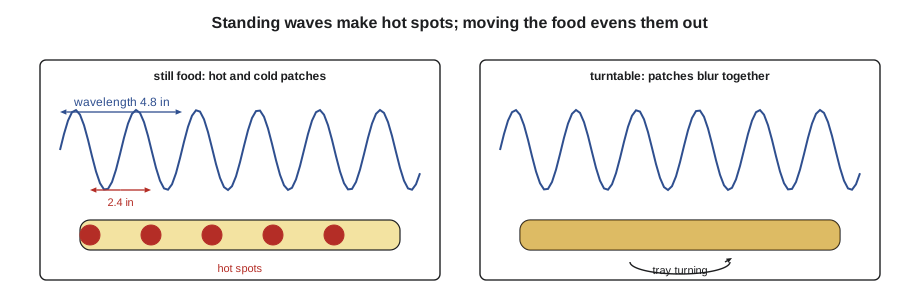
Microwaves travel at the speed of light, about 984,000,000 ft/s. What is the wavelength at 2,450 MHz, and how far apart are the hot spots of a standing wave, which repeat every half wavelength?
Show solution
- Wavelength equals speed divided by frequency:
- \[\lambda = \frac{9.84 \times 10^{8}\text{ ft/s}}{2.45 \times 10^{9}\text{ Hz}} = 0.402 \text{ ft} \approx 4.8 \text{ in}\]
- Half a wavelength:
- \[4.8 \div 2 = 2.4 \text{ in}\]
Answer: The wavelength is about 4.8 in, so the hot spots of a standing wave in a still cavity sit about 2.4 in apart. A plate of food that does not move will heat in a pattern of hot and cold patches on that spacing, which is why turntables and stirrers exist.
The magnetron
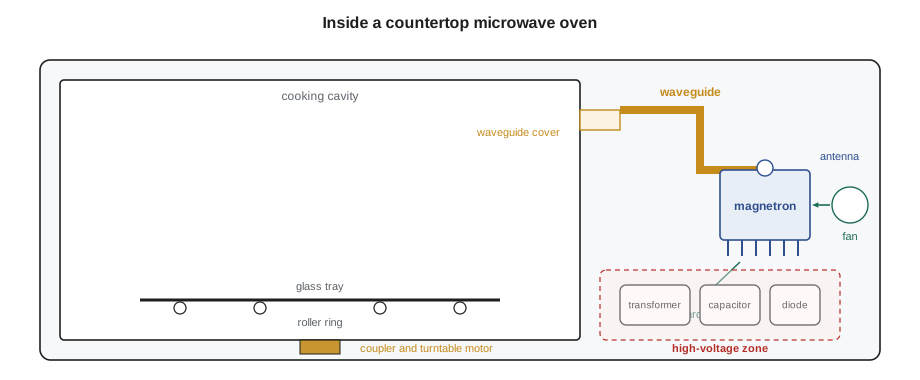
The magnetron is the vacuum tube that turns electrical energy into microwaves. It has a heated cathode (a coiled filament) along its axis, surrounded by a copper anode block cut with a ring of small resonant cavities. Two ring magnets above and below set up a strong magnetic field along the axis. When the high-voltage circuit makes the cathode several thousand volts negative compared with the anode (lesson 2), electrons boil off the hot filament and race toward the anode, but the magnetic field bends their paths into spirals. As the swirling cloud of electrons sweeps past the cavity openings, it sets them ringing at 2.45 GHz, the way air blown across a bottle makes it sing. A short antenna under a dome on top of the magnetron carries the microwave energy out.
Two facts about the magnetron matter on every service call. First, its filament runs on only about 3 V AC (typical), supplied by a separate low-voltage winding on the high-voltage transformer, but that winding sits at the full high voltage, so the filament leads are just as dangerous as the rest of the circuit. Second, the magnetron turns only about 60 to 70 in 100 of its input into microwaves (typical); the rest becomes heat in the anode, which is why the magnetron has cooling fins and why the oven's cooling fan must run whenever the magnetron does. A magnetron also carries a thermal cutout on its body that opens if it overheats, which can happen if the fan fails, the vents are blocked or the oven is run empty for a long time.
From the magnetron to the food
The magnetron does not sit inside the cooking cavity. Its antenna fires into a waveguide, a short rectangular metal duct that carries the energy to an opening in the cavity wall or ceiling. The opening is covered by a waveguide cover, usually a thin sheet of mica or a similar material, that keeps splatter out of the waveguide while letting microwaves through. Grease and food that build up on the cover can carbonize. Carbon conducts, absorbs energy and arcs, and a burned waveguide cover is one of the most frequent repairs on any microwave. Replacing the cover with the maker's part, cleaning the waveguide opening and cleaning the cavity usually ends the arcing; a cover cut from a generic mica sheet must match the original shape and size exactly.
Once in the cavity, the waves bounce off the metal walls and cross one another, forming a standing wave pattern with fixed hot and cold spots, as the worked example showed. Ovens spread the heating in one of two ways:
- A turntable carries the food slowly through the pattern. A small synchronous motor under the floor turns at about 3 to 6 rpm (typical), driving the glass tray through a plastic coupler. The tray rides on a roller ring. A worn coupler, a ring with a missing wheel or a tray put back upside down makes the tray stall or jerk.
- A stirrer, a slowly turning metal fan in the waveguide outlet or the ceiling, scatters the waves so the pattern keeps changing. Larger built-in and commercial ovens often use stirrers so that a flat floor can hold large dishes.
Some newer ovens add a second feed, or steer the energy electronically, and many over-the-range and combination ovens pair microwaves with a convection element or a grill element for browning. The heating principles do not change.
| Complaint | Usual causes | First checks |
|---|---|---|
| Uneven heating, tray still | Split coupler, failed turntable motor, tray or ring seated wrongly | Watch the tray; check the coupler and motor with power off |
| Uneven heating, tray turning | Dense or frozen food, no standing time, weak magnetron | Water power test; explain standing time |
| Sparks or crackling in the cavity | Burned waveguide cover, metal in food, damaged cavity paint | Inspect the cover and cavity; replace the cover |
| Runs, light and fan on, no heat | High-voltage circuit or magnetron fault, open thermal cutout | Lesson 2: discharge first, then test |
| Stops partway through cooking | Magnetron or cavity thermal cutout opening, blocked vents, failed fan | Check vents and fan; test the cutout cold |
Power levels and the magnetron's duty cycle
A conventional microwave oven with a high-voltage transformer has only two states: the magnetron is on at full power or it is off. Lower power levels are made by switching the magnetron on and off over a fixed time base, often about 30 seconds (typical). Power level 5, or half power, keeps the magnetron on for about half of each cycle. That is why a customer can hear the hum change every few seconds on low power, and why defrosting takes a long time: the food rests while heat spreads from the warm outer layers.
An inverter microwave replaces the heavy transformer with an electronic inverter board that can run the magnetron continuously at reduced power. It heats more gently at low settings and weighs less. Its high-voltage section lives on the inverter board itself, which changes how it is tested (lesson 2).
Worked problem
What half power really means
A 1,000 W oven with a 30-second time base is set to power level 3 for 4 minutes. If level 3 means the magnetron is on 30 in 100 of the time, how long is the magnetron on in each cycle, and what is the average microwave output?
Show solution
- On time per cycle:
- \[0.30 \times 30 = 9 \text{ s on, } 21 \text{ s off}\]
- Average output:
- \[0.30 \times 1{,}000 = 300 \text{ W}\]
- Total on time in 4 minutes:
- \[0.30 \times 240 = 72 \text{ s}\]
Answer: The magnetron runs at full power for 9 seconds of every 30, giving an average of 300 W and 72 seconds of real heating in the 4 minutes. On a transformer oven, a customer who says the oven "stops and starts" on low power is describing normal operation.
Checking real output with water
When heating is weak, slow or uneven, a water power test separates a weak magnetron or high-voltage fault from a problem of how the energy is spread. Makers rate output under the international test standard IEC 60705, which heats a measured mass of water in a specified container from a cool starting temperature and corrects for the heat taken up by the container. A field technician does a simpler version and compares it with the rating, knowing that the field result normally reads somewhat lower.
Dee's field method, which follows the pattern most service manuals use, is to:
- Fill a microwave-safe container with about 1 quart, which is 2.2 lb of cool tap water, about 50 to 60 °F, and stir it.
- Measure the starting temperature with an accurate thermometer, put the container in the center of the tray and run the oven at full power for exactly 60 seconds.
- Stir again, measure the final temperature at once, and work out the output from the temperature rise.
A field result of roughly 80 to 90 in 100 of the rated output is normal for this simple method (typical). Penfold's rule is that a result below about 70 in 100 of the rating, measured carefully twice, calls for checking the high-voltage circuit and magnetron. A result near zero means the magnetron is not running at all.
Worked problem
A water power test
Dee heats 2.2 lb (about 1 quart) of water for 60 seconds. It starts at 52.0 °F and ends at 74.5 °F. One British thermal unit raises 1 lb of water by 1 °F, and 1 Btu per minute equals 17.58 W. What output does this show, and how does it compare with the oven's 1,000 W rating?
Show solution
- Temperature rise:
- \[74.5 - 52.0 = 22.5\ ^\circ\text{F}\]
- Heat absorbed in one minute:
- \[2.2 \times 22.5 = 49.5 \text{ Btu}\]
- Power:
- \[49.5 \times 17.58 \approx 870 \text{ W}\]
- Fraction of rating:
- \[870 \div 1{,}000 = 0.87\]
Answer: About 870 W, or 87 in 100 of the rating. That is a normal field result, so the magnetron and high-voltage circuit are doing their job, and the uneven heating Dee saw had to come from the stalled turntable.
What a technician does and does not open
Many microwave complaints can be fixed without ever removing the outer cover: a coupler, a roller ring, a tray, a door handle, a light bulb reached from inside the cavity on some models, or a waveguide cover. Anything behind the outer cover is inside the high-voltage zone. Penfold's rules, which follow the makers' service manuals, are simple. The oven is unplugged before the cover comes off. Nothing inside is touched until the high-voltage capacitor has been discharged by the method in lesson 2. No high-voltage part is ever measured with the oven running. And after any repair that involves the door, the hinges, the interlocks, the waveguide or the magnetron, the oven is tested for microwave leakage before it goes back to the customer (lesson 3).
Some repairs are not worth doing. A low-cost countertop oven with a failed magnetron usually costs more to repair than to replace, and Penfold tells the customer so before ordering parts. Over-the-range and built-in ovens, which cost much more and are fitted into the kitchen, are more often worth repairing (lesson 4).
Common mistakes
MistakeAssuming a weak magnetron when the tray has stopped turning.
InsteadCheck that the turntable turns and the coupler is whole before testing output.
MistakeRunning the oven empty to see if it heats.
InsteadAlways put water in the cavity; an empty oven reflects energy back into the magnetron.
MistakePatching a burned waveguide cover or leaving carbon on it.
InsteadReplace the cover with the maker's part and clean the opening and the cavity.
MistakeReading a field water test against the full rating and condemning the magnetron.
InsteadExpect a field result somewhat below the rating; investigate only a clearly low result, measured twice.
MistakeRemoving the outer cover with the oven plugged in.
InsteadUnplug first, then discharge the high-voltage capacitor before touching anything.
Summary and key terms
- Microwave ovens heat food at about 2,450 MHz by making water molecules twist with the field.
- Microwaves reach only a short way into food; the center heats by conduction and standing time.
- The magnetron makes microwaves from a heated cathode, a cavity anode block and strong magnets.
- The magnetron needs its cooling fan; a thermal cutout protects it from overheating.
- A waveguide carries energy into the cavity; a burned waveguide cover is a common cause of arcing.
- Standing waves create hot spots about half a wavelength apart; turntables and stirrers even them out.
- Transformer ovens make low power levels by cycling the magnetron on and off; inverter ovens vary it.
- A careful water power test separates output problems from heat-distribution problems.
- Magnetron
- The vacuum tube that turns high-voltage energy into microwaves.
- Dielectric heating
- Heating caused by molecules twisting back and forth in an alternating electric field.
- Waveguide
- The metal duct that carries microwaves from the magnetron into the cavity.
- Waveguide cover
- The thin sheet over the waveguide opening that keeps splatter out.
- Standing wave
- A fixed pattern of strong and weak field formed by waves reflecting in the cavity.
- Duty cycle
- The fraction of each time base for which the magnetron is on.
- Coupler
- The plastic part that connects the turntable motor shaft to the glass tray.
Practice problems
Work each problem on paper first, then reveal the answer to check.
At what frequency do household microwave ovens operate?
Show answer
About 2,450 MHz, or 2.45 GHz.
Why does the center of a thick roast heat more slowly than the outside?
Show answer
Microwaves penetrate only a short distance; the center is heated by conduction.
What usually causes sparks near the waveguide opening?
Show answer
A burned, carbonized waveguide cover.
How does a transformer oven deliver half power?
Show answer
It runs the magnetron at full power for about half of each time base.
What does a field water test show if the result is about 87 in 100 of the rating?
Show answer
Normal output; look elsewhere for the complaint.
Lesson quiz · 5 questions
Score 60% or more to complete this lesson.
Create a free account to save your progress, take quizzes and earn a certificate.