
APP-330 · Lesson 11 of 12 · 25 min
Heat pump water heaters and dryers
▶ Video coming soon A video version of this lesson is on the way.
Lucinda Iredale in Steelton had replaced her old electric water heater the year before with a 50-gallon heat pump water heater, expecting her electricity bills to fall. They had gone up. Hiro visited on Wednesday, July 22, 2026. The heater was under its parts warranty, and Ms. Iredale wanted Penfold to look at it before calling the maker. The heater stood in a small utility closet with a solid door, and the closet felt like a refrigerator. A heat pump water heater pulls its heat out of the surrounding air; in a closet of about 140 ft³ with the door shut, it chilled the air within an hour or so, its heat pump became less and less effective, and its control switched to the electric elements to keep up. The unit's air filter was also matted with lint. Hiro cleaned the filter, showed her the heater's mode menu and its error history, which listed repeated low-air-temperature shifts to element heating, and explained what the installation instructions required: a room of at least the volume they stated, or a louvered door or ducting to bring in more air. A carpenter fitted a louvered door the following week, and the heater's history showed it running on its heat pump again.
Six days later, on Tuesday, July 28, Dee visited Ambrose Lowther in Sharon Heights, whose heat pump dryer now took three and a half hours to dry a load. This lesson explains how heat pumps work in these two appliances, what they need from their surroundings, how to maintain them, how they are rated and serviced, and why so many of their problems come down to air and lint.
A heat pump in an appliance
A heat pump is a refrigeration system used for the heat it delivers rather than the cold. Its evaporator absorbs heat from a cool source, its compressor raises the refrigerant's temperature and pressure, and its condenser delivers the heat, plus the heat of compression, to whatever needs warming. Because it moves heat instead of making it from electricity, a heat pump can deliver three or more units of heat for each unit of electricity, a ratio called its coefficient of performance (COP). An electric element, by comparison, delivers exactly one unit of heat per unit of electricity.
Heat pump water heaters and heat pump dryers both use small, factory-sealed systems with hermetic compressors, often inverter-driven, and the same refrigeration, electrical and safety knowledge the refrigerator and electronics courses covered. Many still use R-134a; newer models increasingly use lower-GWP refrigerants, including R-290 in many heat pump dryers and carbon dioxide (R-744) in some heat pump water heaters (typical). Each unit's data plate names its refrigerant and charge, and flammable-refrigerant units carry the usual markings.
Heat pump water heaters
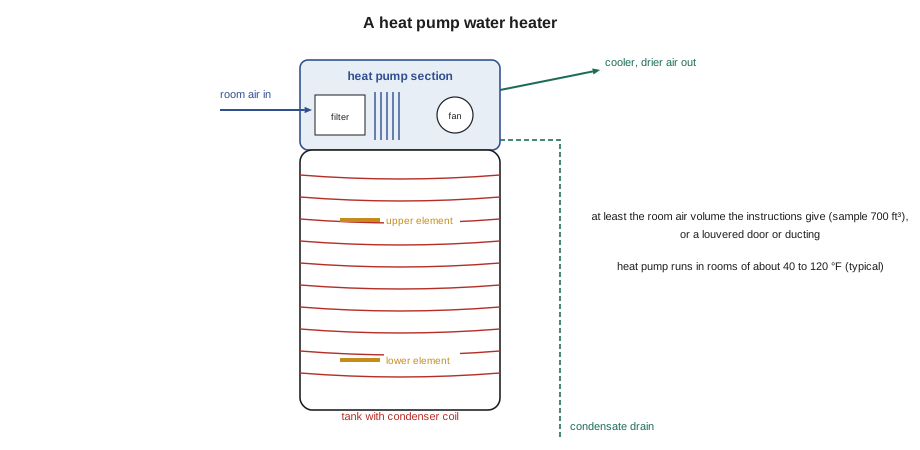
A heat pump water heater (HPWH) is a storage tank with a heat pump built onto its top. A fan draws room air through a filter and across the evaporator, which takes heat from it; the compressor pumps that heat to a condenser, usually a coil wrapped around the outside of the tank or immersed in it, which heats the water. The tank also has one or two electric elements for backup, controlled by the same board. The user chooses a mode:
- Heat pump only: lowest running cost, slowest recovery.
- Hybrid or auto: the heat pump does most of the work and the elements help when demand is high or the air is too cold.
- Electric or high demand: elements only, like an ordinary electric heater.
- Vacation: holds the tank at a low temperature to save energy while the home is empty.
A heat pump water heater cools and dehumidifies the space it sits in, which can be welcome in a hot basement in summer and unwelcome in a small room in winter. Its installation instructions therefore set three requirements that matter on every service call: a minimum air volume around the unit (or louvers or ducting to provide it), an ambient temperature range inside which the heat pump will run, and a condensate drain for the water the evaporator collects (typical requirements; each model's instructions give the figures).
Worked problem
What the heat pump saves
Heating 50 gallons of water by 60 °F takes how much energy? A gallon of water weighs about 8.34 lb, 1 BTU raises 1 lb of water by 1 °F, and 1 kWh is 3,412 BTU. How much electricity does that take with elements alone, and with a heat pump at a COP of 3.5?
Show solution
- Energy:
- \[50 \times 8.34 \times 60 = 25{,}020 \text{ BTU}\]
- In kWh:
- \[25{,}020 \div 3{,}412 \approx 7.3 \text{ kWh}\]
- With the heat pump:
- \[7.3 \div 3.5 \approx 2.1 \text{ kWh}\]
Answer: About 7.3 kWh with elements alone, and about 2.1 kWh with the heat pump doing the work, roughly 70 in 100 less electricity. If the heat pump keeps handing the job to the elements, as Ms. Iredale's did, most of that saving disappears.
Worked problem
Is the closet big enough?
The installation instructions call for at least 700 ft³ of air around the heater, or a louvered door or ducting. The closet measures 4 ft by 4.5 ft and is 8 ft high. Does it meet the requirement?
Show solution
- Volume:
- \[4 \times 4.5 \times 8 = 144 \text{ ft}^{3}\]
- Compare:
- \[144 \ll 700\]
Answer: The closet holds about 144 ft³, about one fifth of the required volume, so with the door shut the heat pump quickly chills its own air. A louvered door, ducting or a different location is needed; the figures are a sample, and each model's instructions give its own.
Servicing a heat pump water heater
Heat pump water heaters combine two kinds of work. The tank, its elements, thermostats, anode, dip tube and relief valve are serviced as the dishwasher and water heater course explained, and the plumbing connections, the relief valve's discharge line and any replacement of the tank are plumbing work under the city's permit rules. The heat pump section is a small refrigeration system: its filter, fan, evaporator, condensate drain, sensors, compressor and controls are appliance work, and its sealed system, factory-charged with a small amount of refrigerant, is opened only by a technician with the right EPA Section 608 certification.
- Air filter: cleaned every few months, more often in a dusty or linty basement (typical). A clogged filter starves the evaporator and the unit shifts to its elements.
- Condensate drain: the evaporator can produce a few liters of water a day in humid weather (typical). A blocked drain or a failed condensate pump triggers an error and can flood the top of the unit.
- Error history: most units log faults and mode changes, such as low ambient temperature, high discharge temperature, sensor faults or element failures. The history often explains a high bill before anything is opened.
- Heat pump not running: check the ambient temperature against the unit's range, the mode, the filter and fan, then the compressor, its start components or inverter, and the sensors, as for any small refrigeration system.
- Electrical supply: most units need a 240 V circuit for the elements; some newer 120 V plug-in models, designed to replace gas heaters without new wiring, rely almost entirely on the heat pump and recover more slowly. A customer with a 120 V model who runs out of hot water may need the mode or the tank size explained.
Heat pump dryers
A heat pump dryer is a ventless dryer that recycles its air in a closed loop. Air leaving the drum passes through the lint filters, then across the heat pump's evaporator, which cools it below its dew point so that the moisture from the clothes condenses and drains away. The cooled, dry air then passes across the condenser, which reheats it, and returns to the drum to pick up more moisture. The water goes to a condensate tank, which the user empties, or through a hose to a drain or the washer's standpipe.
Because the heat pump recovers most of the heat each time around, a heat pump dryer uses much less energy than a vented electric dryer, often half or less per load (typical). It dries at lower air temperatures, which is gentle on clothes, and it needs no outdoor vent, so it can go in a closet or an apartment. Its costs are longer cycles, often two hours or more for a full load, a higher price, and a closed air loop that depends completely on clean filters and coils (typical). Many models run on 120 V; some full-size ones need 240 V. Combination washer-dryers with heat pump drying work the same way.
Worked problem
Where the water goes
A load of laundry weighs 9 lb dry. After the spin cycle it holds water equal to 60 in 100 of its dry weight. How much water must the dryer remove, and how full does that leave a 1.2-gallon condensate tank? (A gallon of water weighs about 8.34 lb.)
Show solution
- Water in the load:
- \[9 \times 0.60 = 5.4 \text{ lb}\]
- In gallons:
- \[5.4 \div 8.34 \approx 0.65 \text{ gal}\]
- Fraction of the tank:
- \[0.65 \div 1.2 \approx 0.54\]
Answer: One load fills the tank about halfway, so a second load without emptying it will stop the dryer with a "tank full" message. A drain hose to the standpipe avoids the problem, and a slow-spinning washer leaves more water for the dryer to remove and lengthens every cycle.
Servicing a heat pump dryer
Mr. Lowther's dryer was typical. Its main lint filter was clean, because he emptied it after every load, but the second filter behind it, a foam or fine-mesh pad that many heat pump dryers have, had not been rinsed in months, and fine lint had passed it and matted the face of the evaporator. With the air loop choked, the dryer could not remove water quickly, and the cycle stretched. Dee rinsed the foam filter, cleaned the evaporator face with a soft brush and vacuum as the manual described, flushed the condensate path and checked that the drain hose did not rise above the maker's height. The next load dried in just over two hours, which the manual gave as normal for a full load.
| Complaint | Likely causes | Checks |
|---|---|---|
| Very long cycles, clothes damp | Second filter or evaporator matted with lint, overloaded drum, poorly spun load | Inspect and clean both filters and the evaporator face |
| Stops with "tank full" | Tank full, drain hose kinked or too high, condensate pump fault | Empty the tank; check the hose; test the pump |
| No heat at all | Compressor or inverter fault, fan fault, sensor fault | Error history; service mode; tests as for a refrigeration system |
| Water on the floor | Condensate tank not seated, drain hose off, door seal leak | Seat the tank; check the hose and seal |
| Runs slowly in a cold room | Room below the dryer's rated range | Check the room temperature against the manual |
Some models wash the evaporator automatically with condensate water, and their manuals say not to brush the fins; others ask the owner to clean the coil face monthly. As always, the model's manual decides. Because the dryer's sealed system holds a small factory charge of R-134a or R-290, sealed-system work follows the same certification and flammable-refrigerant rules as a refrigerator, and is rare: most heat pump dryer calls are about lint, water and airflow.
A heat pump dryer with an internal heat pump does not need the exhaust duct described in the laundry course, so the duct rules there do not apply. It still needs the room air around it that its instructions require, because the heat pump rejects some heat to the room.
Efficiency ratings
Heat pump water heaters are rated by their uniform energy factor (UEF), a measure of the hot water delivered per unit of energy used under a standard draw pattern. Electric resistance heaters rate a little below 1; heat pump models commonly rate between about 3 and 4 (typical). The UEF is measured at standard conditions, and a heater in a cool basement, in heavy use or switched to hybrid mode delivers less in practice. Heat pump dryers are rated by a combined energy factor, the weight of clothes dried per kWh, and the best ones roughly double the figure of a vented electric dryer (typical). Customers who compare the label with their bill are told what affects real performance: the room, the mode, the filters and how the appliance is used.
Common mistakes
MistakeDiagnosing a heat pump water heater's high bills as a failed heat pump without reading the error history.
InsteadRead the history and check the room's air volume, temperature and the filter first.
MistakeInstalling a heat pump water heater in a small closet with a solid door.
InsteadProvide the air volume, louvers or ducting the instructions require.
MistakeCleaning only the main lint filter on a heat pump dryer.
InsteadClean the second filter and, as the manual allows, the evaporator face too.
MistakeLeaving a heat pump dryer's drain hose higher than the maker allows.
InsteadRoute it within the maker's height limit to a standpipe or drain.
MistakeOpening a heat pump appliance's sealed system without the right certification and procedure.
InsteadUse a certified technician and follow the refrigerant and flammability rules on the data plate.
Summary and key terms
- Heat pumps move heat with a refrigeration system and deliver several units of heat per unit of electricity.
- A heat pump water heater takes heat from room air and has backup elements and selectable modes.
- It needs enough air volume, a room within its temperature range and a condensate drain.
- When the heat pump cannot work, the control shifts to the elements and the savings vanish.
- A heat pump dryer recycles its air through filters, an evaporator that condenses the water and a condenser that reheats it.
- Heat pump dryers use far less energy but have longer cycles and depend on clean filters and coils.
- Most heat pump appliance calls are about air, lint and water, not the sealed system.
- Sealed-system work follows the refrigerant certification and flammable-refrigerant rules for the refrigerant on the data plate.
- Heat pump
- A refrigeration system used to deliver heat rather than cold.
- Coefficient of performance
- Heat delivered divided by the electricity used.
- Heat pump water heater
- A storage water heater that heats water with a heat pump taking heat from room air.
- Hybrid mode
- A setting in which the heat pump does most of the heating and the elements help when needed.
- Heat pump dryer
- A ventless dryer that dries clothes with a heat pump in a closed air loop.
- Condensate tank
- The container that collects water removed from clothes or air.
- Louvred door
- A door with slatted openings that lets air flow into a small room.
Practice problems
Work each problem on paper first, then reveal the answer to check.
Why does a heat pump water heater in a small closed closet use its elements more?
Show answer
It chills the closet air, so the heat pump becomes ineffective and the control switches to the elements.
About how much less electricity does a heat pump at a COP of 3.5 use than elements alone?
Show answer
About 70 in 100 less.
What usually lengthens a heat pump dryer's cycles?
Show answer
Lint on the second filter or the evaporator face.
Where does the water from a heat pump dryer go?
Show answer
To a condensate tank or through a hose to a drain.
What is checked first when a heat pump water heater's bills rise?
Show answer
The error history, the room's air volume and temperature, and the filter.
Lesson quiz · 5 questions
Score 60% or more to complete this lesson.
Create a free account to save your progress, take quizzes and earn a certificate.