
APP-330 · Lesson 12 of 12 · 28 min
Specialty appliance case studies
▶ Video coming soon A video version of this lesson is on the way.
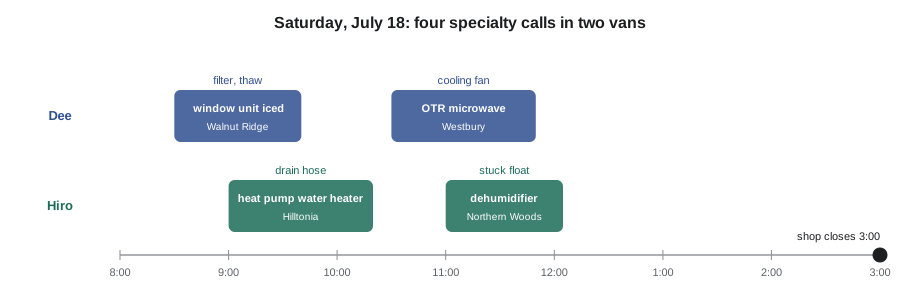
Saturday, July 18, 2026, was the hottest day of the summer, and Penfold ran two vans on call. Dee took one and Hiro the other, and between them they handled four specialty calls before the shop closed at three. Kiran had not yet started with the company, but Dee kept the day's work orders in her training binder because, as she put it, "the day had a little of everything, and nothing on it was solved by guessing." Kiran read them in his first weeks. They show the whole method of the program applied to the appliances in this course: confirm the complaint, gather the facts, check the simple things first, split the system to find the fault, fix the cause as well as the part, verify, and document.
This lesson follows each call in turn, then draws out what they have in common. Every reading and price comes from the work orders, and the invoices use Penfold's standard service call charge of 95 dollars with 8 in 100 sales tax.
The method, once more
Every course in this program has used the same sequence, and specialty appliances are no different:
- Confirm the complaint with your own eyes and instruments, not only the customer's words.
- Gather information: the model and serial number, the age, the history, recent changes such as a move or a new installation, recalls, the error history and the room the appliance is in.
- Check the basics: power, water, airflow, filters, settings, modes and the installation against the instructions.
- Split the system into sections and test the boundaries: is the control asking, is the load receiving, is the load working?
- Fix the cause as well as the failed part, so the call does not come back.
- Verify with measurements: temperatures, current, output, leakage where it applies.
- Document the readings, the parts, the tests and the advice, and explain the result to the customer.
Call 1: a window unit that froze
Dee's first call, at 8:30, was Cordelia Tregarthen in Walnut Ridge, whose bedroom window unit had "stopped blowing cold overnight." Air came out of the grille, but weakly, and it was barely cool. When Dee lifted the front panel the evaporator was white with ice from end to end, and water was dripping from the bottom of the cabinet onto the sill.
Gathering information: the unit was a 2023 6,000 BTU/h model with R-32, run all night on its coldest setting with the fan on low. The filter had not been washed since the unit went in for the season, and the room's humidity had been high for days.
The basics: the filter was matted with dust and lint. A clogged filter cuts airflow across the evaporator; with less warm air to absorb heat from, the coil runs colder, and in a humid room on low fan it falls below freezing and ices over, which cuts the airflow further. Before any test, Dee set the unit to fan only for 45 minutes to melt the ice, with a towel on the sill. With the unit unplugged, she washed the filter, vacuumed the evaporator face with a brush, spun the blower wheel by hand to check it was free, and checked the run capacitor and fan motor: both within their ratings.
Verifying: back on cooling with the fan on high, the unit drew 4.6 A against a nameplate of 4.9 A, and the temperature drop across the coil settled at about 20 °F after 15 minutes, which is normal. Dee explained that low fan in very humid weather can ice the coil even with a clean filter, and showed Ms. Tregarthen how to wash the filter every two weeks in the cooling season.
Worked problem
The temperature drop across the coil
After the repair, the room air entering the unit was 78 °F and the air at the grille was 58 °F. What is the temperature drop, and is it in the normal range of about 18 to 20 °F?
Show solution
- Drop:
- \[78 - 58 = 20\ ^\circ\text{F}\]
Answer: A 20 °F drop is at the top of the normal range: the coil is clear and the refrigeration system is working. A much larger drop would have suggested low airflow; a much smaller one, low capacity or a low charge.
Call 2: a microwave that kept stopping
At 10:30 Dee reached Lysander Yelland in Westbury, whose seven-year-old over-the-range microwave "stops halfway through anything longer than a couple of minutes, then starts again later." The oven heated a cup of water for a minute normally; on a five-minute run it stopped after about three minutes with the light and display still on.
Gathering information: the stops happened only on long runs, and the oven worked again after it had sat for a while. That pattern, a fault that comes with heat and clears with cooling, pointed to a thermal cutout. The hood above the range had been used heavily during the week's canning, and the oven's top vent grille was greasy.
Splitting the system: with the oven unplugged, the capacitor discharged and the grille and control panel removed as the manual showed, Dee found the oven's cooling fan motor stiff and coated with grease; it turned only slowly by hand. Without full cooling air, the magnetron heated until its cutout opened, and the cutout closed again once it cooled. The cutout itself tested closed when cold, as it should. The magnetron filament read 0.4 Ω and open to its case.
Fixing the cause: Dee replaced the cooling fan motor with the maker's part, cleaned the grease from the vent path and the grille, and showed Mr. Yelland how to clean the hood's grease filters, which were so clogged that cooking vapor had been drawn through the oven's own vents instead.
Verifying: a ten-minute run with a water load ran without stopping. A water power test gave about 880 W against a 1,000 W rating. Because she had worked inside the cabinet, Dee made a full leakage survey with the oven back in place: maximum 0.2 mW/cm², below Penfold's limit. The reading, the meter and its calibration date went on the invoice.
Worked problem
The water test after the repair
Dee heats 2.2 lb of water for 60 seconds; it rises from 54.0 °F to 76.7 °F. Using 1 Btu per pound per degree Fahrenheit and 17.58 W per Btu per minute, what output does that show?
Show solution
- Rise:
- \[76.7 - 54.0 = 22.7\ ^\circ\text{F}\]
- Output:
- \[2.2 \times 22.7 \times 17.58 \approx 878 \text{ W}\]
Answer: About 880 W, or 88 in 100 of the rating: normal for a field test. The magnetron was never the problem; heat was.
Call 3: a heat pump water heater in alarm
Hiro's first call, at 9:00, was Linnea Winterbourne in Hilltonia, whose heat pump water heater was beeping and showing a condensate fault. The water was hot, but the display said the unit was running on its elements only.
Gathering information: the heater was three years old, in an unfinished basement, owned outright. The error history showed the condensate fault first appearing four days earlier, when the week's heat and humidity began.
The basics: the condensate pan under the evaporator was full to the sensor, and the drain hose from it ran across the floor to a floor drain. The hose had been pinched under a storage shelf that had been moved, so the water could not flow. With the unit switched off, Hiro freed and rerouted the hose so that it fell steadily all the way to the drain, flushed the pan and the hose with warm water, and cleaned the air filter, which was dusty but not blocked.
Verifying: back in hybrid mode, the fault cleared, the heat pump started, and within twenty minutes water was dripping steadily from the end of the hose into the floor drain. Hiro estimated the collection rate from the drip and noted it on the work order, and showed Ms. Winterbourne where the hose ran and why it must never be pinched or raised.
Worked problem
How much water the evaporator makes
Hiro collects the condensate from the hose for 10 minutes and gets about 2.4 fl oz. If the heat pump runs about 6 hours a day in this weather, about how much water does it produce in a day? (128 fl oz is 1 gallon.)
Show solution
- Per hour:
- \[2.4 \times 6 = 14.4 \text{ fl oz}\]
- Per day at 6 hours:
- \[14.4 \times 6 \approx 86 \text{ fl oz} \approx 0.68 \text{ gal}\]
Answer: About two-thirds of a gallon a day in humid weather, enough to fill the pan and trip the sensor within hours if the drain is blocked. That is why the instructions require a proper condensate drain.
Call 4: a dehumidifier that said it was full
At 11:00 Hiro reached Seraphina Umberleigh in Northern Woods. Her basement dehumidifier showed a full-bucket light although the bucket had just been emptied, and the basement smelled damp.
Gathering information: the unit was two years old and had been moved across the basement the previous weekend. The bucket was empty and seemed to slide in fully.
Splitting the system: with the unit unplugged, Hiro removed the bucket and looked at the float, which hangs in a guide and lifts a lever that works the float switch. A plastic tab on the float had caught on the edge of its guide when the unit was tipped during the move, holding the float up, and therefore holding the switch in the "full" position. He freed the float, checked that it moved through its whole travel, and tested the switch with a meter: it changed state cleanly as the lever moved.
Verifying: back together, the light went out, the compressor started, and water began dripping into the bucket within a few minutes. Hiro also set the humidity target to 50 in 100, where the basement had previously been set to the unit's driest setting and ran almost constantly, and suggested a drain hose to the nearby floor drain so the bucket would not need emptying.
The invoices
| Call | Work | Before tax (dollars) | With 8 in 100 tax |
|---|---|---|---|
| 1. Window unit | Service call; thaw, filter and coil cleaning (flat rate 60) | 155 | 167.40 |
| 2. OTR microwave | Service call; cooling fan motor 48; labor 85 | 228 | 246.24 |
| 3. Heat pump water heater | Service call; condensate drain service (flat rate 40) | 135 | 145.80 |
| 4. Dehumidifier | Service call only; float freed, settings advised | 95 | 102.60 |
Worked problem
Checking an invoice
Mr. Yelland's invoice has a 95-dollar service call, a 48-dollar fan motor and 85 dollars of labor, plus 8 in 100 sales tax. What is the total?
Show solution
- Before tax:
- \[95 + 48 + 85 = 228 \text{ dollars}\]
- Tax:
- \[228 \times 0.08 = 18.24 \text{ dollars}\]
- Total:
- \[228 + 18.24 = 246.24 \text{ dollars}\]
Answer: 246.24 dollars. Checking the arithmetic on every invoice before handing it over is part of the job.
What the day teaches
None of the four calls needed a new sealed system, a new magnetron or a new board. Each was solved by noticing a pattern and checking the simple things first: a coil that iced because a filter was clogged and the fan was on low, a microwave that stopped only when hot, a heater that alarmed because a hose was pinched, a dehumidifier that reported a full bucket because a float had stuck. And in each case the fix included the cause as well as the symptom: cleaning schedules, a rerouted hose, clean grease filters, a sensible humidity setting.
The specialty appliances in this course also share a theme: almost all of them depend on air, water or both. Microwaves need cooling air and a clean vent path; room units, dehumidifiers and heat pump appliances need airflow across clean coils and somewhere for their condensate to go; ice machines need clean water and a free drain. A technician who checks airflow, filters, drains and the room the appliance sits in before reaching for the meter solves most of these calls faster.
Each of the four work orders also recorded something to watch: the window unit's filter schedule, the microwave's leakage reading and grease filters, the water heater's hose route, the dehumidifier's setting and drain. Fenna added each customer to the shop's reminder list: the window unit owner for a spring cleaning before the next cooling season, and the microwave owner for a hood filter reminder. For Kiran, Dee has planned a room air conditioner day in May 2027, before the next cooling season, using a scrapped unit on the bench, and Hiro has booked Ms. Rookwood's ice machine cleaning for early February 2027.
| Appliance | Air, water or heat | Habit that prevents the call |
|---|---|---|
| Window or portable unit | Airflow across the evaporator and condenser | Wash the filter every two weeks in season; clean coils yearly |
| Microwave | Cooling air past the magnetron | Keep vents and hood filters clean; never block the grille |
| Dehumidifier | Airflow and drainage | Clean the filter; drain hose downhill; sensible humidity setting |
| Ice machine | Water quality and drainage | Clean and sanitize every six months; change the filter |
| Heat pump water heater | Room air and condensate | Clean the filter; keep the drain hose clear; give it enough air |
| Heat pump dryer | Closed air loop | Clean both filters; clean the evaporator face as the manual allows |
Common mistakes
MistakeTesting the refrigeration system of an iced room unit before thawing it and checking airflow.
InsteadThaw it on fan only, then check the filter, coil and blower before anything else.
MistakeReplacing a microwave magnetron that stops only when hot.
InsteadLook for a cooling fault: the fan, the vent path and the thermal cutout.
MistakeClearing a condensate fault without finding why the drain failed.
InsteadTrace the hose; fix the pinch, rise or blockage that caused it.
MistakeReplacing a float switch that is only stuck.
InsteadCheck that the float moves freely through its travel, then test the switch.
MistakeLeaving without recording readings and advice.
InsteadRecord the measurements, parts, tests and advice on every work order.
Summary and key terms
- The same diagnostic method works on every specialty appliance.
- An iced room unit is thawed first, then checked for airflow problems such as a clogged filter.
- A microwave that stops only on long runs points to a cooling fault and its thermal cutout.
- A leakage survey follows any microwave repair that worked inside the cabinet.
- Heat pump water heaters raise condensate faults when their drains are pinched or blocked.
- A full-bucket signal with an empty bucket usually means a stuck float or a failed switch.
- Most specialty calls come down to air, water or drainage and are fixed by finding the cause.
- Every call ends with verified readings, a clear explanation and a documented work order.
- Thermal cutout
- A heat-sensing switch that opens to protect a part from overheating.
- Temperature drop
- The difference between the air entering and leaving a cooling coil.
- Condensate fault
- An error raised when a sensor detects water backing up in a condensate pan.
- Float switch
- A switch worked by a float that signals a full bucket or pan.
- Fan-only thaw
- Running a room unit with the compressor off so room air melts an iced coil.
- Water power test
- Heating a measured amount of water to check a microwave's output.
- Work order
- The record of a service call: complaint, findings, readings, parts, tests and charges.
Practice problems
Work each problem on paper first, then reveal the answer to check.
What is the first step with a room unit whose coil is iced?
Show answer
Thaw it on fan only, then check the filter, coil and blower.
A microwave stops only on long runs and works again after cooling. What does that suggest?
Show answer
A cooling fault that lets the magnetron's thermal cutout open.
Why did the heat pump water heater run on its elements only?
Show answer
Its condensate drain was pinched, so the pan filled and the control stopped the heat pump.
What held the dehumidifier's float switch in the full position?
Show answer
A float tab caught on its guide after the unit was moved.
What do most of the day's calls have in common?
Show answer
Each depended on air, water or drainage, and each was fixed by finding the cause.
Lesson quiz · 5 questions
Score 60% or more to complete this lesson.
Create a free account to save your progress, take quizzes and earn a certificate.