
APP-320 · Lesson 12 of 12 · 25 min
Electronic diagnosis case studies
▶ Video coming soon A video version of this lesson is on the way.
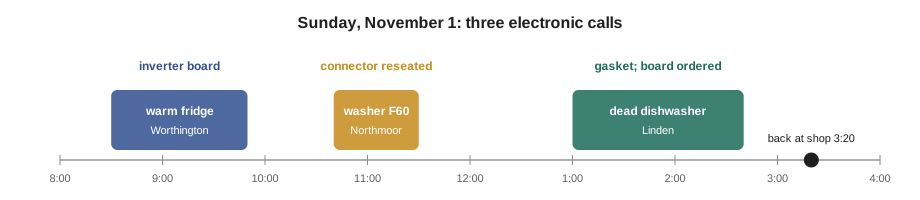
Sunday, November 1 was Dee's turn on call, and Kiran's first Sunday with her. Fenna had booked three calls the evening before, and all three, as Dee noticed when she read them over coffee in the van, were electronic. "A warm refrigerator, a washer with a code and a dead dishwasher," she said. "Good. Today you drive the meter and I keep my hands in my pockets." This lesson follows the three calls, the order of checks on each, and the reasons for what was replaced and what was not. It ends with a review of the method that runs through this course.
Call 1: a warm refrigerator
Leocadia Wrenfield, in Worthington, had a 2020 bottom-freezer refrigerator with an inverter compressor. The fresh food section read 54 °F on a thermometer and the freezer 25 °F. The fans ran, the display was normal and the compressor was silent. Kiran confirmed the complaint, then asked about the history of the problem. It had been fine on Friday and warm on Saturday morning; there had been a short power cut on Friday night during a windstorm.
Kiran entered the service mode from the tech sheet and recorded the history: one inverter communication fault, logged on Friday night, and no sensor faults. The sensor readouts agreed with his thermometer within a degree, so the main board knew the compartments were warm. The service mode showed the compressor commanded at its highest speed. The main board was doing its job.
Behind the refrigerator, with the rear cover off and everything connected, he measured 120 V AC at the inverter board's input and found the speed command at the inverter connector within the range the tech sheet gave. The board's status light was dark. A clamp meter on the inverter's supply lead showed no current at all: the inverter was not even trying to start the compressor. Dee asked, "What would you want to know before you blame the inverter board?" Kiran unplugged the refrigerator, measured the inverter's bus capacitor down to 3 V at the tech sheet's test points, unplugged the compressor lead and measured the windings: 11.9, 11.9 and 11.9 Ω, all matching the tech sheet, and more than 20 MΩ from each pin to the process tube. The compressor's windings were sound.
With supply and command present, no start attempts and a healthy compressor, the evidence pointed to the inverter board. Its status light, which should have shown a heartbeat flash, was also dark. Ade had stocked that brand's common inverter board on Dee's van. Kiran fitted it following lesson 11: refrigerator unplugged, bus measured, wrist strap to the chassis, connectors photographed, old board out by its edges, new board in. On power-up the status light began its slow heartbeat flash and the clamp meter showed a start spike of about 4 A that settled to about 1.1 A as the compressor ran up to speed. Thirty minutes later the freezer was falling steadily and the fresh food section had dropped two degrees.
Dee asked one more question: why had the board failed? The power cut during the storm, and the single communication fault logged that night, suggested a surge or a brown-out had damaged it. Kiran noted that on the work order and suggested Ms. Wrenfield ask an electrician about surge protection. He also told her to expect the temperatures to be normal by the evening, and to call if they were not.
Worked problem
Invoice for call 1
Penfold charges a 95-dollar service call and a flat rate of 260 dollars for this inverter board replacement, including the board. What is the invoice before tax, and after tax at the Franklin County combined rate of 8 in 100?
Show solution
- Before tax:
- \[95 + 260 = 355 \text{ dollars}\]
- With sales tax:
- \[355 \times 1.08 = 383.40 \text{ dollars}\]
Answer: 355 dollars before tax, 383.40 dollars with sales tax.
Call 2: a washer with a communication code
Wilbur Fanthorpe, in Northmoor, had moved house on Thursday. His four-year-old front-loader, carried in by the movers, showed F60, communication lost between boards, every time he pressed Start. The display lit and the keys beeped, but nothing ran. He was sure the move had broken it.
Kiran read the history: F60 twelve times, all since Thursday, and nothing before. Faults that begin with a move point to the move: something was knocked, pulled or left undone. Dee nodded. Kiran unplugged the washer and checked first that the shipping bolts had not been refitted by the movers, which they had not, then removed the top panel. The communication harness from the user interface ran down the right side to the main board in the base. He followed it with a flashlight and found, at the main board, the four-wire communication connector sitting crooked in its header, its latch not engaged, pulled partly out where the harness had been tugged when the washer was tilted onto a dolly.
Before re-seating it, Kiran looked at the terminals for damage and the housing for cracks, as lesson 7 taught. Both were fine. He pushed the connector fully home until the latch clicked, checked that the other connectors on the board were fully seated too, and tied the harness to its original clip, which had come loose. Then, with the washer plugged in, he ran the spin test and a quick cycle. No F60 appeared. He cleared the history after the test and noted that he had done so.
"Two lessons in one call," Dee said in the van. "One: ask what changed. Two: when something has been moved, look at every connector, not just the first one that looks wrong." Mr. Fanthorpe was charged only the service call, and he asked Kiran to look at his dryer vent while he was there, which had been crushed behind the dryer by the movers. Kiran showed him the crushed foil and recommended a rigid metal duct, as the laundry course advised.
Worked problem
Invoice for call 2
The washer needed no parts. What is the invoice for the 95-dollar service call, before and after tax?
Show solution
- With sales tax:
- \[95 \times 1.08 = 102.60 \text{ dollars}\]
Answer: 95 dollars before tax, 102.60 dollars with sales tax.
Call 3: a dead dishwasher
Rosamund Gaillard, in Linden, had a six-year-old dishwasher that was completely dead: no lights, no beeps, nothing. Two weeks before, she said, she had found a small puddle in front of it after a heavy load, wiped it up and thought no more of it. The dishwasher had worked since, until that morning.
Kiran checked the simple things first. The dishwasher's circuit breaker was on, and at the junction box behind the kick plate he measured 120 V between hot and neutral, with the dishwasher still connected. The supply was reaching the appliance. With the breaker off and proved dead, he opened the access to the main board under the tub. The board's cover was spotted with dried water marks, and on the board, around the power supply section, a white and green crust of corrosion had formed between two pins of the line input connector. The board's fuse, visible through its clear cover, was open. There was no point testing further: a board with corrosion across its line input is finished.
The important question was the water. Dee asked Kiran to find where it had come from before ordering anything. With the breaker still off, he inspected the tub, the door, the hoses and the inlet valve for leaks and water tracks. The door gasket was torn along the bottom corner, where a cutlery basket had rubbed it, and the inside of the outer door panel below the tear was stained. Water had been escaping during the wash, running down inside the door and dripping onto the board's cover, and through a gap at its edge onto the board.
The board was not on the van. Kiran replaced the door gasket, which was on the van, dried the area with a towel and a fan for half an hour, added the board's missing cover clip that should have closed the gap, and ordered the main board for a return visit booked for Tuesday, November 17. He explained to Ms. Gaillard why the gasket had to be replaced first: "If we put in a new board without stopping the leak, the new board would be dead in a month." She agreed to wash by hand until then.
Worked problem
Invoices for call 3
Today's invoice is the 95-dollar service call and a 75-dollar door gasket including labor. The return visit will be a 260-dollar flat rate for the board, with no second service call charge. What is today's invoice with tax, and what will the return visit cost with tax?
Show solution
- Today before tax:
- \[95 + 75 = 170 \text{ dollars}\]
- Today with sales tax:
- \[170 \times 1.08 = 183.60 \text{ dollars}\]
- Return visit with sales tax:
- \[260 \times 1.08 = 280.80 \text{ dollars}\]
Answer: 183.60 dollars today and 280.80 dollars on the return visit, which is planned.
What the day showed
Back at the shop at 3:20, Dee asked Kiran to sum up the day in three lines for his notebook. He wrote: "One board proved bad, after checking the compressor. One fault was a connector, after a move. One board was killed by water, and the water was the real fault." Each call had followed the same method, which this course has built lesson by lesson.
| Step | Call 1: refrigerator | Call 2: washer | Call 3: dishwasher |
|---|---|---|---|
| Confirm and ask what changed | Warm; power cut on Friday | F60 since the move | Dead; puddle two weeks ago |
| Read the history | One communication fault at the power cut | F60 twelve times, all since Thursday | No display, so none |
| Check supplies | 120 V at inverter input | Not needed; display lit | 120 V at junction box |
| Check inputs and commands | Sensors agree; command present | Connector half out | Board corroded at line input |
| Check the load | Windings equal; shell very high | Not needed | Not needed |
| Root cause | Probable surge damage | Move pulled connector | Torn door gasket leaking |
| Repair | Inverter board | Reseat and secure connector | Gasket now; board on return visit |
| Verify | Start spike then 1.1 A; temperatures falling | Spin test and quick cycle | On return visit |
A review of the method
Every lesson in this course has pointed to the same habits. They are worth gathering in one place, because they are what separates a technician who replaces boards from one who repairs appliances.
- Confirm the complaint and ask what changed: a power cut, a move, a renovation, a new router, a new detergent.
- Read and record the fault history before any test or reset (lessons 8 and 9).
- Respect the energy: unplug or lock out, measure bus and bulk capacitors, and treat non-isolated boards as live (lesson 2).
- Check the supplies to each board, and unplug loads one at a time if a supply is low (lesson 2).
- Check the inputs: compare sensor readouts with reality and test the sensor, connector and harness (lessons 4 and 8).
- Check the commands and the loads: measure at the load during component tests, and test motors and compressors by their windings and insulation (lessons 3, 5 and 6).
- Check the links between boards, with a flex test on the harness and a look at every connector (lesson 7).
- Rule out the network before a module on connected appliances (lesson 10).
- Find the root cause of any burned, wet or damaged board and fix it first (lessons 1 and 11).
- Replace boards by the procedure: correct part, ESD protection, photographs, configuration, update, test, document and return (lesson 11).
Dee added one habit of her own. "Write it down," she said. "Every measurement, every code, every part number. The next technician, the maker's warranty desk and you, six months from now, will all need it."
Kiran's three work orders from that Sunday became part of Penfold's training binder. The inverter call shows the order of checks on an inverter refrigerator. The washer call shows why a fault that starts with a change points to the change. The dishwasher call is the one Harriet uses most, because it shows the two parts of a repair that every electronic fault can have: the part that failed, and the reason it failed. A technician who fixes only the first will be back. A technician who fixes both, and can prove it with measurements, is the one customers ask for by name.
A fourth case from the binder
Harriet keeps one more electronic case in the training binder, from Hiro's files in the spring, because it shows the method failing when a step is skipped. A refrigerator's ice maker had stopped, the dispenser board showed a sensor fault, and a technician at another company had replaced the dispenser board and then the main board, with no change. Hiro read the fault history, which showed the ice maker's thermistor out of range, and measured it at the main board's connector: open. At the ice maker it read correctly. The harness ran through the freezer door hinge, where years of opening and closing had broken one conductor inside its insulation. A harness repair kit from the maker fixed it in half an hour. Two boards had been replaced because no one had measured the sensor at both ends of its wire.
Common mistakes
MistakeOrdering an inverter board on a warm refrigerator without checking the compressor.
InsteadCheck supply, command, start attempts and windings first.
MistakeTesting only the first connector that looks wrong after a move.
InsteadCheck every connector and clip the move could have disturbed.
MistakeReplacing a water-damaged board without finding the leak.
InsteadFind and fix the water source first, then fit the board.
MistakeLeaving a customer without a plan when a part must be ordered.
InsteadBook the return visit, explain why, and tell the customer what to do meanwhile.
MistakeWriting only the part number on the work order.
InsteadRecord the codes, measurements, root cause and test results too.
Summary and key terms
- Electronic faults are solved by the same method: confirm, ask what changed, read the history, check supplies, inputs, commands, loads and links.
- On inverter refrigerators, prove the compressor before replacing an inverter board.
- Faults that begin with a move, a power cut or a renovation point to that change.
- Communication faults are usually connectors and harnesses.
- Water-damaged boards need the leak fixed before the board is replaced.
- Follow the board replacement procedure, then verify with the cycle that showed the fault.
- Explain the repair and any return visit to the customer clearly.
- Document codes, measurements, root causes and tests on every call.
- Root cause
- The underlying reason a part failed, which must be fixed to prevent a repeat.
- Start spike
- The brief current surge as an inverter starts a compressor.
- Return visit
- A planned second visit to fit an ordered part.
- Flat rate
- A fixed price for a defined repair, including parts and labor.
- Work order
- The record of a service call, with findings, parts and charges.
Practice problems
Work each problem on paper first, then reveal the answer to check.
Why did Kiran check the compressor windings before replacing the inverter board?
Show answer
A shorted or failed compressor could have caused the fault and would damage a new board.
What clue pointed to the washer's connector?
Show answer
The F60 faults began right after the move.
Why was the dishwasher's door gasket replaced before the board?
Show answer
The leak had killed the board and would kill a new one.
What does a dark inverter status light with supply and command present suggest?
Show answer
The inverter board is not working.
What should every work order record?
Show answer
Codes, measurements, root cause, parts and test results.
Lesson quiz · 5 questions
Score 60% or more to complete this lesson.
Create a free account to save your progress, take quizzes and earn a certificate.