
APP-120 · Lesson 6 of 12 · 25 min
Heating elements and testing them
▶ Video coming soon A video version of this lesson is on the way.
On Friday, November 6, the morning's first call was an electric dryer, the pair to a front-load washer, that ran and tumbled but left the clothes damp and cold. The customer had read online that a thermal fuse was the usual culprit and had bought one. Kiran thanked her, set the fuse on the counter and said he would test before replacing anything. Twenty minutes later he showed her the real fault: a broken coil inside the heater housing, with a gap you could see once the element was out. The fuse she had bought tested fine on the dryer, and she kept it as a spare.
Heating elements are the largest loads in most appliances and among the parts most often replaced. This lesson covers the kinds of element, how their ratings and resistance are related, how to test them, how surface elements are controlled, and how to find the damage that makes an element fail early. Lesson 1 gave the key formula: an element's resistance is its rated voltage squared divided by its rated power.
How an element makes heat
A heating element is a resistance wire, usually a nickel-chromium alloy, that turns electrical energy into heat because it opposes the current through it. All the power it uses becomes heat: a 3,000 W element makes 3,000 W of heat. Nickel-chromium is used because it has a fairly high resistance, survives being red hot for years, and forms a protective oxide skin. Its resistance rises only slightly as it heats, so the cold reading is a little lower than the value worked out from the hot rating, typically by a few in 100.
Kinds of element
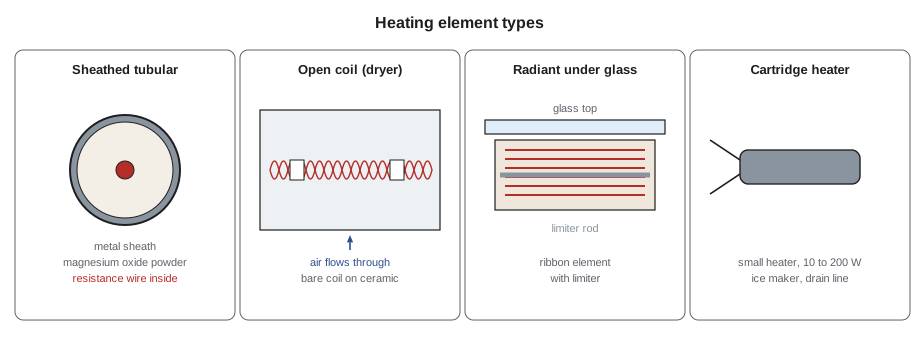
- Sheathed tubular elements, often called by older trade names, have the resistance wire in the center of a metal tube, packed in magnesium oxide powder that insulates electrically but conducts heat. Oven bake and broil elements, older surface coils, dishwasher heaters and many defrost heaters are this kind. The sheath is grounded through the appliance frame.
- Open-coil elements are bare resistance wire wound in a coil and held on ceramic insulators. Most electric dryers use one, mounted in a metal housing that the air passes through. Open coils heat fast and are cheap, but the bare coil can sag, touch the housing and short, and it breaks if it is bent or overheated.
- Radiant ribbon elements sit under the glass top of smooth-top ranges: a ribbon of resistance alloy laid in a coiled pattern on an insulating base, with a built-in limiter that keeps the glass from overheating. Some smooth tops have halogen lamp elements; induction cooktops have no resistance element at all and are covered in APP-230.
- Glass-tube and foil heaters are used for defrost in some refrigerators: a resistance wire inside a glass or quartz tube, or a foil heater bonded to the evaporator or a drain pan.
- Cartridge and small strip heaters warm ice maker molds, drain lines, door gaskets and dispenser parts. They are small, often 10 to 200 W, but they matter: a failed mold heater stops ice making, and a failed drain heater lets defrost water freeze and overflow.
Expected resistance from the rating
The rating plate, the element itself or the tech sheet gives the element's rated power and voltage. From them the expected hot resistance follows. The table gives typical values; the exact rating for each model is on the part or in the tech sheet.
| Element | Typical rating | Expected resistance |
|---|---|---|
| Oven bake | 2,500 to 3,400 W at 240 V | About 23.0 to 16.9 Ω |
| Oven broil | 3,400 to 3,600 W at 240 V | About 16.9 to 16.0 Ω |
| Small surface element | 1,250 W at 240 V | About 46 Ω |
| Large surface element | 2,100 W at 240 V | About 27 Ω |
| Dryer heater | 5,000 to 5,600 W at 240 V | About 11.5 to 10.3 Ω |
| Dishwasher heater | 1,000 W at 120 V | About 14 Ω |
| Refrigerator defrost heater | 350 to 600 W at 120 V | About 41 to 24 Ω |
Worked problem
The dryer heater on the Friday call
The dryer's heater is rated 5,400 W at 240 V. With the dryer unplugged and the heater wires disconnected, Kiran measures OL across the heater terminals. What should it read, and what does OL mean?
Show solution
- \[R = \frac{240^2}{5{,}400} = \frac{57{,}600}{5{,}400} = 10.67\ \Omega\]
- A good heater should read close to 10.7 Ω, a little lower when cold.
- OL means the coil is broken somewhere along its length.
Answer: The heater should read about 10.7 Ω; OL means it is open. Kiran removed the housing and found the break where the coil had sagged against a support. He also checked that the cycling thermostat, high limit and thermal fuse each read about 0 Ω, and that the vent was clear, so that the new heater would not suffer the same overheating.
Testing an element with power off
With the appliance unplugged and at least one wire disconnected from the element, so that nothing else is in parallel with it, measure across its two terminals and compare with the expected value. Then, for a sheathed element, measure from each terminal to the sheath or to the appliance cabinet. A good element reads OL to the sheath. Any reading, even several hundred kilohms, means the insulation inside the element has broken down. That kind of leakage can trip a GFCI or, if it gets worse, the breaker, and can make the sheath live if the ground connection is poor.
Look at the element as well as measuring it. A sheathed element that has blistered, split or shows a bright spot where it overheated is failing even if it still reads correctly. An open coil that sags close to its housing will soon short. Terminals that are blackened, loose or corroded mean the connection has been overheating, and the wire terminal on the harness must be replaced too, not just the element, as the next section explains.
Testing an element with power on
With power on and the element calling for heat, two readings confirm it is working. The voltage across the element's terminals should be the supply voltage, about 240 V for a range or dryer element. The current, measured with a clamp on one lead, should be close to the supply voltage divided by the element's resistance. If the voltage is right and the current is right, the element is working, and a heating complaint lies elsewhere: the control, the thermostat setting, the airflow or the customer's expectation.
Worked problem
An oven element that works, but slowly
An oven's bake element is rated 3,000 W at 240 V. With the oven baking, Kiran measures 232 V across the element and clamps 12.1 A on its lead. Is the element working?
Show solution
- Expected resistance: 240² ÷ 3,000 = 19.2 Ω.
- Expected current at 232 V: 232 ÷ 19.2 = 12.1 A. The clamp agrees.
- Power: 232 × 12.1 = 2,807 W.
Answer: The element is working: its current matches its voltage. It makes about 2,810 W because it has 232 V across it, not 240 V. If the supply at the range receptacle reads 242 V, about 10 V is being lost somewhere between the receptacle and the element, which is a clue to a bad connection. Lesson 12 follows a fault exactly like this.
Terminals and connections
Element connections carry large currents in a hot place, and they are the commonest cause of repeat element failures. A loose or oxidized terminal has resistance; the load current through that resistance makes heat right at the connection; the heat oxidizes the metal further and raises the resistance; and eventually the terminal burns through or welds itself to the element. A blackened terminal on an element means that both the element terminal and the wire terminal have been damaged.
When replacing an element with a burned connection, cut the wire back to clean, bright copper, fit a new high-temperature terminal of the correct size with the right crimper, as APP-110 showed, and make sure it fits the element tab tightly. Many manufacturers supply new terminals or a short replacement lead with the element for this reason. Never reuse a discolored terminal and never fit an ordinary insulated vinyl terminal near an element, where it will melt.
Controlling surface elements: the infinite switch
On coil and radiant-top ranges without electronic controls, each surface element is controlled by an infinite switch, so called because it can be set anywhere between low and high. Inside it is a small bimetal with its own tiny heater. When the switch is on, the bimetal heats and opens the element's circuit, then cools and closes it again. The knob changes how long the contacts stay closed in each cycle. On high, they stay closed all the time; on low, they close for only a small part of each cycle.
An infinite switch typically has terminals marked L1 and L2 for the supply, H1 and H2 for the element, and P for a pilot lamp that shows an element is on. Because the switch cycles, an element on a medium setting turning on and off every several seconds is normal, and a customer who sees the coil go dark and glow again is seeing the switch work, not a fault. A switch whose contacts have stuck closed gives full heat at any setting; one whose contacts have failed open gives no heat; one whose bimetal has drifted gives too much or too little.
Worked problem
Average power on a medium setting
A 2,100 W surface element is on a setting where its infinite switch keeps the contacts closed for 40 in 100 of each cycle. What average power does the element make?
Show solution
- Full power: 2,100 W.
- Average: 2,100 × 40 ÷ 100 = 840 W.
Answer: About 840 W on average, although when the contacts are closed the element runs at its full 2,100 W. A clamp on the element lead shows about 8.75 A when on and 0 A when off, cycling, which is normal for this kind of control.
Radiant smooth-top elements add one more control: a limiter, a rod-shaped thermostat across the element that opens if the glass gets too hot, for example when a pan is lifted off or a pan with a warped bottom leaves the glass uncovered. A radiant element that cycles even on high may be doing so because of its limiter, and a limiter that has failed open leaves the element dead.
Why elements fail
Elements wear out after years of heating and cooling, but many fail early for a reason the technician should look for:
- Overheating from blocked airflow, as in a dryer with a restricted vent, which also opens the thermal fuse and high limit.
- Damage from spills and cleaners on oven elements, or from aluminum foil laid over a bake element, which traps heat and can cause it to burn through.
- Mineral scale on dishwasher heaters in hard water, which insulates the sheath so the wire runs hotter.
- Relays stuck closed on electronic controls, which keep an element on until something else stops it.
- Physical damage when an open coil is bent during installation, or when a sheathed element is flexed by a heavy rack or a dropped pan.
On the Friday dryer, the sag that had let the coil touch its support came from years of running with a long, partly crushed vent. Kiran's work order recommended replacing the vent run with rigid duct, and the customer booked that work for the following week.
Handling and fitting replacement elements
New sheathed elements are fragile at their ends, where the terminals leave the sheath, and a bent terminal can crack the seal and let moisture into the magnesium oxide. Handle them by the sheath, not the terminals, and keep them in their packaging until fitting. Open dryer coils must be threaded onto their insulators without stretching, following the pattern on the old housing, because a stretched turn sags and shorts. After fitting any element, run it and clamp its current before reassembling fully, and look for smoke or smell from the protective oil that many new elements carry; a light smell for the first few minutes is normal, and the customer should be told so. Finally, check the sheath-to-ground reading again on the new part, because elements can be damaged in shipping.
Common mistakes
MistakeReplacing a part the customer bought before testing.
InsteadTest first; the customer's thermal fuse on the Friday call was good, and the heater was open.
MistakeMeasuring an element without disconnecting it.
InsteadDisconnect at least one wire so that parallel parts do not change the reading.
MistakeSkipping the sheath test on a sheathed element.
InsteadMeasure each terminal to the sheath; any reading other than OL means leakage.
MistakeFitting a new element on a burned wire terminal.
InsteadCut back to clean copper and fit a new high-temperature terminal.
MistakeCalling a cycling surface element a fault.
InsteadInfinite switches cycle the element on lower settings; that is normal.
MistakeReplacing the element without finding why it failed.
InsteadCheck airflow, relays and the customer's use, and fix the cause.
Summary and key terms
- An element turns all its power into heat; its resistance is R = V² ÷ P, a little lower when cold.
- Sheathed tubular, open-coil, radiant ribbon and small cartridge heaters each have their uses and failure modes.
- Power off: measure across the element and, for a sheathed element, from each terminal to the sheath.
- Power on: the voltage across the element and the current through it should agree with its resistance.
- Burned terminals cause repeat failures; replace both the element and the wire terminal.
- Infinite switches cycle surface elements; radiant tops add a limiter.
- Look for and fix the cause of early element failure: airflow, foil, scale, stuck relays or damage.
- Heating element
- A resistance that turns electrical energy into heat.
- Sheathed element
- An element with its resistance wire inside a metal tube, insulated by magnesium oxide.
- Open-coil element
- A bare resistance wire coil held on ceramic insulators, as in most electric dryers.
- Radiant element
- A ribbon or coil element under the glass of a smooth-top range.
- Infinite switch
- A surface element control that cycles the element on and off with a bimetal to set the average heat.
- Limiter
- A thermostat across a radiant element that protects the glass from overheating.
- Sheath leakage
- A path from the resistance wire to the metal sheath through damaged insulation.
Practice problems
Work each problem on paper first, then reveal the answer to check.
What resistance should a 1,250 W, 240 V surface element have?
Show answer
About 46 Ω.
What should a good sheathed element read from a terminal to its sheath?
Show answer
OL.
An element has 232 V across it and the clamp reads the expected current. What does that tell you?
Show answer
The element is working; any problem is elsewhere, perhaps a voltage loss before the element.
Why do surface elements turn on and off on medium settings?
Show answer
The infinite switch cycles them to set the average heat.
What must be replaced along with an element whose terminal is blackened?
Show answer
The wire terminal on the harness.
Lesson quiz · 5 questions
Score 60% or more to complete this lesson.
Create a free account to save your progress, take quizzes and earn a certificate.