
APP-120 · Lesson 4 of 12 · 25 min
120 V and 240 V appliance circuits
▶ Video coming soon A video version of this lesson is on the way.
On Tuesday, November 3, Kiran's first call with Dee was a clothes dryer that a young couple had brought with them from their old apartment to a 1950s house in Clintonville. The dryer had a three-prong cord; the new laundry room had a four-slot receptacle. Before touching anything, Dee had Kiran read the receptacle and explain every reading. "The cord is the easy part," she said. "Understanding why it has to change is the part that keeps people safe."
Almost every household appliance runs on 120 V, 240 V or both. This lesson explains where those voltages come from, how 120/240 V appliances such as ranges and dryers use both at once, how the current divides among the conductors, how three-wire and four-wire connections differ, and what changes in buildings supplied at 208 V. Connecting an appliance to its receptacle or cord is appliance work. The branch circuit, the receptacle and the panel belong to the house wiring, and any change to them is work for a licensed electrician.
Where 120 V and 240 V come from
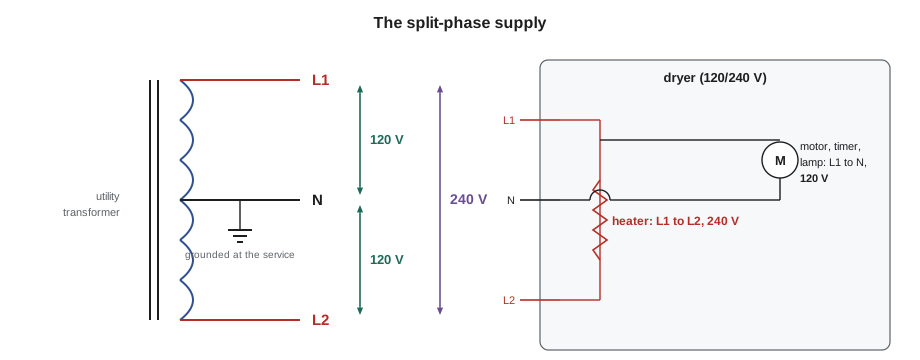
The utility supplies a house through a transformer whose secondary winding has a connection at its middle, called the center tap. The two ends of the winding are the two hot conductors, L1 and L2, and the center tap is the neutral, which is connected to ground at the service. Between L1 and the neutral there is about 120 V; between L2 and the neutral, also about 120 V; and between L1 and L2, about 240 V, because the two halves of the winding add.
At any instant, L1 and L2 are opposite to each other with respect to the neutral: when L1 is 120 V above the neutral, L2 is 120 V below it. That is why the two together give 240 V, and why a 120 V load connected from L1 to neutral and another from L2 to neutral partly cancel each other's current in the neutral. This arrangement is called split-phase, or single-phase three-wire.
120 V appliances
Refrigerators, dishwashers, microwave ovens, washers, gas ranges and gas dryers run on 120 V. Their cords have three conductors: a hot, a neutral and an equipment ground. In the cord, the hot is usually black, the neutral white and the ground green or bare. The polarized plug has a wider neutral blade so that it can only go in one way, which keeps switches and fuses inside the appliance on the hot side. Lesson 10 covers polarity and grounding in detail.
120/240 V appliances: ranges and dryers
Electric ranges and dryers need 240 V for their heating elements, which would draw twice the current at 120 V. They also have parts that run on 120 V: the dryer's drive motor, timer motor and drum lamp, and the range's oven lamp, clock, control board power supply and convection fan. So they connect to L1, L2 and the neutral. The 240 V loads are connected from L1 to L2; the 120 V loads from one hot conductor to the neutral.
Worked problem
How current divides in a dryer
A dryer's heater is rated 5,400 W at 240 V, and its drive motor draws 4 A at 120 V from L1 to neutral. With both running, what current flows in L1, L2 and the neutral?
Show solution
- Heater: I = 5,400 ÷ 240 = 22.5 A, flowing in L1 and L2.
- Motor: 4 A in L1 and the neutral.
- L1 carries the heater and the motor: 22.5 + 4 = 26.5 A.
- L2 carries only the heater: 22.5 A.
- The neutral carries only the motor: 4 A.
Answer: L1 about 26.5 A, L2 about 22.5 A and the neutral about 4 A. A clamp on each conductor of the dryer cord with the dryer heating should show those three readings. If L1 and L2 both read about 4 A and the neutral 4 A, the heater is not on; if L1 reads about 22.5 A but the neutral reads nothing, the motor is not running.
The neutral in a 120/240 V appliance carries only the difference between the 120 V loads on L1 and those on L2. A range manufacturer often puts the oven lamp on one leg and the clock and board on the other, so that the 120 V loads partly balance. That is why a range's neutral conductor can be smaller than its hot conductors.
Three-wire and four-wire connections
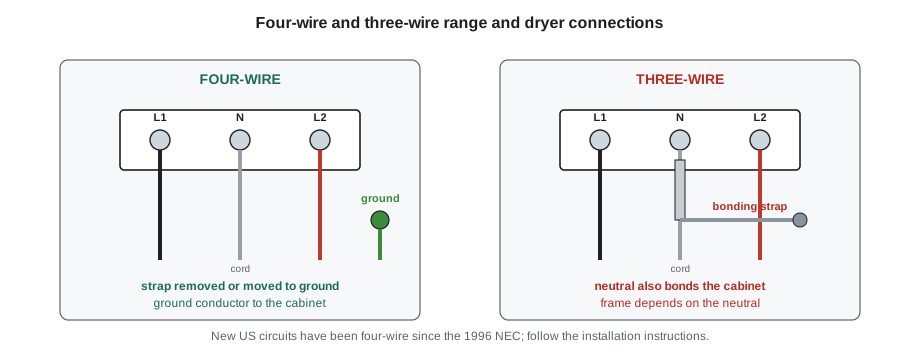
A four-wire connection has two hots, a neutral and a separate equipment ground. The neutral carries the 120 V load current back to the supply; the ground carries no current in normal operation and connects the appliance frame to the house grounding system, so that a fault from a live part to the frame trips the breaker instead of leaving the frame live. Four-wire receptacles for these appliances are commonly the 30 A configuration for dryers and the 50 A configuration for ranges, with an L-shaped or round ground slot.
A three-wire connection has two hots and one other conductor that serves as both the neutral and the frame connection. Inside the appliance, a metal strap or a green wire, called the bonding strap or bonding jumper, connects the neutral terminal to the frame. The danger is that the neutral normally carries current. If the neutral connection becomes loose or broken anywhere, the appliance frame can become live through the 120 V loads, and anyone touching the frame and a grounded object, such as a washer or a water pipe, is in the path.
In the United States, the National Electrical Code has required four-wire circuits for new range and dryer installations since its 1996 edition. Existing three-wire circuits installed before that are still allowed to remain where they meet the conditions the code sets, so technicians meet both. Ranges and dryers sold in the United States usually come without a cord, and the installer fits the three-wire or four-wire cord kit that matches the receptacle and sets the bonding strap to suit, following the installation instructions.
Worked problem
Converting the Clintonville dryer to four-wire
Kiran reads the four-wire dryer receptacle: L1 to L2 240 V, L1 to N 120 V, L2 to N 120 V, N to ground 0.1 V. The dryer has a three-wire cord with its bonding strap from the neutral terminal to the cabinet. What must change, and how does he confirm the result?
Show solution
- The receptacle is a correct four-wire supply.
- With the dryer unplugged, he removes the three-wire cord and fits a four-wire cord kit through a strain relief.
- Hots to the outer terminals, white neutral to the center terminal, green ground to the green ground screw on the cabinet.
- Following the installation instructions, he removes the bonding strap from the neutral terminal and fastens it to the ground screw as the instructions show, so the neutral is no longer connected to the frame.
- Check with the ohmmeter, still unplugged: neutral blade to cabinet OL; ground blade to cabinet about 0 Ω.
Answer: The neutral must be separated from the cabinet and the cabinet grounded through the new green conductor. Leaving the strap in place with a four-wire cord would put the neutral and the ground in parallel, so neutral current would flow on the ground conductor. After the conversion, Kiran ran the dryer on heat and clamped L1, L2 and the neutral: about 26 A, 22 A and 4 A.
Supplies at 208 V
Lesson 1 showed that a 240 V element makes about three-quarters of its power at 208 V. In buildings fed with 120/208 V, the 120 V loads in a range or dryer are unaffected, because each hot is still 120 V to neutral. Only the 240 V loads are weaker. Many appliances list both ratings on the plate, and some manufacturers offer a 208 V element, a lower-resistance element that makes the full rated power at 208 V. Fitting a 208 V element in a 240 V house would make it run hotter than its design, so the part number must match the supply.
Worked problem
Choosing the right replacement dryer heater
A building is supplied at 208 V. The dryer's standard heater is rated 5,400 W at 240 V. A 208 V heater for the same model is rated 5,400 W at 208 V. What resistance does each have, and what does the 208 V heater make if it is fitted in a 240 V house?
Show solution
- Standard: R = 240² ÷ 5,400 = 10.67 Ω.
- 208 V heater: R = 208² ÷ 5,400 = 8.01 Ω.
- The 208 V heater on 240 V: P = 240² ÷ 8.01 = 7,190 W.
Answer: About 10.7 Ω and 8.0 Ω. On 240 V the 208 V heater would make about 7,190 W, a third more than its rating, and draw about 30 A on a 30 A circuit. It must only be used where the supply is 208 V. Always order the heater that matches the measured supply.
Hard-wired appliances
Some appliances are hard-wired rather than plugged in: many dishwashers, cooktops, wall ovens and some ranges connect to a junction box or to cable entering the appliance's terminal box. In both countries, the appliance technician may disconnect and reconnect the appliance at its own terminals, following the instructions, with the circuit off at the breaker and locked out as APP-110 showed. Running new cable, moving a junction box or changing the breaker is electrical work for a licensed electrician, and in many places needs a permit.
When reconnecting a hard-wired appliance, use connectors listed for the conductor material and size, keep the conductors inside a box or the appliance terminal compartment, fit the strain relief or cable clamp, and connect the ground first and disconnect it last. Aluminum conductors, found in some older houses, need connectors listed for aluminum and must not be mixed with copper in an ordinary connector.
Reading 240 V loads with a meter
A 240 V load has no neutral, so its voltage must be measured between its two terminals, or between L1 and L2. Measuring from one terminal of a 240 V element to the cabinet shows about 120 V, which can fool a new technician into thinking the element is getting half its voltage. Each terminal is 120 V to ground; the element has 240 V across it.
A missing leg is the classic 240 V fault, shown in APP-110 on a dryer whose motor ran but whose heater stayed cold. With one leg missing, the 120 V loads on the good leg run normally, the 120 V loads on the dead leg stop, and the 240 V loads either stop or, if the 120 V loads on the dead leg give the current a path back through them, run very weakly with strange symptoms. A range that has lights and a clock but no elements, or elements that glow dull, should send the technician straight to the supply readings.
| Measure between | Normal reading | Points to |
|---|---|---|
| L1 and L2 | About 240 V (about 208 V in a 120/208 V building) | If about 120 V or 0 V: a missing leg |
| L1 and N, L2 and N | About 120 V each | If one is 0 V: that leg is missing |
| N and ground | Close to 0 V | If several volts: a loose neutral or a heavy load |
| Element terminal and cabinet | About 120 V each terminal | Normal; measure across the element for 240 V |
Cords, strain reliefs and terminal blocks
Whatever the connection, the cord or cable must be held by a strain relief at the point where it enters the appliance, so that a pull on the cord cannot loosen the terminals. The terminal block screws must be tightened firmly to the torque the instructions give, because a loose screw on a 30 A or 40 A connection heats in the same way as the burned element terminal in lesson 11. Use only a cord kit rated for the appliance, 30 A for most dryers and 40 A or 50 A for ranges, with ring or spade terminals of the right size. Check that the terminal block cover is refitted, and that the cord is not trapped when the appliance is pushed back. A cord crushed behind a dryer can be damaged over time, and a damaged cord on a 240 V appliance is a serious fire risk.
Common mistakes
MistakeMeasuring a 240 V element from one terminal to the cabinet and reading 120 V as a fault.
InsteadMeasure across the element's two terminals; each terminal is normally 120 V to ground.
MistakeLeaving the bonding strap in place when fitting a four-wire cord.
InsteadFollow the instructions: separate the neutral from the frame and connect the ground conductor to the cabinet.
MistakeOrdering a replacement heater without checking the supply voltage.
InsteadMeasure L1 to L2 and order the heater for 240 V or 208 V to match.
MistakeChanging a receptacle or breaker to match an appliance.
InsteadThe branch circuit belongs to the house wiring; refer it to a licensed electrician.
MistakeIgnoring a range with lights but no heat.
InsteadCheck both legs of the supply first; a missing leg causes exactly this.
Summary and key terms
- The split-phase supply gives 120 V from each hot to neutral and 240 V between the hots.
- 120/240 V appliances run heaters on 240 V and motors, timers, lamps and boards on 120 V.
- L1 and L2 carry the 240 V load; the neutral carries only the 120 V load, or the difference between the legs.
- A four-wire connection keeps the neutral and the ground separate; a three-wire connection uses the neutral to bond the frame.
- New US range and dryer circuits have been four-wire since the 1996 NEC; existing three-wire circuits may remain under the code's conditions.
- At 208 V, 240 V elements make about three-quarters of their power; 208 V replacement heaters must only be used on 208 V supplies.
- Branch circuits, receptacles and breakers are electrical work for a licensed electrician.
- Split-phase supply
- A 120/240 V supply from a center-tapped transformer winding.
- L1 and L2
- The two hot conductors of a split-phase supply.
- Neutral
- The grounded conductor connected to the transformer center tap; it carries the 120 V load current back to the supply.
- Equipment ground
- A conductor that connects appliance frames to the grounding system and carries current only during a fault.
- Four-wire connection
- A range or dryer connection with two hots, a neutral and a separate equipment ground.
- Three-wire connection
- A range or dryer connection in which the neutral also bonds the frame.
- Bonding strap
- A metal strap or wire inside a range or dryer that connects the neutral terminal to the frame for a three-wire connection.
Practice problems
Work each problem on paper first, then reveal the answer to check.
What voltage is there between L1 and the neutral?
Show answer
About 120 V.
In the dryer example, why does L1 carry more current than L2?
Show answer
L1 carries the heater and the 120 V motor; L2 carries only the heater.
Why is a three-wire connection less safe than a four-wire connection?
Show answer
The frame depends on the neutral, which carries current; if it opens, the frame can become live.
What does a 5,400 W, 208 V heater make on 240 V?
Show answer
About 7,190 W.
A range has a working clock and lights but no heat. What should you check first?
Show answer
Both legs of the supply, L1 to L2 and each leg to neutral.
Lesson quiz · 5 questions
Score 60% or more to complete this lesson.
Create a free account to save your progress, take quizzes and earn a certificate.