
AI-101 · Lesson 12 of 12 · 26 min
The future of AI and your place in it
AI is changing faster than almost any technology before it. In a few years, systems went from struggling with simple conversation to writing software, passing professional exams, controlling robots and assisting scientific research. Predicting where this leads is hard, and experts disagree sharply. This final lesson looks at the main directions of current progress (agents, robotics, scientific discovery, more capable reasoning models), the debate about artificial general intelligence and its risks, the trends in computing and energy that will shape what is possible, and how you can build skills and a career in a world where AI is everywhere. It also pulls together the ideas of the whole course.
From chatbots to agents
The first wave of generative AI produced assistants that answer questions and produce text, images and code on request. The next wave is agents: AI systems that pursue goals over many steps, using tools such as web browsers, code interpreters, file systems, business software and other AI models, deciding for themselves what to do next and checking their own work. Agents can already research topics across many sources, write and test software, fill in forms, and operate computer interfaces. Organizations are experimenting with agents that handle customer requests end to end, monitor systems and respond to incidents, or run scientific experiments.
Agents raise new questions. Errors compound over long tasks; agents may take actions with real consequences (spending money, sending messages, changing systems); and they can be manipulated by malicious instructions hidden in the content they read (prompt injection). Designing agents with limited permissions, clear checkpoints where a person approves consequential actions, and thorough logging is an active area of engineering.
Worked problem
Why long tasks are hard
An agent completes each step of a task correctly 98% of the time, independently. What is the chance it completes a 10-step task without error? A 50-step task? What per-step reliability would give 90% success on 50 steps?
Show solution
- 10 steps: \(0.98^{10} = 0.82\).
- 50 steps: \(0.98^{50} = 0.36\).
- For 90% on 50 steps: \(p^{50} = 0.9\), so \(p = 0.9^{1/50} = 0.9979\).
Answer: About 82% for 10 steps but only 36% for 50 steps; reaching 90% on 50 steps needs 99.8% reliability per step. This is why agents that check and correct their own work, and that ask for help when unsure, perform so much better on long tasks than systems that simply proceed.
Robotics and embodied AI
Robots have long excelled at repetitive tasks in controlled settings such as car factories, but struggled in messy, changing environments like homes, warehouses and construction sites. Advances in vision, reinforcement learning, simulation and large models are changing this. Robots can now learn manipulation skills from demonstrations and simulation, follow instructions given in natural language, and generalize to new objects. Self-driving taxis operate commercially in several cities, warehouse robots move goods for large retailers, and many companies are developing general-purpose humanoid robots. Physical AI faces challenges that software does not: safety around people, hardware cost and reliability, and the long tail of unusual situations.
AI for science
Some of the most consequential uses of AI may be in science. DeepMind's AlphaFold, which predicts protein structures from their amino acid sequences, solved a 50-year-old problem in biology; its creators Demis Hassabis and John Jumper shared the 2024 Nobel Prize in Chemistry with David Baker, who used computation to design new proteins. AI is being used to discover materials for batteries and solar cells, predict weather faster and in some cases more accurately than traditional models, control plasma in fusion experiments, find new antibiotics, and assist mathematicians with proofs. Many researchers expect AI to accelerate scientific discovery significantly, though turning predictions into validated results still requires experiments.
How fast is AI improving?
Several measurable trends have driven progress:
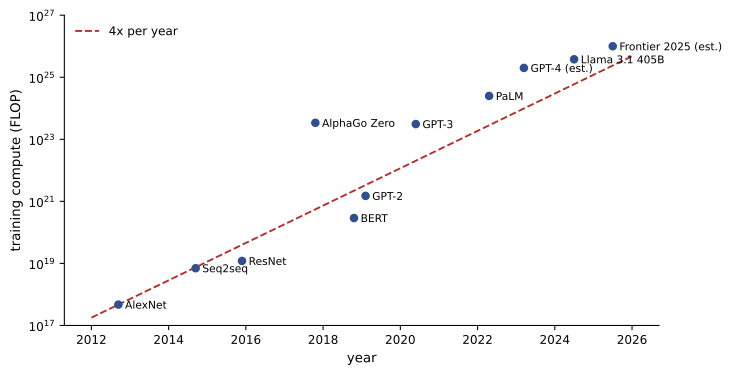
- Training compute for frontier models has grown roughly fourfold per year over the past decade, according to analyses by Epoch AI.
- Algorithms have become more efficient, so the same performance requires less compute each year.
- Investment in AI chips and data centers has grown to hundreds of billions of dollars a year.
- Benchmarks are saturated quickly: tests designed to be hard for AI are often largely solved within a few years, and researchers continually create harder ones.
- The length of tasks AI agents can complete autonomously has been growing rapidly; one 2025 study by the research group METR estimated that it was doubling roughly every seven months.
Whether these trends continue depends on physical and economic limits: electricity supply, chip manufacturing, the cost of training runs, and the availability of high-quality data. Growth in electricity demand for AI data centers is already a major planning issue for utilities and governments (DCE-200).
Worked problem
Compounding trends
If training compute grows fourfold per year and algorithmic efficiency doubles the effective compute per year, by what factor does effective compute grow over 5 years?
Show solution
- Combined growth per year: \(4 \times 2 = 8\).
- Over 5 years: \(8^5 = 32{,}768\).
Answer: About 33,000-fold. Even if each trend slows, compounding over several years produces very large changes, which is why forecasts of AI capability are so uncertain and why many experts take rapid progress seriously.
Artificial general intelligence and its risks
Artificial general intelligence (AGI) usually means AI that can match or exceed humans across most cognitive tasks, rather than in narrow domains. Leading AI companies state that building AGI is their goal, and some of their leaders predict it within a few years; other researchers think it is decades away or doubt that current methods can reach it. There is no agreed definition or test, which makes the debate harder.
Many researchers, including pioneers such as Geoffrey Hinton and Yoshua Bengio, have warned that sufficiently advanced AI could pose serious risks: misuse by malicious actors (for example, to design cyberattacks or biological weapons), accidents from systems pursuing goals in unintended ways, concentration of power, and the possibility of losing human control over highly capable systems. Others argue that these concerns are speculative and distract from present harms such as bias, misinformation and labor disruption (Lesson 11). Most experts agree that both present and future risks deserve attention.
Responses include technical safety research (alignment, interpretability, evaluation of dangerous capabilities, robust oversight), company safety frameworks that commit to tests and safeguards before releasing more capable models, government AI safety institutes in several countries that test frontier models, and international cooperation such as the series of AI summits that began at Bletchley Park in 2023 and the International AI Safety Report, chaired by Yoshua Bengio, first published in January 2025.
AI and the future of work
AI will change most jobs, though how much and how quickly is uncertain. Tasks that involve producing or processing text, code, images and routine analysis are most exposed; tasks involving physical work in varied environments, complex judgment, care and relationships are less so, at least for now. Historically, new technologies have eliminated some jobs, transformed many, and created new ones, but transitions can be painful for individuals and regions. Studies of early AI tools have often found the largest productivity gains for less experienced workers, while also raising concerns about skills development if beginners rely on AI for tasks they need to learn.
In the United States, federal and state governments, universities, community colleges and employers are expanding AI skills training, and AI literacy is increasingly part of school and workforce programs.
Building your AI skills
Whatever your field, some AI knowledge is becoming essential. Useful layers of skill include:
- AI literacy (this course): understanding what AI can and cannot do, how to use it well, and its risks.
- Effective use: prompting, verifying outputs, using AI for research, writing, analysis and coding within your profession.
- Data skills: spreadsheets, statistics, programming in Python, and working with data responsibly (AI-110).
- Machine learning and deep learning: building and evaluating models (AI-210 and later courses).
- Specialized roles: machine learning engineering, data engineering, AI infrastructure and data center engineering, AI product management, AI safety and policy, and domain specialists who apply AI in medicine, law, engineering, finance and other fields.
Careers in AI in the United States span research labs, technology companies, financial institutions, health systems, governments and a rapidly growing data center and chip industry. Universities and community colleges offer AI programs at many levels, and professional bodies are developing guidance on AI use in regulated professions such as engineering, law and medicine.
Just as important are the human skills that AI complements rather than replaces: defining problems well, judging quality, understanding people, communicating clearly, working in teams, and taking responsibility for decisions.
Thinking clearly about AI claims
Whatever happens next, you will hear many claims about AI: that a system is "smarter than a PhD", that a product "uses AI" to guarantee results, that AI will soon replace a profession or that it is all hype. A few habits help you judge them:
- Ask what was actually measured, on what test, compared with what baseline. Benchmark scores rarely capture real work.
- Ask who is making the claim and what they gain from it, whether they are selling a product, raising money or seeking attention.
- Look for independent evaluation, peer review and evidence from real deployments, not just demonstrations.
- Distinguish what a system can do sometimes from what it does reliably; demonstrations show the best case.
- Remember history (Lesson 2): AI has seen cycles of excessive optimism and disappointment, but also genuine, compounding progress.
- Try the tools yourself on tasks you understand well, where you can judge the results.
These habits are the same scientific thinking that underpins engineering and every other discipline, applied to a fast-moving field.
Looking back over the course
This course has covered what intelligence is and how AI developed (Lessons 1 and 2); classic approaches based on search, knowledge and probability (Lessons 3 and 4); how machines learn from data, through neural networks, and without labels (Lessons 5 to 7); how AI perceives images, sound and language (Lesson 8); today's large language models and their limits (Lesson 9); how AI systems are built and deployed in practice (Lesson 10); the social questions AI raises (Lesson 11); and where it may be heading (this lesson). The common thread is that AI systems are powerful tools built from data, computation and human choices, with real strengths and real limitations. Understanding both is the best preparation for using them well and shaping how they are used.
Common mistakes
MistakeAssuming today's limitations will last.
InsteadCapabilities change quickly; reassess regularly.
MistakeAssuming every prediction of rapid progress will come true.
InsteadTreat forecasts as uncertain and look at evidence.
MistakeGiving AI agents broad permissions without oversight.
InsteadLimit permissions and require approval for consequential actions.
MistakeDismissing either present harms or future risks.
InsteadBoth deserve attention and can be addressed together.
MistakeLetting AI do the tasks you are trying to learn.
InsteadUse AI to support learning, not to skip it.
Summary and key terms
- Agents pursue multi-step goals with tools; reliability per step and oversight are crucial.
- Robotics, self-driving vehicles and humanoids are advancing but face physical-world challenges.
- AI is accelerating science, from protein structures to materials and weather.
- Training compute has grown about fourfold per year, with algorithmic gains compounding.
- AGI timelines are disputed; experts warn of misuse, accidents and loss of control as well as present harms.
- Safety research, company frameworks, safety institutes and international reports address risks.
- AI will reshape work; AI literacy, data skills and human skills are valuable in every field.
- AI agent
- An AI system that takes multi-step actions toward a goal using tools.
- Embodied AI
- AI that perceives and acts in the physical world through a body such as a robot.
- AlphaFold
- An AI system that predicts protein structures.
- Artificial general intelligence
- AI matching or exceeding humans across most cognitive tasks.
- Alignment
- Making AI systems pursue the goals their designers and users intend.
- Interpretability
- Understanding how AI models work internally.
- AI safety institute
- A government body that tests and studies advanced AI risks.
- Prompt injection
- Hidden instructions in content that manipulate an AI system.
- Upskilling
- Training workers in new skills for changing jobs.
- AI literacy
- Understanding AI's capabilities, limits and risks well enough to use it wisely.
Practice problems
Work each problem on paper first, then reveal the answer to check.
What distinguishes an AI agent from a chatbot?
Show answer
It pursues goals over many steps, using tools and deciding what to do next.
Per-step reliability 95%, 20 steps. Success probability?
Show answer
0.95²⁰ ≈ 0.36.
Name two safeguards for agents.
Show answer
Limited permissions, human approval for consequential actions, logging.
What problem did AlphaFold address?
Show answer
Predicting protein structures from amino acid sequences.
Compute triples yearly for 4 years. Total growth?
Show answer
81-fold.
Name three physical limits on AI scaling.
Show answer
Electricity, chip manufacturing, training cost, data.
List three categories of risk from advanced AI.
Show answer
Misuse, accidents, concentration of power, loss of control.
What is the International AI Safety Report?
Show answer
A scientific report on advanced AI risks chaired by Yoshua Bengio, first published in 2025.
Which tasks are most exposed to AI automation today?
Show answer
Producing and processing text, code, images and routine analysis.
Name two human skills that AI complements.
Show answer
Problem definition, judgment, communication, teamwork, responsibility.
Lesson quiz · 5 questions
Score 60% or more to complete this lesson.
Create a free account to save your progress, take quizzes and earn a certificate.