
AERO-350 · Lesson 7 of 12 · 25 min
Landing gear and brakes
The landing gear is the only part of the aircraft designed to hit the ground, and it does so on every flight. It must absorb the energy of the touchdown, support the aircraft on the ground, steer it, stop it, and then fold away into a small space so it does not add drag in flight. It is one of the heaviest systems on any aircraft, often several percent of the maximum take-off mass, and its brakes must be able to stop the aircraft from take-off speed with almost no runway to spare. This lesson covers gear layout, shock absorption, tires, brakes and anti-skid, using the Swift 900 study and the Tern Block 2, which has to operate from short gravel strips in rural Alaska and the northern plains.
Layout and loads
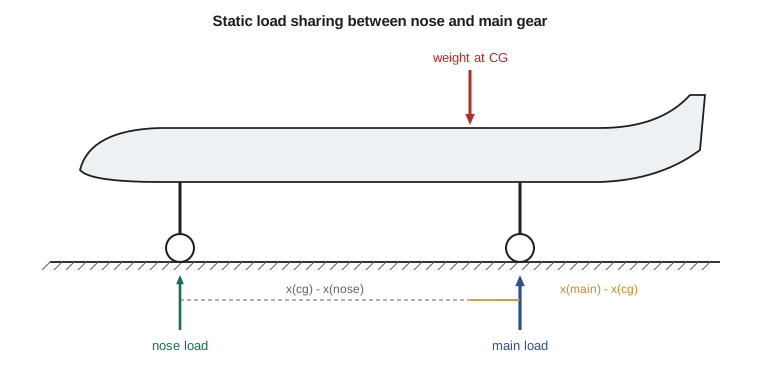
Almost all modern aircraft use a tricycle layout: a nose gear and two main gears slightly behind the center of gravity. It is stable on the ground, gives the pilot a good view, and lets the brakes be used hard without the aircraft nosing over. The main gears carry most of the weight; the nose gear typically carries between about 8 and 15 percent, enough to steer effectively but not so much that it is heavy or that the aircraft is hard to rotate at take-off. The share depends on where the center of gravity is relative to the two gears, so the gear positions are set together with the center of gravity range of Lesson 4 and the stability analysis of AERO-330.
# Landing gear: static loads on nose and main gear, shock strut stroke for the design sink rate,
# and brake energy in a rejected take-off. Values for the Swift 900 study are illustrative.
g = 9.81
m, x_cg = 14300.0, 11.85            # mass kg, CG station m
x_nose, x_main = 3.20, 12.80        # gear stations m
B = x_main - x_nose
F_main = m * g * (x_cg - x_nose) / B
F_nose = m * g - F_main
print(f"static load: nose {F_nose/1000:.1f} kN ({100*F_nose/(m*g):.1f} %), main {F_main/1000:.1f} kN in total")
for x in (11.49, 12.00):            # forward and aft CG limits
    fn = m * g * (x_main - x) / B
    print(f"   CG at {x:5.2f} m: nose carries {100*fn/(m*g):4.1f} % of the weight")
# Shock strut stroke: absorb the vertical kinetic energy of a 3.05 m/s (10 ft/s) sink
w = 3.05; n_gear = 1.8; eta_s, eta_t = 0.80, 0.47   # gear load factor, strut and tire efficiencies
t_def = 0.09                        # tire deflection m
S = (w**2 / (2 * g) / n_gear - eta_t * t_def) / eta_s
print(f"\nshock strut stroke for {w} m/s sink at gear load factor {n_gear}: {S*1000:.0f} mm (add margin)")
# Rejected take-off at 72 m/s: energy into four brakes
V1 = 72.0
E = 0.5 * m * V1**2
E_brake = E * 0.92 / 4              # 8 percent absorbed by drag and rolling resistance
m_heat, cp = 14.0, 1250.0           # carbon heat sink mass per brake kg, specific heat J/kgK
print(f"\nrejected take-off energy {E/1e6:.1f} MJ, about {E_brake/1e6:.1f} MJ per brake")
print(f"carbon heat sink temperature rise about {E_brake/(m_heat*cp):.0f} K per brake")
decel = 0.35 * g
print(f"stopping distance at {decel:.2f} m/s2: {V1**2/(2*decel):.0f} m after the brakes take effect")static load: nose 13.9 kN (9.9 %), main 126.4 kN in total CG at 11.49 m: nose carries 13.6 % of the weight CG at 12.00 m: nose carries 8.3 % of the weight shock strut stroke for 3.05 m/s sink at gear load factor 1.8: 276 mm (add margin) rejected take-off energy 37.1 MJ, about 8.5 MJ per brake carbon heat sink temperature rise about 487 K per brake stopping distance at 3.43 m/s2: 755 m after the brakes take effect
Arjun's first layout put the main gear at station 12.55 m. With the center of gravity at its aft limit, the nose would have carried less than 6 percent of the weight, too little for good steering on a wet or icy ramp. Moving the main gear 0.25 m aft to station 12.80 m raises the share to 8.3 percent at the aft limit and 13.6 percent at the forward limit, both within the usual range. The move has a cost: the aircraft must now rotate about a point further aft at take-off, so Tomasz Wierzbicki's aerodynamics group checks that the elevator still has enough power to lift the nose at the forward center of gravity, and Marcus Webb's structures group checks that the gear's attachment still lands on the wing's rear spar.
Absorbing the touchdown
The design landing case is a vertical speed at touchdown, set by the airworthiness rules at 10 ft/s, about 3.05 m/s, at the design landing weight for most aircraft, with a lower speed at the maximum take-off weight. The energy to absorb is the vertical kinetic energy. Most gear uses an oleo-pneumatic shock strut: a cylinder of hydraulic oil and compressed nitrogen in which a piston forces oil through an orifice. The gas acts as a spring that supports the aircraft statically, and the orifice dissipates the energy of the impact as heat. Oleo struts are efficient, absorbing about 80 percent of the energy that an ideal constant-force absorber would over the same stroke, and they damp the rebound.
The stroke follows from the energy balance. If the gear's load factor N limits the force to N times the aircraft's weight, the strut stroke S times its efficiency, plus the tire's deflection times its lower efficiency, must absorb the sink energy per unit weight. For the Swift 900 study with a gear load factor of 1.8, the program gives a stroke of about 276 mm, to which designers add margin. A lower load factor means a longer, heavier strut but gentler loads on the structure and the passengers. The Tern's gear, designed for rough strips, uses a higher stroke and lower load factor than a business jet would.
Small aircraft often use simpler gear: spring steel or composite legs that bend, rubber discs or trailing link arms. The Tern uses trailing link main gear, in which the wheel is on an arm that swings back and up, with a compact oleo strut. Trailing links handle bumps and ruts better than a straight strut, because the wheel can move back as well as up, which suits unprepared strips.
Tires and the runway
Aircraft tires are built to carry very high loads at high pressure and to survive brief high-speed rolls. Jet transport tires often run at 1.0 to 1.4 MPa (150 to 200 psi), which concentrates the load on a small footprint, suitable for paved runways but not for gravel. The Tern's tires are large and run at about 0.4 MPa (60 psi), spreading the load so that the aircraft does not rut a gravel strip. Runway and aircraft strength are compared through a classification system published by ICAO, which in recent years replaced the long-used aircraft and pavement classification numbers with updated rating values; the principle is that the aircraft's rating must not exceed the pavement's.
Tires are inflated with dry nitrogen rather than air, because nitrogen does not support combustion inside an overheated tire and contains no moisture to freeze or corrode the wheel. Wheels have fusible plugs that melt and release the pressure if the brakes overheat the wheel after a hard stop, preventing a tire explosion, and pressure relief valves protect against over-inflation.
Brakes and the rejected take-off
The hardest case for brakes is the rejected take-off at the highest speed at which the crew may still abort, close to the decision speed V1, at maximum take-off weight. The brakes must convert almost all of the aircraft's kinetic energy into heat in less than a minute. The program estimates 37 MJ for the Swift 900 study at 72 m/s, about 8.5 MJ for each of its four brakes after drag and rolling resistance take a share. With a carbon heat sink of about 14 kg per brake, the temperature rises by nearly 500 K. Carbon brakes are used on most jets because carbon stores much more heat per kilogram than steel, keeps its strength when hot and wears slowly; steel brakes are cheaper and remain common on smaller aircraft.
Certification includes a demonstration rejected take-off on brakes worn to their limit, at maximum energy, after which the aircraft must not need fire fighting for a set period while the brakes cool, which is why the fusible plugs matter. The test is one of the most dramatic in any flight test program, and the brakes are often glowing at the end.
Anti-skid systems keep the wheels from locking. Each wheel has a speed sensor, and a controller reduces brake pressure the moment a wheel begins to slow faster than the aircraft. A locked wheel slides on a patch of rubber that quickly wears through, and it gives much less braking and no directional control. Anti-skid allows maximum braking on wet, icy or contaminated runways, where the friction coefficient may be a fraction of the dry value. Autobrakes on larger aircraft apply a selected deceleration automatically after touchdown or in a rejected take-off.
| Runway condition | Approximate friction coefficient for braking | Stopping distance relative to dry |
|---|---|---|
| Dry | 0.4 to 0.5 | 1.0 |
| Wet | 0.2 to 0.3 | about 1.5 to 2 |
| Compacted snow | 0.15 to 0.2 | about 2 to 3 |
| Wet ice | 0.05 to 0.1 | 4 or more |
Since 2021 both countries have moved toward a common way of reporting runway surface conditions using a runway condition assessment matrix, so that crews can relate what the airport reports to the braking performance they can expect. Lesson 11 returns to the performance calculations crews do with these reports.
Retraction, steering and the Tern's choices
Retractable gear saves drag but adds mass, complexity and a failure mode: gear that will not extend. Every retractable gear has an alternative extension system, usually gravity free-fall after releasing the uplocks, sometimes assisted by springs or a hand pump. Gear position is shown to the crew with indications for each leg, and a warning sounds if the aircraft is configured for landing with the gear up. Nose wheel steering is powered by hydraulics on most jets and is controlled by a tiller and the rudder pedals.
The Tern's gear retracts electromechanically, as Lesson 3 described, and its nose wheel steering is electric. Its brakes are self-contained: each main wheel has an electric brake actuator, removing the hydraulic lines from the wheel wells entirely. Its alternative extension is gravity free-fall with a mechanical release that does not depend on electrical power. On a short gravel strip, the Tern can also use its electric propeller motors in reverse to help stop, with the battery absorbing some energy, a feature that has drawn much interest from operators in rural Alaska and the northern plains.
Worked problem
Nose gear share
An aircraft of 8000 kg has its nose gear at station 2.0 m, its main gear at 8.0 m and its center of gravity at 7.3 m. What fraction of the weight does the nose gear carry?
Show solution
- \(F_{nose}/W = (x_{main} - x_{cg})/(x_{main} - x_{nose}) = 0.7/6.0 = 0.117\).
Answer: About 11.7 percent, within the usual range.
Worked problem
Rejected take-off energy
An aircraft of 20 000 kg rejects at 75 m/s. Find its kinetic energy and the energy per brake if four brakes absorb 90 percent of it.
Show solution
- \(E = 0.5 \times 20\,000 \times 75^2 = 56.3\) MJ.
- Per brake: \(0.9 \times 56.3/4 = 12.7\) MJ.
Answer: 56 MJ in total, about 12.7 MJ per brake.
Worked problem
Strut stroke
Find the strut stroke for a sink rate of 3.05 m/s, gear load factor 2.0, strut efficiency 0.8, and neglecting the tire.
Show solution
- \(S = (3.05^2/(2 \times 9.81 \times 2.0))/0.8 = 0.237/0.8 = 0.296\) m.
Answer: About 0.30 m before margin.
Common mistakes
MistakePlacing the main gear without checking the nose gear share across the center of gravity range.
InsteadThe share must stay within limits at both the forward and aft center of gravity.
MistakeDesigning brakes for the normal landing.
InsteadThe rejected take-off at maximum energy is the sizing case.
MistakeInflating aircraft tires with air.
InsteadDry nitrogen is used to avoid combustion and moisture.
MistakeAssuming wet runway braking is like dry.
InsteadFriction may be half or less, doubling stopping distances.
Summary and key terms
- Tricycle landing gear shares the weight between a nose gear carrying about 8 to 15 percent and two main gears, set together with the center of gravity range; the Swift 900 study moved its main gear aft to keep enough load on the nose.
- Oleo-pneumatic struts absorb the touchdown energy of a 3.05 m/s sink over a stroke set by the gear load factor.
- Tires are inflated with nitrogen and sized for runway strength; the Tern's low-pressure tires suit gravel strips.
- Brakes are sized by the rejected take-off, where carbon heat sinks absorb several megajoules each, and anti-skid keeps the wheels rolling on slippery runways.
- Oleo-pneumatic strut
- A shock absorber using compressed gas as the spring and oil through an orifice as the damper.
- Gear load factor
- The ratio of the gear's peak landing force to the aircraft's weight.
- Rejected take-off
- An aborted take-off, which sets the brakes' maximum energy case.
- Anti-skid
- A system that releases brake pressure on any wheel that begins to lock.
- Fusible plug
- A wheel plug that melts to release tire pressure if the wheel overheats.
- Trailing link gear
- Gear in which the wheel is mounted on a pivoting arm that swings back and up.
Practice problems
Work each problem on paper first, then reveal the answer to check.
In the program, move the aft center of gravity limit to 12.10 m. What share does the nose carry there?
Show answer
About 7.3 percent, below the usual minimum.
Why are carbon brakes common on jets?
Show answer
They store more heat per kilogram, stay strong hot and wear slowly.
In the program, reduce the gear load factor to 1.5. What stroke is needed?
Show answer
About 343 mm.
Why do the Tern's tires run at low pressure?
Show answer
To spread the load on gravel strips.
What does anti-skid do?
Show answer
It releases brake pressure on a wheel that begins to lock.
What is the usual alternative gear extension method?
Show answer
Gravity free-fall after releasing the uplocks.
Lesson quiz · 5 questions
Score 60% or more to complete this lesson.
Create a free account to save your progress, take quizzes and earn a certificate.