
AERO-330 · Lesson 5 of 12 · 23 min
Lateral-directional static stability
The Tern Block 2 will spend much of its life on short gravel strips in western Kansas and Colorado, where the wind rarely blows straight down the runway. Sam's checklist for the stability and control study puts crosswind capability near the top: 'Show me how much rudder and aileron I need at 20 knots across, and how much is left.' Answering means understanding how the aircraft responds to sideslip, the angle between its nose and the relative wind. Two static properties decide that response. Directional stability, the weathercock effect, swings the nose into the wind. The dihedral effect rolls the aircraft away from the sideslip, lifting the upwind wing. This lesson builds both for the Tern and then puts them to work in a crosswind landing.
Directional stability
Directional stability is the yawing equivalent of pitch stability. If a gust yaws the nose to the left, the relative wind now comes from the right: positive sideslip. A directionally stable aircraft responds with a yawing moment to the right, back into the wind, like a weathervane. In coefficient form the requirement is
Note the sign: for yaw the stable derivative is positive, because positive sideslip means the nose is left of the wind and a positive (nose-right) yawing moment corrects it. The fin is the main source of directional stability. In sideslip it meets the flow at an angle and produces a side force which, acting at a long arm behind the CG, yaws the nose into the wind. Its contribution is written with a fin volume coefficient by analogy with the horizontal tail:
where \(\sigma\) is the sidewash angle produced by the fuselage and wing in sideslip, which on most designs increases the fin's effective angle slightly. The fuselage and engine nacelles are destabilizing, for the same reason as in pitch. For the Tern, with a 4.2 m² (45 ft²) fin on a 7.9 m arm, the fin volume coefficient is 0.070, the fin supplies +0.209 per radian and the fuselage and nacelles take away about 0.100, leaving a total of +0.109 per radian.
How much directional stability is enough? Too little, and the aircraft wanders in yaw, the Dutch roll oscillation of Lesson 8 is poorly damped, and an engine failure produces a large sideslip before the pilot catches it. Too much, and the aircraft responds strongly to every sideways gust and the dihedral effect it drives makes the ride rough in turbulence. In practice the fin size of a twin-engined aircraft is often set not by stability but by the rudder power needed to hold straight flight with one engine failed at low speed; the fin and rudder sized for that case then easily satisfy the stability requirement.
The dihedral effect
The rolling moment due to sideslip is called the dihedral effect, because geometric dihedral is its most obvious source. In positive sideslip the upwind, right wing meets the flow at a higher angle of attack if the wings are tilted up in a V, so it lifts more and rolls the aircraft to the left, away from the sideslip. The stable sign is therefore negative:
Several features contribute. Geometric dihedral gives, for a straight tapered wing, approximately
where \(\Gamma\) is the dihedral angle in radians and \(\lambda\) the taper ratio. Wing position on the fuselage matters: a high wing adds stable dihedral effect because of the flow around the fuselage in sideslip, while a low wing subtracts it. That is why high-wing aircraft often have little or no geometric dihedral and low-wing aircraft have more. Sweepback adds dihedral effect that grows with lift coefficient. A tall fin, whose side force acts above the roll axis, also contributes a stabilizing rolling moment. The Tern's 4 degrees of dihedral, low wing and fin together give −0.099 per radian.
Just as with directional stability, more dihedral effect is not always better. It gives the aircraft its tendency to level the wings after a gust and helps spiral stability, but strong dihedral effect paired with weak directional stability makes the Dutch roll oscillation roll-dominated and unpleasant, and it makes the aircraft roll strongly in turbulence. Lesson 8 shows how the ratio of the two derivatives shapes the lateral modes.
Crosswind landings
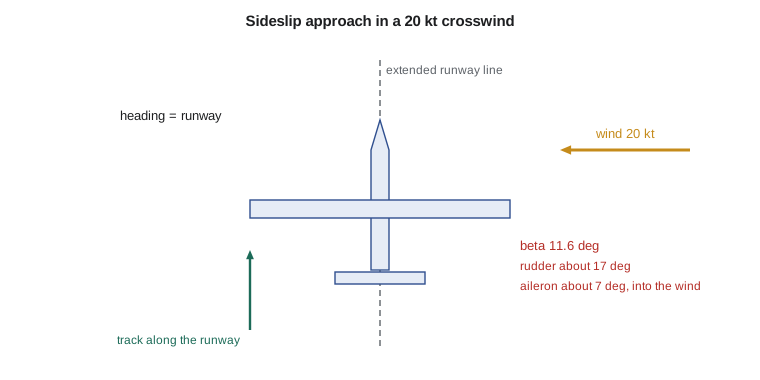
There are two classic ways to land in a crosswind. In the crab method the pilot lets the aircraft weathercock into the wind, flying the approach with the nose pointed upwind so that the track runs along the runway, and then kicks the nose straight with rudder just before touchdown. In the sideslip or wing-low method, the pilot uses rudder to hold the nose along the runway all the way down, which puts the aircraft in a steady sideslip, and holds opposite aileron to stop the dihedral effect from rolling it. The upwind wing is then slightly low and the aircraft drifts neither left nor right. Many pilots combine the two, crabbing on the approach and sideslipping in the last part of the flare.
The steady sideslip is a direct test of the static derivatives. For the yawing and rolling moments both to be zero,
Two linear equations give the rudder and aileron angles for any sideslip. The rudder needed grows with directional stability, so a very stable aircraft needs more rudder to hold a given crosswind; the aileron grows with the dihedral effect.
# Lateral-directional static stability of the Tern Block 2, and the controls needed for a
# steady-heading sideslip in a crosswind landing. Angles in radians unless printed in degrees.
import math
r2d = 57.2958
S, b = 28.0, 17.0
# weathercock (directional) stability, Cn_beta
Sv, lv, a_v, eta_sig = 4.2, 7.9, 3.0, 1.0      # fin area m2, arm m, fin lift slope /rad, eta(1 + dsigma/dbeta)
Vv = Sv * lv / (S * b)
Cnb_fin = Vv * a_v * eta_sig
Cnb_body = -0.100                               # fuselage and nacelles, destabilizing
Cnb = Cnb_fin + Cnb_body
print(f"fin volume Vv = {Vv:.4f}; Cn_beta fin {Cnb_fin:+.3f}, body {Cnb_body:+.3f}, total {Cnb:+.3f} per rad")
# dihedral effect, Cl_beta (negative is stable: right sideslip rolls left, wing up into the wind)
a_w, Gam, lam = 5.04, 4.0 / r2d, 0.45
Clb_dih = -(a_w * Gam / 6) * (1 + 2 * lam) / (1 + lam)
Clb_pos = +0.020                                # low wing on the fuselage reduces the effect
zv = 1.6                                        # fin center of pressure above the roll axis, m
Clb_fin = -a_v * (Sv / S) * (zv / b)
Clb = Clb_dih + Clb_pos + Clb_fin
print(f"Cl_beta: dihedral {Clb_dih:+.3f}, wing position {Clb_pos:+.3f}, fin {Clb_fin:+.3f}, total {Clb:+.3f} per rad")

# crosswind landing by sideslip (wing low): hold beta with rudder, hold wings nearly level with aileron
Cn_dr, Cl_dr, Cl_da, Cn_da = -0.070, 0.010, 0.150, -0.008
dr_max, da_max = 25 / r2d, 20 / r2d
V_app = 50.0                                    # approach speed, m/s
print("\ncrosswind kt   beta deg   rudder deg   aileron deg")
for kt in (5, 10, 15, 20, 25):
    vw = kt * 0.5144
    beta = math.atan(vw / V_app)
    # solve  Cnb*beta + Cn_dr*dr + Cn_da*da = 0 ;  Clb*beta + Cl_dr*dr + Cl_da*da = 0
    det = Cn_dr * Cl_da - Cn_da * Cl_dr
    dr = (-Cnb * beta * Cl_da + Cn_da * Clb * beta) / det
    da = (-Cl_dr * (-Cnb * beta) + Cn_dr * (-Clb * beta)) / det
    flag = '  rudder limit' if abs(dr) > dr_max else ''
    print(f"    {kt:3d}       {beta*r2d:5.1f}       {dr*r2d:+6.1f}       {da*r2d:+6.1f}{flag}")
vw_max = V_app * math.tan(dr_max * abs(Cn_dr) / Cnb)
print(f"\nignoring aileron yaw, full rudder holds about {vw_max/0.5144:.0f} kt of crosswind at {V_app:.0f} m/s")fin volume Vv = 0.0697; Cn_beta fin +0.209, body -0.100, total +0.109 per rad
Cl_beta: dihedral -0.077, wing position +0.020, fin -0.042, total -0.099 per rad
crosswind kt beta deg rudder deg aileron deg
5 2.9 +4.4 +1.7
10 5.9 +8.8 +3.3
15 8.8 +13.1 +4.9
20 11.6 +17.4 +6.5
25 14.4 +21.6 +8.1
ignoring aileron yaw, full rudder holds about 28 kt of crosswind at 50 m/sAt the Tern's approach speed of 50 m/s (97 kt) a 20 knot crosswind requires 11.6 degrees of sideslip, which needs 17.4 degrees of rudder and 6.5 degrees of aileron into the wind. At 25 knots the rudder reaches 21.6 degrees, within the 25 degree stop but with little left for gusts. Ignoring the small yawing moment from the ailerons, full rudder holds about 28 knots. Prairiewind Aerospace will demonstrate a crosswind of 25 knots in flight test and publish it as the demonstrated crosswind in the flight manual; certification standards require a minimum demonstrated crosswind related to the stall speed, and operators treat the demonstrated figure as guidance rather than a hard limit.
Adverse yaw and coordinated turns
Rolling into a turn exposes another lateral-directional coupling. When the pilot deflects the ailerons to roll right, the left aileron goes down and the right aileron goes up. The down-going aileron raises the lift of the left wing and with it the induced drag, while the up-going aileron reduces both on the right. The extra drag on the left wing yaws the nose to the left, away from the intended turn. This is adverse yaw. A second contribution comes from the roll itself: as the aircraft rolls right, the down-going right wing sees a higher angle of attack, its lift vector tilts forward, and the left wing's tilts back, again yawing the nose left. The result is a brief sideslip at the start of every turn, which the dihedral effect then fights by rolling the aircraft back.
Pilots cancel adverse yaw with rudder in the same direction as the roll: the coordinated turn of flight training, checked by keeping the slip ball centerd. Designers reduce the need for it with differential aileron deflection, in which the up-going aileron moves further than the down-going one, and with Frise ailerons, whose nose projects into the flow below the wing when the trailing edge goes up and adds drag on the up-going side. Some aircraft link the rudder to the ailerons with a spring or an interconnect. On the Tern, differential ailerons reduce the adverse yaw derivative to about −0.008 per radian, which is the value in the program; the yaw damper of Lesson 10 removes most of what is left.
| Derivative | Stable sign | Main sources | Tern Block 2 (per rad) |
|---|---|---|---|
| Cn-beta | positive | fin (+), fuselage and nacelles (−) | +0.109 |
| Cl-beta | negative | dihedral, high wing, sweep, fin (−); low wing (+) | −0.099 |
| Cn-delta-r | negative (for positive rudder) | rudder | −0.070 |
| Cl-delta-a | positive (for positive aileron) | ailerons | +0.150 |
Worked problem
Fin contribution
A fin of 5.0 m² is 9.0 m behind the CG of an aircraft with a 30 m² wing of 18 m span. With a fin lift slope of 2.8 per radian and \(\eta_v(1 + d\sigma/d\beta) = 1.05\), find the fin volume coefficient and the fin's \(C_{n_\beta}\).
Show solution
- \(V_V = 5.0 \times 9.0/(30 \times 18) = 0.0833\).
- \(C_{n_\beta,fin} = 0.0833 \times 2.8 \times 1.05 = 0.245\) per radian.
Answer: If the fuselage and nacelles subtract 0.12 per radian, the aircraft has a total of 0.125 per radian.
Worked problem
Crosswind sideslip
An aircraft approaches at 45 m/s in a 15 knot crosswind. With \(C_{n_\beta} = 0.12\) and \(C_{n_{\delta_r}} = -0.08\) per radian, estimate the rudder needed to hold the nose along the runway, ignoring aileron yaw.
Show solution
- \(\beta = \tan^{-1}(15 \times 0.5144/45) = \tan^{-1}(0.171) = 9.7\) degrees.
- \(\delta_r = -C_{n_\beta}\beta/C_{n_{\delta_r}} = 0.12 \times 9.7/0.08 = 14.6\) degrees.
Answer: The required rudder scales with directional stability. A stiffer weathervane needs more rudder to hold it off the wind.
Common mistakes
MistakeExpecting the stable sign of Cn-beta to be negative like Cm-alpha.
InsteadWith the usual sign conventions the stable directional derivative is positive.
MistakeThinking geometric dihedral is the only source of dihedral effect.
InsteadWing position, sweep and the fin all contribute; a low wing reduces it.
MistakeAssuming more directional stability always helps crosswind landings.
InsteadIt increases the rudder needed to hold a sideslip.
MistakeTreating the aileron as purely a rolling control.
InsteadAileron deflection also produces a small yawing moment, usually adverse.
Summary and key terms
- Directional stability, Cn-beta positive, comes mainly from the fin and is reduced by the fuselage and nacelles; it is expressed through a fin volume coefficient.
- The dihedral effect, Cl-beta negative, comes from dihedral, wing position, sweep and the fin.
- In a steady-heading sideslip the rudder balances the weathercock moment and the aileron balances the dihedral effect, so the derivatives set the crosswind capability.
- Too much of either derivative brings its own problems in turbulence and in the lateral modes.
- Sideslip
- The angle between the velocity and the aircraft plane of symmetry; positive when the wind comes from the right.
- Directional stability
- The tendency to yaw into the relative wind, Cn-beta > 0.
- Dihedral effect
- The rolling moment due to sideslip, Cl-beta < 0 for stability.
- Fin volume coefficient
- S_v l_v/(S b), the size of the fin relative to the wing.
- Sidewash
- The sideways deflection of the flow at the fin caused by the wing and fuselage in sideslip.
- Crab
- Flying with the nose pointed into the wind so the track follows the runway.
Practice problems
Work each problem on paper first, then reveal the answer to check.
What sign of Cn-beta is stable?
Show answer
Positive.
Does a high wing add or subtract dihedral effect?
Show answer
It adds stable dihedral effect.
In the program, raise the fin area to 5.0 m². What happens to the rudder needed at 20 knots?
Show answer
It increases, because Cn-beta grows.
Why is fin size on twins often set by engine failure?
Show answer
The rudder must hold straight flight against asymmetric thrust at low speed.
In the wing-low method, which way is the aileron deflected?
Show answer
Into the wind, so the upwind wing stays slightly low against the dihedral effect.
Name a drawback of strong dihedral effect.
Show answer
Rough roll response in turbulence and a roll-dominated Dutch roll.
Lesson quiz · 5 questions
Score 60% or more to complete this lesson.
Create a free account to save your progress, take quizzes and earn a certificate.