
AERO-330 · Lesson 4 of 12 · 24 min
Elevator control and trim
A stable aircraft that cannot be trimmed is useless, and an aircraft that can be trimmed only by holding a heavy force on the control column for an hour is exhausting. Sam's complaint about an earlier prototype is still pinned above Arjun's desk: 'At forward CG with full flap, I was out of nose-up elevator before the wheels touched.' This lesson covers the elevator's job: moving the aircraft from one trimmed state to another, holding it there, and doing so with forces the pilot can manage. It ends with the trim tab, which removes the steady force so the pilot only feels the changes.
Elevator power
Deflecting the elevator changes the camber of the horizontal tail and therefore its lift. Defining positive elevator deflection as trailing edge down, which raises tail lift and pitches the nose down, the elevator adds a term to both the pitching moment and the lift of the aircraft:
\(C_{m_{\delta_e}}\) is the elevator power. The elevator effectiveness \(\tau\) measures how much tail angle of attack one radian of elevator is worth; for an elevator spanning about a third of the tail chord it is about 0.5. The Tern's elevator power works out at −1.36 per radian, comparable in size with \(C_{m_\alpha}\) itself. Note that the elevator also changes lift, slightly reducing it when the trailing edge goes up. This small effect is why a conventional aircraft briefly sinks before it climbs when the pilot pulls: the tail pushes down first, and the wing's lift builds only as the angle of attack rises.
Some aircraft use an all-moving tail, or stabilator, in which the whole horizontal surface pivots. Its effectiveness is 1 rather than about 0.5, so a smaller surface gives the same control power, but the hinge moments are large and need an anti-servo tab to give the pilot a sensible feel. Larger aircraft often combine an adjustable stabilizer, moved slowly by a trim motor, with a conventional elevator for maneuvering. The Tern keeps a fixed stabilizer and elevator, the simplest and lightest arrangement for its size and speed.
Elevator angle to trim
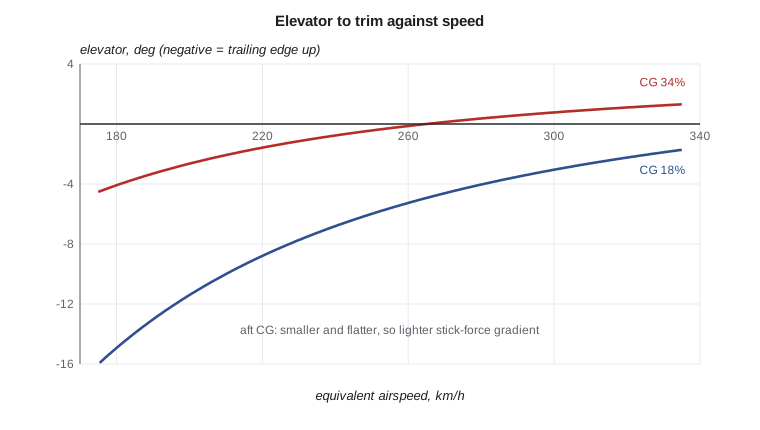
In steady flight both \(C_m = 0\) and \(C_L = W/(qS)\). Solving the two linear equations gives the elevator angle and angle of attack needed at any speed. The result is easiest to read as a gradient: how much the elevator must move per unit change in lift coefficient.
Because \(\Delta\) is negative for a conventional aircraft, a positive static margin gives a negative gradient: more lift coefficient, which means flying slower, needs more trailing edge up elevator. The gradient is proportional to the static margin, which is exactly why flight testing uses it to find the neutral point. At the neutral point the gradient vanishes, so the aircraft would fly at any speed with the same elevator and the pilot would have no sense of where it wanted to settle.
# Elevator to trim, and the trim tab, for the Tern Block 2 across the speed range at the
# forward and aft CG limits. Linear coefficients from Lessons 2 and 3.
import math
r2d = 57.2958
m, g, S, rho0 = 6500.0, 9.81, 28.0, 1.225
a, a_t, eta, VH, St, tau = 5.38, 4.10, 0.92, 0.722, 4.6, 0.50
Cm0 = 0.081
hn = 0.458
Cm_de = -eta * VH * a_t * tau                 # elevator power per radian
CL_de = eta * (St / S) * a_t * tau
print(f"elevator power Cm_de = {Cm_de:.3f}/rad, CL_de = {CL_de:.3f}/rad")

def trim(CL, h):
    Cma = -a * (hn - h)                        # Cm_alpha = -a times the static margin
    # solve  a*al + CL_de*de = CL ;  Cm0 + Cma*al + Cm_de*de = 0
    det = a * Cm_de - CL_de * Cma
    al = (CL * Cm_de + CL_de * Cm0) / det
    de = (-a * Cm0 - Cma * CL) / det
    return al, de

print("\n EAS km/h    CL     elevator to trim (deg)")
print("                    CG 18%     CG 34%")
for V_kmh in (180, 200, 250, 300, 330):
    V = V_kmh / 3.6
    CL = m * g / (0.5 * rho0 * V * V * S)
    d1 = trim(CL, 0.18)[1] * r2d; d2 = trim(CL, 0.34)[1] * r2d
    print(f"   {V_kmh:4d}     {CL:4.2f}    {d1:+6.1f}     {d2:+6.1f}")
for h in (0.18, 0.34):
    dde = (a * (hn - h)) / (a * Cm_de - CL_de * (-a * (hn - h)))
    print(f"CG {100*h:.0f}%: d(delta_e)/dCL = {dde*r2d:+.1f} deg per unit CL")

# Trim tab: zero hinge moment (zero stick force) at 300 km/h, CG 26%
Ch_a, Ch_d, Ch_t = -0.10, -0.25, -0.20          # hinge moment slopes per radian (tab deflection t)
V = 300 / 3.6; CL = m * g / (0.5 * rho0 * V * V * S)
al, de = trim(CL, 0.26)
alpha_t = al * (1 - 0.45) - 2.0 / r2d - 1.5 / r2d     # tail angle: downwash, incidence, zero-lift downwash
tab = -(Ch_a * alpha_t + Ch_d * de) / Ch_t
print(f"\nat 300 km/h, CG 26%: elevator {de*r2d:+.1f} deg, tail alpha {alpha_t*r2d:+.1f} deg, tab to trim {tab*r2d:+.1f} deg")elevator power Cm_de = -1.362/rad, CL_de = 0.310/rad
EAS km/h CL elevator to trim (deg)
CG 18% CG 34%
180 1.49 -14.9 -4.1
200 1.20 -11.4 -2.6
250 0.77 -6.0 -0.4
300 0.54 -3.0 +0.8
330 0.44 -1.9 +1.2
CG 18%: d(delta_e)/dCL = -12.5 deg per unit CL
CG 34%: d(delta_e)/dCL = -5.1 deg per unit CL
at 300 km/h, CG 26%: elevator -1.1 deg, tail alpha -0.3 deg, tab to trim +1.5 degAt 330 km/h (178 kt) the elevator barely moves from neutral at either CG. At 180 km/h (97 kt), just above the clean stall, the aircraft needs 14.9 degrees of up elevator at the forward limit but only 4.1 degrees at the aft limit. The gradients, −12.5 and −5.1 degrees per unit lift coefficient, are in proportion to the two static margins. Adding flaps adds a nose-down moment and lowers the speed further, and the forward-limit elevator requirement then approaches the 25 degree stop. That is the calculation behind the forward CG limit: in the landing configuration at forward CG, the elevator must still reach the stall and flare with a margin left for gusts.
Stick force and the trim tab
In an aircraft with mechanical controls the pilot feels the elevator's hinge moment through the control linkage. The hinge moment coefficient depends on the tail angle of attack, the elevator angle and the tab angle:
where \(G\) is the gearing between stick and elevator. A trim tab is a small surface on the elevator's trailing edge. Deflecting it changes the hinge moment without much change in the elevator's lift, so the pilot can set it to make \(C_h = 0\) at the current speed. The elevator then stays where it is with no force on the column. When the aircraft speeds up or slows down, a force appears again, and the slope of that force against speed is the stick force gradient.
The important result, which the full derivation in standard texts confirms, is that the stick force gradient at the trim speed is proportional to the stick-free static margin \(K_n'\) and to wing loading, and inversely proportional to the trim speed. With a positive stick-free margin, flying faster than the trim speed requires a push, flying slower a pull, and releasing the column returns the aircraft toward the trim speed. the FAA flight requirements of 14 CFR Part 23, including 23.2135 on controllability and 23.2145 on stability require exactly this kind of stable, readable force feedback; certification flight tests measure the force needed to hold speeds away from trim and check that it never reverses.
For the Tern at 300 km/h with the CG at 26 percent, the program finds an elevator angle of −1.1 degrees, a tail angle of attack of −0.3 degrees and a trim tab setting of +1.5 degrees to make the hinge moment zero. A small tab angle at cruise is a sign of a well-chosen tail incidence.
Elevator per g and maneuvering
Pulling into a turn or a pull-up raises the load factor at constant speed. The angle of attack must rise, and the pitch rate of the maneuver adds damping from the tail, so extra elevator is needed beyond the trim value. The elevator per g, and the stick force per g that goes with it, are the maneuvering equivalents of the speed gradients. They grow with the static margin plus an extra term from pitch damping, so the maneuver point, the CG at which stick force per g vanishes, lies a little aft of the neutral point. Too little stick force per g lets a pilot overstress the aircraft with a casual pull; too much makes maneuvering tiring. Typical design targets for a commuter aircraft are a few tens of newtons per g, and the aft CG limit is often set by this requirement rather than by the speed gradient.
The flare and ground effect
The landing flare is the most demanding elevator task for a forward CG. Close to the runway, ground effect reduces the downwash at the tail, which increases the tail's angle of attack and its lift and produces an extra nose-down moment just when the pilot is trying to raise the nose. At the same time the wing's lift slope rises and the speed is falling. The extra up elevator needed in ground effect can be several degrees, and handbook methods or tunnel tests with a ground board estimate it. For the Tern, Arjun adds a ground effect increment from the tunnel campaign of Aerodynamics I to the forward-limit landing case and finds that the elevator still has about 4 degrees of travel left at the touchdown attitude with the CG at 18 percent. That margin is the evidence for keeping the forward limit where it is.
Pilots meet the same physics as a change in feel. A well-trimmed approach becomes slightly nose-heavy in the last few meters, and the flare needs a firmer pull than the same attitude change at altitude. Training material and the flight manual mention it, and simulator models include ground effect so that crews practice with realistic forces. The engineer's task is to make sure the change is gradual and the elevator never runs out.
Worked problem
Elevator gradient
An aircraft has \(a = 5.2\), \(C_{m_\alpha} = -0.78\), \(C_{m_{\delta_e}} = -1.30\) and \(C_{L_{\delta_e}} = 0.30\), all per radian. Find the elevator gradient \(d\delta_e/dC_L\).
Show solution
- \(\Delta = 5.2 \times (-1.30) - 0.30 \times (-0.78) = -6.76 + 0.234 = -6.53\).
- \(d\delta_e/dC_L = 0.78/(-6.53) = -0.119\) rad per unit \(C_L\), or −6.8 degrees.
Answer: Halving the static margin would halve the gradient, to about −3.4 degrees per unit lift coefficient.
Worked problem
Running out of elevator
In the landing configuration at forward CG, an aircraft needs \(C_L = 2.3\) at the stall with \(C_{m_0} = -0.05\), \(C_{m_\alpha} = -1.6\), \(a = 5.6\), \(C_{m_{\delta_e}} = -1.36\) and \(C_{L_{\delta_e}} = 0.31\). The elevator stop is −25 degrees. Can it trim at the stall?
Show solution
- \(\Delta = 5.6 \times (-1.36) - 0.31 \times (-1.6) = -7.62 + 0.50 = -7.12\).
- \(\delta_e = (-a C_{m_0} - C_{m_\alpha} C_L)/\Delta = (0.28 + 3.68)/(-7.12) = -0.556\) rad, or −31.9 degrees.
Answer: The required −32 degrees exceeds the −25 degree stop, so this CG is too far forward for full-flap stalls. The fixes are a more aft forward limit, a larger elevator, or a slotted or variable-incidence tail.
Common mistakes
MistakeAssuming the elevator only changes pitching moment.
InsteadIt also changes lift, which causes the brief sink when the pilot first pulls.
MistakeUsing the stick-fixed margin to predict stick forces.
InsteadStick forces depend on the stick-free margin.
MistakeThinking the trim tab trims the aircraft's moments.
InsteadThe tab trims the hinge moment, removing the force; the elevator still provides the moment.
MistakeSetting the forward CG limit in clean cruise.
InsteadThe landing configuration at low speed is usually critical.
Summary and key terms
- The elevator adds a moment and a smaller lift change, with elevator power proportional to tail volume, lift slope and elevator effectiveness.
- The elevator angle to trim varies with lift coefficient at a rate proportional to the static margin, which is how flight tests find the neutral point.
- The forward CG limit is where the elevator can no longer trim at the stall in the landing configuration.
- The pilot feels hinge moments, which a trim tab removes at the trim speed; the stick force gradient is proportional to the stick-free margin.
- Elevator and stick force per g govern maneuvering and can set the aft limit.
- Elevator power
- C_mδe, the pitching moment change per radian of elevator.
- Elevator effectiveness
- τ, the change in tail angle of attack equivalent to one radian of elevator.
- Trim tab
- A small surface on the elevator that adjusts its hinge moment to remove stick force.
- Stick force gradient
- The change in control force per unit change in speed from the trim speed.
- Stick force per g
- The control force needed per unit increase in load factor.
- Maneuver point
- The CG position at which stick force per g vanishes.
Practice problems
Work each problem on paper first, then reveal the answer to check.
Why does a pull on the elevator first make the aircraft sink?
Show answer
The tail's lift drops before the wing's angle of attack and lift rise.
What happens to the elevator gradient at the neutral point?
Show answer
It becomes zero.
In the program, what elevator is needed at 180 km/h at CG 34 percent?
Show answer
About −4.1 degrees.
What does a trim tab adjust?
Show answer
The elevator hinge moment, so the stick force is zero at the trim speed.
Which CG limit usually depends on the landing configuration?
Show answer
The forward limit.
Why might stick force per g set the aft CG limit?
Show answer
Light forces could let a pilot overstress the aircraft.
Lesson quiz · 5 questions
Score 60% or more to complete this lesson.
Create a free account to save your progress, take quizzes and earn a certificate.