
AERO-330 · Lesson 3 of 12 · 25 min
Neutral point and static margin
Lesson 2 showed the Tern Block 2 growing less stable as its center of gravity moves aft, until somewhere near 45 percent of the mean aerodynamic chord it becomes neutral. That point has a name, the neutral point, and the distance from the CG to it is the single number most often quoted for an aircraft's longitudinal stability. Élise Fournier, the chief engineer, wants Arjun to confirm the approved CG range for Block 2 before the loading manual is written. If the aft limit is too far back, the aircraft will be light and twitchy in pitch; if the forward limit is too far forward, the pilot will run out of elevator in the landing flare. The CG range is a negotiation between those two limits, and the neutral point is where it starts.
The neutral point
The neutral point is the CG position at which \(C_{m_\alpha}\) is zero. It is the aerodynamic center of the whole aircraft: the point about which the total pitching moment does not change with angle of attack. Setting the sum of the contributions from Lesson 2 to zero and solving for \(h\) gives
The terms read naturally. The neutral point starts at the wing-body aerodynamic center, is pulled forward by the fuselage and nacelles, and is pushed aft by the tail. A larger tail, a longer tail arm, a more effective tail or less downwash all move it aft and widen the room for the CG. Textbooks often write the result with the whole-aircraft lift slope \(a\) in place of the wing-body slope; the two forms differ slightly in how the tail's own lift is counted, and either is adequate for preliminary design if used consistently.
Static margin
The static margin is the distance from the CG to the neutral point as a fraction of the mean chord. Since the pitching moment varies linearly with CG position, \(C_{m_\alpha}\) is simply the lift slope times minus the static margin:
A positive static margin means the CG is ahead of the neutral point and the aircraft is stable. Typical values for transport and commuter aircraft are 5 to 25 percent of the mean chord. Too little and the aircraft is sensitive in pitch, with low stick forces and a tendency to overshoot; too much and it needs large elevator angles and large forces to maneuver and to flare, and trim drag rises. Modern fly-by-wire airliners fly with small or even slightly negative natural margins, letting the flight control computer provide the artificial stability, and save tail size and trim drag. The Tern, with a mechanical flight control system, must be stable on its own.
Stick fixed and stick free
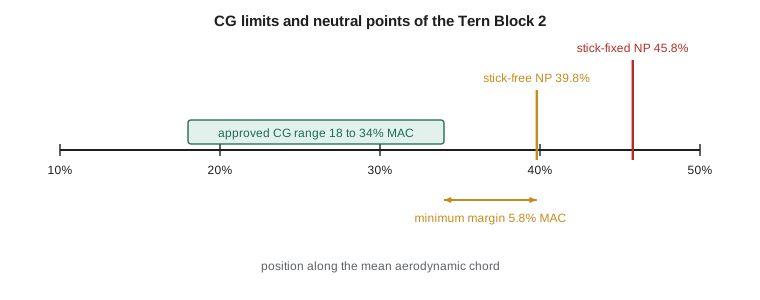
So far the elevator has been assumed locked. In a mechanically controlled aircraft the pilot does not lock the elevator; if the pilot relaxes the grip, the elevator floats to the position where its aerodynamic hinge moment is zero. When the tail's angle of attack rises, the elevator floats trailing edge up, which reduces the tail's lift increment and therefore its stabilizing effect. The aircraft is less stable stick free than stick fixed, and the stick-free neutral point lies ahead of the stick-fixed one.
The size of the effect depends on the hinge moment coefficients. With \(C_{h_\alpha}\) the hinge moment slope with tail angle of attack, \(C_{h_\delta}\) its slope with elevator deflection and \(\tau\) the elevator effectiveness (the change in tail angle of attack equivalent to one unit of elevator), the tail's contribution is multiplied by the free-elevator factor
Both hinge moment slopes are usually negative, so \(F\) is less than one. Aerodynamic balance, a horn or an inset hinge that brings the hinge line closer to the elevator's center of pressure, reduces \(C_{h_\delta}\) and the stick forces but can make \(F\) smaller still. The stick-free margin matters because it governs the stick force the pilot feels, the subject of Lesson 4: if it is negative, the aircraft needs a push force to hold a lower speed and a pull to hold a higher one, the opposite of what pilots expect and what the FAA flight requirements of 14 CFR Part 23, including 23.2135 on controllability and 23.2145 on stability require.
# Neutral points and static margin for the Tern Block 2, stick fixed and stick free,
# then the CG of three loading cases checked against the limits.
a_w, h_ac, dCm_fus = 5.04, 0.25, 0.45
a_t, eta, VH, de_da = 4.10, 0.92, 0.722, 0.45
tail = eta * VH * a_t * (1 - de_da)
hn = h_ac - dCm_fus / a_w + tail / a_w                 # Cm_alpha = 0 here
# stick free: the elevator floats with the tail angle of attack, which weakens the tail
tau, Ch_a, Ch_d = 0.50, -0.10, -0.25                   # elevator effectiveness, hinge moment slopes per rad
F = 1 - tau * Ch_a / Ch_d
hn_free = h_ac - dCm_fus / a_w + F * tail / a_w
print(f"stick-fixed neutral point {100*hn:.1f}% MAC")
print(f"free-elevator factor F = {F:.2f}, stick-free neutral point {100*hn_free:.1f}% MAC")

# CG of the loaded aircraft: mass (kg) and arm (m aft of the datum); MAC leading edge at 7.10 m
LEMAC, c = 7.10, 1.73
empty = (4200, 7.62)
cases = {
    'crew only, full fuel':            [empty, (180, 3.0), (1100, 7.70)],
    'full cabin, front rows first':    [empty, (180, 3.0), (900, 7.70), (800, 5.9), (420, 8.6)],
    'full cabin and aft baggage':      [empty, (180, 3.0), (700, 7.70), (1000, 7.4), (320, 11.8)],
}
lim_fwd, lim_aft = 0.18, 0.34
print("\ncase                              mass kg   CG %MAC   SM fixed  SM free   inside limits?")
for name, items in cases.items():
    m = sum(w for w, x in items); xcg = sum(w * x for w, x in items) / m
    h = (xcg - LEMAC) / c
    ok = 'yes' if lim_fwd <= h <= lim_aft else 'NO'
    print(f"{name:32s}  {m:6.0f}    {100*h:5.1f}     {100*(hn-h):5.1f}     {100*(hn_free-h):5.1f}     {ok}")
print(f"\nat the aft limit ({100*lim_aft:.0f}% MAC) the stick-free margin is {100*(hn_free-lim_aft):.1f}% MAC")stick-fixed neutral point 45.8% MAC free-elevator factor F = 0.80, stick-free neutral point 39.8% MAC case mass kg CG %MAC SM fixed SM free inside limits? crew only, full fuel 5480 22.2 23.6 17.6 yes full cabin, front rows first 6500 14.7 31.1 25.1 NO full cabin and aft baggage 6400 33.1 12.6 6.7 yes at the aft limit (34% MAC) the stick-free margin is 5.8% MAC
The program puts the stick-fixed neutral point at 45.8 percent of the mean chord and, with a free-elevator factor of 0.80, the stick-free neutral point at 39.8 percent. The approved range of 18 to 34 percent therefore leaves a stick-free margin of 5.8 percent at the aft limit, a sensible minimum. The three loading cases show why the loading manual matters. With crew only and full batteries the CG sits comfortably at 22 percent. Filling the front rows first moves it to 14.7 percent, ahead of the forward limit, even though the aircraft is within its maximum take-off mass. Filling the cabin and loading the aft baggage hold moves it to 33.1 percent, inside the aft limit but with only 6.7 percent stick-free margin. A loading manual that tells the operator to fill rows from the back, or to put heavy bags in the forward hold first, keeps every realistic case inside the box.
What sets the forward and aft limits
The aft limit is set by stability and handling: the stick-free margin must stay positive with some allowance for power effects and for the uncertainty in the prediction, and the stick force per g in a pull-up must not become too light. The forward limit is set by control power: at the most forward CG the elevator must still be able to raise the nose for take-off rotation, hold the aircraft at the stall in the landing configuration, and flare with flaps down and power at idle, all with some margin. Lesson 4 calculates the trim elevator angles that show where that runs out. Structural and landing gear limits on how far the CG can move are added, and the published envelope is the area inside all of them.
The CG also moves during a flight. On a fuel-burning aircraft the CG shifts as tanks empty; for the hybrid-electric Tern, whose batteries keep their mass, the shift comes mainly from passengers walking to the lavatory and from the small fuel tank for the range-extender engine. Flight testing checks the margins at the edges of the envelope, not at its middle, and the certification flight test plan includes points at both limits at heavy and light weights.
Finding the neutral point in flight
The predicted neutral point rests on tunnel estimates of downwash, fuselage moments and power effects, each uncertain by several percent. Flight test measures it directly. At each of two or more CG positions the aircraft is trimmed at a series of speeds, and the trim elevator angle is plotted against lift coefficient. Lesson 4 shows that the slope of that line is proportional to the stick-fixed static margin, so it shrinks as the CG moves aft. Plotting the slopes against CG position and extending the line to zero slope gives the measured stick-fixed neutral point. The same method applied to stick force instead of elevator angle gives the stick-free neutral point. In practice the extrapolation must be short, since flying near a neutral point is exactly what the test is meant to avoid, and the test team never deliberately goes beyond the planned aft limit.
Worked problem
Extrapolating flight test slopes
Trim data for the Tern give an elevator gradient of −12.5 degrees per unit lift coefficient at a CG of 18 percent and −5.1 degrees per unit lift coefficient at 34 percent. Estimate the stick-fixed neutral point by straight-line extrapolation.
Show solution
- The gradient changes by \(7.4\) degrees per unit lift coefficient over 16 percent of the chord.
- Zero gradient lies \(12.5/7.4 \times 16 = 27.0\) percent of the chord aft of 18 percent, at about 45.0 percent.
Answer: The extrapolated value is within one percent of the 45.8 percent predicted from the components. The gradient is not exactly linear in CG, because the elevator's own lift changes slightly with trim, so test engineers use three or more CG positions when they can.
| Limit | Set by | Tern Block 2 |
|---|---|---|
| Aft | stick-free static margin, stick force per g, power effects | 34% MAC (5.8% stick-free margin) |
| Forward | elevator power for rotation, stall and flare | 18% MAC |
| Mass | structure and performance | 6500 kg maximum take-off |
Worked problem
Neutral point and margin
An aircraft has \(a_{wb} = 4.8\) per radian, \(h_{ac} = 0.24\), a fuselage contribution of +0.30 per radian, and a tail term \(\eta V_H a_t(1 - d\varepsilon/d\alpha) = 1.40\) per radian. Find the stick-fixed neutral point and the static margin at a CG of 30 percent.
Show solution
- \(h_n = 0.24 - 0.30/4.8 + 1.40/4.8 = 0.24 - 0.0625 + 0.292 = 0.469\).
- \(K_n = 0.469 - 0.30 = 0.169\), or 16.9 percent of the mean chord.
Answer: With a whole-aircraft lift slope of about 5.2 per radian, Cm-alpha is about −0.88 per radian.
Worked problem
Effect of the free elevator
For the same aircraft, \(\tau = 0.45\), \(C_{h_\alpha} = -0.12\) and \(C_{h_\delta} = -0.30\) per radian. Find the stick-free neutral point.
Show solution
- \(F = 1 - 0.45 \times 0.12/0.30 = 0.82\).
- \(h_n' = 0.24 - 0.0625 + 0.82 \times 0.292 = 0.417\).
Answer: Letting the elevator float moves the neutral point forward by about 5 percent of the chord, so the stick-free margin at 30 percent is 11.7 percent.
Common mistakes
MistakeTreating the neutral point as a fixed property of the wing.
InsteadIt depends on the tail, fuselage, downwash and power; it is a property of the whole aircraft.
MistakeSetting the aft CG limit at the stick-fixed neutral point.
InsteadThe stick-free point is further forward and governs the forces the pilot feels.
MistakeForgetting that loading order changes the CG.
InsteadSeating and baggage placement can move the CG outside the limits at legal mass.
MistakeAssuming more static margin is always better.
InsteadLarge margins need large elevator angles and forces and add trim drag.
Summary and key terms
- The neutral point is the CG position where Cm-alpha is zero, the aerodynamic center of the whole aircraft.
- The static margin is the distance from the CG to it, and Cm-alpha equals the lift slope times minus the margin.
- A free elevator floats with the tail angle of attack, reducing the tail's effect and moving the neutral point forward.
- The aft CG limit is set by the stick-free margin and handling; the forward limit by elevator power; and the loading manual must keep real loading cases inside both.
- Neutral point
- The CG position at which the aircraft is neutrally stable in pitch.
- Static margin
- Distance from the CG to the neutral point as a fraction of the mean aerodynamic chord.
- Stick free
- With the elevator free to float to zero hinge moment.
- Free-elevator factor
- F = 1 − τ C_hα/C_hδ, the reduction in tail effectiveness when the elevator floats.
- Hinge moment
- The aerodynamic moment about a control surface hinge line.
- Aerodynamic balance
- Design features that reduce control hinge moments.
Practice problems
Work each problem on paper first, then reveal the answer to check.
What is the static margin if the CG is at 25 percent and the neutral point at 42 percent?
Show answer
17 percent of the mean chord.
Which neutral point is further aft, stick fixed or stick free?
Show answer
Stick fixed.
In the program, raise Ch_a to −0.05. Where is the stick-free neutral point?
Show answer
Further aft, about 42.8 percent, since the elevator floats less.
What sets the forward CG limit?
Show answer
Elevator power for rotation, stall and flare.
Why do fly-by-wire airliners accept small natural margins?
Show answer
The control system provides artificial stability, saving tail size and trim drag.
Why might a legal-mass loading be illegal for CG?
Show answer
Passengers and baggage placed far forward or aft can move the CG outside the limits.
Lesson quiz · 5 questions
Score 60% or more to complete this lesson.
Create a free account to save your progress, take quizzes and earn a certificate.