
AERO-310 · Lesson 5 of 12 · 23 min
Shear flow in closed sections and torsion
A wing must resist twisting as well as bending. The aerodynamic pitching moment, the deflected flaps and ailerons, the nacelles hanging forward and the fuel sitting aft all try to twist it, and if it twists too much the lift distribution changes, the ailerons lose effectiveness and, at high enough speed, the wing can diverge or flutter. A closed box is the answer. Arjun's root summary gives an ultimate torque of 45 kN m, and this lesson shows how the closed Tern box carries it, how much it twists, and how the leading-edge D-cell in front of the main box helps.
Pure torsion of a single closed cell
When a closed thin-walled tube carries a pure torque, with no shear force and no bending, equilibrium of a small piece of wall shows that the shear flow is the same everywhere around the cell, even where the thickness changes. Taking moments of that constant flow about any point gives the Bredt-Batho formula, named after the two engineers who published it independently in the 1890s and early 1900s.
Here \(A\) is the area enclosed by the midline of the wall, not the area of material. This is the key to the strength of closed sections: the torque is carried by a flow that acts at the full lever arm of the section, around a large enclosed area. The twist per unit length follows from the strain energy, or equally from compatibility of the warping displacement around the closed loop.
Compare this with an open section. A steel tube 100 mm across with a 2 mm wall has a torsion constant \(J = 2\pi r^3 t\), about 1.6 × 10⁶ mm⁴. Slit it along its length so it becomes open, and \(J = \sum bt^3/3 = 2\pi r t^3/3\), about 840 mm⁴. The same material is nearly 2000 times stiffer in torsion when the tube is closed. A slit in a fuselage or a wing box, such as a large access door or a landing gear bay, therefore needs careful design to restore the closed load path.
Shear and torsion together
A real wing box carries shear force and torque at the same time. The analysis splits the problem in two. First, cut the box at some point to make it an open section, and calculate the open-section shear flow \(q_b\) for the shear force, exactly as in Lesson 4. Then add an unknown constant flow \(q_{s,0}\) around the whole cell to close it. The unknown is found from one of two conditions: either moments of the total shear flow about any point must equal the moment of the applied loads, or, if the shear load acts through the shear center, the twist of the cell must be zero.
Used the other way round, the same equations locate the shear center of a closed section: apply a shear load, find the shear flows that give zero twist, and take moments to find where their resultant acts. For the Tern box this puts the shear center at about 35 percent of the chord, as the next lesson computes. Any load offset from that point adds torque. Lift, acting near the quarter chord, is ahead of the shear center, so it twists the wing nose up; the pitching moment of the cambered section and of the deflected flaps twists it nose down. The net result at the Tern's root is the 45 kN m in the loads summary.
Multicell boxes
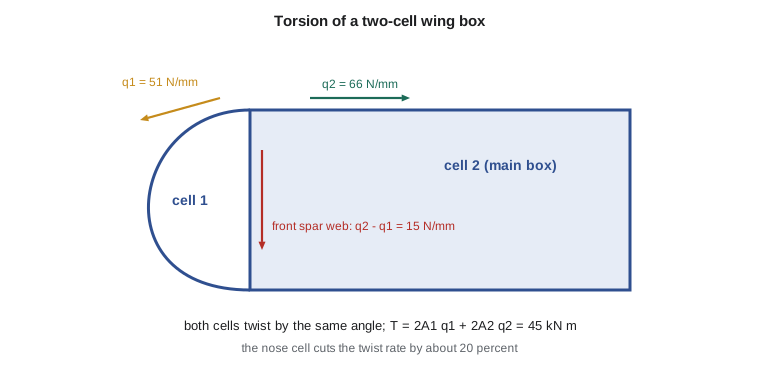
Many wings have more than one cell. The Tern's main box runs between the front spar at 15 percent chord and the rear spar at 60 percent, but the leading-edge skin ahead of the front spar is also a closed D-shaped cell, and some aircraft have three or more spars. In a multicell section, each cell has its own constant shear flow, \(q_1, q_2, \ldots\), and the shared walls carry the difference between the flows of the cells on either side. The unknowns are found from two kinds of equation: the sum of \(2A_i q_i\) must equal the applied torque, and all cells must twist by the same angle, because the ribs hold the cross-section in shape.
The cells share the torque in proportion to their stiffness. A cell with a large enclosed area and a short, thick perimeter takes more; a cell with thin, long walls takes less. A multicell box is statically indeterminate, which is why the compatibility condition of equal twist is needed.
# Torsion of closed thin-walled sections: Bredt-Batho for one cell, then a two-cell wing box
G = 27.0e3                     # MPa, shear modulus of aluminum alloy
T = 45.0e6                     # N mm, ultimate torque at the wing root
# Cell 2: main box 1020 mm wide, spars 304 and 258 mm deep
w, fs, rs = 1020.0, 304.0, 258.0
A2 = w * (fs + rs) / 2
covers = 2 * (w ** 2 + ((fs - rs) / 2) ** 2) ** 0.5
tc, tw = 1.6, 3.0              # actual skin thickness (stringers do not carry shear flow), web thickness, mm
L_over_t_2 = covers / tc + rs / tw
q = T / (2 * A2)
print(f"Single cell: enclosed area {A2/1e6:.3f} m2, shear flow {q:.1f} N/mm")
print(f"   skin shear stress {q/tc:.1f} MPa, web shear stress {q/tw:.1f} MPa")
twist = T / (4 * A2 ** 2 * G) * (L_over_t_2 + fs / tw)
print(f"   twist rate {twist*1000*57.2958:.3f} deg per meter")
# Two cells: nose cell 1 (leading-edge D-cell, area A1, nose skin length Ln) shares the front spar with cell 2
A1, Ln, tn = 0.070e6, 750.0, 1.6
d11 = Ln / tn + fs / tw          # integral of ds/t around cell 1
d22 = L_over_t_2 + fs / tw       # around cell 2
d12 = fs / tw                    # shared wall (front spar web)
# equal twist: (q1 d11 - q2 d12)/(2 A1) = (q2 d22 - q1 d12)/(2 A2), and T = 2 A1 q1 + 2 A2 q2
a11 = d11 / A1 + d12 / A2
a12 = -(d12 / A1 + d22 / A2)
q2 = T / (2 * A2 - 2 * A1 * a12 / a11)
q1 = -a12 / a11 * q2
print(f"\nTwo cells: q1 = {q1:.1f} N/mm (nose), q2 = {q2:.1f} N/mm (box), front spar web carries {q2 - q1:.1f} N/mm")
twist2 = (q2 * d22 - q1 * d12) / (2 * A2 * G)
print(f"   twist rate {twist2*1000*57.2958:.3f} deg per meter, torque check {(2*A1*q1 + 2*A2*q2)/1e6:.2f} kN m")
print(f" adding the nose cell cuts the twist rate by {100*(1 - twist2/twist):.0f} percent")Single cell: enclosed area 0.287 m2, shear flow 78.5 N/mm skin shear stress 49.1 MPa, web shear stress 26.2 MPa twist rate 0.425 deg per meter Two cells: q1 = 50.9 N/mm (nose), q2 = 66.1 N/mm (box), front spar web carries 15.1 N/mm twist rate 0.339 deg per meter, torque check 45.00 kN m adding the nose cell cuts the twist rate by 20 percent
The single main box, enclosing 0.287 square meters, carries the 45 kN m torque with a shear flow of 78.5 N/mm. In the 1.6 mm skins that is 49 MPa of shear stress; in the 3 mm spar webs it is 26 MPa. The twist rate, 0.43 degrees per meter, would add up to a few degrees over the whole span at ultimate load if the torque stayed this large, which it does not, since torque falls toward the tip. Adding the nose cell changes the picture. It encloses only 0.07 square meters but has a short perimeter, so it takes a useful share: 51 N/mm against 66 N/mm in the main box. The front spar web, shared by the two cells, carries only the difference, 15 N/mm. The twist rate falls by 20 percent. This is why designers care about the leading-edge skin even though it carries little bending: as long as it is continuous and attached to the front spar, it is part of the torsion box.
Torsional stiffness and aeroelasticity
Strength is rarely what limits wing torsion design; stiffness is. If a wing is too flexible in torsion, deflecting an aileron twists the wing the other way, reducing and eventually reversing the rolling moment. At a high enough speed a swept-forward or very flexible wing can twist until the aerodynamic moment grows faster than the structure can resist, a static failure called divergence. Flutter, a dynamic coupling of bending and torsion with the air, can destroy a wing in seconds. The rules require that the aircraft be free of these effects with a margin beyond its design dive speed. For a straight, stiff wing like the Tern's they are unlikely to govern, but Marcus's team will still compute the reversal speed and run a flutter analysis, and the torsion constant from this lesson feeds both.
Ribs play an essential role. The thin-walled theory assumes that the cross-section keeps its shape. Without ribs, a box under torque would distort, its corners would rotate and much of the torsional stiffness would be lost. Ribs, spaced about every 500 mm in the Tern, hold the shape, introduce local loads from the flap and aileron hinges and from the landing gear, and break the skin panels into lengths short enough to resist buckling. Their own design, as deep beams with lightening holes, is a topic in the detailed design phase.
Worked problem
Torsion of a rectangular box
A rectangular box 800 mm wide and 240 mm deep has 2 mm covers and 3 mm webs. It carries a torque of 30 kN m. Find the shear flow, the cover shear stress and the twist rate, with G = 27 GPa.
Show solution
- Enclosed area: \(A = 800 \times 240 = 192\,000\) mm².
- \(q = 30 \times 10^6/(2 \times 192\,000) = 78.1\) N/mm; cover stress 39 MPa, web stress 26 MPa.
- \(\oint ds/t = 2 \times 800/2 + 2 \times 240/3 = 800 + 160 = 960\).
- Twist rate: \(30 \times 10^6 \times 960/(4 \times 192\,000^2 \times 27\,000) = 7.2 \times 10^{-6}\) rad/mm, or 0.41 degrees per meter.
Answer: The covers, being thin and long, dominate the integral of ds/t and so set the stiffness. Thickening them would stiffen the box most.
Worked problem
Why a cutout matters
A fuselage section 1.75 m in diameter, with a 1.2 mm skin, carries a torque of 40 kN m. Compare the skin shear stress with the section closed, and the twist with a full-length slit (open).
Show solution
- Closed: \(A = \pi \times 875^2 = 2.41 \times 10^6\) mm²; \(q = 40 \times 10^6/(2 \times 2.41 \times 10^6) = 8.3\) N/mm; \(\tau = 6.9\) MPa.
- Closed \(J = 4A^2 t/(2\pi r) = 2\pi r^3 t = 5.05 \times 10^9\) mm⁴.
- Open \(J = 2\pi r t^3/3 = 3.2 \times 10^3\) mm⁴, more than a million times smaller.
Answer: An open fuselage could not carry torque at all in practice. Doors and large cutouts are surrounded by heavy frames and edge members that carry the loads around the hole.
Common mistakes
MistakeUsing the area of material instead of the enclosed area in Bredt-Batho.
InsteadA is the area enclosed by the wall midline.
MistakeAssuming each cell of a multicell box carries torque in proportion to its area alone.
InsteadSharing depends on the walls too; use equal twist.
MistakeForgetting that shared walls carry the difference of the cell flows.
InsteadA front spar between two cells sees q2 − q1, not either flow alone.
MistakeTreating a box without ribs as able to hold its shape.
InsteadRibs maintain the cross-section; without them torsional stiffness collapses.
Summary and key terms
- A closed cell under pure torque carries a constant shear flow q = T/2A, where A is the enclosed area, and twists at a rate given by T∮ds/t divided by 4A²G.
- Closed sections are vastly stiffer than open ones.
- Combined shear and torsion is handled by cutting the cell, finding open-section flows and adding a constant flow from a moment or zero-twist condition.
- Multicell boxes need equal twist in every cell.
- For the Tern root, the two-cell section carries 45 kN m with 51 and 66 N/mm, and the D-cell cuts the twist rate by 20 percent.
- Torsional stiffness feeds aileron reversal, divergence and flutter checks.
- Bredt-Batho formula
- For a closed thin-walled cell, T = 2Aq.
- Enclosed area
- The area inside the midline of a closed cell.
- Torsion constant
- J, the measure of resistance to twisting; for a closed cell 4A²/∮ds/t.
- Multicell section
- A closed section with more than one cell, such as a box with a leading-edge D-cell.
- Aileron reversal
- The loss and reversal of roll control when wing twist opposes the aileron.
- Divergence
- A static aeroelastic failure in which aerodynamic twisting moment outgrows the structural stiffness.
Practice problems
Work each problem on paper first, then reveal the answer to check.
A cell encloses 0.2 m² and carries 20 kN m. What is q?
Show answer
q = 20 × 10⁶/(2 × 0.2 × 10⁶) = 50 N/mm.
If the skin of that cell is 1.5 mm thick, what is the shear stress?
Show answer
50/1.5 = 33 MPa.
Doubling the enclosed area of a cell changes its torsional stiffness by what factor, perimeter and thickness unchanged?
Show answer
Four times, since J ∝ A².
In the program, remove the nose cell by setting A1 to a very small value. What happens?
Show answer
The result tends to the single-cell values.
Why does the front spar web carry less torsional shear in the two-cell model?
Show answer
It is shared, so it carries only the difference of the two cell flows.
Name two aeroelastic effects that depend on wing torsional stiffness.
Show answer
Aileron reversal and divergence (and flutter).
Lesson quiz · 5 questions
Score 60% or more to complete this lesson.
Create a free account to save your progress, take quizzes and earn a certificate.