
ACCT-431 · Lesson 6 of 12 · 27 min
Integrated audits of internal control over financial reporting
ACCT-331 explained how auditors understand internal control and decide whether to rely on controls when testing the financial statements. This lesson goes further, to engagements and regimes in which internal control over financial reporting (ICFR) is itself the subject of reporting: management's certification or assessment of its controls, the auditor's tests of controls at the depth needed to support an opinion on them, and the evaluation of control deficiencies. The regimes differ sharply between Canada and the United States, but the auditor's techniques for testing controls and evaluating deficiencies are largely shared.
The reporting regimes
Section 404 of the Sarbanes-Oxley Act of 2002 requires management of an issuer to assess and report on the effectiveness of ICFR each year (Section 404(a)). For accelerated and large accelerated filers, Section 404(b) also requires the auditor to attest to ICFR. Tamarack is an accelerated filer, so Hollis Ward performs an integrated audit under PCAOB AS 2201, An Audit of Internal Control Over Financial Reporting That Is Integrated with An Audit of Financial Statements, and issues an opinion on ICFR as well as on the financial statements. Non-accelerated filers, including most smaller reporting companies, are exempt from 404(b) and provide only management's assessment. Private companies have no equivalent requirement, though under AU-C 940 an auditor may be engaged to report on a private entity's ICFR integrated with the financial statement audit.
| Canada (reporting issuer) | United States (accelerated filer) | |
|---|---|---|
| Management | CEO and CFO certify design and, for non-venture issuers, evaluate effectiveness of ICFR (NI 52-109) | Management assesses and reports on effectiveness of ICFR (SOX 404(a)) |
| Auditor | No auditor report on ICFR required; tests controls as needed for the financial statement audit | Opinion on ICFR integrated with the financial statement audit (SOX 404(b), AS 2201) |
| Framework commonly used | COSO 2013 Internal Control-Integrated Framework | COSO 2013 Internal Control-Integrated Framework |
| Public disclosure of material weaknesses | In the MD&A, with a description and remediation plans | In management's report and the auditor's adverse ICFR opinion |
Both regimes rely on a suitable framework, and in practice nearly all issuers in both countries use the COSO 2013 Internal Control-Integrated Framework, with its five components (control environment, risk assessment, control activities, information and communication, and monitoring activities) and 17 principles. Management's evaluation, and the auditor's, consider whether each principle is present and functioning.
A top-down, risk-based approach
An integrated audit or a thorough management evaluation does not test every control. It uses a top-down approach: start with the financial statements and the risks of material misstatement; identify entity-level controls, such as the control environment, the CFO's monthly results review and the period-end financial reporting process; then identify significant accounts and disclosures and their relevant assertions; understand the likely sources of misstatement through walkthroughs; and select the controls that address the risks for testing. The emphasis is on controls that matter, which often means fewer controls tested more thoroughly.
Walkthroughs follow a transaction from origination through the company's processes and systems until it is reflected in the financial records, using inquiry, observation, inspection and reperformance. They confirm the understanding of the flow, identify points where a misstatement could occur, and evaluate the design of controls at those points. For Tamarack, walkthroughs of revenue, trade promotions, purchasing, payroll, inventory and the financial close each identify key controls, which are then tested for operating effectiveness.
Testing operating effectiveness
Tests of operating effectiveness evaluate whether a control operated as designed and whether the person performing it had the necessary authority and competence. The amount of evidence needed depends on the risk associated with the control: the nature and materiality of the misstatements it prevents or detects, whether it is manual or automated, its complexity, the judgment involved, and the results of prior tests. A manual control performed many times a day requires a larger sample than a quarterly review; an automated control may need only one test, combined with effective ITGCs.
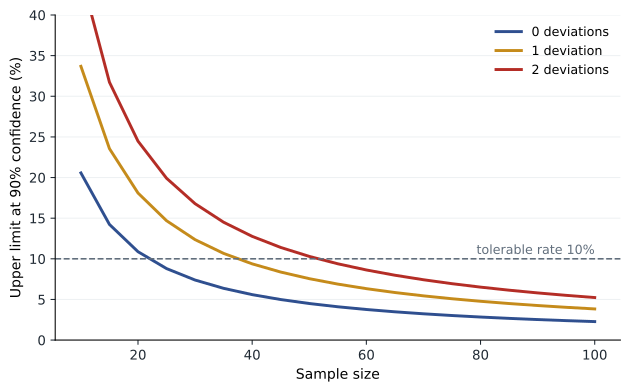
Firms translate these principles into methodology tables that set minimum sample sizes by control frequency. The program shows a typical table and then evaluates a sample of the three-way match control, performed many times a day, using a binomial upper limit on the deviation rate.
# Tests of controls: sample sizes by control frequency and evaluation of deviations.
# The frequency table is a typical firm methodology (illustrative, not taken from a standard).
import math

frequency_table = {"Annual": 1, "Quarterly": 2, "Monthly": 2, "Weekly": 5, "Daily": 20, "Many times a day": 25}
print("Minimum sample sizes for a control relied on, lower risk of failure:")
for f, n in frequency_table.items():
    print(f"  {f:<18}{n:>3}")

def upper_deviation_rate(n, k, conf=0.90):
    """Smallest p with P(X <= k | n, p) <= 1 - conf (one-sided binomial upper limit)."""
    lo, hi = 0.0, 1.0
    for _ in range(60):
        p = (lo + hi) / 2
        cdf = sum(math.comb(n, i) * p**i * (1 - p)**(n - i) for i in range(k + 1))
        lo, hi = (p, hi) if cdf > 1 - conf else (lo, p)
    return hi

tolerable = 0.10
print("\nThree-way match control (many times a day), tolerable rate 10%, 90% confidence:")
for n, k in [(25, 0), (25, 1), (40, 1), (60, 2)]:
    u = upper_deviation_rate(n, k)
    verdict = "supports reliance" if u <= tolerable else "does not support reliance"
print(f" n={n:>2} deviations={k}: upper limit {u:5.1%} {verdict}")Minimum sample sizes for a control relied on, lower risk of failure: Annual 1 Quarterly 2 Monthly 2 Weekly 5 Daily 20 Many times a day 25 Three-way match control (many times a day), tolerable rate 10%, 90% confidence: n=25 deviations=0: upper limit 8.8% supports reliance n=25 deviations=1: upper limit 14.7% does not support reliance n=40 deviations=1: upper limit 9.4% supports reliance n=60 deviations=2: upper limit 8.6% supports reliance
With 25 items and no deviations, the team can say with 90 percent confidence that the deviation rate does not exceed about 8.8 percent, within a tolerable rate of 10 percent, so the sample supports reliance. One deviation in 25 pushes the upper limit to 14.7 percent and does not; the team could extend the sample to 40, and if no more deviations are found, the upper limit of 9.4 percent again supports reliance. Many firms' methodologies do not allow sample extension for manual controls once a deviation is found unless the deviation is understood, isolated and explained; a deviation caused by a systematic flaw, such as a clerk who never performs the match for small invoices, is a control failure regardless of sample size. The confidence levels and tolerable rates here are illustrative; each firm sets its own.
Timing matters too. Tests performed at an interim date need roll-forward evidence for the remaining period, by inquiry, observation and further testing. Controls that operate only at year end, such as the period-end close, can only be tested then. And for an opinion on ICFR as of the year end, controls must be effective at that date; a control remediated in November can support a year-end conclusion if it operated for long enough to test.
Evaluating deficiencies
A control deficiency exists when the design or operation of a control does not allow management or employees, in the normal course of performing their functions, to prevent, or detect and correct, misstatements on a timely basis. Deficiencies are evaluated for severity.
| Category | Definition |
|---|---|
| Deficiency | A control does not allow timely prevention or detection and correction of misstatements |
| Significant deficiency | A deficiency, or combination, that is less severe than a material weakness yet important enough to merit attention by those responsible for oversight of financial reporting |
| Material weakness | A deficiency, or combination, such that there is a reasonable possibility that a material misstatement of the annual or interim financial statements will not be prevented, or detected and corrected, on a timely basis |
Severity depends on two factors: whether there is a reasonable possibility that the control will fail to prevent or detect a misstatement, and the magnitude of the potential misstatement, not the misstatement actually found. A deficiency can be a material weakness even if no misstatement occurred. Compensating controls that operate at a level of precision sufficient to prevent or detect a material misstatement can reduce severity. Indicators of a material weakness include fraud by senior management, a restatement to correct a material misstatement, a material misstatement identified by the auditor that the controls did not catch, and ineffective oversight by the audit committee.
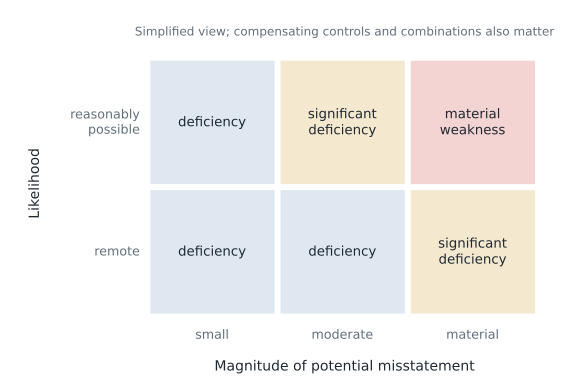
The program applies a simplified version of this reasoning to the deficiencies identified so far in the Tamarack audit, using group materiality of 1.4 million. The thresholds in the code are a teaching device; in practice the evaluation involves judgment about likelihood, magnitude, compensating controls and qualitative factors, and is documented deficiency by deficiency.
# Evaluating control deficiencies at the year end (illustrative logic, thousands of dollars).
materiality = 1_400
deficiencies = [
    # name, potential misstatement if the control fails, reasonably possible?, compensating control?, account
    ("Pay rates not compared to master file (2 deviations)", 260, True, True, "Payroll expense"),
    ("Terminated ERP user still active and used access", 900, True, False, "Journal entries"),
    ("No monthly payroll clearing reconciliation", 1_150, True, False, "Accrued payroll"),
    ("Inventory count instructions not signed", 40, False, True, "Inventory"),
    ("Management review of impairment model lacks precision", 3_800, True, False, "Goodwill"),
]
def classify(amount, possible, compensating):
    if possible and amount >= materiality and not compensating:
        return "material weakness"
    if possible and amount >= 0.5 * materiality and not compensating:
        return "significant deficiency"
    return "deficiency"
for name, amt, poss, comp, acct in deficiencies:
    print(f"{classify(amt, poss, comp):<23}{amt:>6,}  {acct:<16}{name}")
print("\nNext: consider whether deficiencies affecting the same accounts combine into a more severe one.")deficiency 260 Payroll expense Pay rates not compared to master file (2 deviations) significant deficiency 900 Journal entries Terminated ERP user still active and used access significant deficiency 1,150 Accrued payroll No monthly payroll clearing reconciliation deficiency 40 Inventory Inventory count instructions not signed material weakness 3,800 Goodwill Management review of impairment model lacks precision Next: consider whether deficiencies affecting the same accounts combine into a more severe one.
The pay rate deviations at the payroll provider, from lesson 5, are a deficiency: the potential misstatement is small and Tamarack's own reviews partly compensate. The terminated user who retained access, from lesson 4, and the missing payroll clearing reconciliation are significant deficiencies under these assumptions. The weakness in management's review of the goodwill impairment model is assessed as a material weakness: the potential misstatement, 3.8 million, exceeds materiality, there is a reasonable possibility that the review would not detect an error in the discount rate or cash flow assumptions, and no other control compensates. The team also considers whether deficiencies in combination are more severe, for example several weaknesses in access and journal entry controls that together could allow an unauthorized entry to go undetected.
For Tamarack in the United States, a material weakness at year end means management must conclude that ICFR is not effective, and Hollis Ward must issue an adverse opinion on ICFR. The financial statement opinion can still be unmodified if substantive procedures, expanded in response, provide sufficient evidence; the auditor's ICFR report describes the material weakness. Significant deficiencies are communicated in writing to the audit committee but are not publicly reported. The team also considers whether the goodwill evaluation is a critical audit matter, discussed in lesson 8.
Remediation and the period-end close
Management usually tries to remediate deficiencies before the year end. For the goodwill review, Tamarack hires a valuation adviser and redesigns the review so that the CFO compares each key assumption with external data and documents the comparison. If the redesigned control operates for a sufficient period before year end and the team tests it, the material weakness may be remediated as of the year end; if it is implemented only in the last weeks, there may not be enough instances to test, and the weakness would still be reported.
The financial close and reporting process deserves particular attention in both regimes. It includes the procedures for entering transaction totals into the general ledger, selecting accounting policies, initiating and recording journal entries, recording recurring and non-recurring adjustments, and preparing the financial statements and disclosures. Many material weaknesses relate to this process, especially in smaller companies with few accounting staff, where segregation of duties is hard to achieve and complex transactions are handled infrequently.
Worked problem
Judging severity
A Tamarack controller can post and approve her own journal entries (from the access review). The monthly CFO review of results by component looks at variances above 2 million dollars. Group materiality is 1.4 million. How severe is the deficiency?
Show solution
- There is a reasonable possibility that an erroneous or unauthorized entry posted and approved by the same person would not be detected by journal entry controls.
- The CFO review is not precise enough to compensate for misstatements below 2 million, which exceeds materiality.
- The potential misstatement depends on the accounts the controller can post to and their size; if unlimited, it could exceed materiality.
- Unless another precise control compensates, the deficiency is at least significant and may be a material weakness, especially combined with other access deficiencies.
Answer: At least a significant deficiency; a material weakness if no precise compensating control exists and the potential misstatement is material.
Common mistakes
MistakeJudging severity by the misstatement actually found.
InsteadConsider the potential magnitude and the likelihood of failure, even if no misstatement occurred.
MistakeTesting every control in every process.
InsteadUse a top-down, risk-based approach that focuses on controls addressing the risks of material misstatement.
MistakeExtending a sample automatically after a deviation in a manual control.
InsteadUnderstand the cause first; a systematic deviation is a control failure regardless of sample size.
MistakeRelying on a compensating control without considering its precision.
InsteadOnly controls precise enough to detect a material misstatement reduce severity.
MistakeTreating a control remediated in the last week as effective at year end.
InsteadIt must operate long enough to be tested; otherwise the deficiency remains.
MistakeAssuming every issuer receives an auditor's opinion on ICFR.
InsteadNon-accelerated filers are exempt from Section 404(b) and receive no auditor attestation.
Summary and key terms
- In the US, SOX 404(a) requires management's assessment and 404(b) an auditor's opinion for accelerated filers.
- COSO 2013, with five components and 17 principles, is the usual framework.
- A top-down approach starts with risks and entity-level controls, then selects key controls for testing.
- Walkthroughs confirm transaction flows and the design of controls.
- Sample sizes depend on control frequency and risk; automated controls rely on effective ITGCs.
- Severity depends on the likelihood of failure and the magnitude of potential misstatement.
- Significant deficiencies and material weaknesses are communicated in writing to those charged with governance.
- The financial close process is a frequent source of material weaknesses.
- Integrated audit
- An audit of ICFR performed together with the financial statement audit under AS 2201.
- Internal control over financial reporting
- A process designed to provide reasonable assurance about the reliability of financial reporting.
- Walkthrough
- Following a transaction through processes and systems to confirm understanding and evaluate control design.
- Key control
- A control selected for testing because it addresses a risk of material misstatement.
- Control deficiency
- A control that does not allow timely prevention or detection and correction of misstatements.
- Significant deficiency
- A deficiency less severe than a material weakness but important enough to merit attention by those overseeing financial reporting.
- Material weakness
- A deficiency with a reasonable possibility that a material misstatement will not be prevented or detected on a timely basis.
- Compensating control
- A control that reduces the risk addressed by a deficient control.
- Entity-level control
- A control with a pervasive effect, such as the control environment or a results review.
Practice problems
Work each problem on paper first, then reveal the answer to check.
Why does Tamarack receive an opinion on ICFR?
Show answer
Because it is an accelerated filer subject to SOX 404(b).
What does a top-down approach start with?
Show answer
The financial statements, the risks of material misstatement and entity-level controls.
With 25 items and one deviation, does the three-way match support reliance at a 10% tolerable rate?
Show answer
No; the 90% upper limit is about 14.7%.
Change the tolerable rate to 15% in the program. Which samples now support reliance?
Show answer
All four, since every upper limit is at or below 14.7%.
What two factors determine the severity of a deficiency?
Show answer
The likelihood that the control fails to prevent or detect a misstatement, and the potential magnitude.
Why is the goodwill review deficiency a material weakness in the program?
Show answer
Its potential misstatement exceeds materiality, failure is reasonably possible, and no control compensates.
Give two indicators of a material weakness.
Show answer
Fraud by senior management; a restatement; a material misstatement not caught by controls; ineffective audit committee oversight.
Can a deficiency be a material weakness if no misstatement occurred?
Show answer
Yes; severity depends on potential, not actual, misstatement.
Why does the financial close process often contain material weaknesses?
Show answer
It involves manual, judgmental entries by few people, with limited segregation and infrequent complex transactions.
What is needed before a remediated control can be considered effective at year end?
Show answer
It must have operated for enough instances and time to be tested.
Lesson quiz · 5 questions
Score 60% or more to complete this lesson.
Create a free account to save your progress, take quizzes and earn a certificate.