
ACCT-431 · Lesson 2 of 12 · 29 min
Group audits I: scope, components and materiality
Most listed companies, and many private ones, report consolidated financial statements that combine a parent with subsidiaries, joint arrangements, branches and investees, often in several countries. The auditor of those group financial statements cannot usually examine every transaction at every location, and frequently relies on other auditors who know the local language, law and accounting. Group audits are among the most heavily inspected areas of practice, because failures at a distant component, from inventory that did not exist to revenue that was invented, have caused some of the largest restatements. This lesson covers how the group auditor understands the group, decides what components are and where work will be done, and sets materiality for the group and its components. Lesson 3 continues with component auditors, consolidation and reporting.
The standards and when they apply
Two sets of standards apply in the United States. Tamarack is an issuer, so its audit follows PCAOB standards: AS 2101, Audit Planning, and AS 1201, Supervision of the Audit Engagement, as amended for audits involving other auditors, together with AS 1206, Dividing Responsibility for the Audit with Another Accounting Firm. Those amendments apply to audits of fiscal years ending on or after December 15, 2024. Audits of private groups follow the AICPA's SAS 149, Special Considerations: Audits of Group Financial Statements (Including the Work of Component Auditors and Audits of Referred-to Auditors), which amends AU-C 600 and applies to audits of periods ending on or after December 15, 2026. SAS 149 is closely based on the IAASB's revised ISA 600, so its risk-based concepts match those in this lesson; the PCAOB standards use different terms, other auditors rather than component auditors, but impose similar responsibilities for planning and supervision.
Group audit standards also apply when a single company has branches or divisions whose information is audited separately, or when the auditor uses another firm to perform procedures at a location. The essential feature is that the auditor of the group financial statements must plan, direct, supervise and review work that others perform on parts of the group, and must take responsibility for the opinion on the whole.
Key terms
| Term | Meaning |
|---|---|
| Group | All the entities and business units whose financial information is included in the group financial statements |
| Group financial statements | Financial statements that include the financial information of more than one entity or business unit through a consolidation process |
| Component | An entity, business unit, function or business activity, or some combination, determined by the group auditor for planning and performing audit procedures |
| Group engagement team | The partner and staff who direct the group audit, including component auditors under the revised standards |
| Component auditor | An auditor who performs audit work related to a component for the group audit |
| Component performance materiality | An amount set by the group engagement team, lower than group performance materiality, to reduce aggregation risk |
| Aggregation risk | The probability that uncorrected and undetected misstatements, in total, exceed materiality for the group financial statements |
One change in the revised standards is easy to miss. A component is no longer simply a legal entity. The group engagement team decides how to divide the group for audit purposes. A shared service center that processes payables for every subsidiary can be a component; so can a single business activity such as a group-wide revenue stream, or a combination of entities that share systems and management. The question is how to plan work so that it responds to the risks, not how the group happens to be organized legally.
Understanding the group
Before scoping, the group engagement team must understand the group, its environment and its consolidation process well enough to identify and assess the risks of material misstatement in the group financial statements. For Tamarack Foods Group Inc., the team documents the following points from meetings with group management, the prior-year file and a walkthrough of the consolidation.
| Area | What the team learned |
|---|---|
| Structure | Parent manufacturing operations; a wholly owned distribution subsidiary; a wholly owned Mexican manufacturing subsidiary; a small snack-brand subsidiary acquired in 2024; a 30% equity-method investment in a cold-storage business |
| Systems | Parent, distribution and snacks share one cloud ERP and a shared service center for payables, payroll and treasury; Mexico runs a local ERP and reports monthly through a consolidation package |
| Group-wide controls | Monthly results review by the CFO, a group accounting manual, and quarterly certifications by subsidiary controllers |
| Consolidation | Performed in a consolidation application at head office; eliminations of intercompany sales, balances and profit in inventory; translation of the Mexican subsidiary |
| Accounting framework | Mexico keeps its local books under Mexican Financial Reporting Standards; head office converts to the group framework |
| Significant risks | Revenue cut-off around trade promotions; goodwill impairment for the snacks business; inventory valuation for expiring stock; management override |
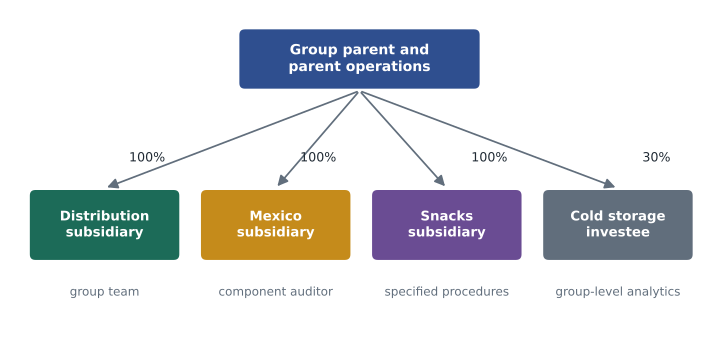
The understanding drives scoping. Because the shared service center processes payables, payroll and treasury for three of the four operating components, the team can test those processes once, centrally, rather than at each entity. Because Mexico runs separate systems and books under a different framework, work there needs local knowledge and a careful look at the conversion adjustments. Because the cold-storage investee is accounted for by the equity method, the team needs evidence about Tamarack's share of its results and the carrying amount of the investment, but not about its individual transactions.
Deciding where work is performed
Under the older standard, auditors identified significant components, usually those exceeding a percentage of a benchmark such as 15 percent of group revenue or profit, and audited them fully. Everything else received analytical procedures at group level. The revised standards drop the mechanical test. The group engagement team determines the components at which audit work will be performed, and the nature and extent of that work, in response to the assessed risks of material misstatement of the group financial statements. Work can be: an audit of the component's financial information; audit procedures on specific accounts, classes of transactions or disclosures; specified procedures; or analytical procedures at group level.
Size still matters, because a large component usually contributes a large share of the risks; but it is no longer the only factor. A small component that holds the group's derivatives, or that has a history of errors, may need focused procedures even though it falls below any size threshold. Conversely, a large component with simple, stable operations whose transactions run through centralized, well-controlled processes may be covered largely by testing those processes at the center. For Tamarack, the team plans full audits of parent operations, distribution and Mexico, specified procedures on inventory and revenue at the snacks subsidiary, and analytical procedures on the equity-method investee, supported by the investee's audited financial statements. Lesson 12 shows that this plan covers 94 percent of group revenue and pre-tax income with full audits.
Coverage percentages are a useful cross-check, not the objective. The standard asks whether the work, taken together, provides sufficient appropriate evidence on the group financial statements. A plan that covers 95 percent of revenue but leaves an untested significant risk, such as the goodwill attached to the snacks business, does not meet that test.
Group materiality and component performance materiality
Group materiality is set exactly as in ACCT-331: a benchmark, usually pre-tax income for a profit-oriented entity, multiplied by a percentage based on judgment. For Tamarack, the team uses 5 percent of pre-tax income of 28.0 million, giving materiality of 1.4 million, performance materiality at 75 percent, or 1.05 million, and a clearly trivial threshold of 70,000 dollars.
Where components are audited separately, each component's work is planned with a lower amount, component performance materiality. The reason is aggregation risk. If each component auditor tested to group performance materiality, misstatements that are individually below that amount could, in total across the components, exceed group materiality without anyone noticing. Component performance materiality must therefore be lower than group performance materiality, and the group engagement team sets it, using judgment about the component's size and risk and the number of components. The sum of component amounts may exceed group performance materiality, because it is unlikely that every component will have undetected misstatements at the maximum level, and all in the same direction.
The program below compares three ways of setting component amounts. The proportional method divides group performance materiality in proportion to each component's share of pre-tax income. A square-root weighting is a common practical approach that gives smaller components relatively more. The judgment band applies percentages the Tamarack team chose for each component, between 40 and 80 percent of group performance materiality. The program then simulates aggregation risk under an illustrative assumption about how much misstatement is left undetected in each component.
# Group materiality and component performance materiality for the group audit (invented figures,
# thousands of dollars). Three common ways of setting component amounts are compared.
import math, random

group_pretax = 28_000
group_mat = 0.05 * group_pretax          # 5% of pre-tax income
group_pm = 0.75 * group_mat              # performance materiality
trivial = 0.05 * group_mat
print(f"Group materiality {group_mat:,.0f}  performance materiality {group_pm:,.0f}  clearly trivial {trivial:,.0f}\n")

components = {          # pre-tax income contribution
    "Parent operations": 14_600,
    "Distribution": 7_600,
    "Mexico": 4_100,
    "Snacks": 1_100,
}
total = sum(components.values())
sqrt_total = sum(math.sqrt(v) for v in components.values())
band = {"Parent operations": 0.80, "Distribution": 0.65, "Mexico": 0.55, "Snacks": 0.40}  # team judgment

rows = {}
print(f"{'Component':<18}{'Share':>7}{'Proportional':>14}{'Square root':>13}{'Judgment band':>15}")
for name, v in components.items():
    prop = group_pm * v / total
    sq = min(group_pm * 0.9, group_pm * math.sqrt(v) / sqrt_total * 2)   # capped below group PM
    jb = group_pm * band[name]
    rows[name] = (prop, sq, jb)
    print(f"{name:<18}{v/total:>7.1%}{prop:>14,.0f}{sq:>13,.0f}{jb:>15,.0f}")
for i, label in enumerate(["Proportional", "Square root", "Judgment band"]):
    print(f"Sum of component amounts, {label.lower()}: {sum(r[i] for r in rows.values()):,.0f}")

# Aggregation risk, simulated: assume undetected misstatement left in each component averages a
# quarter of its performance materiality (an illustrative assumption, exponential distribution).
random.seed(431)
def aggregation_risk(i, trials=20_000):
    over = 0
    for _ in range(trials):
        total_left = sum(random.expovariate(1 / (0.25 * r[i])) for r in rows.values())
        over += total_left > group_mat
    return over / trials
print("\nSimulated probability that undetected misstatement exceeds group materiality:")
for i, label in enumerate(["Proportional", "Square root", "Judgment band"]):
print(f" {label:<14}{aggregation_risk(i):6.1%}")Group materiality 1,400 performance materiality 1,050 clearly trivial 70 Component Share Proportional Square root Judgment band Parent operations 53.3% 559 831 840 Distribution 27.7% 291 600 682 Mexico 15.0% 157 441 578 Snacks 4.0% 42 228 420 Sum of component amounts, proportional: 1,050 Sum of component amounts, square root: 2,100 Sum of component amounts, judgment band: 2,520 Simulated probability that undetected misstatement exceeds group materiality: Proportional 0.0% Square root 0.9% Judgment band 2.6%
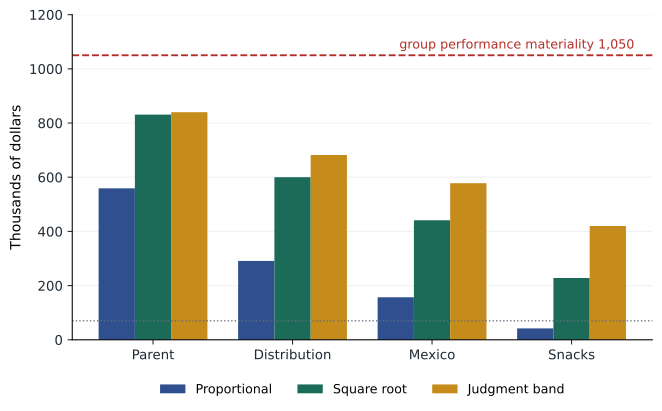
The proportional method produces very low amounts for small components, such as 42,000 dollars for snacks, barely above the clearly trivial threshold. Such low amounts would force excessive work and, as the simulation shows, reduce aggregation risk far below what is needed. The square-root and judgment-band methods give each component a workable amount while keeping the simulated probability that undetected misstatements exceed group materiality low, about 1 to 3 percent under these assumptions. The simulation is a teaching device: real assumptions about undetected misstatement are uncertain, and the standards require judgment rather than a formula. What the exercise shows is why the sum of component amounts may exceed group performance materiality without creating unacceptable aggregation risk, provided no single component's amount approaches group performance materiality.
The group engagement team also communicates to component auditors the threshold above which misstatements must be reported back, usually the group's clearly trivial amount, 70,000 dollars for Tamarack. If a component is subject to a statutory audit with its own, possibly higher, local materiality, the group team must still require the component auditor to work to the component performance materiality set for the group audit.
Acceptance and access
Before accepting or continuing a group audit, the engagement partner must determine whether the group engagement team can reasonably expect to obtain sufficient appropriate evidence, including access to component information, management and component auditors. Restrictions can come from group management, from laws in another country, or from war or sanctions. If access to a material component is restricted and cannot be overcome, the result is a scope limitation and possibly a disclaimer of opinion. For Tamarack's Mexican subsidiary, local law does not restrict sharing of audit documentation with the group auditor, but the team confirms in writing with the Mexican firm that working papers can be made available for review.
Access is also a regulatory question. The PCAOB requires lead auditors to disclose on Form AP the names and locations of other firms that performed 5 percent or more of total audit hours, and the PCAOB inspects foreign firms that play a substantial role in issuer audits. Hollis Ward includes the right to provide the Mexican firm's working papers to regulators in its engagement letter.
Group-wide controls and centralized processes
Group-wide controls, such as the CFO's monthly review of results by component, a group accounting manual and quarterly certifications, can reduce the risk of material misstatement at components, but only if they are designed with enough precision and operate effectively. A monthly results review that looks only at variances above 2 million dollars will not detect a 600,000-dollar error at the snacks subsidiary. The group engagement team evaluates these controls in the same way as any other controls, and tests them where it plans to rely on them.
Centralized processes deserve special attention. The shared service center at head office handles payables, payroll and cash for three components. Testing those processes once, at the center, can provide evidence for all three, avoiding duplicated work. The team must still confirm that the processes operate the same way for each component, for example that the snacks subsidiary's payroll really runs through the same system and controls rather than a local spreadsheet.
Worked problem
Component performance materiality
The Tamarack team considers adding a fifth component, a new 2027 acquisition with pre-tax income of 2.0 million. Using the square-root approach in the program, what would happen to the existing components' amounts and why?
Show solution
- The square-root total rises because a new component is added.
- Each existing component's share of the total falls, so its square-root amount decreases slightly.
- With more components, aggregation risk rises, so lower component amounts are appropriate.
- The team would still check that no component amount approaches group performance materiality.
Answer: Existing amounts fall slightly; more components mean more opportunities for undetected misstatements to add up.
Common mistakes
MistakeTreating every legal entity as a component and every large entity as a full-scope audit.
InsteadDetermine components and the work at each in response to the assessed risks of the group financial statements.
MistakeLetting component auditors use their local statutory materiality for the group audit.
InsteadRequire work to the component performance materiality set by the group engagement team.
MistakeAllocating group performance materiality proportionally to all components.
InsteadUse judgment so small components receive workable amounts, while keeping aggregation risk low.
MistakeRelying on group-wide controls that are not precise enough.
InsteadEvaluate and test the precision of controls such as results reviews before relying on them.
MistakeAssuming the shared service center processes every component the same way.
InsteadConfirm that each component's transactions actually run through the centralized processes.
MistakeAccepting a group audit without confirming access to a material foreign component.
InsteadDetermine before acceptance whether access to information, management and component auditors is available.
Summary and key terms
- PCAOB AS 2101, AS 1201 and AS 1206 govern issuer group audits; SAS 149 applies to private group audits for periods ending on or after December 15, 2026.
- A component is defined by the auditor for planning purposes and can be an entity, unit, function or activity.
- Understanding the group, its systems and its consolidation process drives the scoping decision.
- Work at components can be a full audit, procedures on specific items, specified procedures or group-level analytics.
- Group materiality for Tamarack is 1.4 million, performance materiality 1.05 million, and clearly trivial 70,000.
- Component performance materiality is lower than group performance materiality to address aggregation risk.
- The sum of component amounts may exceed group performance materiality.
- Access to components and component auditors must be confirmed before accepting the engagement.
- Group audit
- An audit of financial statements that include the financial information of more than one entity or business unit.
- Component
- A part of the group determined by the auditor for planning and performing procedures.
- Component auditor
- An auditor who performs work on a component for the group audit.
- Group engagement partner
- The partner responsible for the group audit and the auditor's report on the group statements.
- Aggregation risk
- The probability that uncorrected and undetected misstatements, in total, exceed group materiality.
- Component performance materiality
- An amount below group performance materiality used for work at a component.
- Group-wide control
- A control operated across the group, such as a centralized results review.
- Scoping
- Deciding at which components work is performed, and its nature and extent.
Practice problems
Work each problem on paper first, then reveal the answer to check.
Why did the revised standards drop the significant component test?
Show answer
To replace a size-based rule with scoping driven by the risks of material misstatement of the group financial statements.
What is aggregation risk?
Show answer
The risk that undetected and uncorrected misstatements across components add up to more than group materiality.
Compute Tamarack's group materiality, performance materiality and clearly trivial threshold.
Show answer
1.4 million, 1.05 million and 70,000 dollars.
Change the judgment band for snacks to 0.20 in the program. What happens to aggregation risk?
Show answer
It falls slightly, because the snacks component's amount and its share of possible undetected misstatement drop.
Why can the sum of component performance materiality exceed group performance materiality?
Show answer
Because it is unlikely that all components will have maximum undetected misstatements in the same direction.
Give an example of a component that is not a legal entity.
Show answer
A shared service center processing payables for several subsidiaries.
How should the cold-storage investee be addressed?
Show answer
Evidence on Tamarack's share of results and carrying amount, for example from the investee's audited statements and analytical procedures.
What should happen if access to a material component is restricted?
Show answer
Try to overcome it; if not possible, it is a scope limitation that may lead to a modified opinion or disclaimer, and may affect acceptance.
Why does a 2-million-dollar threshold in a group results review matter?
Show answer
It is not precise enough to detect smaller errors at components, so the team cannot rely on it alone for them.
What threshold should component auditors use to report misstatements to the group team?
Show answer
The group's clearly trivial threshold, 70,000 dollars for Tamarack.
Lesson quiz · 5 questions
Score 60% or more to complete this lesson.
Create a free account to save your progress, take quizzes and earn a certificate.