
WLD-220 · Lesson 6 of 12 · 17 min
Fillet weld symbols
Most welds in a fabrication shop are fillet welds, and most welding symbols on a structural drawing are fillet symbols. They look simple, a small right triangle on a reference line with a number or two beside it, but each part of the symbol carries a specific instruction, and the differences between a continuous weld, a chain intermittent weld and a staggered intermittent weld, or between a leg size and a throat size, decide whether the joint carries its load. This lesson goes through the fillet symbol in detail: the triangle and which way it faces, the size, the length and pitch, unequal legs, intermittent welds on one and both sides, and the effective throat that the size really stands for.
The fillet weld symbol
The fillet weld symbol is a right triangle sitting on the reference line, with its vertical leg always drawn on the left, whichever way the arrow points. Below the line it means a fillet on the arrow side; above the line, a fillet on the other side; on both sides, fillets on both sides of the joint. The vertical leg is always on the left so that symbols look the same whatever the drafter's habits, and it has nothing to do with which member is vertical in the real joint.
A fillet symbol with no dimensions means a fillet weld of the size given in the general notes, or in the specification, for the full length of the joint. On Hartwell's drawings, note 4 sets that default. A symbol with dimensions overrides it.
Size
The size of a fillet weld is written to the left of the triangle. For an equal-leg fillet, the size is the leg length: the distance from the root of the joint to the toe of the weld on each member. A 6 to the left of the triangle means a fillet with legs of 6 mm. The size is the minimum leg, measured as the largest right isosceles triangle that fits inside the weld cross-section. A convex weld with extra reinforcement is still only as big as the triangle that fits inside it.
When there are fillets on both sides of the joint, each side has its own size, written to the left of its own triangle. They may be different. On the Coldwater base frame, the long beam to end plate connection has an 8 mm (5/16 in) fillet on the outside face and a 6 mm (1/4 in) fillet on the inside, where access is tighter and the design needed less.
Throat: what the size really means
A fillet weld carries load through its throat, the shortest distance from the root to the face of the weld. For a flat-faced, equal-leg fillet, the theoretical throat is the leg times the cosine of 45 degrees, about 0.707 times the leg.
The strength of a fillet weld depends on its throat times its length. That is why size matters so much: going from a 6 mm to an 8 mm (1/4 in to a 5/16 in) fillet increases the throat and the strength by a third, but it nearly doubles the weld metal, because the area of the triangle grows with the square of the leg. A welder who puts down an oversized fillet is spending money and putting in heat and distortion for strength nobody asked for. A welder who puts down an undersized fillet is leaving out strength the design needs.
The effective throat used in design may include penetration beyond the root on some processes, such as submerged arc, if the procedure has shown it. For most hand-held welding, the theoretical throat is used, and any extra penetration is a margin, not something to count on.
Unequal-leg fillets
Sometimes a fillet is specified with unequal legs, for example to spread the weld further along a thin member or to suit a skewed joint. The size is written as both legs, such as 6 x 10, and the drawing must show which leg goes on which member, usually by a detail or a section drawn with the legs labelled. The throat of an unequal-leg fillet is the height of the triangle measured from the root to its hypotenuse:
where a and b are the two legs.
# Fillet throat, weld area and metal per length for equal and unequal legs
import math
RHO = 7850                # steel density, kg/m3
def fillet(a, b):
    throat = a * b / math.hypot(a, b)
    area = 0.5 * a * b
    return throat, area
for a, b in [(5, 5), (6, 6), (8, 8), (10, 10), (6, 10)]:
    t, area = fillet(a, b)
    mass = area * RHO / 1e6
print(f"legs {a} x {b} mm: throat {t:.2f} mm, area {area:.1f} mm2, weld metal {mass:.3f} kg per metre")legs 5 x 5 mm: throat 3.54 mm, area 12.5 mm2, weld metal 0.098 kg per metre legs 6 x 6 mm: throat 4.24 mm, area 18.0 mm2, weld metal 0.141 kg per metre legs 8 x 8 mm: throat 5.66 mm, area 32.0 mm2, weld metal 0.251 kg per metre legs 10 x 10 mm: throat 7.07 mm, area 50.0 mm2, weld metal 0.393 kg per metre legs 6 x 10 mm: throat 5.14 mm, area 30.0 mm2, weld metal 0.235 kg per metre
The table shows the two facts every estimator knows: the throat grows in proportion to the leg, and the weld metal grows with its square. The unequal-leg fillet has a throat only a little larger than the equal-leg fillet on its smaller leg, but much more metal.
Length
If a fillet weld is not continuous for the whole joint, its length is written to the right of the triangle. A 6 50 (1/4 2) fillet is 6 mm (1/4 in) in size and 50 mm (2 in) long. Where the weld is to start and stop must be shown on the drawing by dimensions or by hatching along the joint. If there is no length, the weld runs the full length of the joint as shown, between any abrupt changes in direction, unless the weld-all-around symbol carries it around the corners.
Intermittent fillets
An intermittent fillet is a series of short welds along a joint, used where a continuous weld is not needed for strength and would add cost and distortion. The symbol gives the length of each segment and the pitch, written as length-pitch to the right of the triangle. The pitch is the distance from the centre of one segment to the centre of the next. A 6 50-150 (1/4 2-6) fillet is 6 mm (1/4 in), in segments 50 mm (2 in) long, spaced 150 mm (6 in) centre to centre, leaving gaps of 100 mm (4 in) between segments.
Intermittent welds come in two arrangements when they are on both sides of a joint:
- Chain intermittent: the segments on the two sides are opposite each other. The symbol shows the two triangles directly above and below each other.
- Staggered intermittent: the segments on one side are opposite the gaps on the other. The symbol shows the two triangles offset from each other along the reference line.
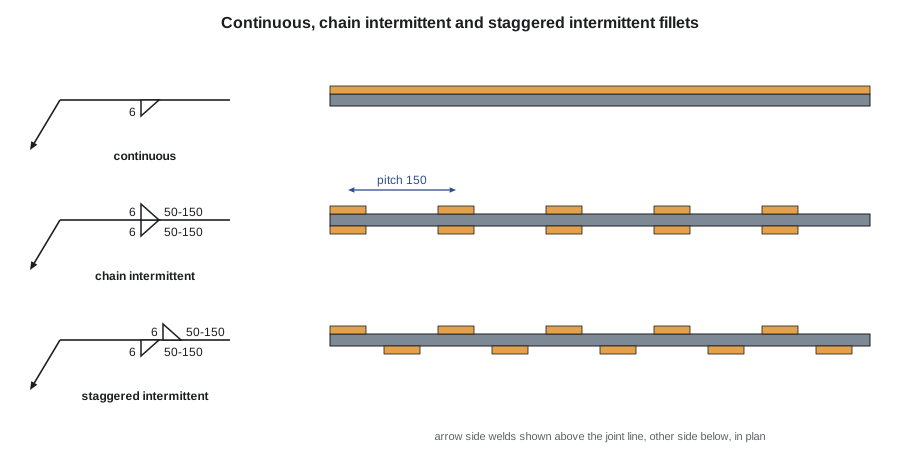
Unless the drawing shows otherwise, the segments are placed so that there is a weld at each end of the joint, and the remaining segments are spaced at the pitch between them. On a staggered weld, the two sides are offset by half a pitch, so one side starts at the end of the joint and the other starts half a pitch in, and the codes and drawings usually require an extra segment at the far end of each side so that the ends are always welded. Where the joint length does not divide evenly by the pitch, the drawing should say how to handle the remainder; if it does not, the fitter asks.
# Intermittent fillet layout: number of segments and total weld length on a joint
import math
def chain(joint, length, pitch):
    # a segment at each end, the rest at the pitch between them
    n = math.floor((joint - length) / pitch) + 1
    last_end = (n - 1) * pitch + length
    if joint - last_end > 1e-9:
        n += 1          # extra segment at the far end so both ends are welded
    return n
joint = 1200                 # joint length, mm
for size, length, pitch, sides, kind in [(6, 50, 150, 2, "chain"), (6, 50, 150, 2, "staggered"), (6, 75, 300, 2, "staggered"), (6, 75, 200, 1, "one side")]:
    n = chain(joint, length, pitch)
    total = n * length * sides
    cont = joint * sides
print(f"{size} {length}-{pitch} {kind:9}: {n} segments per side, {total:.0f} mm of weld, {100 * total / cont:.0f}% of a continuous weld")6 50-150 chain : 9 segments per side, 900 mm of weld, 38% of a continuous weld 6 50-150 staggered: 9 segments per side, 900 mm of weld, 38% of a continuous weld 6 75-300 staggered: 5 segments per side, 750 mm of weld, 31% of a continuous weld 6 75-200 one side : 7 segments per side, 525 mm of weld, 44% of a continuous weld
On a stiffener 1,200 mm (48 in) long, the 50-150 (2-6) intermittent fillet puts down a little over a third of the weld metal of a continuous weld. Because each side of a staggered weld still needs a segment at both ends, the counts per side are the same as for a chain weld; only the positions shift. The code still has rules: intermittent fillets have a minimum segment length, a maximum gap, and are not allowed at all in some fatigue-loaded or corrosive situations, where the gaps are crack starters or pockets for moisture.
Fillets on pipe, tube and around corners
A fillet symbol pointing at one side of a square tube means a weld on that side only, stopping at the corners. To weld the whole perimeter, such as a tube post to a base plate, the symbol needs the weld-all-around circle. A pipe support or nozzle reinforcing pad that must be welded around its whole circumference carries the circle too. Fillets that are to stop short of an edge or a corner by a set distance, a common requirement for stiffener welds near flange edges, show the stop dimension on the drawing.
The end returns of a fillet, a short continuation of the weld around the end of a lap or around the end of a stiffener, are a detail some codes require for certain connections. They are shown on the drawing either by a separate symbol or by a note. Devon asks Raj about the end of each gusset weld and is told that note 7 requires the fillets on the gussets to be wrapped around the ends for 12 mm (1/2 in).
Combined fillet and groove welds
Many T-joints and corner joints combine a groove weld with a reinforcing fillet on top, for example a bevel groove on a lifting lug finished with a fillet. The symbol shows the groove symbol and the fillet symbol on the same side of the reference line, the groove symbol next to the line and the fillet stacked on top of it, or the two on separate reference lines in sequence. Each has its own size. The fillet adds strength and smooths the stress flow at the toe.
ISO fillet notation
As the last lesson noted, ISO 2553 writes fillet sizes with a letter: a for the throat and z for the leg. ISO sizes are in millimetres: an ISO fillet marked a5 has a throat of 5 and legs of about 7, and one marked z5 has legs of 5. Intermittent ISO fillets are written as the number of segments times their length, with the gap between them in brackets, for example a5 4 x 50 (100). When a supplier drawing gives an ISO size, Hartwell's detailer converts it to an AWS-style leg size on the shop drawing.
Checking fillet size with a gauge
Lucia hands Devon a set of fillet gauges and shows him the two kinds of check. A convex fillet is measured for its leg: the gauge is set against one member and the weld face, and the leg length is read where the gauge touches the toe. A concave fillet is measured for its throat, because a concave face can have full-size legs and still be thin in the middle. The gauge for concave welds touches both toes and reads the distance to the face at the centre. A weld passes only if both checks are met: the legs at least the size on the symbol, and the throat at least the throat that size implies.
She also shows him the most common way a fillet ends up undersized: an unequal fillet that is full size on the flat member and short on the vertical one, because the arc was pointed too low. The gauge finds it at once, and the symbol, which asks for equal legs unless it says otherwise, makes it a reject.
Common mistakes
MistakeReading the fillet size as the throat.
InsteadIn the AWS system the size is the leg; the throat is about 0.7 times the leg.
MistakeMaking fillets bigger than shown to be safe.
InsteadOversize fillets add metal, heat and distortion; weld the size shown.
MistakeReading the pitch of an intermittent weld as the gap.
InsteadThe pitch is centre to centre; the gap is the pitch minus the segment length.
MistakeSpacing intermittent welds from one end and leaving the far end unwelded.
InsteadPut a segment at each end of the joint unless the drawing says otherwise.
MistakeWelding one side of a tube when the symbol shows the circle.
InsteadThe weld-all-around circle means the full perimeter.
Summary and key terms
- The fillet symbol is a right triangle with its vertical leg on the left.
- The size, to the left, is the leg; the theoretical throat is about 0.707 times the leg.
- Strength depends on throat times length; weld metal grows with the square of the leg.
- Unequal-leg fillets give both legs, and the drawing shows their orientation.
- Length, to the right, limits the weld; no length means the full joint.
- Intermittent fillets are given as length-pitch, with the pitch centre to centre.
- Chain intermittent welds are opposite each other; staggered welds alternate.
- Fillet weld size
- The leg length of the largest right triangle that fits inside the fillet cross-section.
- Throat
- The shortest distance from the root of a fillet to its face.
- Pitch
- The centre-to-centre distance between segments of an intermittent weld.
- Chain intermittent
- Intermittent welds on both sides of a joint, opposite each other.
- Staggered intermittent
- Intermittent welds on both sides of a joint, alternating with each other.
- Unequal-leg fillet
- A fillet weld with legs of different lengths.
Practice problems
Work each problem on paper first, then reveal the answer to check.
What is the theoretical throat of an 8 mm equal-leg fillet?
Show answer
8 x 0.707 = about 5.7 mm.
A fillet is marked 6 75-200. What is the gap between segments?
Show answer
200 - 75 = 125 mm.
How does the weld metal in a 10 mm fillet compare with a 5 mm fillet?
Show answer
Four times as much, because area goes with the square of the leg.
Lesson quiz · 5 questions
Score 60% or more to complete this lesson.
Create a free account to save your progress, take quizzes and earn a certificate.