
WLD-110 · Lesson 9 of 12 · 17 min
Plasma arc cutting
Plasma arc cutting cuts any metal that conducts electricity, including the stainless steel, aluminum and copper alloys that an oxyfuel torch cannot touch, and it cuts thin and medium carbon steel faster and with less distortion. It does so by forcing an electric arc through a narrow nozzle along with a stream of gas, which heats the gas to a temperature of more than 20,000 °C (36,000 °F) and accelerates it to a jet that melts the metal and blows it out of the kerf. In the Hartwell shop, the CNC plasma table cuts most of the plate parts for the Riverside bridge and the Coldwater skid, and a hand-held plasma cutter is the tool of choice for stainless pipe and for repair work. This lesson explains how plasma cutting works, how a plasma system is chosen and set up, how to cut by hand, how to read the cut, and the electrical, radiation, fume and noise hazards that come with it.
How plasma cutting works
A gas becomes a plasma when it is heated so much that its atoms lose electrons and it conducts electricity. In a plasma torch, an electrode inside the torch is connected to the negative side of a constant current power source, and the work is connected to the positive side through the work lead. Gas flows around the electrode, through a swirl ring that spins it, and out of a small hole in the copper nozzle. The arc between the electrode and the work is squeezed through the nozzle hole, which makes it far hotter and more concentrated than an open arc. The gas passing through the arc is heated to a plasma, expands violently and leaves the nozzle at very high speed.
To start, the torch first strikes a low-current pilot arc between the electrode and the nozzle, usually by a brief contact inside the torch or, on some machines, by high-frequency sparking. The pilot arc blows out of the nozzle as a small flame of plasma. When it touches the work, the arc transfers from the nozzle to the work, the current rises to the cutting level, and the cut begins. The process is called transferred-arc cutting. Because the cutting current flows through the work, the work must be electrically connected to the work lead, and painted or rusty surfaces can make starts difficult.
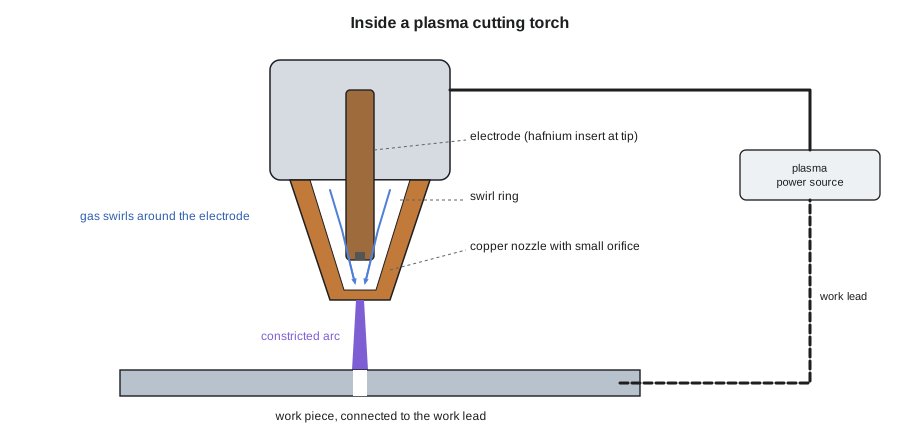
The parts that carry the arc wear out. The electrode has a small insert of hafnium at its tip, which emits electrons and slowly erodes; the nozzle orifice wears oval and larger; the swirl ring and shield also wear. Together they are called consumables, and they are matched to the torch, the current and the type of cutting. A worn electrode or nozzle gives a wider, bevelled, rougher cut and can fail suddenly, damaging the torch. Most electrode wear happens at each start and stop, not during the cut, so a job with many short cuts uses consumables much faster than one with a few long ones.
Gases
Small and medium plasma systems use compressed air for both the plasma and the shield, which is cheap and works well on carbon steel, stainless and aluminum. The air must be clean and dry. Water and oil in the air shorten consumable life sharply and cause erratic arcs, so the supply has filters and a dryer, and the system's own filter is drained regularly.
Larger systems, such as the CNC table at Hartwell, use different gases for different metals. Oxygen as the plasma gas gives the smoothest, squarest cuts on carbon steel, with an air shield. Nitrogen, or argon-hydrogen mixtures, are used for stainless and aluminum, where they give clean, bright edges. The table's gas console switches automatically for each job. Each gas brings its own handling: oxygen at the cutting table is kept away from oil and grease, argon-hydrogen mixtures are flammable, and nitrogen and argon displace oxygen in low areas.
Choosing current and speed
Plasma systems are rated by output current and by cutting capacity. Manufacturers usually give three capacities for each system: a recommended thickness that it cuts at a good production speed with good quality, a higher thickness it can cut more slowly, and a maximum severance thickness at which it will just separate the metal with a rough edge. Buying or choosing a system for the recommended thickness, not the severance figure, is what gives good cuts.
# Choose plasma current for a plate, and estimate cutting time and consumable use
systems = [  # output current (A), recommended thickness, maximum severance (mm), speed at recommended (mm/min)
    (30, 6, 12, 1000), (45, 12, 25, 750), (65, 20, 32, 600), (85, 25, 38, 550), (105, 32, 50, 450),
]
t = 16                     # thickness to cut (mm)
length = 48                # total length of cut (m)
starts = 140                # number of pierces or starts
for amps, rec, sever, speed in systems:
    if t <= rec:
        minutes = length * 1000 / speed
        print(f"{amps} A system: recommended for {rec} mm; about {minutes:.0f} min of arc-on time")
        break
    elif t <= sever:
        print(f"{amps} A system can sever {t} mm but not cleanly; look at the next size")
else:
    print("thicker than any system listed; use oxyfuel or a larger system")
life_starts = 300           # typical electrode life in starts for this class of torch (illustrative)
print(f"{starts} starts use about {starts / life_starts:.1f} electrodes")45 A system can sever 16 mm but not cleanly; look at the next size 65 A system: recommended for 20 mm; about 80 min of arc-on time 140 starts use about 0.5 electrodes
The ratings and speeds above are illustrative of the class of air plasma systems used in fabrication shops; each manufacturer publishes charts for its own torches and consumables. The example shows how a medium system is chosen for the gusset plates on the Coldwater skid base, and how the number of starts, as much as the length, sets the consumable cost.
Speed matters as much in plasma as in oxyfuel cutting, and the cut shows it. The arc lags behind the torch as it cuts, so the drag lines curve backward. Too slow, and the arc wanders and widens the kerf, leaving a heavy bead of low-speed dross, re-solidified metal, along the bottom edge that is easy to knock off. Too fast, and the arc cannot get through cleanly, leaving a thin, hard bead of high-speed dross welded to the bottom and strongly curved drag lines, or not cutting through at all. Between them is a speed window that gives a nearly dross-free cut. A plasma cut face is not perfectly square: one side of the kerf has a small bevel, a few degrees, because of the swirl of the gas, and on a CNC table the cut path is arranged so the good side is on the part and the bevelled side is on the scrap.
| What you see | Likely cause |
|---|---|
| Thick, bubbly dross that comes off easily | Speed too slow or current too high for the thickness |
| Thin, hard dross welded to the bottom edge | Speed too fast or current too low |
| Wide kerf with a large bevel | Worn nozzle or electrode, or torch held too high |
| Top edge rounded, heavy spatter on top | Torch too close or nozzle damaged |
| Arc goes out during the cut | Speed too fast, poor work connection or worn consumables |
Cutting by hand
For hand plasma cutting, the torch is held square to the work with the shield either resting on the plate, for drag cutting at lower currents with a drag shield, or held at a short standoff of a few millimetres above it, as the torch maker specifies. A guide or a standoff roller makes straight lines easier. The cut is started at the edge where possible. To pierce, the torch is tilted so the blow-back of molten metal goes away from the torch and the operator, then brought upright as the arc breaks through. Piercing is the hardest thing on consumables, and on thick plate it is better to start from an edge or a drilled hole.
The operator moves at a steady speed, watching the spark stream under the plate. It should leave at a slight backward angle; if it sprays forward or the arc starts to blow back up through the cut, the torch is moving too fast. At the end of the cut, the torch is carried past the edge before releasing the trigger, and most systems keep the gas flowing for a few seconds after the arc stops to cool the torch. The torch is never set down while the gas is still flowing near the operator's legs, and it is never pointed at a person, even when the trigger is not pressed.
Plasma can also gouge. With a gouging nozzle and the torch tilted to a low angle, the arc removes a groove of metal, which is useful for removing tack welds, back-gouging welds and taking out defects on stainless and aluminum. It is quieter and produces less fume than air carbon arc gouging, which is covered in the next lesson.
Electrical hazards
Plasma cutters have a much higher open-circuit voltage than welding machines, often 250 V or more, because the arc is long and constricted. They are designed so the operator cannot touch live parts in normal use: the torch has a parts-in-place interlock that prevents operation unless the shield cap is fitted, and the trigger has a safety catch. The rules that come from this are strict. The power is switched off, and the system disconnected if the manual says so, before consumables are changed or the torch is inspected. The torch body, leads and connectors are inspected before use and replaced if cracked or burned. The operator stands on dry ground and wears dry gloves, as for welding, and the work lead is clamped to the work close to the cut. On the CNC table, the table's safety covers and interlocks are never bypassed.
High-frequency start systems, where fitted, can interfere with electronic equipment and with implanted medical devices. CNC tables and their controllers are shielded and grounded as the manufacturer specifies.
Light, fume and noise
The plasma arc is extremely bright and rich in ultraviolet light. Operators use a filter shade suited to the current, typically shade 8 to 9 for medium currents and darker for high currents, and helpers and passers-by are protected by screens. The arc reflects strongly from stainless steel and aluminum.
Plasma cutting produces large amounts of fume, much of it very fine, along with ozone and nitrogen oxides, and cutting stainless steel produces hexavalent chromium and nickel compounds. Hand cutting needs local exhaust or a fume extraction system, and the CNC table at Hartwell has a downdraft table divided into zones that open under the torch, with a filter unit. Some tables use a water bed under the plate or cut under water, which traps much of the fume and reduces noise and arc light. Water tables have their own hazard: aluminum dross reacting with water can produce hydrogen, which can collect under plates and ignite, so aluminum is not cut over a water table unless the table is designed for it and cleaned regularly.
Plasma cutting is loud, often above 100 dBA at higher currents, and hearing protection is required. Alberta's OHS Code sets a noise exposure limit of 85 dBA averaged over eight hours with a 3 dB exchange rate, so every 3 dB above 85 halves the allowed time.
The CNC table
Most production plasma cutting at Hartwell is done on the CNC table, which reads a cutting program prepared from the drawings. The parts are nested on the plate to use as much of it as possible, and the program sets the cut path, the lead-ins and lead-outs where the arc starts and stops off the part edge, the current, the gas and the speed for each part. A torch height controller keeps the standoff constant by measuring the arc voltage. Devon's job on the table in the first month is to load plates with the crane and magnet lifter, check the plate thickness and grade against the program, check and change consumables at the start of each shift and whenever cut quality falls off, remove cut parts, and clean the slats. The table's safety rules are to keep everyone outside the gantry's travel zone when it is running, to use the emergency stops, and to lock out the table before reaching under the gantry for any reason.
On a Tuesday in the second week, the parts coming off the table for the bridge's stiffener plates start showing thin, hard dross. Devon checks the plate thickness and the program, then pulls the torch consumables. The electrode's hafnium insert is pitted almost 1.5 mm (1/16 in) deep, well past the maker's replacement depth. A new electrode and nozzle bring the cut back, and Devon writes in the notebook: check consumables by the count of starts, not by waiting for bad parts.
Common mistakes
MistakeChanging consumables with the power on.
InsteadSwitch off and, where the manual says so, disconnect before touching the torch.
MistakeChoosing a plasma system by its maximum severance thickness.
InsteadChoose by the recommended production thickness.
MistakeRunning plasma on wet, oily shop air.
InsteadUse clean, dry air through filters and a dryer.
MistakeCutting aluminum over an ordinary water table.
InsteadUse a table designed for aluminum, or dry downdraft, and clean it regularly.
MistakeWaiting for bad parts before checking consumables.
InsteadInspect and replace consumables by count of starts and the maker's wear limits.
Summary and key terms
- Plasma cutting constricts an arc through a nozzle, heating gas to a plasma jet that melts and blows away any conductive metal.
- A pilot arc starts in the torch and transfers to the work, so the work must be connected to the work lead.
- Electrodes, nozzles, swirl rings and shields are consumables that wear most at each start.
- Choose current by recommended thickness, and adjust speed to stay in the window between low-speed and high-speed dross.
- Open-circuit voltage is high; never service the torch with power on or bypass interlocks.
- Plasma is bright, loud and produces heavy fume, including hexavalent chromium from stainless; use shading, hearing protection and extraction.
- Plasma
- A gas heated until it is ionized and conducts electricity.
- Pilot arc
- A low-current arc between electrode and nozzle that starts a plasma cut.
- Transferred arc
- An arc that runs from the torch electrode to the work.
- Consumables
- The electrode, nozzle, swirl ring and shield that wear in use.
- Dross
- Re-solidified metal left on the bottom edge of a cut.
- Standoff
- The distance between the torch tip and the work.
Practice problems
Work each problem on paper first, then reveal the answer to check.
A 45 A system is recommended for 12 mm and severs 25 mm. Is it a good choice for regular 20 mm cutting?
Show answer
No; choose a system recommended for 20 mm, such as the 65 A system.
A cut leaves thin, hard dross and curved drag lines. What would you change?
Show answer
Slow down, or check the current and consumables.
Why do many short cuts use more consumables than one long one?
Show answer
Most electrode wear happens at each start and stop.
Lesson quiz · 5 questions
Score 60% or more to complete this lesson.
Create a free account to save your progress, take quizzes and earn a certificate.