
WLD-110 · Lesson 1 of 12 · 17 min
The welding trade and the shop
Welding joins metal by melting it, and cutting separates metal by melting, burning or blowing it away. Almost everything made of steel, from a pedestrian bridge to a pressure vessel, a refinery pipe spool or the frame of a grain auger, has been cut and welded by someone who learned the trade one step at a time. This course is the first step. Before a new welder strikes an arc for a production weld, they learn how welding and cutting can hurt people, how to control those hazards, and how to cut and prepare metal safely with oxyfuel, plasma, air carbon arc and mechanical methods. Every later course in the program, from shielded metal arc welding to pipe welding and code qualification, builds on the habits set here.
This lesson introduces the trade, the apprenticeship path, the shop where the course is set and the people in it. It also introduces the idea that runs through all twelve lessons: a welder is responsible for the hazards their work creates, not only for themselves but for everyone around them, above them and below them.
What welders do
A welder reads drawings, lays out and cuts material, fits parts together, welds them using one or more processes, and inspects the result. The common arc processes are shielded metal arc welding (SMAW, often called stick welding), gas metal arc welding (GMAW, or MIG), flux-cored arc welding (FCAW) and gas tungsten arc welding (GTAW, or TIG). Each uses an electric arc between an electrode and the work to melt the base metal and, usually, a filler metal. Oxyfuel welding, brazing and soldering use a flame instead. Cutting and gouging processes, which are the practical subject of this course, include oxyfuel cutting, plasma arc cutting, air carbon arc cutting and gouging, and mechanical cutting with saws, shears and abrasive wheels.
Welders work in fabrication shops, on construction sites, in refineries and plants during maintenance shutdowns, in shipyards, on pipelines, in agricultural and heavy equipment repair, and in manufacturing. The work can be structural, such as beams, columns, girders and trusses; pressure-retaining, such as vessels, boilers and piping; or general fabrication and repair. Pressure work and structural work are governed by codes that require the welding procedure and the welder to be qualified by testing, which is the subject of the code and qualification course near the end of the program. Until then, everything an apprentice welds on a code job is done under supervision.
In Canada, structural steel welding is done to CSA W59, and the fabricator, its procedures and its welders are certified by the Canadian Welding Bureau under CSA W47.1. Pressure equipment is welded to the ASME Boiler and Pressure Vessel Code, with procedures and welders qualified to ASME Section IX and registered with the provincial safety authority, which in Alberta is ABSA. These names will come up throughout the program.
The apprenticeship path
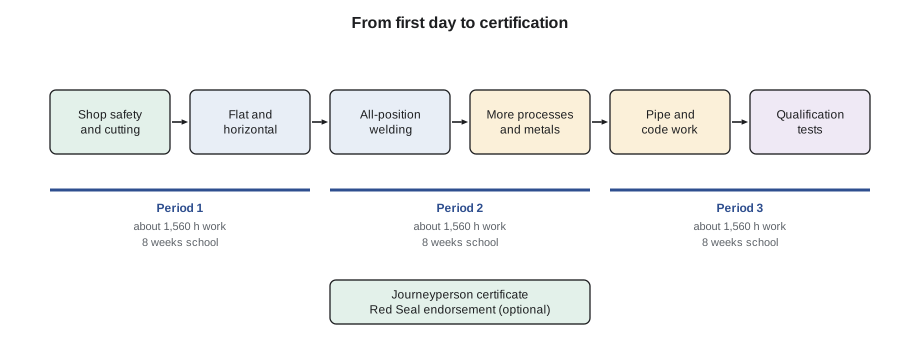
In Alberta, welder is a compulsory certification trade under the Skilled Trades and Apprenticeship Education Act. Certain welding activities may be done only by a registered apprentice, a certified journeyperson or someone holding a recognized trade certificate. The apprenticeship has three periods. Each period combines about 1,560 hours of paid work under a journeyperson with eight weeks of technical training at a college or training provider, so the full program is about 4,680 hours of work and 24 weeks of school, normally over three years. The final exam can include the interprovincial Red Seal examination, which gives a certificate recognized across Canada. Experienced welders who never apprenticed can challenge the trade through a qualifier route that requires documented work experience and both theory and practical exams.
Whatever the system, an apprentice moves through the same stages: safe shop practice and cutting first, then flat and horizontal welding with one process, then all-position welding, then other processes and materials, then pipe and code qualification. The hours on the job matter as much as the school, because a welder's hands learn by repetition and a journeyperson's eye corrects habits before they set.
# Apprenticeship progress: where am I, and when will I finish?
periods = 3                 # number of periods or years in the program
hours_per_period = 1560        # on-the-job hours required per period or year
school_weeks = 8             # weeks of technical training or related instruction per period
week_hours = 40                 # paid hours in a normal week
logged = {"cutting and fitting": 610, "SMAW flat and horizontal": 420, "grinding and prep": 260, "shop moves and rigging": 140}
done = sum(logged.values())
total = periods * hours_per_period
print(f"logged {done} of {total} hours ({100 * done / total:.0f} %)")
for task, h in sorted(logged.items(), key=lambda kv: -kv[1]):
    print(f"  {task:26s}{h:6d} h  {100 * h / done:4.0f} %")
weeks_left = (total - done) / week_hours + school_weeks * periods
print(f"about {weeks_left:.0f} more weeks of work and school, or {weeks_left / 48:.1f} years at 48 weeks a year")logged 1430 of 4680 hours (31 %) cutting and fitting 610 h 43 % SMAW flat and horizontal 420 h 29 % grinding and prep 260 h 18 % shop moves and rigging 140 h 10 % about 105 more weeks of work and school, or 2.2 years at 48 weeks a year
The calculation is simple, but it is a useful habit: an apprentice who keeps their own record of hours, by process and by type of work, can see whether they are getting the variety they need and can raise it with their supervisor before a period ends with gaps.
The shop in this course
The course follows a first-year apprentice through a fabrication shop and its jobs. The shop and people are invented, but the work is typical of a mid-sized structural and pressure fabricator.
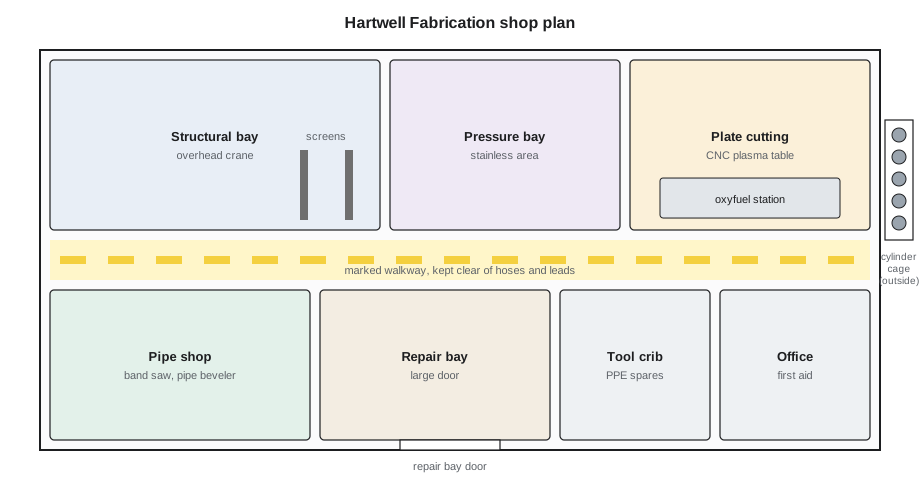
Hartwell Fabrication is a family-owned shop of about 45 people in the Nisku industrial park, south of Edmonton, Alberta. It holds CWB certification to CSA W47.1 for structural work and an ABSA quality program for pressure piping and vessels. It has a structural bay with an overhead crane, a pressure bay, a plate cutting area with a CNC plasma table and a manual oxyfuel station, a pipe shop, a small maintenance and repair bay that farmers and contractors drive into, and a field crew that works in plants and refineries around Edmonton.
The people who appear throughout the program are:
- Devon Okafor, a first-period apprentice who came to the shop after two years of general labour on construction sites. Devon keeps a notebook of every job, setting and mistake.
- Marta Kowalchuk, a Red Seal journeyperson welder with 24 years in the trade, CWB tickets in several processes and positions, and a habit of asking "what happens if" before every job. She is Devon's mentor.
- Glen Teskey, the shop foreman, who assigns work, signs off cutting lists and decides when a job moves from one bay to the next.
- Priya Natarajan, the safety coordinator, a Canadian Registered Safety Professional who runs orientation, issues hot work permits for the field crew and keeps the shop's exposure monitoring records.
Four jobs recur through the program:
- The Riverside pedestrian bridge: two weathering steel plate girders about 36 m (118 ft) long, with floor beams and bracing, cut and fitted in the structural bay.
- The Coldwater separator skid: a gas separator vessel, piping and a structural base for a gas processing plant, built in the pressure bay.
- The Unit 4 turnaround: a set of carbon steel and stainless pipe spools for a refinery maintenance shutdown, with some field cutting and welding inside the refinery under its permit system.
- Farm repairs: a grain auger frame, a loader bucket and a cultivator toolbar brought in by a farmer from near Leduc, cut, rebuilt and welded in the repair bay.
How the shop is organized for safety
A fabrication shop concentrates hazards that most workplaces never see together: open flame, electric arcs, intense light, fume, compressed gases, heavy loads on cranes, sharp edges, hot metal and loud noise. The shop controls them partly through its layout. Cutting and welding areas are separated from storage of combustible material. Welding screens and curtains contain arc light. Gas cylinders are stored outside in a ventilated cage, with oxygen separated from fuel gases, and only the cylinders in use are brought inside on carts. Walkways are painted and kept clear, and leads and hoses cross them only under covers or overhead. Fume extraction arms and a general ventilation system serve the welding stations.
The rest of the control comes from people and procedures. On their first day, Devon goes through Priya's orientation: the shop's hazard assessment, where the fire extinguishers, eyewash and first aid kits are, how to report an incident or a near miss, the right to refuse unsafe work, and the requirement to wear the shop's basic PPE everywhere past the office door. Then Devon spends a week with Marta before touching a torch.
Alberta's Occupational Health and Safety Act gives every worker the right to know the hazards of their work, the right to participate in health and safety, and the right to refuse dangerous work without reprisal. The OHS Code requires the employer to assess hazards and control them, and Part 10 and the welding sections refer to CSA W117.2, Safety in welding, cutting and allied processes, which is the main Canadian safety standard for this course. Its latest edition was published in 2025.
Codes and standards set minimums. The shop's rules often go further, and Marta's rules go further still. Hers are short: know what is behind and below what you cut; never assume a container is empty; nothing goes into the cutting area that can burn unless it has to be there; and if you are not sure, stop and ask.
A welder's first week
Devon's first week is deliberately slow. Marta walks the shop with Devon and points out what can go wrong at each station: a cylinder cart left without its chain, a stinger lying on a steel table with the machine on, a rag soaked in oil near the plasma table, a grinder with its guard removed, a pipe spool waiting to be cut that came out of a refinery and might hold residue. Devon writes each one in the notebook along with what should have been done.
Devon also learns the tools of the cutting area. The plate saw and the band saw, the shear and the ironworker, the angle grinders and their wheels, the oxyfuel cutting outfit and the hand plasma cutter each have their own hazards and their own pre-use checks, and each later lesson in this course covers one of them. By the end of the week Devon has cut nothing for production, but can explain what every machine in the cutting area does, how it can hurt someone, and how it is checked before use.
At the end of the week, Marta asks Devon to list the hazards of a simple task: cutting a 10 mm (3/8 in) steel plate to size on the oxyfuel station. Devon's list includes burns, eye damage from the flame and hot slag, fire from sparks travelling across the floor, fume from the cut and from any paint or galvanizing, a cylinder or hose leak, a flashback, the weight of the plate, sharp edges, and noise from the grinder used afterwards. Marta adds two: the plate is on a cutting table that has collected slag and dust for months, and someone else in the bay may walk into the cut line. The habit she is building is that the hazard list comes before the cut, every time.
Reading this course
Each lesson in this course follows the same pattern. It explains a hazard or a process, shows how it is controlled, works through the arithmetic the trade uses, and applies it to one of the shop's jobs. Units are given in the system used on each site, and Python examples let you check the arithmetic and change the inputs. The capstone in Lesson 12 brings everything together in a cutting job from layout to cleanup.
The arithmetic is not there for its own sake. A welder who can work out how long a cylinder will last, how much air a fume hood needs to move, or which lens shade an arc requires makes better decisions on the floor than one who guesses. Most of the numbers in this course are simple products and ratios that can be done in a notebook, and the Python versions are there so you can try different inputs and see how sensitive the answer is.
Common mistakes
MistakeAssuming that safety is someone else's job until you are a journeyperson.
InsteadEvery worker is responsible for the hazards their own work creates, from the first day.
MistakeTreating the code as the only rule.
InsteadCodes and standards are minimums; the shop's procedures and the manufacturer's instructions apply as well.
MistakeKeeping no record of hours and tasks.
InsteadTrack your own hours by process and type of work so gaps can be fixed early.
MistakeWalking past a hazard because it belongs to another crew.
InsteadReport it or fix it; the next person hurt may be you.
Summary and key terms
- Welders cut, fit, weld and inspect metal in shops, plants, construction sites and repair work, using arc, flame and mechanical processes.
- Welder is a compulsory trade in Alberta: three periods of about 1,560 hours each with eight weeks of school, and an optional Red Seal endorsement.
- CSA W117.2 is the main Canadian safety standard for welding and cutting, referred to by the Alberta OHS Code.
- A shop controls hazards by layout, screening, ventilation, cylinder storage and clear walkways, and by orientation, procedures and supervision.
- Listing the hazards before the cut is the habit that the rest of the course builds on.
- SMAW
- Shielded metal arc welding, using a flux-covered consumable electrode.
- GMAW
- Gas metal arc welding, using a continuously fed wire and a shielding gas.
- GTAW
- Gas tungsten arc welding, using a non-consumable tungsten electrode and inert gas.
- Journeyperson
- A fully certified tradesperson who can supervise apprentices.
- Qualification test
- A test weld, examined or bent, that shows a welder or procedure can meet a code.
- Hazard assessment
- A written review of the hazards of work and the controls that will be used.
Practice problems
Work each problem on paper first, then reveal the answer to check.
An apprentice works 38 hours a week for 48 weeks a year. How many years of work are needed for 4,680 hours?
Show answer
4,680 / (38 × 48) = 2.6 years of work, plus the school weeks.
Name the Canadian standard for structural steel welding and the one for certifying fabricators.
Show answer
CSA W59 for welding and CSA W47.1 for certification by the Canadian Welding Bureau.
List five hazards of cutting plate with an oxyfuel torch.
Show answer
Burns, eye damage, fire from sparks, fume, gas leaks or flashback, plus heavy and sharp material.
Lesson quiz · 5 questions
Score 60% or more to complete this lesson.
Create a free account to save your progress, take quizzes and earn a certificate.