
WLD-110 · Lesson 3 of 12 · 18 min
Fumes, ventilation and confined spaces
The plume that rises from a weld or a cut looks like smoke, but it is a cloud of metal oxide particles so fine that most of them pass deep into the lungs, mixed with gases produced by the arc or flame. Welders who breathed it for years without controls developed lung disease, metal fume fever, nervous system damage from manganese and, from stainless steel, lung cancer from hexavalent chromium. The International Agency for Research on Cancer classified welding fume as a cause of cancer in humans in 2017, so there is no such thing as a safe amount of fume to breathe on purpose. This lesson explains what is in fume, how exposure is measured against limits, how ventilation controls it, when a respirator is needed, and why confined spaces turn ordinary welding and cutting hazards into fatal ones.
What is in welding and cutting fume
Fume forms when metal vaporizes in the arc or flame, then condenses and oxidizes as it cools, forming particles mostly smaller than one micrometre. Its composition depends on the base metal, the filler metal and its flux, the coating on the work, and the process. The main constituents of concern are:
- Iron oxide, the bulk of fume from carbon steel. Long exposure causes siderosis, a deposit of iron in the lungs, and adds to the total particulate load.
- Manganese, present in nearly all steels and filler metals, and in higher amounts in some flux-cored wires and hardfacing electrodes. Chronic exposure can damage the nervous system, causing tremor, slowed movement and mood changes similar to Parkinson's disease. The effects can be permanent.
- Hexavalent chromium, formed when stainless steel and other chromium alloys are welded or cut, especially with SMAW and FCAW, whose fluxes help convert chromium to the hexavalent form. It causes lung cancer and damages the nose, skin and eyes. Nickel from stainless is also a carcinogen.
- Zinc oxide from galvanized steel, which causes metal fume fever: chills, fever, aches and a metallic taste a few hours after exposure, like a bad flu. It passes in a day or two, but it is a sign of heavy overexposure.
- Lead and cadmium from old paint and plated parts, which are toxic even in small amounts. Old structures, farm equipment and machinery often carry lead paint.
The gases include ozone, formed when the arc's ultraviolet light reacts with oxygen and highest with GMAW and GTAW on aluminum and stainless; nitrogen oxides from flames and plasma cutting; carbon monoxide from flames, from carbon dioxide shielding gas and in poorly ventilated spaces; and the shielding gases themselves, argon, helium and carbon dioxide, which do not poison but displace oxygen. One combination deserves special mention: chlorinated solvents used for degreasing break down in the arc's ultraviolet light to phosgene, a highly toxic gas. Degreasing with chlorinated solvents is never done near welding, and parts are dry and free of solvent before they are welded.
Exposure limits
Alberta's OHS Code sets occupational exposure limits in Schedule 1, and the employer must keep workers' exposure below them, as low as reasonably practicable for carcinogens. Most limits are eight-hour time-weighted averages: the average concentration in the worker's breathing zone over a shift. Many Canadian jurisdictions follow the American Conference of Governmental Industrial Hygienists (ACGIH) threshold limit values, which since 2013 have set manganese at 0.02 mg/m³ for the respirable fraction and 0.1 mg/m³ for the inhalable fraction, a fraction of the older limits. Hexavalent chromium limits are in micrograms per cubic metre.
Exposure is measured by personal air sampling: a small pump on the welder's belt draws air through a filter cassette clipped in the breathing zone, inside the helmet for welders, for the whole shift. The filter is analyzed for total particulate and for individual metals. Priya runs sampling at Hartwell whenever a new process, wire or material is introduced and on a schedule for routine work, and keeps the results with the shop's hazard assessment.
The arithmetic of a time-weighted average is a weighted mean of the concentrations during each part of the shift:
A welder who spends two hours welding stainless with FCAW in a corner booth and six hours fitting and grinding carbon steel has an exposure set mostly by the two hours, because the stainless fume is so much more hazardous.
How ventilation controls fume
There are two kinds of ventilation. Local exhaust ventilation captures fume at the source before it reaches the breathing zone: a hood on a movable arm, a downdraft or backdraft bench, a fume extraction gun on GMAW, or the water table and downdraft on a plasma cutting table. General or dilution ventilation moves large volumes of air through the whole shop to dilute what escapes. Local exhaust is much more effective, because it removes fume where it is concentrated; dilution can only lower an average that is already too high near the welder.
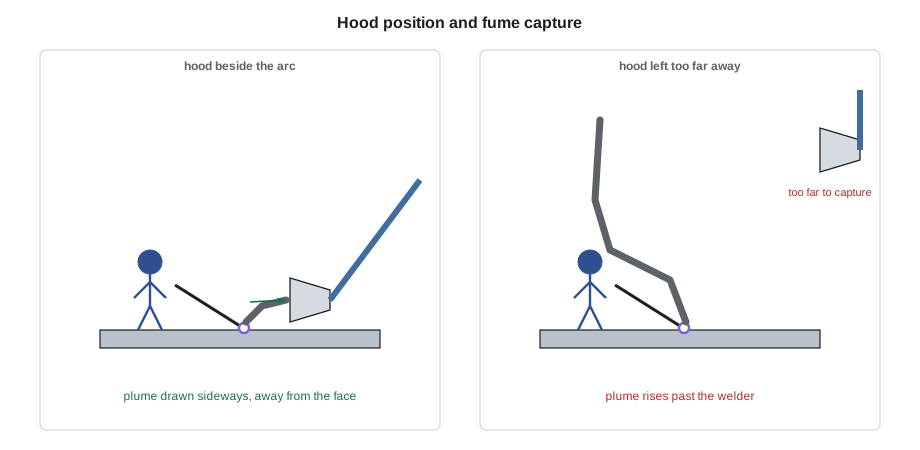
A capture hood works only close to the source. Air speed in front of a hood falls off quickly with distance, roughly as the square of the distance for a plain opening, so a hood that captures fume well at 150 mm (6 in) does little at 600 mm (24 in). The Dalla Valle equation estimates the airflow a plain hood needs to produce a capture velocity at a given distance in front of it:
where Q is the airflow, V the capture velocity needed at the source, x the distance from the hood face to the source and A the area of the hood face. A capture velocity of about 0.5 m/s (100 ft/min) at the weld is a common design figure for welding fume in still air; drafts across the bench need more.
# Fume hood: airflow needed at different distances (Dalla Valle), and what a fixed fan delivers
V = 0.5          # capture velocity needed at the weld (m/s)
A = 0.07          # hood face area (m²)
fan = 900      # airflow the extraction arm actually delivers (m³/h)
for x in [0.15, 0.25, 0.35, 0.50]:   # distance from hood face to the arc (m)
    q = V * (10 * x ** 2 + A) * 3600
    ok = "captures" if q <= fan else "too far"
    print(f"hood at {x:5.2f} m: needs {q:7.0f} m³/h  -> {ok}")
# the largest distance the fan can manage
x_max = (((fan / 3600) / V - A) / 10) ** 0.5
print(f"with this fan the arm must be within {x_max:.2f} m of the arc")hood at 0.15 m: needs 531 m³/h -> captures hood at 0.25 m: needs 1251 m³/h -> too far hood at 0.35 m: needs 2331 m³/h -> too far hood at 0.50 m: needs 4626 m³/h -> too far with this fan the arm must be within 0.21 m of the arc
The answer explains a rule that every welder learns: move the hood as you move along the weld. An extraction arm left at the start of a long fillet is at the edge of its reach by the middle and useless by the end. The hood is placed beside or slightly above the arc, so the plume is drawn sideways away from the face, and never directly above the welder's head with the plume passing the face on its way up.
Position matters as much as hardware. The welder keeps the head out of the plume, works with the hood between their face and the arc, and in a cross draft stands upwind. Shielding gas welding needs some care: a hood too close or too strong can pull the shielding gas away and cause porosity, so the arm is set back slightly for GMAW and GTAW and a fume extraction gun is often the better choice.
Dilution ventilation and its limits
When fume escapes into the shop, the general ventilation sets the background concentration that everyone breathes. A simple mass balance gives the steady concentration: the rate at which a contaminant is generated divided by the effective airflow. Real shops do not mix perfectly, so the airflow is divided by a mixing factor, usually between 3 and 10, to allow for dead spots and short circuits.
# Background manganese from welding in a bay with general ventilation
welders = 4                 # welders in the bay
fume_rate = 0.4               # fume generated per welder (g/min), typical for SMAW/FCAW
mn_fraction = 0.05            # share of manganese in the fume
capture = 0.0               # share of fume caught by local exhaust (0 if none)
Q = 20000                       # general ventilation airflow (m³/h)
K = 5                         # mixing factor for a real shop
Q_m3_min = Q * 1 / 60           # convert to m³/min
G_mn = welders * fume_rate * mn_fraction * (1 - capture) * 1000   # mg of Mn per minute escaping
C = K * G_mn / Q_m3_min
limit = 0.02                  # mg/m³, ACGIH respirable manganese TLV
print(f"manganese escaping: {G_mn:.1f} mg/min")
print(f"background manganese about {C:.3f} mg/m³, {C / limit:.1f} times the respirable TLV")
for cap in (0.0, 0.7, 0.9, 0.97):
    c = K * welders * fume_rate * mn_fraction * (1 - cap) * 1000 / Q_m3_min
print(f" capture {cap:4.0%}: {c:.3f} mg/m³")manganese escaping: 80.0 mg/min background manganese about 1.200 mg/m³, 60.0 times the respirable TLV capture 0%: 1.200 mg/m³ capture 70%: 0.360 mg/m³ capture 90%: 0.120 mg/m³ capture 97%: 0.036 mg/m³
The figures are illustrative, but the lesson is real: with today's manganese limits, general ventilation alone cannot keep a busy bay acceptable, and even good local exhaust leaves a background that has to be checked by sampling. The same arithmetic shows why the shop's general system is still needed. It carries away what local exhaust misses, along with the heat and the gases.
Alberta's OHS Code requires that a hazardous substance be controlled by ventilation or other means so that exposure stays within the limits, and CSA W117.2 gives guidance on the ventilation of welding and cutting operations, including when local exhaust is required.
Respiratory protection
Where ventilation cannot bring exposure low enough, or while it is being set up, welders wear respirators as part of a written respiratory protection program. The program covers selection based on the measured or expected exposure, medical clearance, fit testing for tight-fitting respirators, training, cleaning and storage, and filter change schedules. A respirator that does not fit protects very little, and facial hair under the seal of a tight-fitting respirator defeats it.
In Alberta, the OHS Code requires respiratory protective equipment approved by NIOSH and a code of practice that follows CSA Z94.4, Selection, use and care of respirators, including fit testing.
For welding fume, the usual choices are a half-face elastomeric respirator with P100 (high efficiency) particulate filters worn under the helmet, a disposable filtering facepiece rated for welding fume for low exposures, or a powered air-purifying respirator built into the welding helmet, which blows filtered air across the face and does not need a tight seal. Particulate filters do nothing for gases or for oxygen deficiency. Ozone and nitrogen oxides need ventilation or a supplied-air respirator, and an atmosphere short of oxygen needs supplied air or must be ventilated before entry.
Devon is fit tested in the first week and issued a half-face respirator and a powered air-purifying helmet for the pressure bay, where stainless is welded. The rule in that bay is that the extraction arm runs and the powered helmet is worn for every stainless weld, whatever the length.
Confined spaces
A confined space is an enclosed or partly enclosed space that is not designed for continuous occupancy, has restricted entry or exit, and may become hazardous because of its contents, its atmosphere or the work done in it: tanks, vessels, silos, large pipes, boxed girders, pits and the inside of a separator skid. Welding and cutting inside one can turn ordinary hazards into fatal ones within minutes.
- Oxygen deficiency. Argon and carbon dioxide are heavier than air and pool in vessels and pits. A welder who leaves a GTAW torch running inside a vessel at lunch can fill it with argon, and there is no warning: argon has no smell, and the first breath of an oxygen-deficient atmosphere can cause collapse.
- Oxygen enrichment. A leaking oxygen hose or torch, or someone using oxygen to blow dust off clothing or to cool off, can raise the oxygen level so that clothing, hair and grease ignite violently. Oxygen is never used for ventilation.
- Flammable and toxic atmospheres. Residue of the vessel's contents, coatings, and fuel gas leaks can create an explosive atmosphere; fume and gases build up quickly in a small volume.
- Heat, restricted movement and difficult rescue. A person who collapses in a vessel cannot be lifted out through a 450 mm (18 in) manway without equipment and training.
Alberta's OHS Code, Part 5, requires a hazard assessment, a code of practice, an entry permit system, atmospheric testing, a trained attendant and a rescue plan for confined space entry. The atmosphere is tested before entry and continuously or at intervals during work for oxygen, flammable gases and toxic contaminants. Oxygen must be between 19.5 and 23 percent, and flammable gas must be held well below its lower explosive limit.
For hot work inside a confined space, the precautions go further. Gas cylinders and welding power sources stay outside the space. Torches and hoses are brought out of the space whenever work stops, even for a short break, and the gas is shut off at the cylinder, so a leak cannot fill the space. The atmosphere is ventilated with fresh air, exhausted from the work area. The attendant watches the welder, keeps the lines clear and can summon rescue. Welding leads are in good condition and the welder is insulated from the work where the space is wet or the welder is in contact with steel all around. Lesson 4 returns to this.
The Coldwater skid's separator vessel has a 600 mm (24 in) manway. Before Devon goes in to grind a nozzle weld, Priya issues the permit, tests the atmosphere at the top, middle and bottom of the vessel, and sets up a fresh-air blower and an exhaust duct. Marta is the attendant. Nothing with gas in it goes through the manway.
Common mistakes
MistakeLeaving the extraction arm where it was set at the start of the weld.
InsteadMove the hood along with the arc, keeping it close beside the weld.
MistakeTreating a dust mask as protection from welding fume.
InsteadUse a fit-tested respirator with filters rated for welding fume, or a powered air-purifying helmet.
MistakeWelding galvanized steel without extraction because metal fume fever passes.
InsteadRemove the zinc where possible and capture the fume; fume fever means heavy overexposure.
MistakeLeaving a torch and hoses inside a vessel during a break.
InsteadBring them out and shut the gas off at the cylinder whenever work stops.
MistakeBlowing off clothing with oxygen.
InsteadNever use oxygen for cleaning or ventilation; it makes clothing burn violently.
Summary and key terms
- Welding fume is mostly fine metal oxide particles; it is classified as a human carcinogen.
- Manganese, hexavalent chromium, nickel, zinc, lead and cadmium are the main metals of concern; ozone, nitrogen oxides and carbon monoxide are the main gases.
- Exposure is measured in the breathing zone and compared with eight-hour limits; current manganese limits are very low.
- Local exhaust captures fume at the source and must be kept close to the arc; dilution ventilation handles what escapes.
- Respirators are used within a program with fit testing; particulate filters do not protect against gases or low oxygen.
- Confined spaces need permits, testing, ventilation, an attendant and a rescue plan; gas and torches stay outside when work stops.
- Fume
- Fine solid particles formed when vaporized metal condenses and oxidizes.
- Time-weighted average
- The average concentration a worker breathes over a shift.
- Local exhaust ventilation
- Ventilation that captures a contaminant at its source.
- Capture velocity
- The air speed needed at the source to draw fume into a hood.
- Metal fume fever
- A flu-like illness from breathing zinc or other metal oxide fume.
- Confined space
- An enclosed space with restricted access, not meant for continuous occupancy, that may become hazardous.
Practice problems
Work each problem on paper first, then reveal the answer to check.
A hood needs 0.5 m/s at 0.25 m with a 0.07 m² face. What airflow is needed?
Show answer
Q = 0.5 × (10 × 0.0625 + 0.07) = 0.35 m³/s, or about 1,250 m³/h.
A welder breathes 0.06 mg/m³ manganese for 3 hours and 0.01 mg/m³ for 5 hours. What is the TWA?
Show answer
(0.18 + 0.05) / 8 = 0.029 mg/m³.
Why is argon dangerous in a pit?
Show answer
It is heavier than air, pools, displaces oxygen and gives no warning.
Lesson quiz · 5 questions
Score 60% or more to complete this lesson.
Create a free account to save your progress, take quizzes and earn a certificate.