
WLD-110 · Lesson 6 of 12 · 18 min
Compressed gas cylinders and regulators
A full oxygen cylinder holds gas at about 15 MPa (2,200 psi), roughly a hundred and fifty times atmospheric pressure. If its valve is broken off, the escaping gas can drive the cylinder through a block wall. A fuel gas cylinder holds enough energy to fill a shop with flame, and an argon cylinder can quietly fill a pit with gas that will suffocate anyone who climbs into it. Welders handle these cylinders every day, so the rules for moving, storing, connecting and opening them become habits early. This lesson covers the gases used in welding and cutting, how cylinders are built and marked, how they are handled and stored, how regulators reduce pressure, and how to work out how much gas is left.
The gases
Welding and cutting use three groups of gases:
- Oxygen supports combustion. It is not flammable itself, but it makes anything that burns burn far faster and hotter, and it makes some materials that do not burn in air, such as oily rags, grease and some fabrics, burn violently. Oxygen is supplied as a high-pressure gas in steel cylinders or as a liquid in insulated containers for larger users.
- Fuel gases burn with oxygen to give the preheat flame for cutting, heating, brazing and welding. Acetylene gives the hottest flame and is the only fuel used for oxyfuel welding of steel. Propane, propylene and natural gas give cooler flames that are used for cutting and heating, and they are cheaper. Propane and propylene are stored as liquids under their own vapour pressure.
- Shielding and process gases protect the arc and weld pool or carry the plasma: argon, helium, carbon dioxide, nitrogen, hydrogen mixtures and argon-based blends. Compressed air is used for plasma cutting and air carbon arc gouging. Argon, helium, carbon dioxide and nitrogen are not toxic, but they displace oxygen.
Each gas has its own hazards, but they share the hazards of pressure: a cylinder or regulator failure releases stored energy suddenly, and a leak releases gas that may burn, feed a fire or suffocate.
How cylinders are built and marked
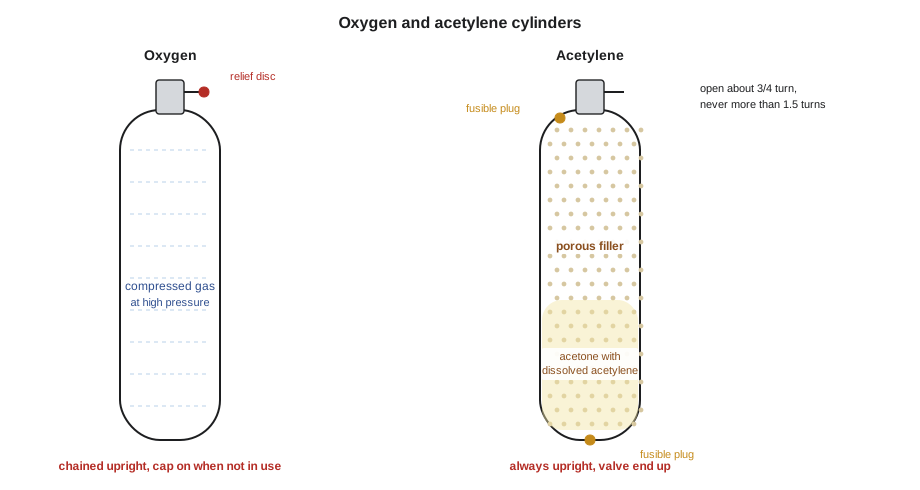
High-pressure cylinders for oxygen, argon, nitrogen and mixtures are seamless steel or aluminum tubes with a threaded neck for the valve. Each cylinder is stamped on the shoulder with its specification, serial number, service pressure, the owner's mark and the dates of its periodic hydrostatic tests, usually every five or ten years depending on the type. Cylinders that are past their test date are not filled. The valve has a pressure relief device, usually a rupture disc, that vents the cylinder if heat raises the pressure too far.
Acetylene cylinders are different. Acetylene is unstable at high pressure and can decompose explosively on its own, so it is never compressed as a free gas above about 100 kPa (15 psi) gauge. Instead, an acetylene cylinder is packed with a porous filler, like a very fine stone, soaked with acetone, and the acetylene dissolves in the acetone the way carbon dioxide dissolves in a soft drink. A full cylinder is at roughly 1.7 MPa (250 psi) at room temperature. Acetylene cylinders have fusible plugs in the top and bottom that melt at around 100 °C (212 °F) and release the gas in a fire before the cylinder can burst. Because the acetone is a liquid, acetylene cylinders are always stored and used upright, valve end up, so that acetone cannot be drawn into the regulator and hoses. A cylinder that has been lying on its side is stood up for some time before use, as the supplier specifies.
Cylinders in Canada are made and tested to Transport Canada requirements under the Transportation of Dangerous Goods Regulations and CSA B339, and are marked TC. The contents label, with the gas name and hazard class, is what identifies the gas. Colour is not a reliable guide: colour codes vary between suppliers and countries, and a cylinder is never used on the basis of its colour alone.
Handling and storage
Cylinders are heavy, top-heavy and easily damaged. The habits that keep them safe are the same in every shop:
- Secure every cylinder upright with a chain or strap, in storage, on a cart and at the work, so it cannot fall. A cylinder that falls can break its valve off.
- Keep the valve protection cap on whenever the regulator is not attached, and move cylinders only with the cap on, on a cylinder cart or a hand truck made for them. Cylinders are not rolled on their sides, dragged, dropped or lifted by the cap.
- Lift cylinders with a crane only in a cradle or cylinder basket designed for the purpose, never with a sling or a magnet around the cylinder body or by the cap.
- Keep cylinders away from heat, sparks, slag and electrical circuits. A cylinder is never used as a work support or roller, and an arc is never struck on a cylinder: an arc burn can weaken the wall and start a crack.
- Close the cylinder valve when work stops, and when the cylinder is empty. Leave a little positive pressure in an empty cylinder so air and moisture do not get in, close the valve, put the cap on and mark it as empty.
Storage areas are dry, well ventilated and away from exits and heat. Oxygen is stored at least 6 m (20 ft) from fuel gases and combustible materials, or separated from them by a non-combustible barrier at least 1.5 m (5 ft) high with a fire-resistance rating of at least half an hour, as CSA W117.2 describes. Propane cylinders are stored to the requirements of CSA B149.2 and the fire code, outdoors where possible. Full and empty cylinders are kept in separate, marked groups.
At Hartwell, the storage cage outside the north wall has three sections: oxygen on the left, fuel gases on the right with a block wall between them, and inert and shielding gases in the middle. Cylinders come into the shop only on carts with chains, and the carts are returned to the cage at the end of the day.
Regulators
A regulator reduces the high, falling pressure in a cylinder to a steady, low working pressure at the torch or the gas valve. A spring and diaphragm open and close a small valve to hold the delivery pressure set by the adjusting screw. Most regulators have two gauges: a high-pressure gauge showing the cylinder pressure and a low-pressure gauge showing the delivery pressure. Single-stage regulators make one reduction and their delivery pressure creeps up slightly as the cylinder empties; two-stage regulators make two reductions and hold a steadier pressure, which matters for long cuts and for automated cutting.
Regulators are made for one gas or a family of gases and are not interchangeable. The cylinder valve outlets and regulator inlets follow the standard connections of the Compressed Gas Association: oxygen connections have right-hand threads, and fuel gas connections have left-hand threads, marked with a groove or notch on the nut, so that an oxygen regulator cannot be fitted to a fuel gas cylinder by accident. Adapters are never used to defeat these connections. An oxygen regulator that has been used on another gas, or has had oil on it, is not used for oxygen again until it has been cleaned for oxygen service by a qualified repairer.
Connecting a regulator is a routine with a fixed order:
- Check the cylinder label and the regulator's gas marking, and inspect the regulator for damage, oil or grease, and a damaged inlet nipple or gasket.
- Stand to the side of the valve outlet and crack the cylinder valve briefly to blow out dust, except for hydrogen or other gases where the supplier says not to. Never crack a fuel gas valve near a flame or sparks.
- Attach the regulator, tighten the nut with the correct wrench, without force beyond what is needed, and make sure the adjusting screw is backed out so the regulator is closed.
- Stand to the side of the regulator, not in front of the gauges, and open the cylinder valve slowly. A sudden rush of high-pressure oxygen into a regulator compresses the gas in front of it and heats it, which can ignite the regulator seat. Gauges have blowout backs for the same reason.
- Open the oxygen valve fully so it seals on its back seat. Open an acetylene valve no more than about one and a half turns, preferably three-quarters of a turn, and leave the valve key on the valve so it can be closed quickly.
- Test every connection for leaks with a leak test solution approved for oxygen service, never with a flame.
Alberta's OHS Code requires that the regulator and hose connection be leak tested after a regulator is connected to a cylinder, and that if a leak develops the gas be shut off and work not resume until it is repaired.
Oil, grease and oxygen
Oil and grease ignite spontaneously in high-pressure oxygen. Regulators, cylinder valves, fittings and hoses for oxygen are never lubricated, and they are handled with clean hands and clean gloves. Oxygen is never used as a substitute for compressed air: to run air tools, to blow off work or clothing, to start engines, to pressure-test equipment or to ventilate. Clothing that has been soaked in oxygen burns almost explosively, and workers have died from a spark landing on a shirt that had been blown off with oxygen a few minutes earlier.
How much gas is left
For a compressed gas such as oxygen, argon or nitrogen, the volume of gas left is roughly proportional to the cylinder pressure, at a given temperature. A cylinder that holds 6.9 m³ at 15.2 MPa (244 ft³ at 2,200 psi) full holds about half of that at half the pressure. Acetylene, propane and carbon dioxide are different: their pressure depends on temperature and on how much liquid or dissolved gas is left, so the pressure gauge says little about the contents. They are measured by weight. The tare weight, stamped on the cylinder, is the empty weight, and for acetylene it includes the filler and the acetone. The weight of gas is the gross weight minus the tare, and each kilogram (pound) of acetylene is about 0.91 m³ (14.5 ft³) of gas.
# Gas left in two cylinders and how long it will last
o2_full_vol, o2_full_p = 6.9, 15.2       # full oxygen cylinder: volume (m³) at service pressure (MPa)
o2_p = 6.5                              # gauge pressure now (MPa)
o2_left = o2_full_vol * o2_p / o2_full_p
gross, tare = 72.0, 66.5                    # acetylene cylinder gross and stamped tare weight (kg)
c2h2_left = (gross - tare) * 0.91          # m³ of acetylene
o2_use, c2h2_use = 2.8, 0.35             # flow while cutting (m³ per hour)
print(f"oxygen left    {o2_left:6.2f} m³  -> {o2_left / o2_use:4.1f} h of cutting")
print(f"acetylene left {c2h2_left:6.2f} m³  -> {c2h2_left / c2h2_use:4.1f} h of cutting")
limit = "oxygen" if o2_left / o2_use < c2h2_left / c2h2_use else "acetylene"
print(f"the {limit} cylinder runs out first")oxygen left 2.95 m³ -> 1.1 h of cutting acetylene left 5.00 m³ -> 14.3 h of cutting the oxygen cylinder runs out first
Oxygen runs out first in cutting, because the cutting stream uses many times more oxygen than the preheat flame uses fuel. The numbers are typical of hand cutting of plate around 20 mm (3/4 in) thick. In the next lesson the same acetylene figures are used to check whether one cylinder can supply the flow a larger torch needs.
Liquid containers and manifolds
Shops that use a lot of gas switch from cylinders to liquid containers, which hold oxygen, argon, nitrogen or carbon dioxide as a cold liquid and deliver gas through a built-in vaporizer, or to a bulk tank outside. Liquid cylinders have their own hazards: extremely cold liquid that burns skin, pressure relief valves that vent regularly, and great weight. Several cylinders can also be joined by a manifold, a pipe header with check valves and a master regulator, that feeds a piping system to stations around the shop. Manifolds are installed by qualified people, with flashback protection and shutoff valves at each station, and are covered in the next lesson for acetylene.
A cylinder that will not close
Now and then a cylinder valve leaks at its stem or will not close fully, or a cylinder arrives with a damaged valve or a bulge, a dent or arc burns on its wall. The response is the same whatever the gas: do not try to repair it, do not force the valve, and do not use the cylinder. If it can be done safely, close the valve, take the cylinder outdoors to a place away from people, ignition sources and drains, tag it with the problem, and call the supplier, who owns the cylinder and will tell you what to do. A fuel gas cylinder leaking at its valve is kept upright, away from anything that could ignite it, and the area is kept clear. If a cylinder is involved in a fire, everyone leaves the area and the fire department is told what is in it; cylinders exposed to fire are cooled with water from a safe distance only by trained firefighters.
At Hartwell, every cylinder that comes off the supplier's truck is checked before it goes into the cage: the label and the gas, the test date, the valve and its cap, and the cylinder body. Devon finds one argon cylinder with its cap seized on and refuses it, which Priya counts as the right call.
Common mistakes
MistakeMoving a cylinder without its cap, or rolling it on its side.
InsteadCap on, on a cylinder cart, chained.
MistakeStanding in front of the regulator gauges when opening the valve.
InsteadStand to the side and open slowly.
MistakeUsing a leaking regulator because the leak is small.
InsteadShut off the gas and repair or replace it before use.
MistakeJudging acetylene contents by the gauge.
InsteadWeigh it: gross minus tare times the gas per unit weight.
MistakeBlowing dust off clothing with oxygen.
InsteadNever use oxygen in place of compressed air.
Summary and key terms
- Oxygen supports combustion, fuel gases burn, and inert gases suffocate; all are stored under pressure.
- Acetylene is dissolved in acetone in a porous filler, kept upright, and never used above about 100 kPa (15 psi).
- Cylinders are identified by their labels, not their colour, and are secured upright with caps on when not in use.
- Oxygen is stored 6 m from fuel gas or behind a 1.5 m half-hour fire barrier.
- Regulators are gas-specific, with right-hand oxygen and left-hand fuel gas connections; valves are opened slowly while standing to the side.
- Compressed gas contents follow pressure; acetylene, propane and carbon dioxide are measured by weight.
- Service pressure
- The pressure a cylinder is designed to be filled to at a reference temperature.
- Tare weight
- The empty weight of a cylinder, stamped on it.
- Fusible plug
- A plug that melts in a fire to release gas before the cylinder bursts.
- Two-stage regulator
- A regulator that reduces pressure in two steps for a steadier delivery pressure.
- Cracking a valve
- Opening a cylinder valve briefly to blow out dust before attaching a regulator.
- Manifold
- A header joining several cylinders to feed a piping system.
Practice problems
Work each problem on paper first, then reveal the answer to check.
A 6.9 m³ oxygen cylinder full at 15.2 MPa reads 4.0 MPa. About how much oxygen is left?
Show answer
6.9 × 4.0 / 15.2 = 1.8 m³.
An acetylene cylinder weighs 70.2 kg with a tare of 66.5 kg. How much gas is left?
Show answer
3.7 kg × 0.91 = 3.4 m³.
How far apart are oxygen and fuel gas cylinders stored without a barrier?
Show answer
At least 6 m.
Lesson quiz · 5 questions
Score 60% or more to complete this lesson.
Create a free account to save your progress, take quizzes and earn a certificate.