
WLD-110 · Lesson 2 of 12 · 18 min
Welding hazards and personal protective equipment
Welding and cutting produce temperatures of several thousand degrees, light many times brighter than daylight, invisible ultraviolet and infrared radiation, molten metal that sprays and drips, fume and gases, electrical circuits that run through the welder's work, and noise. Every one of those can injure a person in seconds, and most of them can also injure people who are not doing the work. This lesson surveys the hazards, explains how the hierarchy of controls applies to them, and then covers the personal protective equipment a welder wears: eye and face protection with the right shade, clothing that will not melt or burn, gloves, footwear, hearing protection and head protection. Fume and respiratory protection have their own lesson, as do electrical safety and fire.
The hazards of welding and cutting
It helps to sort the hazards by what they do to the body.
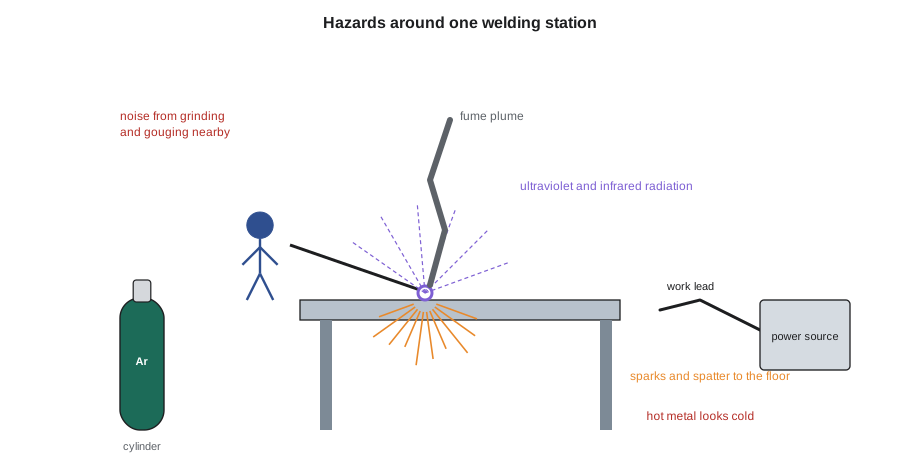
- Radiation. The arc and, to a lesser degree, the oxyfuel flame emit ultraviolet, visible and infrared light. Ultraviolet burns the cornea in seconds, causing photokeratitis, known in the trade as arc eye or welder's flash, which feels like sand in the eyes several hours after exposure. It also burns exposed skin like severe sunburn. Infrared heats the eye and over years can contribute to cataracts. Intense visible light can damage the retina. Reflected light from bright surfaces, such as aluminum, stainless steel or light-coloured walls, can expose the face from the side or behind.
- Heat and molten metal. Spatter, slag, sparks and hot metal cause burns, especially when they get inside a collar, cuff, pocket or boot. Hot work pieces look exactly like cold ones. A cut plate, a freshly ground edge or a slag chip can still burn several minutes after the work.
- Fume and gases. Welding fume is made of very fine particles of metal oxides from the base metal, filler metal and coatings. Gases include shielding gases that displace oxygen, ozone formed by the arc, nitrogen oxides from flames and plasma, and carbon monoxide. Lesson 3 covers them.
- Electric shock. The welding circuit is live whenever the machine is on, and wet gloves, damp clothing or contact with the work and the electrode at once can complete a path through the body. Lesson 4 covers it.
- Fire and explosion. Sparks and slag can travel 10 m (35 ft) or more across a floor and fall through gaps to lower levels. Containers that held flammable material can explode when cut. Lesson 5 covers hot work control.
- Compressed gases. Cylinders hold gas at high pressure, fuel gases burn, oxygen makes everything burn faster, and inert gases can suffocate. Lessons 6 and 7 cover them.
- Noise. Air carbon arc gouging, plasma cutting, grinding and hammering can exceed 100 dBA, and long exposure causes permanent hearing loss.
- Physical and ergonomic hazards. Plate and pipe are heavy and sharp, cranes move loads overhead, welding positions strain the neck and back, and work inside hot vessels or outdoors in summer causes heat stress.
Applying the hierarchy of controls
Personal protective equipment is the last line of defence, not the first. The hierarchy of controls puts elimination and substitution first, then engineering controls, then administrative controls, then PPE. Applied to welding and cutting, it looks like this:
- Elimination: avoid hot work where another method works. A bolted connection, a cold cut with a band saw or a pipe cutter, or prefabrication in the shop instead of field cutting in a refinery all remove the hazard at the source.
- Substitution: choose a process or consumable with less hazard. Plasma or mechanical cutting instead of oxyfuel near combustibles, low-fume consumables, or removing paint and galvanizing before welding instead of burning through it.
- Engineering controls: fume extraction, welding screens and curtains, interlocked machines, guarded grinders, flashback arrestors, and fixed cylinder storage.
- Administrative controls: hot work permits, procedures, training, signs, scheduling noisy work when fewer people are nearby, and keeping a fire watch.
- PPE: what the welder wears, which protects only the wearer and only when it is chosen correctly, fits, is in good condition and is worn the whole time.
Marta puts it plainly: a screen protects everyone in the bay, a helmet protects one person, and a helmet left on the bench protects nobody.
Eye and face protection
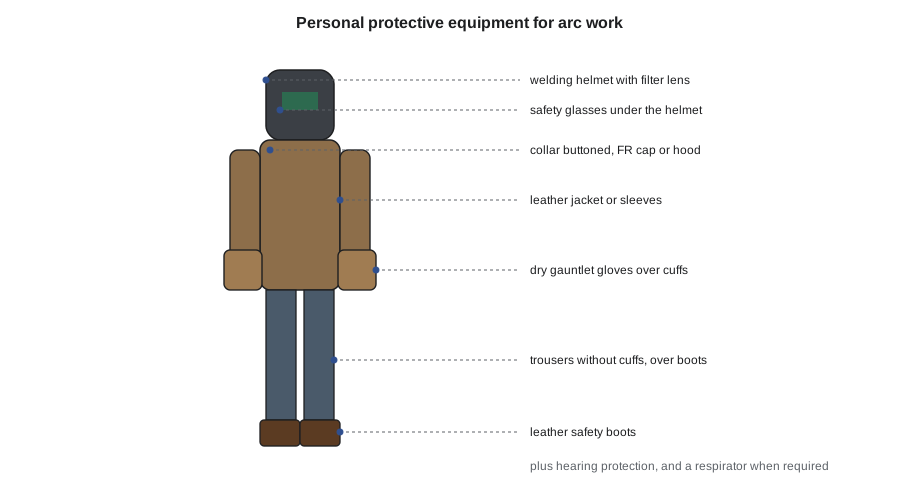
Every welder and cutter needs two layers of eye protection. Safety glasses with side shields, or goggles, are worn at all times in the shop, including under the welding helmet, because slag and grinding particles fly when the helmet is up and because chipping slag is done with the helmet raised. Over them, the welder uses a filter matched to the process: a welding helmet for arc welding, cutting and gouging, or tinted goggles or a face shield with a filter for oxyfuel work.
In Alberta, the OHS Code requires eye protection that meets CSA Z94.3, Eye and face protectors, where there is a hazard to the eyes. The standard classifies protectors by type: spectacles, goggles, welding helmets, welding hand shields, non-rigid hoods and face shields. Face shields are worn over spectacles or goggles, never alone, because they do not seal against particles coming from below or the side.
The filter's shade number describes how much visible light it transmits: each step up in shade number transmits much less light. All welding filters block ultraviolet and infrared almost completely regardless of the shade, so the shade is chosen for comfort and to protect the retina from visible glare. The rule is to start with a darker shade than needed, then go lighter until the weld zone can be seen clearly, without going below the minimum for the process and current.
| Process and current | Minimum shade | Suggested shade |
|---|---|---|
| SMAW below 60 A | 7 | – |
| SMAW 60 to 160 A | 8 | 10 |
| SMAW 160 to 250 A | 10 | 12 |
| SMAW 250 to 550 A | 11 | 14 |
| GMAW and FCAW 60 to 160 A | 10 | 11 |
| GMAW and FCAW 160 to 250 A | 10 | 12 |
| GTAW 50 to 150 A | 8 | 12 |
| Plasma cutting 60 to 80 A | 8 | – |
| Plasma cutting 80 to 300 A | 8 | 9 |
| Air carbon arc gouging below 500 A | 10 | 12 |
| Oxyfuel cutting, plate under 25 mm | 3 | 3 or 4 |
| Oxyfuel cutting, plate 25 to 150 mm | 4 | 4 or 5 |
# Pick a filter shade from a typical shade guide (minimum, suggested)
GUIDE = {
    "SMAW":   [(60, 7, 7), (160, 8, 10), (250, 10, 12), (550, 11, 14)],
    "GMAW":   [(60, 7, 7), (160, 10, 11), (250, 10, 12), (500, 10, 14)],
    "GTAW":   [(50, 8, 10), (150, 8, 12), (500, 10, 14)],
    "PLASMA": [(20, 4, 4), (40, 5, 5), (60, 6, 6), (80, 8, 8), (300, 8, 9), (400, 9, 12)],
    "CAC-A":  [(500, 10, 12), (1000, 11, 14)],
}
def shade(process, amps):
    for top, minimum, suggested in GUIDE[process]:
        if amps <= top:
            return minimum, suggested
    raise ValueError("current above the guide; use the manufacturer's data")
jobs = [("SMAW", 125, "farm repair, loader bucket"), ("GMAW", 210, "bridge floor beam fillets"), ("PLASMA", 65, "plasma, 12 mm plate"), ("CAC-A", 400, "gouging a weld root")]
for process, amps, job in jobs:
    lo, sug = shade(process, amps)
print(f"{job:34s}{process:7s}{amps:4d} A minimum shade {lo:2d}, start at {sug}")farm repair, loader bucket SMAW 125 A minimum shade 8, start at 10 bridge floor beam fillets GMAW 210 A minimum shade 10, start at 12 plasma, 12 mm plate PLASMA 65 A minimum shade 8, start at 8 gouging a weld root CAC-A 400 A minimum shade 10, start at 12
Auto-darkening helmets use a liquid crystal filter that switches from a light state, often shade 3 or 4, to the selected dark shade within a fraction of a millisecond when sensors detect the arc. They let the welder position the electrode with the helmet down, which saves the neck and reduces the number of times the welder strikes an arc with the helmet up. The ultraviolet and infrared protection is permanent and does not depend on the battery or the switching, but the sensors must be able to see the arc: a sensor blocked by the welder's arm or by the work, low-current GTAW, or bright sunlight can delay or prevent switching. The welder checks the battery, the shade and sensitivity settings and the cover lenses before use, and replaces cracked or pitted cover lenses.
Arc eye is not treated by rubbing or by home remedies. A worker who has been flashed reports it, keeps the eyes closed and protected from light, and gets first aid or medical care. Repeated flashes mean the controls are not working, whether because of missing screens, a helmet with a cracked lens, or a habit of striking the arc before lowering the helmet.
Protecting other people from arc light
The arc can flash people who are not looking at it, from across a bay. Welding stations are enclosed by opaque screens or by transparent welding curtains, which are tinted to filter ultraviolet and blue light while allowing passers-by to see that someone is working. A transparent curtain is not a substitute for a filter lens: it protects against brief accidental exposure only. Walls and screens are painted with a dull, non-reflective finish. Helpers, fitters and the fire watch working near the arc wear filter lenses suited to their distance and position, and anyone near gouging or plasma cutting, which are very bright, wears at least a shaded face shield over safety glasses.
Clothing, gloves and footwear
Clothing for welding must resist ignition and must not melt. Wool and heavy cotton, especially flame-resistant treated cotton, are the usual choices, and leather is used for jackets, sleeves, aprons and capes. Synthetic fabrics such as polyester and nylon melt onto the skin when hit by spatter and must not be worn as outer or under layers. Clothing must cover the arms and neck, with sleeves rolled down and collars buttoned, and must be free of oil and grease, which make it easier to ignite. Pockets are kept closed or removed, because sparks lodge in them, and cuffs on trousers are avoided for the same reason. Trousers go over the boot tops, not tucked in.
Leather welding gloves are gauntlet style to cover the wrist and jacket cuff. Heavy gloves are used for SMAW, gouging and cutting, and thinner, more flexible gloves for GTAW. Gloves must be dry: wet leather conducts, and a damp glove is one of the most common causes of shock. Torn or burned-through gloves are replaced. Butane lighters, matches and other ignition sources are never carried in pockets during hot work, because a spark that hits a disposable lighter can make it explode.
Safety footwear with a protective toe is required where there is a risk of foot injury, and in a fabrication shop that is everywhere. Alberta requires footwear that meets CSA Z195 where protective footwear is needed. Leather boots that lace high, or slip-on boots, keep sparks out better than low shoes, and spats or leggings are used for overhead work and gouging. Footwear with conductive or worn-through soles is not used for arc welding.
Head, hearing and heat
A hard hat is worn wherever there is overhead work, crane movement or a risk of striking the head, and welding helmets that attach to a hard hat are available. A flame-resistant welding cap or a hood protects the head and neck from sparks under the helmet and is especially important for out-of-position work.
Hearing protection, foam plugs or earmuffs that fit under or with the helmet, is worn wherever the noise exceeds the shop's limit, and earplugs also keep sparks and spatter out of the ear canal during overhead work, which is a real and very painful injury. Lesson 10 works out the noise dose from gouging and grinding.
Heat stress is a real hazard in summer, during preheating, and inside vessels. Leather and wool add to it. The shop plans heavy jobs for the cooler part of the day where it can, provides cool water and shaded breaks, and uses the buddy system so that a welder showing signs of heat exhaustion, such as headache, dizziness, nausea or confusion, is noticed by someone else.
Choosing and caring for PPE
PPE works only if it fits, is in good condition and is worn. The employer provides and maintains most of it, trains workers to use it and replaces it when it is damaged, and the worker inspects it before use and reports problems. At Hartwell, Priya keeps spare cover lenses, gloves and jackets in the tool crib, and anyone who burns through a glove or cracks a lens exchanges it at once, no questions asked. Marta inspects Devon's PPE on the first day of every job and expects Devon to inspect hers.
Devon's notebook entry for the week reads: helmet with shade 10 for stick, sensitivity high, new outer lens; safety glasses always; flame-resistant shirt buttoned to the top; leather sleeves for overhead; gauntlets dry; boots under the trouser legs; plugs in the pocket of the jacket, not the shirt; no lighter in any pocket.
Common mistakes
MistakeLifting the helmet to strike an arc and lowering it after.
InsteadLower the helmet first; use an auto-darkening helmet if positioning is hard.
MistakeWearing a polyester shirt under the welding jacket.
InsteadWear wool or flame-resistant cotton next to the skin; synthetics melt.
MistakeUsing a transparent welding curtain as eye protection for a helper.
InsteadCurtains protect against accidental exposure; helpers near the arc wear filter lenses.
MistakeWelding in damp gloves.
InsteadKeep gloves dry and change them when they get wet.
MistakeCarrying a butane lighter in a shirt pocket.
InsteadKeep lighters and matches out of pockets during hot work.
Summary and key terms
- Welding hazards include radiation, heat and molten metal, fume and gases, electric shock, fire, compressed gas, noise and physical strain.
- Elimination, substitution, engineering and administrative controls come before PPE.
- Safety glasses are worn under the helmet; the filter shade is chosen from the shade guide for the process and current.
- Screens and curtains protect other workers from arc light.
- Clothing is wool, flame-resistant cotton or leather, covering the skin, with no cuffs, open pockets or synthetics; gloves are dry gauntlets.
- PPE must fit, be inspected before use and be replaced when damaged.
- Photokeratitis
- A burn of the cornea from ultraviolet light, called arc eye or welder's flash.
- Shade number
- A rating of how much visible light a filter transmits; higher numbers are darker.
- Auto-darkening filter
- A liquid crystal filter that darkens automatically when it detects the arc.
- Welding curtain
- A tinted transparent screen that protects passers-by from brief arc exposure.
- Hierarchy of controls
- Elimination, substitution, engineering, administrative controls and PPE, in that order of preference.
- Heat stress
- Strain on the body when it cannot shed heat, leading to heat exhaustion or heat stroke.
Practice problems
Work each problem on paper first, then reveal the answer to check.
Which shade would you start with for SMAW at 120 A?
Show answer
Shade 10, going no lighter than shade 8.
Why is a face shield never worn alone?
Show answer
It does not seal against particles from below and the side, so spectacles or goggles go under it.
Name three items that make clothing more likely to catch sparks or fire.
Show answer
Open pockets, trouser cuffs, and oil or grease on the fabric (or synthetic fibres).
A helper is flashed while holding a part for tack welding. What should change?
Show answer
The helper needs a filter lens or shield for their position, and the welder warns before striking.
Lesson quiz · 5 questions
Score 60% or more to complete this lesson.
Create a free account to save your progress, take quizzes and earn a certificate.