
WLD-110 · Lesson 10 of 12 · 16 min
Air carbon arc gouging and other thermal cutting
Sometimes the job is not to cut a part off but to remove metal from it: to dig out a cracked weld, to gouge the back of a full-penetration weld down to sound metal before welding the second side, to remove a temporary attachment, or to open a groove. Air carbon arc gouging does this fast, on almost any metal, with equipment that is little more than a welding machine, a special torch and a compressed air line. It is also the loudest, dirtiest and most fire-prone process in the shop. This lesson covers air carbon arc cutting and gouging, how it is set up and used, its hazards, and several other thermal cutting processes a welder will meet: shielded metal arc cutting, exothermic oxygen lances and laser cutting.
How air carbon arc gouging works
Air carbon arc cutting and gouging, often called arc air or CAC-A, strikes an arc between a carbon-graphite electrode and the work. The arc melts a small pool of metal, and a jet of compressed air from the torch, blowing along the electrode, blasts the molten metal away. Unlike oxyfuel cutting, the process does not depend on oxidizing the metal, so it works on carbon steel, stainless steel, cast iron, copper alloys and other metals.
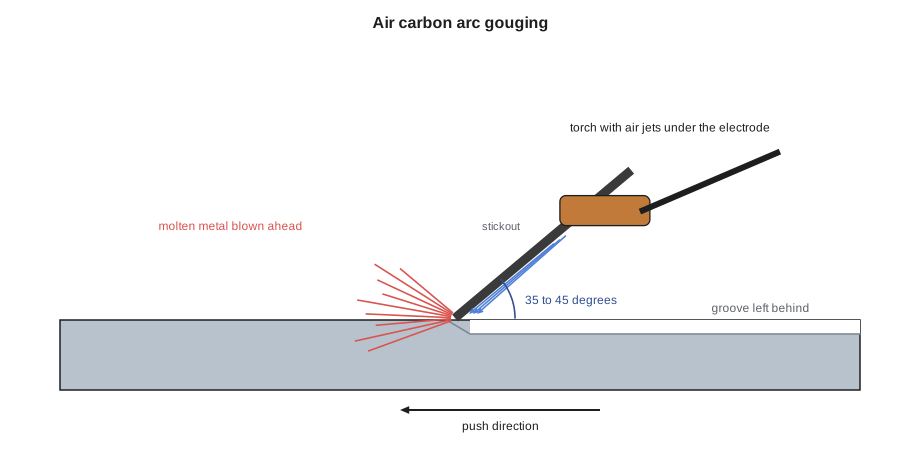
The electrodes are rods of carbon and graphite, usually coated with copper, which carries current along the rod, reduces its erosion and keeps it cooler. They come in diameters from about 4 mm (5/32 in) to 19 mm (3/4 in) and larger, and in pointed, flat and jointed forms. The torch holds the electrode in a pair of jaws with air holes below it, so the air stream runs along the underside of the electrode into the arc. A valve on the torch turns the air on and off.
Most gouging uses direct current electrode positive from a constant current machine, which gives a steady arc and a smooth groove. Some electrodes are made for alternating current or for electrode negative on cast iron and copper alloys. The machine must have enough output for the electrode: gouging uses high currents, 400 A or more for a 9.5 mm (3/8 in) electrode, and long gouges need a machine with a high duty cycle. The air supply must deliver enough flow at about 550 to 690 kPa (80 to 100 psi) at the torch; too little air leaves molten metal in the groove and carbon deposits on the surface.
Technique
Before striking the arc, the air valve is opened, so the air is flowing before the arc forms; striking without air carburizes the surface and can damage the electrode. The electrode is set with a stickout of about 150 mm (6 in) from the jaws, with the air holes underneath it on the side toward the work. For gouging, the electrode is held at about 35 to 45 degrees to the surface and pushed forward in the direction it is pointing, so the air blows the molten metal ahead and away. A steeper angle gives a deeper, narrower groove, a shallower angle a wider, shallower one, and the travel speed controls the depth as well. The arc is kept short and the electrode is not allowed to touch the work, which leaves carbon deposits.
A smooth groove with clean sides and a bright surface shows the right current, air and speed. A groove with irregular sides, carbon deposits or bits of molten metal sticking to it shows too little air, too slow a speed, or the electrode touching the work. A rough, ripple-like groove usually means unsteady travel. As the electrode burns down, the welder stops, opens the jaws and slides more electrode out, keeping the stickout in the right range; jointed electrodes can be screwed together so a long gouge can continue.
Gouging to remove a weld defect is done in steps, examining the groove as it goes, until sound metal is reached, and then the groove is ground to remove the thin layer of carbon-enriched, hardened metal left on the surface. On hardenable steels, the welding procedure may require preheating before gouging and grinding afterwards, because that layer can crack. Back-gouging a double-sided groove weld for the Riverside girders, for example, is followed by grinding and a visual or magnetic particle check that the root is clean before the second side is welded.
# Back-gouging a girder seam: metal removed, electrodes used, arc-on time
length = 12              # length of seam to back-gouge (m)
depth, width = 8, 12   # groove depth and width (mm)
steel = 7850             # steel density (kg/m³)
removal = 0.25            # metal removal rate for this electrode and current (kg per minute, illustrative)
stub_per = 0.6           # length of groove gouged per electrode, including the stub left (m)
area = 0.5 * depth * width                 # a U-shaped groove is roughly half the rectangle
volume = area * length / 1e6
mass = volume * steel
minutes = mass / removal
electrodes = length / stub_per
print(f"metal removed about {mass:.1f} kg")
print(f"arc-on time about {minutes:.0f} min, about {electrodes:.0f} electrodes")metal removed about 4.5 kg arc-on time about 18 min, about 20 electrodes
The numbers are rough, but they show why gouging is planned. Twenty or thirty minutes of arc-on time, at a high current, with a long spray of molten metal and extreme noise, is a significant hot work task on its own, and it needs its own preparation even in the shop.
Hazards of gouging
Every hazard in this course is at its worst during air carbon arc gouging:
- Noise. Gouging commonly produces 110 to 120 dBA at the operator, enough to damage hearing within minutes. Earplugs and earmuffs together are often needed, and people nearby need protection too.
- Molten metal. The air jet throws large globules of molten metal several metres. Gouging is done with the spray directed away from people, cylinders, hoses, cables and combustibles, with screens or blankets to catch it, and with the area cleared and a fire watch as for any hot work. Hoses and leads are kept behind the operator.
- Fume. Gouging produces heavy fume containing the base metal, copper from the electrode coating and carbon. Local exhaust is used where practical, and a respirator is usually needed.
- Light. The arc is very bright, and filter shades of about 12 for light gouging and 14 for heavy gouging are typical. Spectators and helpers need shielding.
- Electric shock and heat. Currents are high, electrode holders get hot, and the stub of a used electrode is hot enough to start a fire or burn through a glove. Stubs go in a metal container, not on the floor.
Protective clothing for gouging is heavier than for welding: leather jacket or cape and sleeves, a leather apron for bench work, spats over the boots, and a hood or cap. Ear canals are protected against sparks as well as noise.
Noise dose
Noise exposure is measured as a dose: the share of the allowed daily exposure a worker has received. Each sound level has an allowed time, and the dose is the sum of the actual time at each level divided by the allowed time at that level. The allowed time halves for every increase in level equal to the exchange rate.
where L is the sound level, L_c the criterion level for eight hours and q the exchange rate.
# Daily noise dose for a welder who gouges, grinds and welds
criterion, exchange = 85, 3          # dBA for 8 h, and dB per halving of time
tasks = [  # (task, level in dBA, hours per shift)
    ("air carbon arc gouging", 115, 0.5),
    ("grinding", 98, 1.5),
    ("plasma cutting", 102, 0.75),
    ("SMAW welding", 85, 3.0),
    ("fitting and layout", 80, 2.25),
]
dose = 0.0
for task, level, hours in tasks:
    allowed = 8 / 2 ** ((level - criterion) / exchange)
    dose += hours / allowed
    print(f"{task:24s}{level:4d} dBA  {hours:5.2f} h  allowed {allowed:7.2f} h")
print(f"daily dose {100 * dose:.0f} % of the limit")
twa = criterion + exchange * __import__('math').log2(dose)
print(f"equivalent 8-hour level about {twa:.0f} dBA")air carbon arc gouging 115 dBA 0.50 h allowed 0.01 h grinding 98 dBA 1.50 h allowed 0.40 h plasma cutting 102 dBA 0.75 h allowed 0.16 h SMAW welding 85 dBA 3.00 h allowed 8.00 h fitting and layout 80 dBA 2.25 h allowed 25.40 h daily dose 7301 % of the limit equivalent 8-hour level about 104 dBA
Under Alberta's criteria of 85 dBA and a 3 dB exchange rate, half an hour of gouging at 115 dBA alone is many times the daily limit. That is why gouging is done with double hearing protection and why the shop limits how long any one person gouges in a shift.
Hearing protectors are rated for how much they reduce noise, but real-world reduction is usually much less than the label, because of fit. Plugs that are inserted properly, deeply and with clean hands, and earmuffs worn without hair or safety glass arms breaking the seal, are what make the difference.
Shielded metal arc cutting and gouging
Special covered electrodes, run on an ordinary SMAW machine at high current, can cut and gouge without compressed air. Their thick flux covering burns away more slowly than the core, forming a deep cup that concentrates the arc and creates a gas jet that pushes molten metal out. The welder uses a pushing or sawing motion. The process is slower and rougher than air carbon arc gouging, but it is handy for field repairs where there is no air supply, such as removing a broken bracket on a piece of farm equipment. Its hazards are those of SMAW at high current, with more spatter.
Exothermic cutting and oxygen lances
An oxygen lance is a long steel pipe through which oxygen flows; once its end is ignited, the pipe itself burns in the oxygen, producing a very hot flame that will pierce and cut steel, cast iron, concrete and rock. Exothermic cutting rods, often called burning bars, are tubes packed with steel and other metal wires, ignited by an arc or a flare, that burn at extreme temperatures. They are used for demolition, for cutting heavy and rusted sections, for piercing tap holes in furnaces and for underwater work. They produce intense heat, light, fume and molten slag, use large amounts of oxygen, and are used only by trained people under specific procedures.
Laser cutting
Laser cutting focuses a high-power beam on the work through a nozzle with an assist gas, oxygen for carbon steel or nitrogen for stainless and aluminum. It is a precise, fast process for sheet and thin plate, used in production on fully enclosed CNC machines. Industrial cutting lasers are the most hazardous class of laser: direct or reflected beams can blind and burn instantly, and some wavelengths are invisible. They are safe only as long as their enclosures and interlocks are intact, and the machines are operated and maintained by trained people under the laser safety program. Welders meet laser-cut parts more often than they operate laser cutters, but the rule is the same as for any CNC machine: never defeat an interlock or open an enclosure to clear a part while the machine is running.
Devon gouges a repair
The farmer's cultivator toolbar has a cracked old repair weld. Marta has Devon gouge it out in the repair bay. Devon's preparation: the toolbar is cleaned of mud and grease; it is set on stands with the work lead clamped beside the crack; the bay door is closed to stop drafts blowing sparks across the shop, but the extraction is on; welding screens and a fire blanket stand on the spray side; cylinders, hoses and the other welder's leads are moved behind the operator; the fire watch, a second apprentice, has an extinguisher and the fire watch duty for an hour afterwards; Devon wears plugs and muffs, a leather cape and spats, and a shade 12 lens; the air is set to about 620 kPa (90 psi). The crack is gouged out in three passes, ground clean, and checked with dye penetrant before Marta welds it.
Common mistakes
MistakeStriking the arc before opening the air.
InsteadTurn the air on first, then strike the arc.
MistakeGouging toward other workers or cylinders.
InsteadDirect the spray away from people, cylinders, hoses and combustibles, and screen it.
MistakeWelding straight onto a gouged surface on hardenable steel.
InsteadGrind off the carbon-enriched layer first and follow the procedure for preheat.
MistakeWearing earplugs only for heavy gouging.
InsteadUse plugs and muffs together, and limit time.
MistakeDropping electrode stubs on the floor.
InsteadPut hot stubs in a metal container.
Summary and key terms
- Air carbon arc gouging melts metal with a carbon electrode arc and blows it away with compressed air; it works on most metals.
- Use DCEP for most work, enough current and air at about 550 to 690 kPa (80 to 100 psi), air on before the arc, and a 35 to 45 degree push angle.
- Gouged surfaces carry a hard, carbon-rich layer that is ground off before welding.
- Gouging is extremely loud and throws molten metal far; it needs hearing protection, screens, fire watch and heavy clothing.
- Noise dose adds the time at each level divided by the allowed time, which halves for each exchange-rate step.
- Shielded metal arc cutting, oxygen lances, burning bars and laser cutting are other thermal methods, each with its own controls.
- CAC-A
- Air carbon arc cutting and gouging.
- Back-gouging
- Removing metal from the back of a weld root to reach sound metal before welding the second side.
- Stickout
- The length of electrode extending from the torch jaws.
- Exchange rate
- The increase in sound level that halves the allowed exposure time.
- Noise dose
- The share of the allowed daily noise exposure received.
- Burning bar
- An exothermic cutting rod that burns in oxygen at very high temperature.
Practice problems
Work each problem on paper first, then reveal the answer to check.
Under 85 dBA and a 3 dB exchange rate, how long is allowed at 97 dBA?
Show answer
8 / 2^4 = 0.5 hours.
Why is the air turned on before striking a gouging arc?
Show answer
So molten metal is blown away at once and the surface is not carburized.
What does a steeper electrode angle do to the groove?
Show answer
Makes it deeper and narrower.
Lesson quiz · 5 questions
Score 60% or more to complete this lesson.
Create a free account to save your progress, take quizzes and earn a certificate.