
VIS-410 · Lesson 9 of 12 · 26 min
Competitions, festivals and portfolio reviews
Competitions, festivals and portfolio reviews promise visibility, prizes and introductions to influential people. Some deliver real career value; others mainly earn entry fees for their organizers or quietly take rights to your images. This lesson helps you choose opportunities wisely: understanding what each type offers, estimating whether the cost is worth it, spotting red flags and unfair terms, and preparing so that the time you spend in front of reviewers and juries pays off.
The opportunity landscape
Photographers encounter many kinds of opportunity, and they serve different purposes.
- Juried competitions and awards select winning images or projects, often with prizes, exhibitions or publication. Some are highly respected in particular fields; many are not.
- Open calls invite submissions for an exhibition, festival program, publication or book, usually reviewed by a curator or jury.
- Photography festivals present exhibitions, talks and events over days or weeks; many include open calls, portfolio reviews and fringe programs.
- Portfolio reviews give short, scheduled meetings with curators, editors, gallerists, publishers and art buyers, usually for a fee.
- Grants and fellowships, covered in lesson 8, fund projects rather than rewarding finished images.
In Canada, examples include month-long festivals such as the CONTACT Photography Festival in Toronto and the Capture Photography Festival in Vancouver, and the MOMENTA Biennale de l'image in Montréal. In the United States, long-running portfolio review events include FotoFest in Houston and Photolucida in Portland, along with festivals and reviews organized by non-profits across the country. Formats and dates change, so check current details before planning.
What makes an opportunity worth entering
A good opportunity offers something you cannot easily get elsewhere: exposure to the right audience, a credible endorsement, a meaningful prize, a quality exhibition or publication, or access to decision makers. Before entering, ask who the jurors or reviewers are and whether they matter to your career, who has won before and where those photographers are now, what winners actually receive, how many people enter and what it costs in fees, printing, shipping and travel, and what rights you give up by entering.
| Question | Good sign | Red flag |
|---|---|---|
| Who judges? | Named, credible jurors relevant to your work | No jurors named or vague "industry experts" |
| What do winners get? | Exhibition, publication, cash, introductions | Only a certificate or online gallery |
| What does it cost? | Modest or no fee; fee waivers available | High fees per image with many award categories |
| What rights do you grant? | Limited use to promote the competition, with credit | Broad, perpetual or commercial use of all entries |
| Who has won before? | Winners went on to exhibit, publish or get work | Past winners are hard to find or unknown |
Estimating the value of an entry
Entry fees add up quickly. A photographer who enters ten competitions a year at $40 to $90 each can easily spend $600 or more, plus prints and shipping for finalists. A rough expected-value calculation helps you compare opportunities, even though the most valuable outcomes, such as a new relationship with a curator, are hard to price.
Worked problem
Is this competition worth entering?
A competition charges $60 for up to 5 images. It receives about 2,500 entries and selects 25 finalists for an exhibition that you value at about $1,500 in career benefit (exposure, CV credit, possible sales). One winner gets a $5,000 prize. Your work is a good fit, and you estimate your chance of being a finalist at about three times the average. What is the expected value of entering?
Show solution
- Average chance of being a finalist: \( 25 / 2{,}500 = 0.01 \); your estimate is \( 3 \times 0.01 = 0.03 \).
- Expected value from being a finalist: \( 0.03 \times 1{,}500 = 45 \) dollars.
- Chance of winning the top prize, assuming one winner among the finalists: \( 0.03 \times 1/25 = 0.0012 \), so expected prize value is \( 0.0012 \times 5{,}000 = 6 \) dollars.
- Expected value: \( 45 + 6 - 60 = -9 \) dollars.
Answer: About −$9: slightly negative on these assumptions. The decision depends on how much you really value the exhibition and the jurors' attention; a competition with a worse fit or higher fees would be clearly negative.
The numbers are rough, but the method forces honest questions. Most competitions have a negative expected value for most entrants. Choose a few that are well matched to your work and career goals, rather than entering everything.
Rights grabs and unfair terms
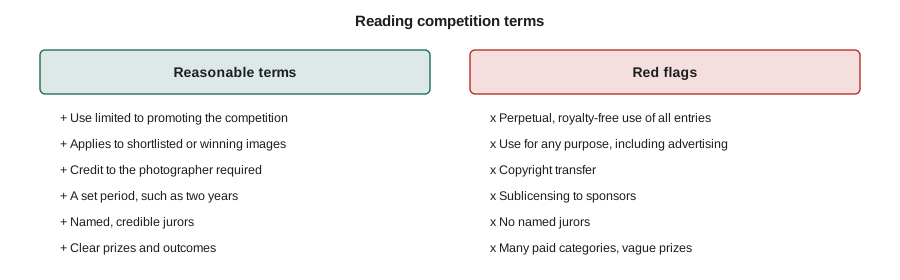
Read the terms and conditions of every competition before entering. A rights grab is a clause that gives the organizer broad rights to use entered images, sometimes all entries rather than just winners, for commercial purposes, without payment, for an unlimited time. Some terms even claim to transfer copyright. Reasonable terms limit use to promoting the competition and exhibition, require credit, apply mainly to shortlisted or winning images, and end after a set period.
- Red flag: "By entering, you grant the organizer a perpetual, worldwide, royalty-free licence to use all submitted images for any purpose."
- Red flag: copyright transfer or a right to sublicense to sponsors for advertising.
- Red flag: no named jurors, unclear prizes and many paid categories designed to maximize fees.
- Reasonable: "Winning and shortlisted images may be used, with credit, to promote the competition and exhibition for two years."
Professional organizations and copyright advocates publish guidance on fair competition terms, and some maintain lists of competitions with problematic rules. If terms are unclear, ask the organizer in writing before entering. If they claim rights you are not willing to give, do not enter.
Portfolio reviews
Portfolio review events schedule short meetings, often 20 minutes, between photographers and reviewers such as curators, gallery directors, editors, publishers and art buyers. Registration fees can be substantial, especially once travel and accommodation are added, so preparation matters. Reviews are most valuable when you meet reviewers who can genuinely help your work move forward, and when you treat each meeting as the start of a relationship rather than a sales pitch.
- Research reviewers before choosing or ranking them: what do they program, publish or commission, and does your work fit?
- Bring a tight edit, usually 15 to 20 prints or a tablet with the same, plus a printed leave-behind with your contact details.
- Know what you want from each meeting: feedback on an edit, advice on next steps, a book or exhibition possibility, an introduction.
- Let the reviewer look; talk briefly about the project, then ask focused questions.
- Follow up within a week with a short thank-you and a link, and stay in touch when you have genuine news.
Worked problem
Budgeting for a review event
A portfolio review event costs $750 for 8 reviews. Travel costs $420, accommodation $165 a night for 3 nights, meals $55 a day for 3 days and printing a leave-behind $90. What is the total cost and the cost per review? If one review in eight typically leads to a meaningful opportunity, what does each opportunity cost?
Show solution
- Accommodation: \( 3 \times 165 = 495 \) dollars; meals: \( 3 \times 55 = 165 \) dollars.
- Total: \( 750 + 420 + 495 + 165 + 90 = 1{,}920 \) dollars.
- Cost per review: \( 1{,}920 / 8 = 240 \) dollars.
- With 1 meaningful opportunity per 8 reviews, each opportunity costs about \( 1{,}920 \) dollars.
Answer: About $1,920 in total, or $240 per review; plan for roughly $1,920 per meaningful opportunity, and choose reviewers carefully to improve the odds.
Preparing for a jury or review
Whether you are entering a competition or sitting with a reviewer, the principles from lessons 2 and 3 apply: a tight, consistent edit, a strong opening and closing, clear captions and a short, plain-language statement. For online competitions, follow file specifications exactly and name files as instructed. For reviews, practise a 30-second introduction to your project: what it is, why you are making it and where you hope it will go.
Giving and receiving feedback well
Reviewers will disagree with each other. One may love the series another finds unresolved. Take notes on every meeting, look for patterns across reviewers and remember that a reviewer's suggestion reflects their taste and program as well as your work. Thank people for criticism, even when you disagree; reviewers remember photographers who listen. Never argue in a review or post negative comments about reviewers or competitions publicly.
Building a yearly opportunity plan
Rather than reacting to every deadline, choose opportunities strategically. At the start of the year, list the competitions, open calls, festivals and reviews that best fit your goals, with deadlines, fees and expected benefits. Set a yearly budget for entry fees and review events, and stick to it. Leave room for one or two unexpected opportunities. Track results: what you entered, what happened and what you learned. After a year or two you will know which kinds of opportunity actually move your career forward.
Online competitions and generated images
Many competitions now publish rules on digital manipulation, compositing and generated images. Some ban generated content entirely; others create separate categories or require disclosure of any tools used. Documentary and nature categories often require original raw files on request to verify that images were not staged or altered beyond accepted limits. Read these rules carefully and keep your raw files, because a disqualification after a public announcement can damage your reputation more than never entering.
Fee waivers and access
Entry fees can exclude photographers with limited income. Some organizers offer fee waivers, reduced fees for students and early-career photographers, or free entry for members of under-represented groups. If an opportunity you value is too expensive, it is reasonable to ask politely whether a waiver or reduced fee is available. When you have more experience, supporting free or low-cost opportunities, by volunteering as a reviewer or juror, helps keep the field open to newcomers.
Measuring your results
Keep a simple record of every opportunity: the date, the fee, what you submitted, the outcome and any contacts or later benefits that came from it. After a year, total the fees and compare them with the results. Many photographers find that one or two kinds of opportunity, such as a particular review event or a festival open call, produce most of their exhibitions and contacts, while scattered competition entries produce little. Use that evidence to plan the following year.
Common mistakes
MistakeEntering every competition you see
InsteadChoose a few well-matched opportunities with credible jurors and meaningful outcomes.
MistakeClicking "I agree" without reading the terms
InsteadRead the rights clauses and avoid competitions that claim broad commercial use or copyright.
MistakeBooking portfolio reviews without researching reviewers
InsteadChoose reviewers whose programs, publications or clients fit your work.
MistakeTreating a review as a sales pitch
InsteadSeek feedback and start a relationship; let the reviewer look and ask focused questions.
MistakeFailing to follow up after a review
InsteadSend a short thank-you with a link within a week and stay in touch with real news.
Summary and key terms
- Competitions, open calls, festivals and portfolio reviews offer different benefits and costs.
- Judge an opportunity by its jurors, outcomes, costs, rights terms and past winners.
- Most competitions have a negative expected value for most entrants, so choose carefully.
- Avoid rights grabs that claim broad, perpetual or commercial use of all entries.
- Portfolio reviews can cost close to $2,000 with travel, so research reviewers and prepare a tight edit.
- Look for patterns in feedback and follow up promptly and professionally.
- Plan opportunities and fees for the year and track what actually helps your career.
- Juried competition
- A contest in which a jury selects winners from submitted work
- Open call
- A public invitation to submit work for an exhibition, festival or publication
- Portfolio review
- A scheduled short meeting in which a reviewer looks at and discusses your work
- Rights grab
- A competition term giving the organizer broad rights to use entries without payment
- Royalty-free licence
- A licence allowing use without further payment to the creator
- Perpetual licence
- A licence with no end date
- Expected value
- The average outcome of a choice, weighting each result by its probability
- Leave-behind
- A printed card or booklet left with a reviewer as a reminder of your work
- Shortlist
- The group of entries chosen for final consideration or exhibition
- Fee waiver
- An arrangement that lets some applicants enter without paying the fee
Practice problems
Work each problem on paper first, then reveal the answer to check.
Name five types of opportunity discussed in this lesson.
Show answer
Juried competitions, open calls, festivals, portfolio reviews and grants or fellowships.
30 finalists from 3,000 entries; your chance is twice average; finalist value $1,200; fee $45. What is the expected value?
Show answer
\( 2 \times 0.01 \times 1{,}200 - 45 = 24 - 45 = -21 \) dollars.
What is a rights grab?
Show answer
A clause giving the organizer broad, often perpetual commercial rights to entries without payment.
Give one example of reasonable competition terms.
Show answer
Use of winning images with credit to promote the competition and exhibition for a limited time.
A review event costs $600 for 6 reviews, plus $900 in travel and lodging. What is the cost per review?
Show answer
\( 1{,}500 / 6 = 250 \) dollars.
What should you bring to a portfolio review?
Show answer
A tight edit of 15 to 20 prints or a tablet, and a printed leave-behind with contact details.
How should you handle conflicting reviewer feedback?
Show answer
Take notes, look for patterns and remember each reviewer's taste and program.
What warning signs suggest a competition mainly earns fees?
Show answer
No named jurors, vague prizes and many paid categories.
When should you follow up after a review?
Show answer
Within about a week, with a short thank-you and a link.
Why set a yearly budget for entries and reviews?
Show answer
Fees add up quickly, and a plan focuses spending on opportunities that fit your goals.
Lesson quiz · 5 questions
Score 60% or more to complete this lesson.
Create a free account to save your progress, take quizzes and earn a certificate.