
VIS-410 · Lesson 2 of 12 · 29 min
Editing a portfolio
Editing is where most portfolios are won or lost. Making strong images is necessary, but choosing which ones to show, and having the discipline to leave out good images that do not serve the purpose, is what separates a professional portfolio from a collection of nice pictures. Photographers often say that you are judged by your weakest image, not your strongest. This lesson turns that saying into a method: how to move from hundreds of candidates to a tight selection of 15 to 25 images, how to balance consistency and range, and how to use outside critique without losing your own judgment.
Why editing is hard
Editing your own work is difficult for reasons that have little to do with skill. You remember the effort behind each image: the early alarm, the long drive, the difficult client, the lucky moment. Those memories are invisible to a viewer, but they make you overvalue certain frames. You also know what you meant to show, so your mind fills in what the image does not quite deliver. And recent work always feels more exciting than older work, whether or not it is better.
Good editors work against these biases deliberately. They let time pass before final decisions, they look at images small and large, in sequence and alone, and they ask other people to look without explaining the backstory. The goal is to see each image as a stranger would see it for the first time.
A staged edit from hundreds to a portfolio
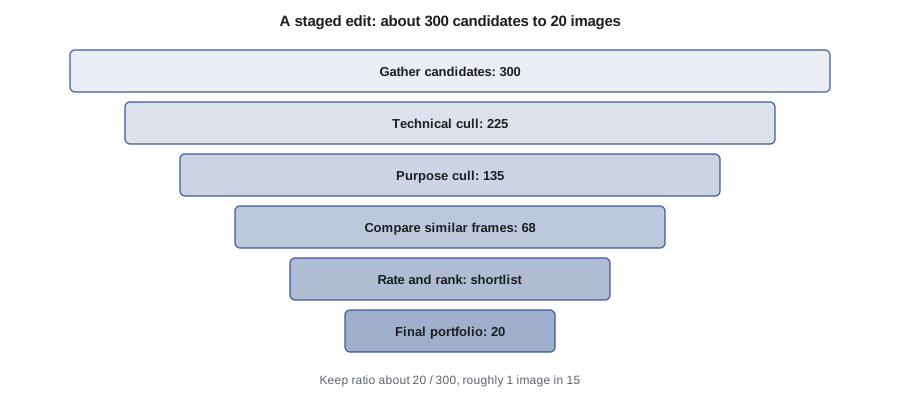
A reliable way to edit is in stages, each with a clear question. Trying to choose the final 20 from 400 images in one pass leads to fatigue and inconsistency; narrowing in stages keeps each decision manageable.
- Stage 1, gather: pull every candidate from your archive that might fit the purpose sentence. Be generous; it is easier to cut than to remember something you forgot.
- Stage 2, technical cull: remove images with focus, exposure, colour or file-quality problems that cannot be fixed. Be strict; a technically weak image cannot carry a professional portfolio.
- Stage 3, purpose cull: remove images that do not support the purpose sentence, however good they are.
- Stage 4, compare similar images: when you have several frames of the same subject or idea, keep the strongest one and let the others go.
- Stage 5, rate and rank: give each remaining image a score against simple criteria, then rank.
- Stage 6, test the set: lay the top images out together, in print or on screen, and check consistency, variety and flow. Replace weak links and remove repetition.
Worked problem
From 300 candidates to 20
Jonah pulls 300 candidate images for an editorial portrait portfolio. His technical cull removes 25 per cent. His purpose cull removes 40 per cent of what remains. Comparing similar frames removes half of what is left. He then ranks the rest and wants a final portfolio of 20. How many images reach the ranking stage, and what is the overall keep ratio?
Show solution
- After the technical cull: \( 300 \times 0.75 = 225 \).
- After the purpose cull: \( 225 \times 0.60 = 135 \).
- After comparing similar frames: \( 135 \times 0.50 \approx 68 \) images reach the ranking stage.
- Final selection of 20 from 300 gives a keep ratio of \( 20 / 300 \approx 0.067 \), or about 1 image in 15.
Answer: About 68 images are ranked, and the final keep ratio is about 6.7 per cent, roughly 1 in 15.
The exact numbers vary, but the shape is typical. Many working photographers report keeping well under 10 per cent of their candidates for a portfolio. If you find yourself keeping a third or a half, you are probably not editing yet; you are approving.
Criteria for rating images
Rating against explicit criteria makes editing more consistent and easier to explain to yourself and others. Choose four or five criteria that match the portfolio's purpose, score each image from 1 to 5 on each, and weight the criteria if some matter more.
| Criterion | Question | Weight |
|---|---|---|
| Impact | Does the image hold attention within a few seconds? | 30 % |
| Relevance | Does it support the purpose sentence and the audience's needs? | 25 % |
| Craft | Is light, focus, colour and post-processing at a professional level? | 20 % |
| Voice | Is it recognizably yours rather than generic? | 15 % |
| Fit | Does it work with the other images in style and tone? | 10 % |
Worked problem
Scoring two candidates
Using the weights above, image A scores impact 5, relevance 3, craft 4, voice 4, fit 3. Image B scores impact 4, relevance 5, craft 4, voice 3, fit 5. Which ranks higher?
Show solution
- Image A: \( 0.30 \times 5 + 0.25 \times 3 + 0.20 \times 4 + 0.15 \times 4 + 0.10 \times 3 = 1.50 + 0.75 + 0.80 + 0.60 + 0.30 = 3.95 \).
- Image B: \( 0.30 \times 4 + 0.25 \times 5 + 0.20 \times 4 + 0.15 \times 3 + 0.10 \times 5 = 1.20 + 1.25 + 0.80 + 0.45 + 0.50 = 4.20 \).
Answer: Image B ranks higher (4.20 against 3.95). Its strength in relevance and fit outweighs image A's extra impact, which shows why scoring against the purpose is more useful than asking "which do I like more?"
Scores are a tool, not a verdict. Use them to surface disagreements with your own instincts: if you love an image that scores poorly, ask why. Sometimes the score is wrong because your criteria missed something important; more often the image is a personal favourite that does not serve the audience.
Consistency and range
Consistency is the single most important quality of a professional portfolio. It means that the images look as though they came from one photographer with one standard, so that a client can predict what you will deliver. Consistency comes from repeated choices: a characteristic approach to light, a colour palette, a working distance, a type of subject, a level of finish. It does not mean that every image looks the same.
Range shows that you can apply your approach to different situations within your specialty. A product photographer shows reflective, transparent and soft products; a portrait photographer shows different ages, settings and moods; an architectural photographer shows exteriors and interiors, day and twilight. Range that stays within your specialty builds confidence; range that wanders into unrelated genres weakens it.
- Too consistent: twenty almost identical images make the viewer stop looking after five. Vary scale, composition, colour accents and subject within the style.
- Too varied: images that look like they came from five different photographers make the client doubt which one they would get.
- About right: a recognizable style applied to varied, relevant subjects, with no image noticeably weaker than the rest.
How many images?
There is no universal number, but conventions exist. Many commercial portfolios and printed books run between 15 and 30 images. Gallery and exhibition submissions often ask for 10 to 20 images of one body of work. Grant and residency portals set exact limits, frequently between 10 and 20 images, and sometimes count video minutes separately. Employers reviewing a website may click through only a gallery or two. When in doubt, show fewer images. A portfolio of 15 excellent images is stronger than 30 that include ten average ones, because the average images lower the whole set.
Worked problem
How weak images drag down a portfolio
A photographer has 15 images that a reviewer would score 9 out of 10 and is tempted to add 10 more that would score 6. What happens to the average perceived quality?
Show solution
- With 15 images: average \( = 9 \).
- With 25 images: total \( = 15 \times 9 + 10 \times 6 = 135 + 60 = 195 \), so the average is \( 195 / 25 = 7.8 \).
- The extra images add volume but lower the average by 1.2 points, and reviewers tend to remember weak images as signs of inconsistency.
Answer: The average falls from 9 to 7.8. Adding the weaker images makes the portfolio look less consistent, not more impressive.
Getting outside critique
Outside eyes are essential, because you cannot unknow the backstory of your own images. The most useful feedback comes from people who understand the audience you are aiming at: an art director for commercial work, a curator or established artist for gallery work, a working editor for editorial work. Friends and family can tell you which images they like, but not which ones a client will hire you for.
Make critique productive by asking specific questions. Rather than "What do you think?", ask "Which three images would you remove first?", "Does the opening image tell you what I do?", "Which image feels like it came from a different photographer?" or "If you were hiring for a product shoot, what is missing?" Do not explain or defend images during the critique; listen, take notes and decide later.
- Portfolio reviews at festivals, schools and professional associations offer short sessions with experienced reviewers (lesson 9).
- Peer critique groups, in person or online, provide regular, honest feedback from other photographers.
- Mentors offer longer-term perspective on how your work and career are developing.
- Analytics such as website time-on-page or which images get enquiries give indirect evidence, though they reflect your audience more than quality.
Expect conflicting advice. Two respected reviewers may disagree about the same image. Look for patterns: if three people independently suggest removing the same image, remove it. If opinions split, return to your purpose sentence and your audience.
Editing a personal project
Editing a body of work for exhibition or publication differs from editing a commercial portfolio. Here the images must work as a group to express an idea, and a quieter image may earn its place by connecting two stronger ones or by changing the pace. Photographers editing a project often work with small prints on a wall or table, moving them around for days or weeks. They remove images that repeat what another image already says, and they look for gaps where the story or idea needs another picture, which may mean returning to make new work.
Editors of photobooks and exhibitions often talk about the edit and the sequence as one process; lesson 3 covers sequencing in detail.
Keeping the portfolio current
A portfolio is never finished. Review it at least twice a year and after every significant new job or project. Replace the weakest images with stronger new ones, retire work that no longer represents the direction you want to pursue, and rebuild audience-specific versions as your goals change. A useful habit is to keep a running "portfolio candidates" collection in your catalogue software, tagging strong new images as you deliver jobs, so that updating takes an hour rather than a weekend.
Common mistakes
MistakeKeeping images because of the effort or story behind them
InsteadJudge each image as a stranger would, using the purpose sentence and audience needs.
MistakeChoosing the final selection in a single pass
InsteadEdit in stages, each with one clear question, and let time pass before final decisions.
MistakeAdding average images to look more productive
InsteadShow fewer, stronger images; weak images lower the perceived quality of the whole set.
MistakeAsking only friends and family for critique
InsteadSeek feedback from people who understand the target audience, and ask specific questions.
MistakeDefending images during a critique
InsteadListen, take notes and decide later, looking for patterns across reviewers.
Summary and key terms
- You are judged by your weakest image, so editing is as important as making images.
- Edit in stages: gather, technical cull, purpose cull, compare similar frames, rate and test the set.
- Many professionals keep well under 10 per cent of candidates for a portfolio.
- Weighted scoring against explicit criteria makes editing consistent and reveals personal biases.
- Consistency of standard and style matters more than range; show range within your specialty.
- Fewer excellent images beat more images that include average ones.
- Use specific questions in outside critique and look for patterns rather than single opinions.
- Cull
- A pass that removes images failing a specific test, such as technical quality or relevance
- Keep ratio
- The share of candidate images that make it into the final selection
- Weighted score
- A total that multiplies each criterion's rating by its importance and adds the results
- Similars
- Several frames of the same subject or moment, from which one is usually kept
- Shortlist
- The ranked group of images from which the final selection is made
- Weak link
- An image noticeably below the standard of the rest of a set
- Portfolio review
- A short critique session with an experienced reviewer, often at a festival or association event
- Peer critique
- Regular feedback exchanged among photographers working at a similar level
- Mentor
- An experienced practitioner who advises on work and career over time
- Candidates collection
- A tagged set in catalogue software holding images that might enter a future portfolio
Practice problems
Work each problem on paper first, then reveal the answer to check.
List the six stages of the edit described in this lesson.
Show answer
Gather, technical cull, purpose cull, compare similar images, rate and rank, test the set.
You start with 240 candidates and keep 18. What is the keep ratio?
Show answer
\( 18/240 = 0.075 \), or 7.5 per cent.
With weights 40/30/30 for impact, relevance and craft, score an image rated 4, 5, 3.
Show answer
\( 0.4 \times 4 + 0.3 \times 5 + 0.3 \times 3 = 1.6 + 1.5 + 0.9 = 4.0 \).
Twelve images average 8.5 and you add six that average 6. What is the new average?
Show answer
\( (102 + 36)/18 = 138/18 \approx 7.7 \).
Why do photographers overvalue some of their own images?
Show answer
They remember the effort and story behind them and mentally fill in what they intended.
Give two specific questions to ask a reviewer.
Show answer
"Which three images would you remove first?" and "Does the opening image tell you what I do?"
What does range within a specialty look like for an architectural photographer?
Show answer
Exteriors and interiors, day and twilight, different building types, all in one consistent style.
How should you treat conflicting advice from two reviewers?
Show answer
Look for patterns across several reviewers and return to the purpose sentence and audience to decide.
How is editing a personal project different from editing a commercial portfolio?
Show answer
Images must work together to express an idea, and quieter connecting images may earn a place.
What habit makes updating a portfolio fast?
Show answer
Tag strong new images in a candidates collection as you deliver jobs, and review the portfolio twice a year.
Lesson quiz · 5 questions
Score 60% or more to complete this lesson.
Create a free account to save your progress, take quizzes and earn a certificate.