
VIS-410 · Lesson 1 of 12 · 28 min
What a portfolio is for
A portfolio is a small, carefully chosen set of your best work, assembled for a particular person who has to make a decision about you. That last part is the one most new photographers forget. A portfolio is not an archive, a scrapbook or a record of everything you can do. It is an argument, made with pictures, that you are the right person for a job, an exhibition, a grant, a place in a program or a contract. This course is the last step in the photography program: it turns four years of images into a professional package and a plan for the first year of a working practice. Earlier courses covered business basics (PHOT-302), event and wedding work (PHOT-340), crew careers in film (CINE-420) and creator businesses (the CRE courses). Here the focus is the portfolio itself and the professional habits that carry it to the people who matter.
The portfolio as an argument
Every portfolio answers three questions, whether you intend it to or not. What can this person do? How consistently can they do it? And what would it be like to work with them? A viewer forms an answer to all three within minutes, often within the first few images. Art directors, gallery directors and grant juries look at hundreds of submissions; they are not hunting for reasons to like you, they are looking for reasons to narrow a pile. A strong portfolio makes the decision easy by being clear about what you offer.
That clarity comes from purpose. Before you choose a single image, write one sentence that finishes "This portfolio shows that I…". For a commercial photographer it might be "…can make clean, consistent product images that sell on a website." For an artist it might be "…have a sustained, original body of work about memory and place in Northern Ontario." For a graduate school applicant it might be "…can develop an idea through research and iteration." Every image you later include must support that sentence; every image that does not, however much you love it, belongs somewhere else.
Four audiences and what they look for
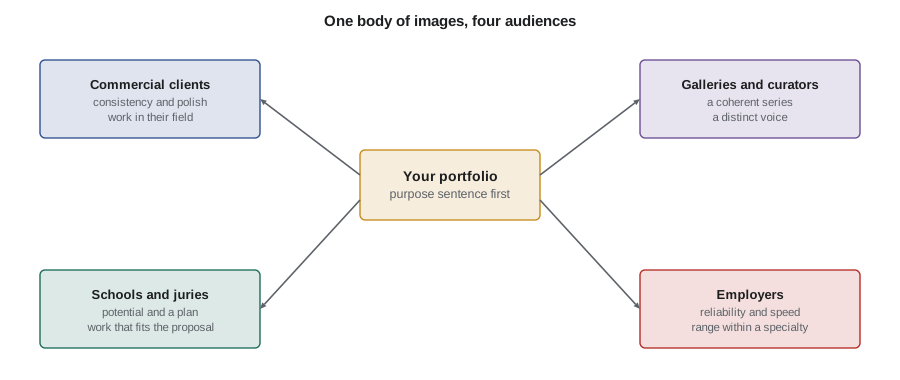
Different decision makers read portfolios differently. The same photographer often needs several versions of a portfolio, each built for one audience.
- Commercial clients and art directors want evidence that you can deliver a brief reliably, on time and in a recognizable style that fits their brand. They look for consistency, technical polish and relevance to their industry.
- Galleries, curators and exhibition juries want a coherent body of work with a distinct voice and a clear idea. They care about the series, the artist statement and how the work fits their program, much less about technical range.
- Schools, residencies and grant juries want potential, seriousness and a credible plan. They read the portfolio alongside a statement or proposal and ask whether the work and the plan belong together.
- Employers such as studios, newspapers, agencies and in-house creative teams want to know you can do the daily work: turnaround speed, versatility within a specialty, and professional reliability.
| Audience | Main question | Evidence they want | Typical format |
|---|---|---|---|
| Commercial client | Can you deliver this kind of job for us? | Consistent work in their field, credits, a clear style | Website, PDF, short print book |
| Gallery or curator | Is this a strong, original body of work for our program? | A coherent series, statement, exhibition history | 15 to 20 images of one project, statement, CV |
| School or grant jury | Does this person have potential and a credible plan? | Work samples that match a proposal, growth over time | Upload portal with fixed image count |
| Employer | Can you do the daily work well and reliably? | Range within a specialty, speed, references | Website plus a short tailored PDF |
Portfolio, archive and body of work
It helps to separate three things that beginners often blur together. Your archive is everything you have made, organized and backed up so that you can find it. Your body of work is a coherent group of images made around a single idea, place, community or approach; a mature artist may have several bodies of work. Your portfolio is a selection drawn from the archive or from one or more bodies of work for a particular purpose and audience. A portfolio changes far more often than a body of work, and a body of work changes far more often than the archive.
This distinction protects you from a common trap: trying to make one portfolio that serves everyone. A wedding photographer who also makes fine art landscapes may need two websites or two clearly separated sections, because a couple planning a wedding and a gallery director want different evidence. Mixing them weakens both.
What a complete professional package contains
The portfolio images are only part of what you send. Most decision makers expect a package, and missing pieces can sink an otherwise strong submission.
- A selection of images, sized and sequenced for the format (lessons 2 to 4).
- A short biography or artist statement in plain language, usually 100 to 300 words.
- A curriculum vitae (CV) for art contexts, or a client list and services page for commercial work.
- A website or online portfolio that matches the selection you send.
- Contact details, social media handles and, where relevant, representation.
- For grants and residencies, a project description, budget and timeline (lesson 8).
- References or testimonials you have permission to use.
The package should feel like one designed thing. The same name, the same headshot or logo, the same tone of voice and a consistent visual style across the website, PDF and CV signal professionalism before anyone reads a word.
Worked problem
Matching a portfolio to an audience
Amira has 400 strong images from four years: a long-term project on a fishing community (60 images), editorial portraits (90), product work for small local businesses (120) and travel landscapes (130). She is applying to two things this month: a curated group exhibition on working life, and a part-time studio job shooting e-commerce products. How should she build the two portfolios?
Show solution
- Write the purpose sentence for each. Exhibition: "This work shows a sustained, respectful view of working life in one community." Job: "I can produce clean, consistent product images quickly."
- For the exhibition, draw only from the fishing community project, perhaps adding two or three editorial portraits of the same people if they fit. Choose about 15 images that tell the story, plus a statement and CV.
- For the studio job, draw from the product work, choosing about 15 to 20 images that show consistent lighting, colour accuracy and range across product types (reflective, transparent, soft goods), and add three or four portraits only if the job also involves models.
- Leave out the travel landscapes from both; they are good, but they answer neither audience's question.
Answer: Two separate portfolios: about 15 images from the community project with a statement for the exhibition, and about 15 to 20 consistent product images for the job. Neither includes the landscapes.
How long decision makers look
The time a reviewer spends on a portfolio is short and front-loaded. Industry surveys and the experience of reviewers at portfolio events suggest that many art buyers and editors decide within the first few images whether to keep looking. Grant and exhibition juries may score dozens or hundreds of applications in a session and often see each image for well under a minute in the first round. You cannot control the time, but you can control what they see first, how clear the idea is and how easy it is to move from one image to the next.
A practical rule follows: your first three images and your last image matter more than any others. The opening must state your strengths at once; the closing image is the one they remember when they decide.
Worked problem
How much attention does each image get?
A juror has 3 hours to score 60 applications in the first round. Each application includes 15 images plus a 300-word statement that takes about 1 minute to read. How long can the juror spend on each image, on average?
Show solution
- Total time is \( 3 \times 60 = 180 \) minutes, so each application gets \( 180 / 60 = 3 \) minutes.
- Subtract 1 minute for the statement, leaving 2 minutes, or 120 seconds, for the images.
- Each image gets about \( 120 / 15 = 8 \) seconds.
Answer: About 8 seconds per image, which is why a clear opening, a coherent idea and no weak images matter so much.
Quality, consistency and voice
Three qualities run through every strong portfolio. Quality is technical and aesthetic competence: images that are sharp where they should be, well exposed, carefully colour managed and printed or displayed well. Consistency means a viewer can predict the standard of your next image; one weak image lowers the perceived level of the whole set. Voice is the hardest to define: a recognizable way of seeing, through choices of subject, light, distance, colour and timing, that makes your work yours.
New photographers often overvalue range and undervalue consistency. A client hiring a food photographer does not need proof that you can also shoot weddings and sports; they need to be confident that every food image will be excellent. Range belongs inside a specialty: different dishes, settings and lighting moods, all at the same level.
Honesty, ethics and permissions
A portfolio must represent your own work honestly. Credit collaborators such as stylists, art directors, retouchers and assistants, and make clear when an image was made as part of a team or as a commissioned assignment. Do not include images you shot as a second shooter or assistant as if you were the lead unless your agreement allows it and you say so. If you used substantial compositing, generative tools or heavy retouching, be ready to explain it, and disclose it wherever the context expects documentary truth.
Permissions matter too. Commercial images made for clients may be restricted by your contract; most allow portfolio use, but some confidentiality agreements do not, and unreleased products or campaigns may be embargoed. Recognizable people in portfolio images raise privacy and personality-rights questions, which differ between Canada and the United States.
In Canada, using a recognizable person's image to promote your services can engage provincial privacy statutes in British Columbia, Saskatchewan, Manitoba and Newfoundland and Labrador, the common-law tort of appropriation of personality, and, in Quebec, the Civil Code and the Aubry decision, which protect a person's right to their image. A signed model release that covers portfolio and self-promotion use is the safest practice.
Starting your portfolio plan
By the end of this course you will have a professional package and a one-year plan. Start now with a short inventory: which audiences matter most to you over the next year, what each one needs, what you already have and what is missing. Most graduating photographers find that they need to make new work to fill gaps, especially consistent commissioned-style work for commercial audiences or a stronger final edit of a personal project for art audiences. Identifying the gap early lets you plan shoots in the months ahead rather than scrambling before a deadline.
Common mistakes
MistakeBuilding one portfolio for every audience
InsteadBuild a separate selection for each audience, each answering that audience's main question.
MistakeIncluding your favourite images because they took effort to make
InsteadInclude only images that support the portfolio's purpose sentence, whatever they cost to make.
MistakeShowing range across many unrelated genres
InsteadShow range within one specialty at a consistent level of quality.
MistakeTreating the portfolio as the whole package
InsteadSend a matching statement or bio, CV or client list, website and contact details with the images.
MistakeUsing client or model images without checking permissions
InsteadConfirm that contracts and releases allow portfolio and self-promotion use before including them.
Summary and key terms
- A portfolio is a small, purposeful selection of your best work made for a specific decision maker.
- Write a one-sentence purpose before choosing images, and include only images that support it.
- Commercial clients, galleries, schools or juries, and employers each look for different evidence.
- Separate your archive, your bodies of work and your portfolios, which change at different rates.
- A complete package includes images, a statement or bio, a CV or client list, a website and contact details.
- Reviewers often spend only seconds per image, so openings, closings and consistency matter most.
- Credit collaborators honestly and confirm contracts and releases allow portfolio use.
- Portfolio
- A selection of work assembled for a particular audience and decision
- Body of work
- A coherent group of images made around one idea, place, community or approach
- Archive
- The complete, organized and backed-up collection of everything you have made
- Purpose sentence
- A one-line statement of what a portfolio must show, used to test every image
- Art director
- A person who plans the visual look of a campaign or publication and often hires photographers
- Curator
- A person who selects and organizes work for exhibitions or collections
- Artist statement
- A short text explaining the ideas and methods behind a body of work
- Curriculum vitae (CV)
- A record of exhibitions, education, awards, publications and collections used in art contexts
- Consistency
- The quality of every image in a set meeting the same standard and style
- Voice
- A recognizable personal way of seeing expressed through repeated visual choices
Practice problems
Work each problem on paper first, then reveal the answer to check.
What is the difference between a portfolio and an archive?
Show answer
The archive holds everything; a portfolio is a small selection made for a specific audience and purpose.
Write a purpose sentence for a portfolio aimed at food magazine editors.
Show answer
For example: "This portfolio shows that I can make appetizing, editorial-style food images with consistent natural light."
Why do galleries care less about technical range than commercial clients?
Show answer
They are judging a coherent body of work and a distinct voice, not your ability to handle many types of jobs.
A juror has 2 hours for 40 applications of 20 images each, with 1 minute per statement. How many seconds per image?
Show answer
\( 120/40 = 3 \) minutes each; minus 1 minute leaves 120 seconds; \( 120/20 = 6 \) seconds per image.
Name four items besides images that a complete package usually includes.
Show answer
A statement or bio, a CV or client list, a website, contact details (also references or a proposal where required).
Why might a wedding photographer keep landscapes off the wedding website?
Show answer
Couples want evidence of wedding work; unrelated genres dilute the message.
Which images in a portfolio matter most, and why?
Show answer
The first three and the last, because reviewers decide early and remember the ending.
What should you do before including images from a commissioned job?
Show answer
Check your contract and any confidentiality terms allow portfolio use, and credit the client and team appropriately.
What is voice in photography?
Show answer
A recognizable way of seeing built from consistent choices of subject, light, distance, colour and timing.
Why is consistency more important than range for most commercial portfolios?
Show answer
Clients need to trust that every image you deliver will meet the same high standard in their field.
Lesson quiz · 5 questions
Score 60% or more to complete this lesson.
Create a free account to save your progress, take quizzes and earn a certificate.