
VIS-210 · Lesson 8 of 12 · 27 min
Photography and the mass media
For most of the nineteenth century, photographs reached the public mainly as original prints: cased portraits, cartes de visite, album prints and lantern slides. Newspapers and magazines could not print photographs directly; they printed engravings copied by hand from photographs. The invention of the halftone process changed this. Once photographs could be printed with type on a press, they became part of everyday reading, and by the 1930s illustrated magazines built huge audiences around photographs and photo essays. This lesson traces photography's integration into the mass media, from the halftone to the picture magazine, the photo agency and the great exhibitions of mid-century, and introduces the critical questions about mass-media images that later theory would develop. PHOT-320 covers contemporary photojournalism practice and ethics.
From engraving to halftone
Before the halftone, newspapers used wood engravings. An artist traced a photograph onto a wooden block and engravers cut the lines by hand. The process took time and changed the image: engravers simplified details, added drama and sometimes combined several photographs. Readers saw interpretations of photographs, often with the line "from a photograph" to claim authority.
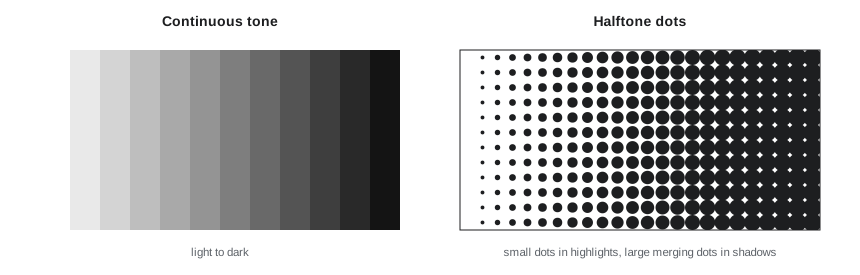
The halftone solved the problem of printing continuous tones with ink, which is either present or absent. A photograph was rephotographed through a fine screen that broke the image into a grid of dots. Dark areas became large dots that nearly merged, light areas tiny dots on white paper. At normal reading distance, the eye blends the dots into continuous tones. The dots could be etched into a metal plate and printed alongside type on the same press.
Canada has a strong claim to an early milestone. On 30 October 1869 the Canadian Illustrated News in Montreal published on its cover a photographic reproduction of Prince Arthur, from a portrait by the Notman studio, made by a process developed by William Augustus Leggo and George-Édouard Desbarats, often described as the first halftone reproduction of a photograph printed in a periodical. The process, called leggotype, was not yet practical for daily use, but it anticipated the technology that transformed the press.
By around 1900, halftones were common in magazines, and by the 1910s many newspapers printed photographs daily. The change created new professions: press photographers, picture editors and photo agencies. It also changed how readers thought about news. Photographs seemed to offer direct access to events, even though they were selected, cropped, retouched and captioned like any other content.
Worked problem
Halftone screens and image resolution
A newspaper prints at a screen of 85 lines per inch, a magazine at 150 lines per inch and a fine art book at 200 lines per inch. A common rule of thumb is that an image for halftone printing should have about twice as many pixels per inch as the screen ruling. How many pixels wide should a photograph be to print 8 inches wide in each case?
Show solution
- Newspaper: \( 2 \times 85 = 170 \) ppi, so \( 170 \times 8 = 1{,}360 \) pixels.
- Magazine: \( 2 \times 150 = 300 \) ppi, so \( 300 \times 8 = 2{,}400 \) pixels.
- Art book: \( 2 \times 200 = 400 \) ppi, so \( 400 \times 8 = 3{,}200 \) pixels.
Answer: About 1,360, 2,400 and 3,200 pixels wide respectively; the familiar 300 ppi figure for print comes from the magazine case.
News photography and the wire
Faster cameras and plates allowed press photographers to capture news events, sports and celebrities. The Speed Graphic, a large-format press camera with flash, became the standard tool of American newspaper photographers from the 1910s to the 1950s. Sending photographs quickly over long distances became possible with wire services; the Associated Press launched its Wirephoto network in the United States in 1935, transmitting photographs over telephone lines. In Canada, The Canadian Press, a cooperative news agency founded in 1917, distributed news photographs to member papers. Tabloid newspapers built circulation on sensational photographs of crime and scandal, and photographers such as Weegee (Arthur Fellig) in New York became famous for nighttime flash pictures of accidents and murders in the 1930s and 1940s.
The illustrated magazine
The great age of the photographic magazine began in Germany in the 1920s, where weekly illustrated papers such as the Berliner Illustrirte Zeitung and the Münchner Illustrierte Presse used small-camera photographs in sequences and layouts, guided by editors such as Stefan Lorant. Photographers such as Erich Salomon made candid pictures of politicians at diplomatic meetings. In France, the magazine Vu, founded in 1928, pioneered dynamic layouts. When the Nazis came to power in 1933, many editors and photographers, a number of them Jewish, emigrated, carrying their methods to Britain and the United States.
In the United States, Henry Luce launched Life magazine on 23 November 1936, with a cover photograph by Margaret Bourke-White of the Fort Peck Dam in Montana. Life became one of the most popular magazines in the country, with millions of readers each week. Look followed in 1937. In Britain, Stefan Lorant founded Picture Post in 1938. These magazines developed the photo essay, a story told through a sequence of photographs with captions and short texts, laid out across several pages to guide the reader's eye and build a narrative.
| Magazine | Country | Founded | Notable features |
|---|---|---|---|
| Berliner Illustrirte Zeitung | Germany | 1890s, photographic boom in 1920s | candid small-camera reportage |
| Vu | France | 1928 | dynamic modernist layouts |
| Life | United States | 1936 | the photo essay, huge weekly audience |
| Look | United States | 1937 | features and picture stories |
| Picture Post | Britain | 1938 | social reportage, wartime coverage |
| Weekend Magazine | Canada | 1951 | weekly newspaper supplement with photo features |
The photo essay and its makers
The photo essay gave photographers a new form and new power, but also new constraints. Editors chose assignments, selected frames, wrote captions and designed layouts, often without the photographer's approval. W. Eugene Smith's essay "Country Doctor" (1948), following a rural Colorado physician, is often cited as a model of the form. Smith later clashed with Life over editorial control and left the magazine, insisting that photographers should shape how their work was presented. His later project on mercury poisoning in Minamata, Japan, published in 1972 and 1975, combined documentary and advocacy.
Margaret Bourke-White, one of Life's first staff photographers, covered industry, the Soviet Union, the Second World War, the liberation of concentration camps and India's partition. Robert Capa became famous for combat photographs from the Spanish Civil War and the D-Day landings in 1944. The authenticity of Capa's 1936 photograph of a falling Spanish Republican soldier has been debated for decades, another example of questions about staging in documentary images.
Magnum and the photographer's rights
In 1947 Robert Capa, Henri Cartier-Bresson, David "Chim" Seymour and George Rodger founded Magnum Photos, a cooperative agency owned by its photographer members. Magnum's founders wanted photographers to keep the copyright to their negatives, choose their own stories and control how their work was used, in contrast to staff photographers whose employers owned their images. The cooperative model influenced how photographers think about authorship and rights. Later histories have also examined Magnum's limitations, including its predominantly Western and male membership in its early decades and controversies about its archive.
In Canada, the illustrated press included Maclean's, the Star Weekly and the newspaper supplement Weekend Magazine, which published photo features to national audiences. The Ottawa portrait photographer Yousuf Karsh, an Armenian refugee who came to Canada as a teenager, became internationally famous after his 1941 portrait of Winston Churchill, made in the Parliament buildings, was widely reproduced, including on magazine covers. Karsh went on to photograph many of the leading figures of the twentieth century; his archive is held by Library and Archives Canada.
The Family of Man
In 1955 Edward Steichen, director of photography at MoMA, organized The Family of Man, an exhibition of more than 500 photographs by photographers from many countries, arranged by themes such as birth, love, work, death and hope. It toured internationally for years and was seen by millions of people, and the accompanying book sold millions of copies. Its message, in the shadow of the Cold War and nuclear weapons, was the essential unity of humanity.
The exhibition was also sharply criticized. The French theorist Roland Barthes, in an essay collected in Mythologies (1957), argued that its emphasis on a universal human nature hid real differences of history, injustice and power: it showed that everyone is born and dies, but not the unequal conditions under which people live and work. Later critics described the show as part of American Cold War cultural diplomacy. The debate illustrates a central question about mass-media photography: does a universal visual language unite viewers, or does it erase history and politics?
Television and the decline of the picture magazine
From the 1950s, television drew audiences and advertisers away from picture magazines. Look closed in 1971 and Life ceased weekly publication in 1972, later returning as a monthly and in special issues. News photography continued in newspapers and newsmagazines, and agencies such as Magnum, Gamma and Sygma supplied images worldwide, but the photo essay's central position in mass culture had passed to television and later to the internet. The questions the picture magazine raised, about editorial control, captions, the construction of narratives from images and the photographer's rights, remain central today.
Worked problem
Reading a photo essay layout
A described 1950s magazine photo essay opens with a full-page close portrait, follows with four small photographs of daily routines arranged in a row, and ends with a wide establishing view on the final page. The captions are written by the editors. What does the layout do to meaning, and how would you evaluate it?
Show solution
- The opening portrait creates identification with one person before the reader knows the context.
- The row of small images suggests routine and repetition, compressing time.
- The final wide view places the individual in a community or landscape and offers closure.
- Because editors wrote the captions and chose the sequence, the photographer's intentions may differ from the published story.
Answer: The layout builds a narrative arc from individual to context, and evaluating it means asking who designed that arc and what it emphasizes or leaves out.
Practice: build a magazine-style photo essay
Plan a short photo essay of six to eight images on a local subject, such as a small business, a festival or a daily routine. Sketch a layout on paper for a two-page spread followed by a second spread: decide which image opens, which is largest, which images sit side by side and which closes the story. Write a headline, a short introduction and captions for each photograph.
Then swap roles with a classmate. Let them re-edit your essay as a picture editor would, choosing a different opening image, cropping one photograph and rewriting two captions. Compare the two versions. Most students are surprised by how much the editor's choices change the story, even when every photograph is the same. This exercise shows why photographers such as W. Eugene Smith fought for editorial control, and why historians studying magazine photography always look at the full page, the captions and the surrounding text rather than isolated images.
Common mistakes
MistakeThinking nineteenth-century newspapers printed photographs directly
InsteadBefore halftones, they printed hand-made engravings copied from photographs
MistakeAssuming photo essays were the photographer's own story
InsteadEditors often chose frames, sequences and captions
MistakeBelieving the Family of Man was universally praised
InsteadBarthes and others argued it hid history, injustice and power
MistakeConfusing lines per inch with pixels per inch
InsteadA rule of thumb is about twice the screen ruling in pixels per inch
MistakeTreating famous war photographs as beyond question
InsteadImages such as Capa's falling soldier have been debated for staging
Summary and key terms
- Before halftones, the press printed engravings copied from photographs.
- The halftone breaks tones into dots; Canada's 1869 leggotype and New York's 1880 Shantytown halftone were early milestones.
- Wire services and press cameras made news photography fast and widespread.
- Picture magazines such as Life (1936) and Picture Post (1938) built mass audiences around the photo essay.
- Magnum (1947) gave photographers ownership and control of their work.
- The Family of Man (1955) promoted universal humanity and was criticized by Barthes for erasing history.
- Television ended the dominance of the picture magazine, but questions about editorial control remain.
- Halftone
- A process that reproduces continuous tones as dots of varying size for printing
- Screen ruling
- The number of halftone lines per inch used in printing
- Wood engraving
- A hand-cut relief print used to reproduce images before halftones
- Photo essay
- A story told through a sequence of photographs with captions and text
- Picture editor
- The person who selects, sequences and sizes photographs for publication
- Wire service
- A news agency that transmits stories and photographs to many outlets
- Magnum Photos
- A cooperative photo agency founded in 1947 and owned by its photographers
- Leggotype
- An early halftone process used by the Canadian Illustrated News in 1869
- Family of Man
- Steichen's 1955 MoMA exhibition on universal human experience
- Cultural diplomacy
- The use of culture, including exhibitions, to promote a nation's image abroad
Practice problems
Work each problem on paper first, then reveal the answer to check.
How did newspapers reproduce photographs before halftones?
Show answer
Artists copied them as hand-cut wood engravings.
How does a halftone represent dark tones?
Show answer
With large dots that nearly merge.
What Canadian periodical published a photographic halftone in 1869?
Show answer
The Canadian Illustrated News in Montreal.
Using the rule of thumb, how many pixels wide should a photo be to print 8 inches wide at 150 lpi?
Show answer
About 2,400 pixels.
When did Life magazine launch, and what was its first cover?
Show answer
On 23 November 1936, with Bourke-White's photograph of the Fort Peck Dam.
What is a photo essay?
Show answer
A story told through a sequence of photographs with captions and short texts.
Why did Magnum's founders form a cooperative?
Show answer
To keep copyright and control over their work and choice of stories.
What portrait made Yousuf Karsh internationally famous?
Show answer
His 1941 portrait of Winston Churchill.
What was Barthes's criticism of The Family of Man?
Show answer
Its universalism hid history, injustice and unequal conditions.
Why did picture magazines decline after the 1950s?
Show answer
Television drew away audiences and advertisers.
Lesson quiz · 5 questions
Score 60% or more to complete this lesson.
Create a free account to save your progress, take quizzes and earn a certificate.