
VIS-210 · Lesson 2 of 12 · 28 min
Precursors and the invention of photography
Photography was not invented in a single flash of genius. It came from the meeting of two much older ideas: the optical knowledge that light passing through a small opening forms an image, and the chemical knowledge that some substances change when light falls on them. For centuries these ideas existed separately. In the early nineteenth century, several people in different countries worked to bring them together, and in 1839 two very different processes were announced within weeks of each other. This lesson follows that story, the rivalries and priority disputes it produced, and the question of why photography appeared when it did.
The camera obscura
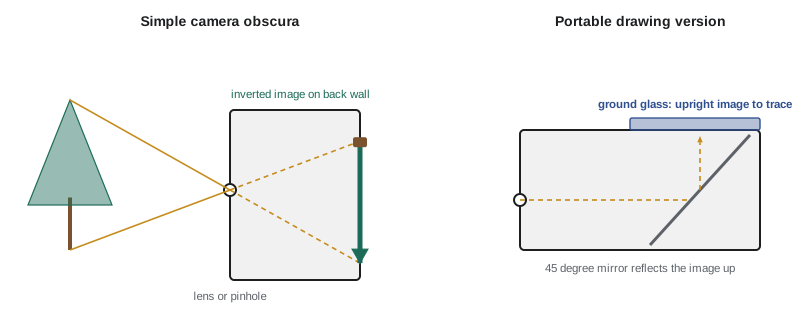
The camera obscura, Latin for "dark room", is the optical ancestor of every camera. When light from a bright scene passes through a small hole into a darkened space, it forms an inverted image on the opposite wall. Thinkers in ancient China and Greece described the effect, and the Arab scholar Ibn al-Haytham analyzed it carefully around the year 1000 in his work on optics. Renaissance writers recommended it for watching solar eclipses safely.
By the sixteenth century, makers had added lenses to brighten and sharpen the image, and by the seventeenth and eighteenth centuries portable camera obscuras, boxes with a lens, a mirror and a sheet of ground glass, were common drawing aids. Artists traced the projected image to get perspective and proportions right. The debate about whether some painters, such as Vermeer, used optical aids continues, as VIS-130 discussed. What the camera obscura could not do was keep the image. When the light changed or the box moved, the picture vanished.
Light-sensitive chemistry
The second ingredient was chemistry. In 1727 the German scientist Johann Heinrich Schulze showed that silver salts darken because of light, not heat. Later experimenters, including the Swedish chemist Carl Wilhelm Scheele, studied the effect further. Around 1800, Thomas Wedgwood and Humphry Davy in England made images by placing objects on paper or leather coated with silver nitrate and exposing them to sunlight. They could produce silhouettes, but they could not stop the unexposed areas from darkening when the images were later viewed in light. The problem of fixing, making the image permanent, remained unsolved.
Niépce and the first camera photographs
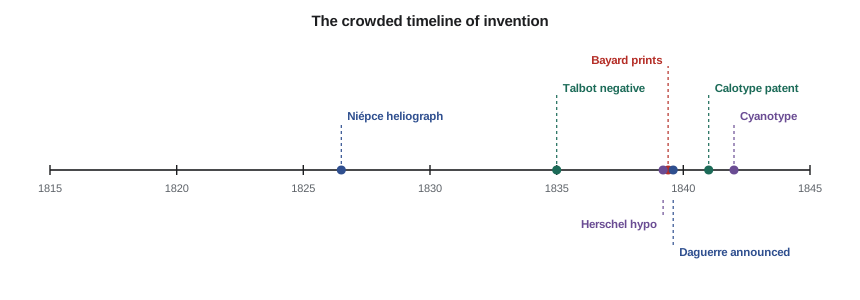
The French inventor Nicéphore Niépce began experimenting in the 1810s. He coated plates with bitumen of Judea, a kind of asphalt that hardens in light. After a long exposure in a camera obscura, he washed the plate with solvents that dissolved the unhardened bitumen, leaving an image. He called his process heliography, "sun writing". A view from an upstairs window at his estate at Le Gras, made around 1826 or 1827, is usually described as the oldest surviving photograph made with a camera. Its exposure lasted many hours, perhaps days, so that sunlight appears to fall on both sides of the buildings. Niépce's process was too slow for practical use, but it proved that a camera image could be fixed.
Daguerre and the daguerreotype
Louis-Jacques-Mandé Daguerre was a painter and showman who ran the Diorama in Paris, a theatre of huge translucent paintings transformed by changing light. He formed a partnership with Niépce in 1829. Niépce died in 1833, and Daguerre continued working, eventually discovering that a silver-coated copper plate sensitized with iodine vapour could record a hidden, latent image in minutes, which mercury vapour then developed. Common salt, and later sodium thiosulfate, fixed the image.
The French government bought the process and, on 19 August 1839, the scientist François Arago presented the details to a joint meeting of the Academies of Sciences and Fine Arts. France presented the daguerreotype as a gift to the world, free for anyone to use, although Daguerre had taken out a patent in England a few days earlier. The daguerreotype produced astonishingly detailed images, but each was a unique positive on a mirror-like plate that had to be tilted to be seen correctly. It could not be copied except by photographing it again.
Talbot and photogenic drawing
In England, William Henry Fox Talbot, a scientist and gentleman scholar, had been working on a paper-based process since 1834. Frustrated by his inability to draw scenes on holiday at Lake Como using a camera lucida, he wanted to make nature draw itself. He coated paper with salt and silver nitrate, made images of leaves and lace by contact, and small camera images of his home at Lacock Abbey. A small paper negative of a latticed window, made in 1835, is the oldest surviving photographic negative.
When news of Daguerre's announcement reached him in January 1839, Talbot hurried to present his own work to the Royal Institution and the Royal Society. His early "photogenic drawings" needed long exposures and faded easily. In 1840 he discovered that a latent image could be developed chemically, cutting exposure times dramatically, and in 1841 he patented this improved process as the calotype, from the Greek for "beautiful picture". The calotype produced a paper negative from which many positive prints could be made, the principle on which most photography would be based for the next 150 years.
Herschel, Bayard and other inventors
Talbot's friend Sir John Herschel, an astronomer and chemist, contributed crucial ideas. In 1819 he had discovered that sodium thiosulfate, then called hyposulphite of soda or "hypo", dissolves silver salts. In 1839 he showed that hypo fixed photographic images, and photographers have used it ever since. Herschel also coined or popularized the words "photography", "negative" and "positive" and later invented the cyanotype, a blueprint process using iron salts, in 1842.
Talbot and Daguerre were not alone. In France, Hippolyte Bayard developed a direct positive paper process and exhibited prints in June 1839, before Daguerre's public announcement. Officials encouraged him to delay, and he received little recognition. In protest he made a famous staged photograph in 1840 showing himself as a drowned man, with a text complaining that the government had ignored him, which is often described as the first staged or fictional photograph. In Brazil, the French-born artist Hercule Florence experimented with light-sensitive images in the 1830s and used the word "photographie" in his notes. These parallel inventions show that the idea was, as historians say, in the air.
| Figure | Country | Contribution | Approximate date |
|---|---|---|---|
| Nicéphore Niépce | France | heliography; oldest surviving camera photograph | 1826 to 1827 |
| Louis Daguerre | France | daguerreotype, developed latent image on silvered copper | announced 1839 |
| William Henry Fox Talbot | Britain | photogenic drawing, then the calotype negative-positive process | 1835 to 1841 |
| John Herschel | Britain | hypo fixer, the words negative and positive, cyanotype | 1839 to 1842 |
| Hippolyte Bayard | France | direct positive paper prints; first staged photograph | 1839 to 1840 |
| Hercule Florence | Brazil | early independent experiments in light-sensitive images | 1830s |
Priority disputes and the politics of invention
Who invented photography? The answer depends on what you count. If the first permanent camera image counts, Niépce has a strong claim. If the first practical process announced to the public counts, Daguerre. If the negative-positive principle that dominated photography counts, Talbot. National pride shaped these claims. French histories emphasized Niépce and Daguerre, British histories Talbot, and many accounts ignored Bayard and Florence entirely.
Patents mattered too. Daguerre's process was free in France but patented in England, and Talbot's calotype patents in England were strict. Some historians argue that Talbot's patents slowed the spread of paper photography in Britain in the 1840s, while the free daguerreotype spread rapidly in France and the United States. Talbot eventually gave up most of his patent rights in the 1850s after legal challenges. The story is a reminder that inventions are shaped by law, money and politics as well as science.
Why 1839?
Why did photography appear in the 1830s rather than earlier? The optics and the basic chemistry had existed for decades. Historians point to several factors. Industrialization created a growing middle class that wanted affordable portraits and a culture fascinated by science and mechanical progress. Lithography and other printing techniques had already created appetite for images. Chemistry was advancing rapidly, and scientists corresponded across borders. Some historians, such as Geoffrey Batchen, have argued that the desire to fix the image, to capture nature without the hand of the artist, appeared among many people at once around 1800, which explains why so many independent inventors emerged.
Worked problem
Comparing early exposure times in stops
Suppose an early daguerreotype in bright sun needed about 10 minutes at an aperture of about f/15, while a modern camera at ISO 100 and f/16 in bright sun needs about 1/125 s. Ignoring the small aperture difference, how many stops more sensitive is the modern setting?
Show solution
- Convert the daguerreotype exposure to seconds: \( 10 \times 60 = 600 \) s.
- Find the ratio: \( 600 \div (1/125) = 600 \times 125 = 75{,}000 \).
- Convert the ratio to stops: \( \log_2 75{,}000 \approx 16.2 \).
- Each stop doubles sensitivity, so the modern setting is about 16 stops faster.
Answer: About 16 stops, a factor of roughly 75,000, which is why the first daguerreotypes could not record moving people.
The figures are approximate because early exposures varied greatly with weather, lens and plate preparation. Within a few years, faster lenses, such as the Petzval portrait lens of 1840, and chemical accelerators using bromine cut daguerreotype exposures to well under a minute, making studio portraiture possible.
Worked problem
Estimating the equivalent ISO of an early process
If the modern setting is ISO 100 and the daguerreotype is about 16 stops slower, what equivalent ISO does the daguerreotype have?
Show solution
- Sixteen stops slower means dividing by \( 2^{16} = 65{,}536 \).
- \( 100 \div 65{,}536 \approx 0.0015 \).
Answer: Roughly ISO 0.0015, an equivalent speed so low it is hard to imagine; even a 1/1000 sensitivity film would be hundreds of times faster.
The first reactions
The public response to photography in 1839 was a mixture of wonder and anxiety. Newspapers described "daguerreotypomania" as crowds bought cameras and chemicals. Scientists welcomed a tool that could record without bias, artists worried that their livelihoods were threatened, and critics argued over whether a mechanical process could ever be art. Edgar Allan Poe, writing in 1840, praised the daguerreotype as more truthful than any painting. The French poet Charles Baudelaire, writing in 1859, attacked photography as the refuge of failed painters and insisted it should remain a humble servant of science and art. These early arguments about truth, art and mechanism return again and again throughout this course.
News of photography reached British North America quickly. Daguerreotypists advertised in Quebec City and Montreal as early as 1840 and 1841, often travelling between towns and offering portraits for a few days at a time. Some of the earliest surviving photographs made in what is now Canada are daguerreotype portraits and views of Quebec City and Montreal from the 1840s.
Trying it yourself
You can experience the problems early inventors faced with simple, safe activities. Make a pinhole camera from a box and observe the inverted image on tracing paper. Make cyanotypes, Herschel's iron-based process, by placing leaves on pre-treated paper in sunlight and rinsing in water; kits are widely sold and avoid the toxic chemicals of early silver processes. Photograph a busy street with a very long exposure using a neutral density filter and notice how moving people vanish, as they did in the earliest daguerreotypes of Paris. PHOT-240 covers darkroom chemistry and safety in detail; never attempt the mercury development of real daguerreotypes, which is highly toxic.
Common mistakes
MistakeSaying Daguerre invented photography alone
InsteadSeveral people contributed, including Niépce, Talbot, Herschel, Bayard and Florence, and the answer depends on what counts as invention
MistakeThinking the daguerreotype could be reproduced easily
InsteadEach daguerreotype was a unique positive with no negative
MistakeAssuming the camera obscura was invented in 1839
InsteadThe camera obscura was known for centuries; the breakthrough was fixing the image chemically
MistakeBelieving the first photographs were snapshots
InsteadEarly exposures took minutes or hours, so moving subjects disappeared
MistakeIgnoring law and money in the story of invention
InsteadPatents, government purchases and national pride shaped how processes spread
Summary and key terms
- Photography combined the optics of the camera obscura with light-sensitive chemistry.
- Niépce made the oldest surviving camera photograph around 1826 to 1827 with heliography.
- Daguerre's process, announced in Paris on 19 August 1839, produced unique detailed positives on silvered copper.
- Talbot's calotype, patented in 1841, introduced the negative-positive principle with developed latent images.
- Herschel discovered hypo as a fixer and popularized the terms photography, negative and positive.
- Bayard and Florence show that invention happened in several places at once.
- Early exposures were about 16 stops slower than a modern ISO 100 setting.
- Camera obscura
- A darkened room or box in which light through a small opening forms an image
- Heliography
- Niépce's process using light-hardened bitumen
- Daguerreotype
- A unique positive image on a silver-coated copper plate developed with mercury vapour
- Calotype
- Talbot's paper negative process with chemically developed latent images
- Latent image
- An invisible image formed by light that becomes visible only after development
- Fixing
- Removing unexposed light-sensitive salts so an image stays stable
- Hypo
- Sodium thiosulfate, the fixing agent identified by Herschel
- Photogenic drawing
- Talbot's early contact and camera images on salted paper
- Cyanotype
- An iron-based process that produces blue images, invented by Herschel in 1842
- Priority dispute
- An argument over who first made an invention or discovery
Practice problems
Work each problem on paper first, then reveal the answer to check.
What two older bodies of knowledge combined to make photography?
Show answer
The optics of the camera obscura and the chemistry of light-sensitive substances.
Why could Wedgwood and Davy not keep their images?
Show answer
They could not fix them, so the unexposed areas darkened when viewed in light.
What made the daguerreotype difficult to copy?
Show answer
It was a unique positive with no negative.
What principle did the calotype introduce?
Show answer
A paper negative from which many positive prints could be made.
What did Herschel contribute to fixing?
Show answer
He showed that sodium thiosulfate, or hypo, dissolves unexposed silver salts.
Why is Bayard's 1840 self-portrait historically important?
Show answer
It is often described as the first staged photograph and protested his lack of recognition.
How many stops slower than ISO 100 was an early daguerreotype in the lesson's example?
Show answer
About 16 stops.
Name two developments that shortened daguerreotype exposures in the early 1840s.
Show answer
Faster lenses such as the Petzval portrait lens and bromine accelerators.
Why did the daguerreotype spread more freely in France and the US than the calotype in Britain?
Show answer
The daguerreotype was free in France and widely adopted in the US, while Talbot's calotype was restricted by patents in England.
What safe alternative process can students try at home?
Show answer
Cyanotype.
Lesson quiz · 5 questions
Score 60% or more to complete this lesson.
Create a free account to save your progress, take quizzes and earn a certificate.