
TRD-107 · Lesson 4 of 12 · 19 min
Your agreement, wages and rights as an apprentice
An apprentice is an employee first. You have the same rights as any other worker: to be paid properly, to work safely, to be treated with respect and to refuse unsafe work. On top of those, a registered apprenticeship gives you rights and protections that come from the agreement itself: a wage that rises as you progress, supervision by qualified workers, time off for school and records that follow you if you change employers. This lesson explains what your agreement covers, how apprentice wages work and what to do if something goes wrong.
What the agreement covers
An Ontario training agreement is a fairly short document, but it ties you and your sponsor to the training standard for your trade and to the rules that govern apprenticeship in the province. It identifies the trade, the sponsor and the apprentice, and commits the sponsor to providing the training in the standard under the supervision of qualified people. The detailed rules about wages, ratios and school come from provincial regulations, from any collective agreement that covers your work and from your employment contract. Read all of them, and keep copies.
Whatever the system, the questions you want answered are the same. What will I be paid now, and when and how will it rise? Who will supervise me? When will I go to school, and will my job be there when I come back? How are my hours and skills recorded? What happens if work slows down? How can the agreement be changed or ended?
How apprentice wages work
Apprentice wages are usually set as a percentage of the journeyperson rate, rising in steps as the apprentice progresses through the program. A common pattern starts at 40 to 60 per cent of the journeyperson rate in the first period and rises to 80 or 90 per cent in the last, but the exact steps vary widely by trade, region and employer. Progression may be tied to hours worked, to completing school levels, to time served or to a combination.
Where you work under a collective agreement, the agreement sets the apprentice percentages and the journeyperson rate, along with benefits, pension contributions and overtime rules. In non-union work, the employer sets the wage schedule, and it must never fall below the provincial minimum wage. Ontario's Employment Standards Act covers apprentices like other employees, with some special rules for certain trades and situations, so check how it applies to your trade. Ask for the schedule in writing when you are hired.
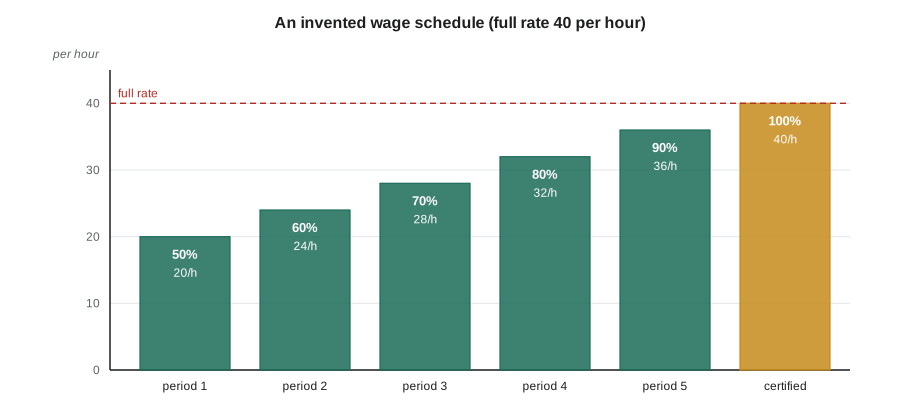
The program below works out an apprentice's hourly rate and estimated annual earnings for each period of an invented schedule. It also shows how much the time away for school affects the annual figure, which is why grants and income support during school matter so much.
# hourly rate and estimated yearly earnings for an invented wage schedule
JOURNEY_RATE = 40.00                       # dollars per hour
schedule = [0.50, 0.60, 0.70, 0.80, 0.90]  # share of the journeyperson rate by period
work_weeks = 42                            # weeks on the job in a year with an 8-week school block
hours_per_week = 40
for period, pct in enumerate(schedule, 1):
    rate = pct * JOURNEY_RATE
    year = rate * hours_per_week * work_weeks
    print(f"period {period}: {pct:.0%} = ${rate:5.2f}/h, about ${year:8,.0f} for {work_weeks} weeks")
print(f"certified: ${JOURNEY_RATE:.2f}/h, about ${JOURNEY_RATE * hours_per_week * 50:,.0f} for 50 weeks")period 1: 50% = $20.00/h, about $ 33,600 for 42 weeks period 2: 60% = $24.00/h, about $ 40,320 for 42 weeks period 3: 70% = $28.00/h, about $ 47,040 for 42 weeks period 4: 80% = $32.00/h, about $ 53,760 for 42 weeks period 5: 90% = $36.00/h, about $ 60,480 for 42 weeks certified: $40.00/h, about $80,000 for 50 weeks
Pay attention to what triggers each increase. If your raise depends on completing a school level, delaying school delays your raise. If it depends on hours, accurate records matter. Many apprentices lose money simply because a step was missed and nobody noticed for months. Check your pay stub each time you finish a level or pass an hours milestone.
Benefits, overtime and expenses
Wages are only part of the package. Ask about health and dental benefits, pension or retirement contributions, paid holidays and vacation, overtime rates, travel time and allowances for working away from home, tool allowances and whether the employer pays for school costs, books or safety equipment. In union work, many of these come from the collective agreement and are paid into union-run funds; in non-union work, they depend on the employer and can vary a lot. Two job offers with the same hourly rate can be worth very different amounts once benefits are included.
Overtime follows the law and any collective agreement. Under Ontario's Employment Standards Act, the general rule is overtime pay after 44 hours in a work week, but many construction collective agreements set overtime after 8 hours in a day or 40 in a week, sometimes at double time. Know which rule applies to you.
Supervision and ratios
An apprentice must be supervised by a qualified journeyperson, and most systems limit how many apprentices one journeyperson can supervise. These ratios protect both the apprentice, who needs real teaching and oversight, and the public, who depend on the work being done properly. They also stop employers from replacing journeypersons with cheaper apprentices.
In Ontario, a journeyperson-to-apprentice ratio of one to one has applied in the compulsory trades since 2018, replacing higher ratios that applied in some trades before. In practice, supervision means more than having a journeyperson on the payroll: in many tasks, especially early in an apprenticeship, the journeyperson needs to be working alongside the apprentice. As you gain skill, supervision becomes less direct, but the journeyperson remains responsible for checking your work.
If you find yourself working alone on tasks you have not been trained for, or a crew with far more apprentices than journeypersons, say so to your foreman. Working beyond your training is a safety problem as well as a training problem.
Time off for school
Your sponsor must release you to attend in-school training when you are scheduled. In most Ontario trades, school is a full-time block of several weeks, during which you are usually not paid by the employer but may receive Employment Insurance and federal grants. Your job should be there when you return; if your employer says it will not be, contact the apprenticeship office. Plan school with your foreman early, because crews and schedules have to adjust.
Your other rights at work
Being an apprentice does not reduce your rights as a worker. You have the right to know about the hazards of your work, to take part in health and safety, and to refuse work you believe is dangerous without being punished for it. You are protected by human rights and anti-discrimination laws and by the rules against harassment covered in TRD-106. You must be paid at least the minimum wage and given the breaks the law requires. You cannot be fired or disciplined for raising a safety concern, filing a complaint or taking time off you are legally entitled to.
If you are injured at work, report it right away to your supervisor. In Ontario, the Workplace Safety and Insurance Board covers work-related injuries and illnesses for apprentices like other workers, and your employer must report qualifying injuries to it.
Changing employers or ending the agreement
Apprenticeships do not always stay with one employer. Companies run out of work, apprentices move, or a sponsor turns out to be a poor fit. In most systems, your hours and school levels belong to you and can move to a new sponsor.
To change sponsors in Ontario, you and the new employer register a new training agreement, and the old one is cancelled. Your completed hours and in-school levels carry over. Keep your own records so nothing is lost in the transfer. If a sponsor lays you off or the agreement ends, contact the apprenticeship office; it can help you find a new sponsor and keep your registration active.
| Situation | First step | If that does not fix it |
|---|---|---|
| Pay increase missed | Show your foreman or payroll the schedule and your records | Contact the apprenticeship office or your union |
| Not released for school | Remind your foreman of the dates early | Contact the apprenticeship office |
| Working alone beyond training | Tell your journeyperson and foreman | Raise it with the health and safety representative or committee |
| Only one narrow task for months | Ask for a range of work across the standard | Ask about time with another crew or employer |
| Laid off | Ask about recall and keep your records | Contact the apprenticeship office to find a new sponsor |
Maya checks her pay
When Maya finished her basic in-school level last winter, her wage was supposed to rise to the next step on Northbridge's schedule. Her first pay stub after school showed the old rate. She did not complain to the crew or guess at the cause; she took a photo of her school completion letter and the wage schedule and showed them to Dave at the end of the day. Dave checked with payroll, who had not received the completion notice. The rate was fixed on her next cheque, with back pay for the two weeks she had been short.
Probation and the first months
Most apprenticeships begin with a probationary period, during which the sponsor can decide that the arrangement is not working and end it more easily, and so can you. Treat the probation as an extended interview. Show up reliably, work safely, ask good questions and take feedback well. If you are unsure how you are doing, ask your journeyperson or foreman directly: Is there anything I should be doing differently? Most foremen respect that question and answer it honestly.
Probation also protects you. If a sponsor turns out to be unsafe, disorganized or unwilling to teach, it is easier to move on early than after years. Keep your records from the first day so that any hours you earn go with you.
Keeping the paperwork straight
Make a folder, paper or digital, for your apprenticeship. In it, keep your registration documents or agreement, the training standard or program standards, your wage schedule, every pay stub, your school transcripts or class records, letters about level completions and any correspondence with the registration office. Add your own logbook and photos of your work. When something goes wrong, such as a missed raise, a dispute about hours or a transfer to a new sponsor, the folder lets you settle it in minutes instead of weeks.
Pay stubs deserve a regular look. Check the hourly rate, the hours paid, overtime, deductions and any union dues or benefit contributions. Mistakes happen in every payroll system, and the person most motivated to catch them is you. Raise any problem politely and quickly, with the stub and the schedule in hand.
If you are ever unsure what you are entitled to, the registration office, your union representative if you have one, or the employment standards office in your area can explain the rules. Asking is not a sign of distrust; it is how you keep a long working relationship clear and fair for both sides.
Common mistakes
MistakeNot getting the wage schedule in writing.
InsteadAsk for it when you are hired and keep a copy.
MistakeAssuming raises happen automatically.
InsteadCheck your pay after each level or milestone and raise any mistake with records.
MistakeComparing job offers by hourly rate only.
InsteadCompare benefits, pension, overtime, travel and school support too.
MistakeAccepting work far beyond your training to look capable.
InsteadSay so; supervision is required for safety and training.
MistakeLeaving an employer without telling anyone.
InsteadArrange the transfer so your hours and levels carry over.
Summary and key terms
- An apprentice has all the rights of any worker plus the protections of the apprenticeship agreement.
- Apprentice wages are usually a rising percentage of the journeyperson rate, tied to hours, school or time.
- Wages come from collective agreements or employers and must never fall below minimum wage.
- Ratios limit how many apprentices one journeyperson supervises, to protect training and safety.
- Sponsors must release apprentices for school; plan school dates early.
- Hours and school levels usually move with you to a new sponsor; keep your own records.
- Wage schedule
- The list of apprentice wage rates, usually as percentages of the journeyperson rate, for each stage.
- Journeyperson rate
- The hourly wage for a fully certified worker, used as the base for apprentice percentages.
- Ratio
- The number of apprentices allowed for each journeyperson supervising them.
- Collective agreement
- A contract between a union and employers that sets wages, benefits and working conditions.
- WSIB
- The Workplace Safety and Insurance Board, which provides workers' compensation in Ontario.
Practice problems
Work each problem on paper first, then reveal the answer to check.
How are apprentice wages usually expressed?
Show answer
As a percentage of the journeyperson rate that rises in steps.
Give three things besides the hourly rate to compare between job offers.
Show answer
Any three of: benefits, pension, overtime, travel allowances, tool allowances, school support, vacation.
Why do supervision ratios exist?
Show answer
To make sure apprentices are properly taught and supervised, to protect the public and to stop apprentices replacing journeypersons.
Your wage did not rise after a milestone. What should you do?
Show answer
Show your foreman or payroll the wage schedule and your completion record, and follow up.
What happens to your hours if you change sponsors?
Show answer
They usually carry over to the new sponsor; keep your own records.
In the program above, why is the certified line calculated for 50 weeks instead of the apprentice weeks?
Show answer
A certified worker no longer loses weeks to school.
Lesson quiz · 5 questions
Score 60% or more to complete this lesson.
Create a free account to save your progress, take quizzes and earn a certificate.