
TRD-107 · Lesson 11 of 12 · 19 min
After certification: foreman, estimator, inspector and other paths
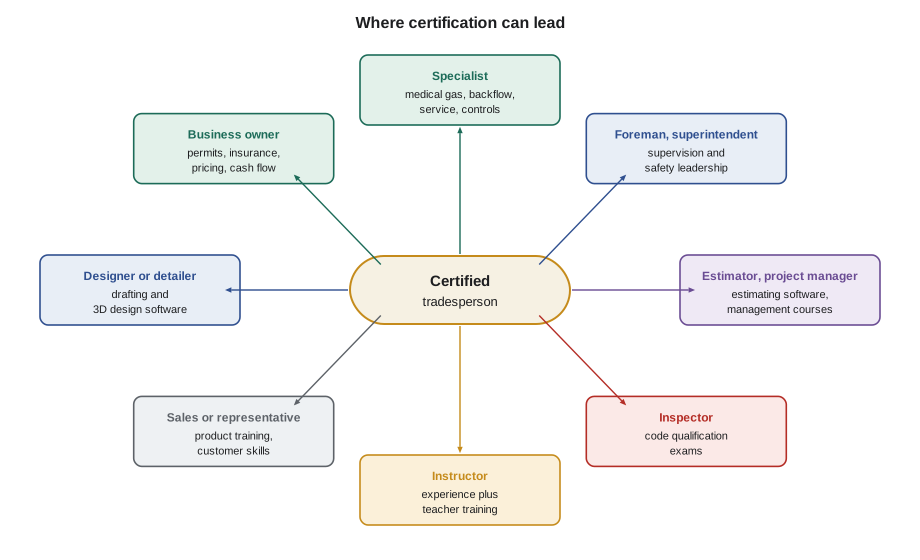
Certification is not the end of a trades career; for most people it is the middle of the beginning. A certified journeyperson can spend a whole career doing excellent work in the trade, and many do. Others move into leading crews, running projects, estimating, inspecting, teaching, selling, designing or running their own businesses. This lesson looks at where a trade can lead, what each path involves, what extra training or credentials it needs and how to start preparing while you are still an apprentice.
Mastering the trade
The first path is the one most people start on: becoming an excellent journeyperson. That means building deep skill and a broad range of experience, keeping up with code changes, new materials and new technology, and becoming the person others ask when something is unusual. Many tradespeople specialize: in plumbing, for example, in medical gas, backflow prevention, large commercial systems, service and diagnostics, or high-efficiency heating. Specialties often bring extra certifications, higher pay and more interesting work.
Some specialties need their own credentials. In Ontario, gas work requires a gas technician certificate under the Technical Standards and Safety Authority, and medical gas piping and backflow prevention testing have their own training and certification. Electricians who want to run an electrical contracting business need a master electrician licence from the Electrical Safety Authority. Ask about the certifications that matter in your trade and region.
Leading people: lead hand, foreman, superintendent
Many journeypersons move into leading crews. A lead hand runs a small crew on part of a job while still working with the tools. A foreman, like Dave, runs a trade contractor's crew on a site: planning the work, assigning tasks, ordering material, keeping records, managing safety, coordinating with other trades and training apprentices. A general superintendent runs a whole site for a general contractor, coordinating every trade. Each step means less time with the tools and more time with people, plans and paperwork.
Leading people is a different skill from doing the work. The best foremen combine trade knowledge with planning, communication, fairness and calm under pressure. TRD-106 covered the communication side. Training in supervision, scheduling, safety leadership and conflict resolution helps, and many companies offer it. CON-355 covers safety leadership for site supervisors in depth.
A widely recognized credential for construction supervisors in Canada is Gold Seal Certification, offered through the Canadian Construction Association for superintendents, project managers, estimators and other roles, based on experience, education and an exam. Some employers prefer or require it for senior site roles.
Estimating and project management
Estimators work out what a job will cost: they read drawings and specifications, take off quantities of material and labour, get prices from suppliers and subcontractors, and build a bid. Tradespeople make good estimators because they know how long work really takes and what goes wrong. Many move into estimating after an injury or simply when they want to work in an office. The skills include blueprint reading (TRD-103), trade math (TRD-102), spreadsheets and estimating software, and a strong sense of how the work goes together.
Project coordinators and project managers run the business side of a job: contracts, schedules, budgets, submittals, requests for information, change orders and communication with the client and general contractor. Trade experience gives project managers credibility with crews and a feel for what is realistic. Many larger companies have a path from foreman or estimator into project management, sometimes supported by college courses in construction management. The construction management program on this site covers estimating, scheduling and project management in detail.
Inspection and codes
Building and plumbing inspectors check that work meets the code. Municipal inspectors in Ontario must be qualified under the Building Code, which involves passing exams in the areas they inspect and registering with the province; experienced tradespeople often have a head start because they already know how systems are built and what goes wrong. Other inspection roles include electrical inspectors with the Electrical Safety Authority, insurance and loss-control inspectors, and quality inspectors for large contractors and owners.
Inspection jobs are often with municipalities, which can mean steady hours, good benefits and a pension, in exchange for less hands-on work. They require a firm grasp of code, good judgement and the ability to explain a decision clearly to a contractor who may not like it.
Teaching, sales, design and other paths
Instructors at colleges and training centres are usually experienced journeypersons who enjoy explaining their trade. Most need certification, years of experience and, at many colleges, some teacher training. Teaching keeps you close to the trade and lets you shape the next generation of apprentices.
Technical sales and manufacturer representatives work for suppliers and manufacturers, helping contractors and engineers choose and use products. Trade experience makes their advice credible. The work involves travel, training sessions and relationships with customers, and often pays well through salary plus commission.
Designers and detailers draw systems for contractors and engineers. Many mechanical and electrical contractors now model their work in three dimensions before installing it, to find conflicts and to prefabricate assemblies in a shop. Tradespeople who learn drafting and modelling software are in demand for this work, because they know how systems are actually installed. Prefabrication shops also need experienced tradespeople to build assemblies under controlled conditions.
Other paths include safety coordination (Anika Shah, Kingsway Tower's safety coordinator, started as a carpenter), facilities maintenance for hospitals, universities and large buildings, work for utilities and energy companies, and roles in industry associations and unions.
Planning your path
You do not have to choose a path as an apprentice, but you can start preparing. Pay attention to which parts of the work you enjoy most: solving problems, planning, teaching others, talking to customers, working with drawings. Ask people in different roles how they got there. Take on small responsibilities when offered, such as helping a new apprentice or tracking material for your crew. Keep learning beyond the minimum: codes, software, business, communication. And keep your records, because many advanced credentials require documented experience.
The program below compares the estimated earnings of two invented career paths over twenty years after certification, one staying on the tools with steady raises, the other moving to foreman and then project manager with larger salary steps but some time spent in courses. The figures are illustrative, not real salaries; the point is that different paths pay off over different time frames.
# twenty-year earnings for two invented paths after certification (illustrative)
def on_tools(year):
    base = 80000
    return base * (1.025 ** year)                    # steady raises, overtime ignored

def leadership(year):
    if year < 3:   pay = 80000 * (1.025 ** year)      # journeyperson
    elif year < 8: pay = 95000 * (1.03 ** (year - 3)) # foreman
    else:          pay = 115000 * (1.03 ** (year - 8))# project manager
    course_cost = 4000 if year in (2, 7) else 0       # supervision and management courses
    return pay - course_cost

a = b = 0
for y in range(20):
    a += on_tools(y); b += leadership(y)
    if y in (4, 9, 14, 19):
print(f"after {y + 1:2d} years: on the tools {a:12,.0f} leadership path {b:12,.0f}")after 5 years: on the tools 420,506 leadership path 434,900 after 10 years: on the tools 896,271 leadership path 975,868 after 15 years: on the tools 1,434,554 leadership path 1,623,601 after 20 years: on the tools 2,043,573 leadership path 2,374,501
Earnings are only one factor. Some people are happiest and do their best work on the tools for their whole career, and a highly skilled specialist or service technician can earn as much as many managers. Others find they enjoy planning and leading. The right path is the one that fits what you are good at and what you want your working days to look like.
Luis, Dave and Grace
The people around Maya show how varied trades careers are. Luis has been a journeyperson for more than twenty years and has turned down foreman jobs twice because he likes working with the tools and teaching apprentices; he is Northbridge's go-to person for difficult installations and code questions. Dave started as an apprentice at Northbridge, became a lead hand, then a foreman, and is taking evening courses in construction management with the company paying half. Grace Lin moved from new construction into service because she liked diagnosing problems and dealing with customers, and she is now thinking about starting her own service business, which is the subject of the next lesson.
| Path | What the work involves | Typical extra training or credentials |
|---|---|---|
| Specialist | Deep expertise in one area of the trade | Specialty certifications, manufacturer training |
| Foreman and superintendent | Planning, leading crews, coordination, safety | Supervision and safety leadership courses, Gold Seal |
| Estimator | Takeoffs, pricing, bids | Blueprint reading, estimating software, courses |
| Project manager | Contracts, schedules, budgets, client communication | Construction management courses or diploma |
| Inspector | Checking work against code | Building Code qualification exams and registration |
| Instructor | Teaching apprentices | Certification, experience, teacher training |
| Sales or representative | Helping customers choose and use products | Product training, sales skills |
| Designer or detailer | Drawing and modelling systems | Drafting and modelling software |
Lifelong learning
Whatever path you take, the trades keep changing. Codes are revised every few years. New materials, such as different kinds of plastic pipe and pressing systems for copper and steel, change how work is done. Building electrification, heat pumps, solar, battery storage, smart controls and electric vehicle charging are reshaping the electrical and mechanical trades. Prefabrication and digital modelling are changing how projects are planned and built. Tradespeople who keep learning stay in demand; those who stop find their skills slowly falling behind.
Learning after certification can take many forms: manufacturer training on new equipment, code update courses, specialty certifications, college courses in estimating or management, union or association upgrading courses, online learning, and simply reading the trade magazines and talking to colleagues. Some licenses and certifications require a set number of continuing education hours to renew. Even where they do not, a few days of training each year is one of the best investments a tradesperson can make.
Health and longevity
A trades career is long, and the body has to last. Many tradespeople change paths later in their careers because of wear and tear on knees, backs and shoulders. Protect yourself from the start: use lifting aids and good technique, wear hearing and eye protection, kneel on pads, rotate tasks, stay fit and treat small injuries before they become big ones. Planning a path that uses your experience in less physical roles later, such as estimating, inspection, teaching or service management, is sensible, not a sign of giving up.
Maya does not know yet which path she will take. She likes the problem solving of service work she saw with Grace, and she has noticed that she enjoys helping the newest apprentice on the crew find his way around the drawings. For now, she keeps a short list in the back of her logbook of the parts of the job she enjoys most and least, and she plans to look at it again when she is certified.
Whatever you choose, a reputation for good work, honesty and reliability is the one asset that goes with you into every path.
Common mistakes
MistakeThinking certification is the end of learning.
InsteadKeep up with code, technology and new skills throughout your career.
MistakeAssuming the only way up is into management.
InsteadSpecialists and service experts can build excellent careers on the tools.
MistakeTaking a leadership role without preparing.
InsteadLearn supervision, planning and communication skills before and after the move.
MistakeWaiting until you are certified to think about your path.
InsteadPay attention to what you enjoy and take small responsibilities as an apprentice.
MistakeLetting records lapse after certification.
InsteadMany advanced credentials need documented experience.
Summary and key terms
- Certification opens many paths: specialist, foreman and superintendent, estimator, project manager, inspector, instructor, sales, designer and business owner.
- Specialties and leadership roles often need extra certifications or training.
- Leading people is a different skill from doing the work; prepare for it deliberately.
- Inspection, estimating and project management all value trade experience.
- Different paths pay off over different time frames; earnings are only one factor.
- Start preparing as an apprentice by noticing what you enjoy, taking small responsibilities and keeping records.
- Lead hand
- A journeyperson who runs a small crew while still working with the tools.
- Foreman
- The person who runs a trade contractor's crew on a site.
- Superintendent
- The person who runs a whole site for a general contractor.
- Estimator
- A person who works out the cost of a job and prepares bids.
- Gold Seal Certification
- A national credential for construction supervisors, estimators and managers based on experience, education and an exam.
Practice problems
Work each problem on paper first, then reveal the answer to check.
Name five paths a certified tradesperson can take.
Show answer
Any five of: specialist, lead hand or foreman, superintendent, estimator, project manager, inspector, instructor, sales representative, designer, business owner.
How does a foreman's day differ from a journeyperson's?
Show answer
More planning, leading, paperwork and coordination; less time with the tools.
Why do tradespeople make good estimators?
Show answer
They know how long work really takes and what goes wrong.
What do inspectors need besides trade knowledge?
Show answer
A firm grasp of code, good judgement, any required qualifications and the ability to explain decisions.
In the earnings program, why does the leadership path dip in some years?
Show answer
Course costs are subtracted in those years.
Give two ways to prepare for a career path while still an apprentice.
Show answer
Any two of: notice what you enjoy, ask people how they got their roles, take small responsibilities, keep learning beyond the minimum, keep records.
Lesson quiz · 5 questions
Score 60% or more to complete this lesson.
Create a free account to save your progress, take quizzes and earn a certificate.