
SMW-430 · Lesson 7 of 12 · 18 min
Trade math and science drills
Calculation questions are scattered through every area of the exam: a stretchout in layout, a weight in fabrication, an airflow in installation, a slope in roofing. Each is usually worth one mark, like any other question, but each takes longer than a recall question, and a slow or careless calculation costs time that other questions need. Kai's diagnostic showed that he got most calculations right in the end but took nearly three minutes over each one. Aggie's target for him was under ninety seconds, with a quick check built in. This lesson collects the formulas, shows the right-triangle methods that solve most offsets and slopes, and gives a drill generator that produces a fresh mixed set every night.
The formula sheet in your head
The Red Seal exam is written without reference material, so the common formulas must be known by heart. A basic calculator is allowed at most exam centres, but the candidate should confirm the rule when booking. Kai wrote his formula list on one page and copied it from memory every Sunday until he could do it without a mistake.
| Quantity | Formula | Notes |
|---|---|---|
| Circumference | C = πD | Use the mean diameter for patterns |
| Area of a circle | A = πD² / 4 | Square the diameter first |
| Area of a rectangle | A = W × H | Duct face area |
| Duct surface area | 2(W + H) × L | Rectangular duct |
| Volume of a cylinder | V = A × L | Tanks, plenums |
| Airflow | Q = A × V | Face area times velocity |
| Right triangle | c² = a² + b² | Offsets and true lengths |
| Slope | rise / run | Roofs, drainage, grease duct |
| Bend allowance | BA = θ(π/180)(R + Kt) | θ in degrees, K about 0.33 to 0.5 |
| Thermal movement | ΔL = αLΔT | Gutters, copings, long duct |
Right triangles and offsets
Most offset, slope and true-length problems are right triangles. The rise and run are the two short sides and the travel is the hypotenuse. If two sides are known, Pythagoras gives the third. If one side and the angle are known, the trigonometric ratios do the work: the sine of the angle is the rise over the travel, the cosine is the run over the travel, and the tangent is the rise over the run. A memory aid many apprentices use is SOH CAH TOA. For standard fitting angles, the travel can also be found by multiplying the offset by a constant: 1.414 for 45°, 2.000 for 30°, 1.155 for 60° and 2.613 for 22.5°, where the constant is one divided by the sine of the angle.
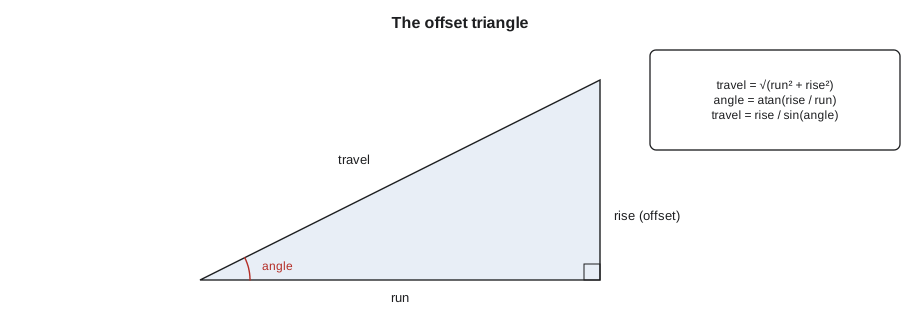
A useful check is that the travel is always the longest side, and that a 45° offset has equal rise and run. If a calculation gives a travel shorter than the rise, the wrong ratio has been used.
Areas, weights and airflow
Area problems become weight problems once the mass per unit area of the sheet is known, and become airflow problems once the velocity is known. The units are where errors creep in. Round duct face area in square metres from a diameter in millimetres needs the diameter in metres first. In imperial units, a duct size is given in inches but velocity is in feet per minute, so the face area must be in square feet: divide square inches by 144. A 400 mm round duct has a face area of 0.126 m², and at 5 m/s it carries 0.63 m³/s, or 630 L/s.
Bend allowance comes up in brake work. It is the length of the neutral line through the bend, and it depends on the bend angle, the inside radius, the thickness and a factor K for where the neutral line sits. For most light-gauge brake work K is taken as about 0.4, although exam questions will state the value to use.
Science questions
The exam also asks short science questions: heat flows from warm to cold; warm air rises; the dew point is the temperature at which moisture condenses, which is why cold duct in a warm ceiling is insulated with a vapour retarder on the outside; pressure in a duct is the sum of static and velocity pressure; and air density falls as temperature rises. Electrical questions are limited to safety, lockout and the basic idea that current flows through a closed circuit. Kai treated these as recall questions and put them on flash cards.
A drill generator
Aggie's best idea for calculation speed was a nightly drill of eight mixed problems, different each night, timed, and checked straight away. A worksheet would have been learned by heart in a week, so she wrote a short generator. Each night Kai used the date as the seed, so the set was new every night but could be produced again later to check an answer. He worked the problems on paper with a calculator, then ran the script with the answers shown to mark them.
# Mixed calculation drill: a fresh, reproducible set each night
import math, random
seed = 20261102                     # use the date as the seed
rng = random.Random(seed)
show_answers = True

def offset():
    o = rng.choice([300, 450, 600, 750]); a = rng.choice([22.5, 30, 45, 60])
    return f"offset {o} mm at {a} degrees: travel?", f"{o / math.sin(math.radians(a)):.0f} mm"
def stretchout():
    d = rng.choice([250, 300, 400, 500])
    return f"stretchout of {d} mm mean diameter pipe?", f"{math.pi * d:.0f} mm"
def airflow():
    d = rng.choice([250, 300, 400, 500]); v = rng.choice([4, 5, 6])
    q = math.pi * (d / 1000) ** 2 / 4 * v * 1000
    return f"{d} mm round duct at {v} m/s: flow?", f"{q:.0f} L/s"
def slope():
    run = rng.choice([6, 9, 12, 15]); s = rng.choice([1, 2, 4])
    return f"fall over a {run} m run at {s} percent?", f"{run * s / 100:.2f} m"

drill, seen = [], set()
while len(drill) < 8:
    q, a = rng.choice([offset, stretchout, airflow, slope])()
    if q not in seen:                       # no repeated problems in one set
        seen.add(q); drill.append((q, a))
for i, (q, a) in enumerate(drill, 1):
print(f"{i}. {q}" + (f" answer {a}" if show_answers else ""))1. offset 750 mm at 30 degrees: travel? answer 1500 mm 2. offset 750 mm at 22.5 degrees: travel? answer 1960 mm 3. stretchout of 500 mm mean diameter pipe? answer 1571 mm 4. fall over a 9 m run at 4 percent? answer 0.36 m 5. fall over a 12 m run at 1 percent? answer 0.12 m 6. offset 300 mm at 22.5 degrees: travel? answer 784 mm 7. fall over a 12 m run at 4 percent? answer 0.48 m 8. stretchout of 250 mm mean diameter pipe? answer 785 mm
The generator is short on purpose. Kai added a new problem type each week as his review moved through the trade: a bend allowance function in week 4, a fan law function in week 6, and an air change function in week 7. Setting show_answers to False gave him a clean sheet to work from.
Speed with accuracy
Speed comes from doing the same kinds of problems many times, but accuracy comes from habits. Aggie taught Kai four: write the formula before the numbers; convert every value to one set of units before calculating; estimate the answer roughly before pressing keys; and compare the result with the options and the estimate. On a multiple-choice exam, the distractors are often the answers produced by common mistakes, such as using the radius for the diameter or forgetting to divide by 144, so an answer that matches an option is not proof that it is right. The estimate is the check.
# Rough estimates catch calculator slips
import math
d, v = 0.4, 5.0                         # 400 mm duct (0.4 m) at 5 m/s
exact = math.pi * d ** 2 / 4 * v * 1000
rough = 3 * d * d / 4 * v * 1000         # pi taken as 3
slip = math.pi * d / 4 * v * 1000        # forgot to square the diameter
print(f"exact {exact:.0f} L/s, rough {rough:.0f} L/s, slip {slip:.0f} L/s")
print("slip is far from the rough estimate, so it would be caught" if abs(slip - rough) > 0.2 * rough else "")exact 628 L/s, rough 600 L/s, slip 1571 L/s slip is far from the rough estimate, so it would be caught
Worked problem
An offset at 30 degrees
A round duct must offset 450 mm using two 30° elbows. What is the travel between the elbow centres?
Show solution
- Travel = offset / sin 30°.
- sin 30° = 0.5.
- Travel = 450 / 0.5 = 900 mm.
- Check: the travel is longer than the offset, and the 30° constant is 2.000.
Answer: 900 mm.
Bend allowance worked through
Bend allowance is the calculation apprentices most often forget, because the brake operator rarely does it by hand. It is still worth knowing, because it explains why a flat blank must be a little shorter than the sum of the outside dimensions of the finished part. For a 90° bend in 1.6 mm steel with an inside radius of 1.6 mm and K = 0.4, the bend allowance is about 3.5 mm. A channel with two such bends and outside legs of 25, 50 and 25 mm therefore needs a blank of the inside flat lengths plus two bend allowances, not the sum of the outside dimensions.
# Bend allowance and flat blank for a channel with two 90 degree bends
import math
t = 1.6          # thickness
R = 1.6          # inside radius
K = 0.4
BA = math.radians(90) * (R + K * t)
legs = [25, 50, 25]    # outside dimensions of the channel
setback = R + t                                   # outside corner to the start of the bend
flats = [legs[0] - setback, legs[1] - 2 * setback, legs[2] - setback]
blank = sum(flats) + 2 * BA
print(f"bend allowance {BA:.1f}, flats {[round(f, 1) for f in flats]}, blank {blank:.1f} mm")
print(f"sum of outside dimensions {sum(legs):.1f} mm (too long by {sum(legs) - blank:.1f})")bend allowance 3.5, flats [21.8, 43.6, 21.8], blank 94.2 mm sum of outside dimensions 100.0 mm (too long by 5.8)
The difference is small on light gauge, but on heavier material it decides whether a part fits. The exam will usually give the K factor and ask for either the bend allowance or the blank length; the trap is to forget that the flats are measured from the outside corner minus the setback.
Percentages, ratios and scale
Several common exam calculations are not trade formulas at all, just percentages and ratios. A seam and waste allowance of 10 percent multiplies a quantity by 1.10; a discount of 15 percent multiplies it by 0.85. A slope of 2 percent is a fall of 2 units in 100. A drawing at 1:50 means that 10 mm on the drawing is 500 mm on site, while an imperial drawing at 1/4 in = 1 ft is a scale of 1:48. Kai added a scale problem to his generator after missing two in one practice set, both because he had divided where he should have multiplied.
Calculator habits
A calculator is a tool, and like any tool it needs the right technique. Kai's calculator errors fell into three groups: order of operations, where he typed a sum and a product without brackets; memory, where he reused a stored value from the previous problem; and rounding, where he rounded intermediate results too early. He fixed them by using brackets around every sum, clearing the calculator at the start of each problem, and keeping at least four significant figures until the final answer. He also used the same calculator for every practice session, so that on exam day its keys and its quirks were familiar.
By the end of week 7, Kai's average time per calculation in his nightly drill had fallen from just under three minutes to about seventy seconds, and his accuracy had risen from about 75 percent to 92 percent. The time saved on calculations was the margin that let him go back to marked questions in his mocks.
Common mistakes
MistakeUsing the radius where the formula needs the diameter.
InsteadWrite the formula first and label each value.
MistakeMixing millimetres and metres, or inches and feet.
InsteadConvert everything to one set of units before calculating.
MistakeUsing the tangent when the travel is wanted.
InsteadTravel is offset divided by sine.
MistakeTrusting an answer because it matches an option.
InsteadCompare with a rough estimate; distractors come from common slips.
MistakePractising the same worksheet until it is memorised.
InsteadUse a fresh mixed set each time.
Summary and key terms
- Know the core formulas by heart; reference material is not allowed.
- Most offsets and slopes are right triangles: Pythagoras or the sine, cosine and tangent ratios.
- Area leads to weight with the mass per unit area and to airflow with the velocity, once the units match.
- A seeded drill generator gives a fresh, reproducible set each night.
- Write the formula, convert units, estimate, then check against the estimate.
- Travel
- The length of the sloped side of an offset, the hypotenuse of the right triangle.
- Offset constant
- The multiplier, one divided by the sine of the angle, that turns an offset into a travel.
- Bend allowance
- The length of the neutral line through a bend.
- K factor
- The fraction of the thickness at which the neutral line sits in a bend.
- Seed
- The starting number for a random generator, which makes its output repeatable.
- Dew point
- The temperature at which moisture in air begins to condense.
Practice problems
Work each problem on paper first, then reveal the answer to check.
An offset of 600 mm at 45°: travel?
Show answer
600 × 1.414 ≈ 848 mm.
A 300 mm round duct at 4 m/s: flow?
Show answer
0.0707 × 4 = 0.283 m³/s, or 283 L/s.
A 12 m run at 2 percent slope: fall?
Show answer
0.24 m.
Why use the date as the seed?
Show answer
A new set every night that can be reproduced to check answers.
Lesson quiz · 5 questions
Score 60% or more to complete this lesson.
Create a free account to save your progress, take quizzes and earn a certificate.