
SMW-430 · Lesson 1 of 12 · 19 min
The Red Seal exam today and how it is built
Kai Ferreira has reached the last stretch of his apprenticeship at Keelson Sheet Metal in Halifax. Over four years he has cut his first drain pan on the shop floor, laid out gore elbows for the Ashgrove Elementary retrofit, soldered copper flat-lock panels for St. Brendan's, welded the Brine & Ember grease duct, hung and leak-tested the Ashgrove library system and helped Lin Zhao detail the Eastgate Hospital wing, which is now going up floor by floor. What stands between Kai and his certificate of qualification is one exam: the interprovincial Red Seal examination for sheet metal workers. Aggie MacLeod, the journeyperson who has mentored him since his first week, has agreed to coach him through the final twelve weeks, and Halima Noor has promised him the lead hand position on Eastgate's level 4 once he passes. This course follows those twelve weeks: the exam itself, a structured review of the trade, practice under exam conditions, and the leadership skills that a new journeyperson needs on the first day with a crew.
Why the certificate matters
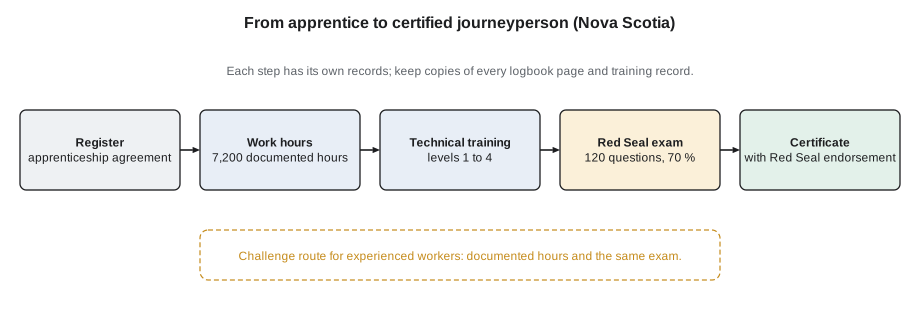
Sheet metal worker is a compulsory certified trade in Nova Scotia, which means that only a registered apprentice working under supervision, or a certified journeyperson, may do the work of the trade. The certificate of qualification is issued by the Nova Scotia Apprenticeship Agency once an apprentice has completed the required documented hours and technical training and has passed the certification exam. In Nova Scotia the apprenticeship requires 7,200 documented hours on the job. Because sheet metal worker is a Red Seal trade, the exam is the interprovincial Red Seal examination, and a pass earns a certificate with a Red Seal endorsement. That endorsement is recognised in every province and territory, so Kai could work in Alberta or Ontario without writing another exam. For Keelson, a certified journeyperson can supervise apprentices, lead a crew and sign off work on jobs where the contract or the owner requires certified tradespeople.
What the exam looks like
The Red Seal Sheet Metal Worker examination has 120 multiple-choice questions, each with four options and one correct answer. The pass mark is 70 percent. It is written on a computer or on paper at an approved exam centre, under supervision, and it is usually written in a single sitting of up to about four hours; Kai confirms the time and the rules for calculators and reference material with the Nova Scotia Apprenticeship Agency when he books. The questions are drawn from the Red Seal Occupational Standard for the trade, which describes what a journeyperson does, grouped into major work activities, tasks and sub-tasks. The weighting of each activity on the exam reflects the share of the job it represents, so the exam is a sample of the whole trade rather than of one course or one textbook.
| Feature | Detail |
|---|---|
| Questions | 120, multiple choice, four options |
| Pass mark | 70 percent |
| Source | Red Seal Occupational Standard for sheet metal workers |
| Weighting | by major work activity (Lesson 2) |
| Time | confirm with the apprenticeship agency; often up to about four hours |
| Result | certificate of qualification with Red Seal endorsement |
How the questions are written
Exam questions are written by experienced tradespeople and reviewed by committees so that each one tests a real task. Most questions describe a situation and ask what the worker should do or what value is correct, rather than asking for a definition. A typical question gives a duct size, a pressure or a roof detail and asks for the right gauge, joint, fastening or sequence. Some questions require a calculation: a stretchout, a cone pattern radius, an offset travel, an area or a weight. Others test safety and judgement, such as the first step before working on a fan or the right response when an inspector rejects a damper installation.
The wrong options are not random. Each distractor is built from a common mistake: using the outside diameter instead of the mean diameter, applying a rule that belongs to a different pressure class, or choosing a step that is correct but comes in the wrong order. That is why reading every option before answering matters, and why an apprentice who has done the work carefully has an advantage over one who has memorised definitions. Aggie's advice to Kai was blunt: the exam rewards the habits of a good journeyperson, so the review should rebuild those habits rather than collect trivia.
| Question type | What it tests | Example |
|---|---|---|
| Knowledge | Recall of a fact or term | Which seam is used for longitudinal joints on rectangular duct? |
| Application | Using a rule in a situation | Which joint suits a medium-pressure duct of a given size? |
| Calculation | Working out a value | What is the stretchout of a 300 mm pipe? |
| Judgement | Choosing the safest or best action | What do you do first when a fire damper fails its drop test? |
Taking stock: Kai's starting point
Before building a plan, Aggie asked Kai to list what he had actually done during the apprenticeship, using his logbook, the job list and his technical training transcripts. The list is useful in two ways. It reminds the apprentice of how much is already known, which matters for confidence, and it reveals gaps: work the apprentice has read about but never done. Kai had plenty of duct fabrication and installation, good layout experience from the Ashgrove fittings, and recent welding and estimating work. His gaps were in maintenance and repair work, in industrial exhaust beyond the Ironbark dust collector, and in roofing details other than copper.
# Kai's experience log: hours by area of the trade (from logbook totals)
log = {
    "shop fabrication": 2650,
    "duct installation": 2400,
    "layout and pattern development": 620,
    "welding and soldering": 380,
    "architectural and roofing": 520,
    "testing, balancing and service": 210,
    "detailing and estimating": 260,
    "safety training and orientation": 160,
}
total = sum(log.values())
print(f"total documented hours: {total}")
for area, h in sorted(log.items(), key=lambda x: -x[1]):
    bar = "#" * round(h / 100)
print(f"{area:34s} {h:5d} {100 * h / total:5.1f} % {bar}")total documented hours: 7200 shop fabrication 2650 36.8 % ########################## duct installation 2400 33.3 % ######################## layout and pattern development 620 8.6 % ###### architectural and roofing 520 7.2 % ##### welding and soldering 380 5.3 % #### detailing and estimating 260 3.6 % ### testing, balancing and service 210 2.9 % ## safety training and orientation 160 2.2 % ##
The totals tell a familiar story. Most of an apprentice's hours are spent fabricating and installing, which is the core of the trade and the heaviest part of the exam. The smaller areas, such as service and repair, are where an apprentice may have little hands-on experience and must rely on study. Kai flagged service and repair, and testing and balancing, as areas to check in the diagnostic test.
Rules on exam day
The exam centre's rules are strict and the same for everyone. Kai must bring government photo identification and arrive early. Phones and smart watches go into a locker. Approved calculators may be allowed, but programmable devices are not. Any reference material allowed is provided by the centre. Leaving the room may be limited, and the time limit is fixed. If Kai does not pass, he receives a report showing his performance by major work activity, and he may rewrite after a waiting period set by the province, with a fee. Knowing these rules in advance removes one source of stress on the day.
Worked problem
Reading the format
Kai has 240 minutes for 120 questions. He wants to finish a first pass with 30 minutes left for review. How much time per question should he plan on the first pass?
Show solution
- Time for the first pass: 240 − 30 = 210 minutes.
- Time per question: 210 / 120 = 1.75 minutes, or 1 minute 45 seconds.
- Calculation questions take longer, so knowledge questions should be quicker than this average.
Answer: About 1 minute 45 seconds per question on the first pass.
Where the exam sits in the apprenticeship
The exam is the last step of a long process, not a separate event. A Nova Scotia sheet metal apprentice registers with the apprenticeship agency, works under a certified journeyperson, logs on-the-job hours, completes each level of technical training and has the logbook tasks signed off. Only when the hours, the training and the sign-offs are complete does the agency approve the apprentice to write the certification exam. Kai's approval letter arrived in the same week Aggie started coaching him, which is why the plan in this course runs for twelve weeks: long enough to review every area, short enough to keep the date in sight.
Kai's logbook also showed him what he had and had not done on the job. Four years at Keelson had given him plenty of rectangular duct, spiral pipe, kitchen exhaust and roofing, but very little industrial work and almost no service on existing systems. The exam covers the whole trade, not one contractor's work, so the gaps in the logbook pointed straight at topics he would need to study from books and from questions rather than from memory of the job.
| Logbook area | Hours logged | Exam risk |
|---|---|---|
| Rectangular and round duct installation | High | Low; review details only |
| Fabrication and layout in the shop | Medium | Medium; hand methods out of practice |
| Kitchen exhaust and welding | Medium | Low to medium |
| Roofing and architectural | Low to medium | Medium; details forgotten |
| Maintenance and repair of existing systems | Low | High; little job experience |
What the exam is really testing
Aggie told Kai that the exam is not trying to catch him out. It is checking that a person who holds the certificate can be trusted to do the trade's work safely and correctly anywhere, on any job, with any contractor. That idea explains the way the questions are written. They focus on the common, important tasks and on the judgements that matter most, especially safety and the correct installation of systems that protect people, such as fire dampers and kitchen exhaust. When a question is hard to answer, it helps to ask which option a careful journeyperson would choose on a job they had never seen before.
It also explains why job experience alone is not enough. Every contractor develops its own habits, some better than the standard and some worse. Kai realised that a few of his instinctive answers in the diagnostic were really Keelson habits, such as a particular hanger detail or an assumed seal class, and that the exam's answer was the standard's, not the shop's. Part of his review became sorting what he knew into two piles: what the standard says, and what Keelson happens to do.
Myths about the exam
Apprentices pass stories to each other about the exam, and some of them are harmful. One is that the questions are tricks; in fact, they are written and reviewed carefully, and a question that seems tricky is usually one that has been misread. Another is that the exam can be passed by memorising a bank of questions; banks help with practice, but the real exam's questions are not the same, and memorised answers break when the wording changes. A third is that experienced workers do not need to study. Kai heard that one from a journeyperson who had failed his first attempt, and who told him that confidence had cost him more marks than any gap in his knowledge.
Aggie's answer to all three myths was the same: treat the exam as a fair test of the trade, prepare for it with the trade's knowledge and with exam skills, and let the practice results, not stories, decide when you are ready. The rest of this course follows that approach, one area and one skill at a time.
Common mistakes
MistakeAssuming the exam tests one textbook.
InsteadThe exam samples the whole trade as described by the occupational standard or the committee's curriculum.
MistakeIgnoring the exam rules until the day.
InsteadRead the rules, identification requirements and calculator policy before booking.
MistakeStudying only what you enjoy.
InsteadUse the experience log and a diagnostic test to find the gaps.
MistakeTreating the credential as paperwork.
InsteadCertification sets who may supervise, lead and sign off work.
Summary and key terms
- Sheet metal worker is a compulsory certified trade in Nova Scotia; the certificate requires 7,200 hours, technical training and the Red Seal exam.
- The Red Seal exam has 120 four-option questions and a 70 percent pass mark.
- Questions test knowledge, application, calculation and judgement, and distractors are built from common mistakes.
- An experience log and a diagnostic test show where study time is needed.
- Knowing the exam rules in advance removes stress on the day.
- Certificate of qualification
- The provincial document showing that a person is certified in a trade.
- Red Seal endorsement
- The interprovincial standard of excellence added to a certificate after the Red Seal exam.
- Compulsory trade
- A trade that only certified workers or registered apprentices may practise.
- Occupational standard
- The national description of the tasks of a trade, used to build the exam.
- Distractor
- A wrong option written to look plausible.
- Challenge route
- Certification for experienced workers who did not complete an apprenticeship.
Practice problems
Work each problem on paper first, then reveal the answer to check.
How many documented hours does Nova Scotia require for the sheet metal apprenticeship?
Show answer
7,200 hours.
What does the Red Seal endorsement allow?
Show answer
Recognition of the certificate across all provinces and territories without another exam.
Why are the wrong options on an exam question plausible?
Show answer
They are built from common mistakes.
With 210 minutes for 120 questions, what is the average time per question?
Show answer
1.75 minutes.
Lesson quiz · 5 questions
Score 60% or more to complete this lesson.
Create a free account to save your progress, take quizzes and earn a certificate.