
SMW-430 · Lesson 4 of 12 · 20 min
Fabrication, joining and welding review
Fabrication is the other half of the largest block of questions, and it is the part of the exam where shop experience helps the most. Kai had spent two years in the Keelson shop before moving to site, so the machines, the seams and the locks were familiar. The risk was different: questions that turn on one detail, such as which seam suits a given pressure class, which metals must not touch, or what fumes come off galvanized steel when it is welded. This lesson walks through the joining methods reviewed in SMW-130, SMW-220 and SMW-230, and the way the exam tends to ask about them.
Seams and locks
A seam joins two edges of sheet along their length. The seams that come up most often are the Pittsburgh lock, the button punch snap lock, the grooved seam, the standing seam and the double seam. The Pittsburgh lock is the standard longitudinal seam on rectangular duct made on a roll former: one edge is formed into a pocket and the other into a flange that is inserted and hammered over. The button punch snap lock is quicker to assemble on site, because the flange snaps into the pocket and is held by punched buttons, but it is limited to lower pressure classes and lighter gauges. The grooved seam joins flat sheet or round pipe and is locked with a hand groover or a machine. Standing seams stiffen large panels and are used on roofs and on some large duct, and double seams join bottoms to cylinders, as on tanks and some fittings.
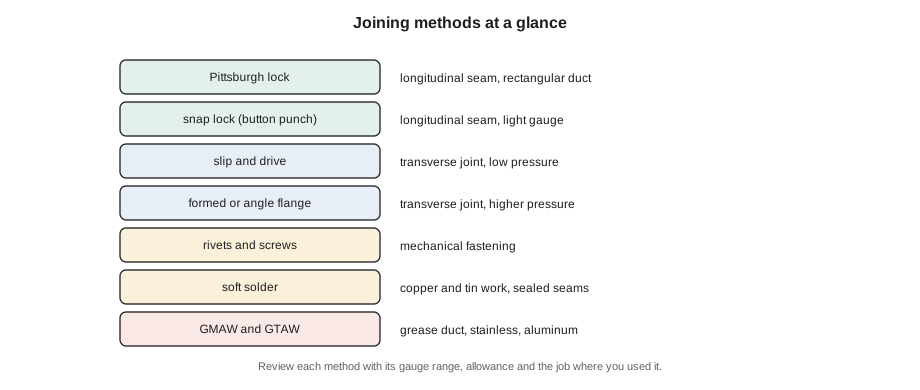
Exam questions on seams usually test one of three things: which seam is used where, which edge carries which allowance, or why one seam is chosen over another. A good habit is to think of each seam in terms of what it must do: hold the shape, seal against air or water, carry load, or be quick to assemble on site.
Transverse joints
Transverse joints connect one section of duct to the next. On low-pressure rectangular duct, the S slip and drive is the traditional joint: S slips on the long sides and drive cleats on the short sides. On higher-pressure and larger duct, the joint must also stiffen the duct, so flanged connections are used: formed-on flanges rolled as part of the duct wall, or slip-on flange systems, joined at the corners with corner pieces, gasketed and clipped or bolted. Companion angle flanges, made of steel angle and bolted, are used on heavy and industrial work. Round duct uses slip joints with sealant and screws, or beaded couplings and drawbands, and spiral duct is often joined with fittings that slip into the pipe and are sealed.
The duct construction standard sets the joint spacing, joint type and reinforcement by pressure class, duct size and gauge. The exam does not expect anyone to memorise the tables, but it does expect an apprentice to know how to read them: find the pressure class, find the duct dimension, choose the gauge, and read off the joint and reinforcement that suit them. Kai practised with photocopied tables, timing himself to find the right cell in under a minute.
| Joint or seam | Typical use | Key point |
|---|---|---|
| Pittsburgh lock | Longitudinal seam on rectangular duct | Shop formed; suits most pressure classes |
| Button punch snap lock | Longitudinal seam assembled on site | Fast but limited to lower pressures |
| S slip and drive | Transverse joint on low-pressure duct | Simple; must be sealed to meet the seal class |
| Formed-on or slip-on flange | Transverse joint on larger or higher-pressure duct | Gasketed; also acts as reinforcement |
| Companion angle | Heavy and industrial duct | Bolted steel angle frames |
| Welded seam | Grease, fume and some industrial duct | Continuous and liquid-tight where required |
Sealing
Every joint and seam leaks unless it is sealed. The duct construction standard groups sealing requirements into seal classes, with the highest class sealing all transverse joints, longitudinal seams and wall penetrations, and lower classes sealing fewer of them. Duct sealant, gaskets and approved tapes are the usual materials. A typical exam question gives a duct pressure and asks which joints must be sealed, or gives a failed leakage test and asks what to check first; the answer is usually the transverse joints and the corners of flanged connections, where most leaks start.
Fasteners and corrosion
Sheet metal screws, rivets and blind rivets are the common fasteners. Self-drilling screws are standard for duct, but their points must not project into a grease or fume duct, and they must not be used where the specification calls for a watertight or airtight seam without sealant. Blind rivets are used where only one side can be reached. Exam questions on fasteners often turn on corrosion: when two different metals touch in the presence of moisture, the less noble one corrodes. Copper in contact with galvanized steel or aluminum, for example, attacks the zinc or the aluminum. Fasteners should be of the same metal as the work or of a compatible one, such as stainless steel screws on stainless steel or aluminum rivets on aluminum.
# Galvanic pairs: flag fastener and sheet combinations to avoid in wet locations
series = ["magnesium", "zinc", "aluminum", "steel", "lead", "tin", "copper", "stainless", "titanium"]
pairs = [("aluminum", "aluminum"), ("copper", "zinc"), ("stainless", "stainless"),
         ("copper", "aluminum"), ("steel", "zinc"), ("stainless", "aluminum")]
for fastener, sheet in pairs:
    gap = abs(series.index(fastener) - series.index(sheet))
    less_noble = fastener if series.index(fastener) < series.index(sheet) else sheet
    note = "same metal" if gap == 0 else ("close" if gap == 1 else f"avoid when wet: {less_noble} corrodes")
print(f"{fastener:9s} on {sheet:9s} {note}")aluminum on aluminum same metal copper on zinc avoid when wet: zinc corrodes stainless on stainless same metal copper on aluminum avoid when wet: aluminum corrodes steel on zinc avoid when wet: zinc corrodes stainless on aluminum avoid when wet: aluminum corrodes
The ranking in the code is a simplified version of the galvanic series. It is good enough for exam questions, which usually ask which pair is the worst choice or which metal will corrode. Steel and zinc are close together, and that is why galvanizing protects steel: the zinc corrodes first and shields the steel beneath it.
Soldering
Soldering joins metal with a filler that melts below about 450 °C, without melting the base metal. Sheet metal workers solder copper roofing and flashing, tin-coated steel and some gutters and fittings. The joint must be clean, fluxed and heated evenly so the solder flows into the lap by capillary action. Lead-bearing solders are not used where water may be collected for drinking, and many specifications now call for lead-free solder on all roofing. Flux residue must be washed off after soldering, because it is corrosive. Exam questions often ask about lap width, the purpose of flux, why the joint must be clean, or why the iron must be large enough to heat the whole lap.
Welding thin gauge
Welding comes up on the exam in three ways: process choice, distortion control and safety. Gas metal arc welding with short-circuit transfer is the common process for sheet steel, because it puts little heat into the work. Gas tungsten arc welding is used on stainless steel and aluminum where appearance and control matter. Oxy-fuel equipment is still used for cutting, heating and brazing. Distortion is controlled by tacking at short intervals, welding in short stitches, skipping along the seam, and using backing bars or clamps to draw heat away. Thin material burns through easily, so the current is kept low and travel speed is kept up.
Welding galvanized steel releases zinc oxide fumes, which cause metal fume fever, with flu-like symptoms that appear hours later. The coating should be removed from the weld area where possible, and local exhaust and respiratory protection are used. Welding stainless steel releases fumes containing chromium compounds, which require exposure controls too. Kai found that the safety questions in this area were the easiest marks to collect, as long as he read each option carefully.
Grease and fume duct
Commercial kitchen grease duct is the most tested welding application. It carries grease-laden vapour from the hood to the fan and must be liquid-tight, so that grease cannot leak into the building, and strong enough to contain a fire inside it. The kitchen exhaust standard calls for carbon steel of at least 1.37 mm (16 gauge) or stainless steel of at least 1.09 mm (18 gauge), with all seams and joints continuously welded or brazed, and with cleanouts at changes of direction. The Brine & Ember kitchen from SMW-330 used welded black steel grease duct in a fire-rated shaft, and Kai remembered the inspection: the inspector checked every joint for continuous welds, every cleanout, and the slope of horizontal runs back toward the hood.
Grease duct work is also governed by the building code and the authority having jurisdiction, so the exam may ask who approves a deviation. In Nova Scotia that is the local building official, working under the provincial building code and the standards it references.
Worked problem
Choosing a joint
A run of rectangular supply duct, 900 mm × 500 mm, is in a high-pressure class. The detailer has drawn S slips and drives. Is that a sensible choice, and what should the lead hand check?
Show solution
- S slips and drives are a low-pressure joint and add little stiffness.
- High-pressure duct of that size normally needs flanged joints that also act as reinforcement.
- Check the duct construction table for the pressure class, the size and the gauge, and confirm the joint type and spacing with the detailer.
Answer: No. A flanged joint is expected; check the table and raise it with the detailer before fabrication.
Forming machines and their limits
Fabrication questions also cover the machines that make seams and shapes. The roll former makes Pittsburgh locks and other seams along the edge of a sheet in one pass, and it is limited by the gauge range it was built for: forcing heavier metal through damages the rolls and gives a poor lock. The brake bends straight lines; its capacity is set by the length and thickness of material it can bend, and stainless steel needs more capacity than mild steel of the same thickness. The slip roll forms cylinders and cones; the shear cuts straight lines and, like the brake, has a rated capacity for mild steel that falls for stainless. Exam questions often give a material and a thickness and ask which machine, or which setting, is suitable.
Safety questions on machines are some of the most reliable marks on the exam. Guards must be in place, hands are kept clear of the hold-downs and blades, only one person operates the foot pedal of a shear, and machines are locked out before any blade change, adjustment or clearing of a jam. Kai answered every machine safety question correctly on his diagnostic, and he kept it that way by reading every option, because the distractors on these questions are often almost right.
Inspecting a joint
Knowing how to judge a finished joint is part of the trade, and the exam asks about it. A good Pittsburgh lock is closed tightly along its length with no open spots, and the flange is fully inserted. A good snap lock has every button engaged. A soldered lap shows solder flowed through the full width of the lap, visible as a fillet on the far side. A good thin-gauge weld has even width, full fusion at the edges, no burn-through and minimal distortion. Kai used a simple test on practice questions about joint quality: if the joint failed under the conditions it was built for, which feature would have caused it?
| Joint | Good sign | Fault to look for |
|---|---|---|
| Pittsburgh lock | Closed tight along its length | Open spots, flange not fully inserted |
| Snap lock | Every button engaged | Buttons missing or not seated |
| Soldered lap | Solder visible through the full lap | Solder only on the edge; flux left on |
| Fillet or seam weld | Even width and full fusion | Burn-through, undercut, distortion |
| Flanged joint | Gasket continuous; corners sealed | Gaps at corners; missing clips |
This kind of inspection also matters for the lead hand role in Lessons 10 and 11. The same eye that answers an exam question about a poor lock is the eye that catches it on the shop floor before it goes to site, where fixing it costs ten times as much.
Common mistakes
MistakeUsing a button punch snap lock on high-pressure duct.
InsteadUse a Pittsburgh lock or the seam the table allows for that pressure class.
MistakeLeaving transverse joints unsealed.
InsteadSeal every joint the seal class requires, starting with transverse joints and flange corners.
MistakeMixing copper with galvanized steel or aluminum.
InsteadUse compatible metals or isolate them.
MistakeWelding galvanized steel without fume control.
InsteadRemove the coating where possible and use local exhaust and respiratory protection.
MistakeUsing screws through grease duct.
InsteadWeld grease duct continuously; nothing should project inside it.
Summary and key terms
- The Pittsburgh lock is the standard longitudinal seam on rectangular duct; the snap lock is faster but limited.
- Transverse joints range from S slips and drives on low-pressure duct to gasketed flanges on larger, higher-pressure duct.
- Seal classes set which joints and seams must be sealed.
- Dissimilar metals in contact and in moisture cause galvanic corrosion of the less noble metal.
- Thin-gauge welding needs low heat, short stitches and fume control.
- Grease duct must be continuously welded, liquid-tight and fitted with cleanouts.
- Pittsburgh lock
- A longitudinal seam formed with a pocket on one edge and a flange on the other.
- Transverse joint
- A joint between two lengths of duct.
- Seal class
- A level of sealing that sets which joints and seams must be sealed.
- Galvanic corrosion
- Corrosion of the less noble of two metals in electrical contact in the presence of moisture.
- Metal fume fever
- A short illness caused by breathing zinc oxide fumes.
- Grease duct
- Exhaust duct that carries grease-laden vapour from a kitchen hood.
Practice problems
Work each problem on paper first, then reveal the answer to check.
Which seam would you expect on shop-made rectangular duct from a roll former?
Show answer
A Pittsburgh lock.
Copper flashing is fastened with galvanized nails. What happens?
Show answer
The zinc and then the steel corrode; use copper or stainless fasteners.
Why is flux washed off after soldering?
Show answer
The residue is corrosive.
What must every grease duct seam be?
Show answer
Continuously welded or brazed and liquid-tight.
Lesson quiz · 5 questions
Score 60% or more to complete this lesson.
Create a free account to save your progress, take quizzes and earn a certificate.