
SMW-330 · Lesson 11 of 12 · 19 min
TAB reports, hydronic coordination and commissioning
A balancing job is not finished when the last damper is locked. It is finished when the readings are in a report that the engineer can accept, the commissioning authority can verify and the building operator can use for years afterward. This lesson covers what goes into a TAB report, how deficiencies are recorded and resolved, how air balancing relates to the hydronic balancing done by others on many projects, and how TAB fits into commissioning. It also covers the habits that make a report trustworthy: readings that add up, honest notes and a clear record of what was changed.
What a TAB report contains
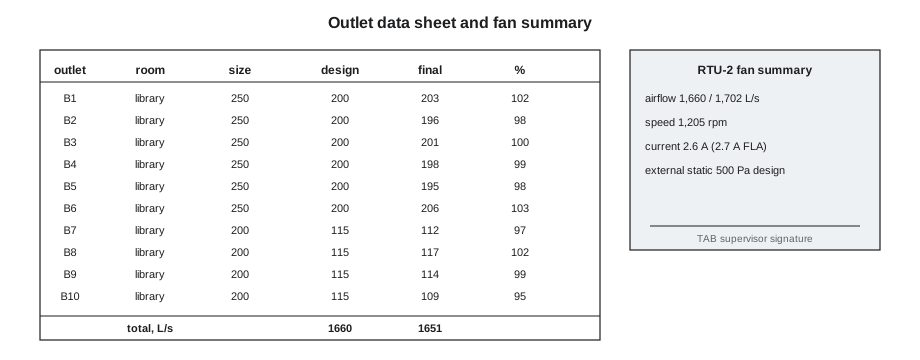
The TAB standards set out the contents of a report, and project specifications often add to them. A typical air system report includes a title page and certification signed by the TAB supervisor; a summary of the systems tested and the standard followed; a list of instruments with serial numbers and calibration dates; a list of deficiencies and their status; and, for each system, a set of data sheets. The data sheets record the air handler or fan: design and measured airflow, fan speed, motor nameplate data and measured current and voltage, static pressures at the inlet and outlet and through the unit, filter and coil pressure drops, sheave and belt sizes or drive frequency. They record each traverse, with its location, duct size, readings, average velocity and airflow. They record each terminal unit, with design and measured maximum and minimum, controller reading and flow coefficient. And they record each outlet, with its number, room, type and size, design airflow, measured airflow and percentage of design, and any Ak or correction factor used.
Good reports also include the marked-up drawings with outlet numbers, traverse locations and damper locations, so that a future technician can find them; notes on any special conditions during the test, such as outdoor temperature, filters clean or not, and system operating mode; and the final pressure readings for rooms with pressure relationships. A report is not a place for readings copied from design. Every number in it must be one that was measured, or clearly labelled as design.
Checking the report before it goes out
Marisol checks every report before she signs it, and she taught Kai to check his own data sheets first. The checks are simple arithmetic and common sense. The outlets on each branch should add up to the branch within the accuracy of the instruments; the branches should add up to the trunk; the trunks should add up to the fan traverse; supply minus return minus exhaust should make sense for the building's pressure. Percentages should be within tolerance or carry a remark explaining why not. Fan current should be below nameplate. Static pressures should have the right sign. A reading that looks odd is a reading to repeat, not a reading to adjust on paper.
# Report check: do the branch totals agree with the trunk traverse, within an allowance for leakage and instrument accuracy?
trunks = {"T1": 1702, "T2": 1105, "T3": 461}     # traverse airflows, L/s
outlets = {"T1": [203, 196, 201, 198, 195, 206, 112, 117, 114, 109], "T2": [198, 195, 206, 112, 117, 114, 109], "T3": [112, 117, 114, 109]}    # hood readings of the outlets fed downstream
allow = 0.10    # allowance, a fraction of the traverse
for t, q in trunks.items():
    s = sum(outlets[t])
    diff = (s - q) / q
    flag = "OK" if abs(diff) <= allow else "investigate"
print(f"{t}: traverse {q} L/s, outlets {s} L/s, difference {100*diff:+.1f}% -> {flag}")T1: traverse 1702 L/s, outlets 1651 L/s, difference -3.0% -> OK T2: traverse 1105 L/s, outlets 1051 L/s, difference -4.9% -> OK T3: traverse 461 L/s, outlets 452 L/s, difference -2.0% -> OK
In this check from the Ashgrove library, T1 is compared with the sum of all ten outlets, and T2 and T3 with the outlets downstream of their traverse planes. T1 shows the outlets about 3 percent below the traverse and T2 about 5 percent below, both within the allowance; T3 agrees within 2 percent. Had any trunk been outside the allowance, the first places to look would be an outlet missed or counted twice, a traverse in a poor location, or leakage between the traverse plane and the outlets.
Deficiencies
During TAB, the technician finds things that prevent the system from meeting design: a missing damper, a crushed flexible duct, a fan short of capacity, a VAV box that cannot reach maximum, a room that cannot hold its pressure, a coil with a high pressure drop, a door undercut that is wrong. Each one is recorded as a deficiency with its location, what was found, its effect and who is responsible for fixing it, and sent to the general contractor, the mechanical contractor and the engineer as soon as it is found, not saved for the final report. Most are fixed by the trades and then retested. Some, such as a fan that cannot reach design airflow without a larger motor, need a decision by the engineer. The final report lists every deficiency and its status: resolved and retested, accepted by the engineer as is, or outstanding.
A good deficiency note is specific. Not "B9 low", but "Classroom 112, diffuser 112-3 reads 55 percent of design with branch damper open and all other outlets on branch proportioned; flexible duct above ceiling compressed to about half diameter over 1 m; recommend replacement and retest." The person reading it can find the problem and knows what to do.
Hydronic balancing in brief
Many buildings also have hot water heating, chilled water or condenser water systems, and these are balanced too, usually by a TAB firm with hydronic capability or by a mechanical contractor's specialist. Sheet metal TAB technicians do not normally balance hydronic systems, but they work alongside the people who do and should understand the basics. The principles are the same as for air: pumps develop pressure, piping and coils resist flow, and balancing valves in branches share the flow. Flow is measured at balancing valves with a differential pressure meter across the valve's ports and the valve's flow coefficient, or by ultrasonic meters, and the pump is checked against its curve.
Air and water balancing affect each other. A coil's air-side pressure drop depends on its airflow, and its capacity depends on both its airflow and its water flow. If the water side is not balanced, a zone can be uncomfortable even with perfect airflow. On VAV systems with hot water reheat, the reheat valves' flows are set and verified at the same time as the box airflows. The TAB report for each air handler normally records the coil air temperatures entering and leaving, and the hydronic report records the water flows and temperatures, so that the engineer can see whether the coil is performing as designed.
Controls verification
The TAB technician is often the first person to test the controls with the system actually moving air. In addition to VAV boxes, lesson 8, the technician checks that outdoor, return and relief dampers move fully and in the right direction, that airflow measuring stations read correctly against a traverse, that fan speed control responds to its duct pressure sensor, and that minimum outdoor airflow is maintained. Problems are recorded as deficiencies for the controls contractor. This work overlaps with commissioning; the specification defines who does what, and the TAB group's readings become data the commissioning authority relies on.
TAB and commissioning
Commissioning is a quality process for the whole building, led by a commissioning authority who represents the owner. It runs from design through construction to occupancy, and includes design reviews, installation checks, functional testing of systems and sequences, training of the operators and a final report. TAB is one input. The commissioning authority reviews the TAB report, may witness a sample of readings, and may spot-check a percentage of outlets and fans with their own instruments, often around 10 percent. If the spot-checks disagree with the report by more than an allowed amount, the report can be rejected and the work repeated, which is why accurate, honest readings matter so much.
In Canada, building commissioning is described in CSA Z320, Building commissioning, and many institutional owners and hospitals follow it or their own commissioning guidelines. The Eastgate project has a commissioning authority hired by the health authority, who reviewed Marisol's TAB plan before the work started and will witness the isolation room tests.
Commissioning also continues after occupancy. Seasonal testing checks heating performance in winter and cooling in summer, and a system rebalanced years later, after a renovation or a change of use, starts from the original TAB report. The more complete the report, the easier that future work is.
Professional practice
TAB technicians are trusted to measure things nobody else will measure again in detail. The TAB certification programs all have codes of conduct that come down to a few principles: report what was measured, not what was hoped for; state the limitations of the readings; do not certify work you did not supervise; and do not let commercial pressure from the installer, the owner or your own company change the numbers. A report that shows every outlet at exactly 100 percent of design should make a reviewer suspicious; real systems show a spread within the tolerance.
Kai saw this in practice when an Eastgate exhaust fan came in at 88 percent of design with no avoidable losses left. The mechanical contractor asked whether the report could simply show it within tolerance. Marisol recorded the actual reading, listed it as a deficiency and sent it to the engineer, who approved a sheave and motor change that the mechanical contractor installed; the retest was within tolerance and the report showed both readings.
Worked problem
Writing a deficiency
During the Ashgrove library balance, branch B8 reads 62 percent of design with its damper wide open and the other outlets proportioned. Above the ceiling, Kai finds the branch's flexible connection kinked around a sprinkler pipe. Write the deficiency.
Show solution
- Location: Ashgrove Elementary, library, supply branch B8 to diffuser L-8, ceiling grid C-4.
- Finding: branch reads 62 percent of design with damper fully open; flexible connection kinked around sprinkler branch line, cross-section reduced by about half.
- Effect: diffuser cannot reach design; library corner under-ventilated.
- Responsibility and action: mechanical contractor (Keelson installation crew) to reroute or replace flexible connection; TAB to retest. Reported to general contractor and engineer the same day.
Answer: The note is specific enough that Sean's crew went straight to it, rerouted the connection the next morning, and the branch came up to the proportioned value on the retest.
What reviewers look for in a report
A reviewer reading a TAB report starts with the summary pages, then samples the detail. Every outlet should appear with its design, measured and percentage values, and the percentages should be consistent with the arithmetic. Every fan should have a measured airflow, speed, motor current and static pressure, with the motor nameplate data beside them. Every traverse should show the location, duct size, number of points and the resulting airflow, so the reviewer can see that the traverse plane was reasonable. Instruments should be listed with serial numbers and calibration dates. Anything that does not meet tolerance should be listed as a deficiency with its status, not hidden in a footnote.
Marisol reads each report from her crews as if she were the reviewer before she signs it. On the Ashgrove report she found one outlet where the percentage had been calculated against the wrong design value, corrected it, and added a line to the crew's checklist so the field sheets list the design value next to every reading.
Keeping the records
TAB reports are useful long after handover. When an occupant complains about a room years later, the original readings show what the room received when the system was new, which helps the service technician tell whether something has changed. Keelson keeps a copy of every report with the field sheets, the instrument list and the marked-up drawings, and gives the owner a copy for the building's operating manuals, so the information is not lost if either company's files change hands.
Common mistakes
MistakeCopying design values into the measured column.
InsteadRecord only measured values, and label design values clearly.
MistakeSaving deficiencies for the final report.
InsteadReport them as found so they can be fixed and retested.
MistakeWriting vague deficiency notes.
InsteadGive the location, finding, effect, responsibility and action.
MistakeIgnoring hydronic and controls problems because they belong to others.
InsteadRecord them as deficiencies for the responsible party.
MistakeAdjusting numbers on paper to show compliance.
InsteadReport actual readings and let the engineer decide.
Summary and key terms
- A TAB report contains certification, instruments, deficiencies and data sheets for fans, traverses, terminals and outlets.
- Check that outlets add up to branches, branches to trunks and trunks to fans.
- Deficiencies are specific, reported promptly and tracked to resolution.
- Hydronic balancing uses the same principles; air and water balance affect each other.
- Commissioning (CSA Z320) verifies the whole building; the commissioning authority spot-checks TAB.
- Report what was measured, state limitations and never adjust numbers on paper.
- TAB report
- The certified record of a system's measured performance and settings.
- Deficiency
- A condition found during TAB that prevents a system meeting design.
- Spot-check
- A sample of readings repeated by a reviewer to verify a report.
- Balancing valve
- A valve with pressure ports used to measure and set water flow in a hydronic branch.
- Airflow measuring station
- A permanent sensor that measures airflow in a duct for controls.
- Commissioning
- A quality process verifying that a building meets the owner's requirements.
Practice problems
Work each problem on paper first, then reveal the answer to check.
Three outlets on a branch read 110, 96 and 102 L/s; the branch traverse reads 330 L/s. Is this acceptable with a 10 percent allowance?
Show answer
Outlets total 308 L/s, 6.7 percent below the traverse; acceptable.
Name four parts of a good deficiency note.
Show answer
Location, finding, effect, responsibility and action (any four).
Why should a report with every outlet at exactly 100 percent raise questions?
Show answer
Real readings scatter within the tolerance; exact values suggest copied design figures.
What does a commissioning authority do with a TAB report?
Show answer
Reviews it and spot-checks a sample of readings.
Lesson quiz · 5 questions
Score 60% or more to complete this lesson.
Create a free account to save your progress, take quizzes and earn a certificate.