
SLS-298 · Lesson 7 of 12 · 22 min
Coaching the sales team
▶ Video coming soon A video version of this lesson is on the way.
The season is under way. The stage 7 brief is dated Monday, April 5, 2027, after the first nine weeks, and contains each seller's results for February and March, the floor checklist scores from Aiden's observations, and Marcus's protection-plan cancellation report. The deliverable is a coaching record for one seller: what you observed, what you agreed, and how you will follow up. Bev adds a short note: "Pick the person where coaching will make the biggest difference to the season, not the person who is easiest to talk to."
SLS-230 described coaching as the sales leader's most valuable use of time: regular, specific conversations built on observation, focused on one or two behaviours at a time, and owned by the seller. SLS-250 gave the floor checklist, ten skills scored 0 to 2 for a total out of 20. This stage brings the two together.
The first two months
February and March together carried 560,000 dollars of the season plan, and the department sold exactly 560,000 dollars: 248,000 in February, 12,000 below plan, and 312,000 in March, 12,000 above, helped by the early Easter. Behind the total, the sellers looked very different.
| Seller | Goal for Feb and Mar | Sales | Engaged groups | Transactions | Conversion (in 100) | Average sale | Plan attachment (in 100) |
|---|---|---|---|---|---|---|---|
| Jasmine | 175,300 | 182,400 | 640 | 86 | 13.4 | 2,121 | 16 |
| Leon | 159,200 | 151,300 | 760 | 108 | 14.2 | 1,401 | 28 |
| Mei | 102,000 | 104,900 | 420 | 57 | 13.6 | 1,840 | 21 |
| Aiden | 76,600 | 78,200 | 330 | 42 | 12.7 | 1,862 | 26 |
| Dylan | 46,900 | 31,600 | 260 | 24 | 9.2 | 1,317 | 25 |
| Others (Carl and cover) | 11,600 | 40 | 6 |
Worked problem
Reading one row
Check Jasmine's conversion, average sale and attachment from her raw figures: 640 groups, 86 transactions, 182,400 dollars of sales and 14 protection plans.
Show solution
- Conversion:
- \[\frac{86}{640} \approx 0.134\]
- Average sale:
- \[\frac{182{,}400}{86} \approx 2{,}121 \text{ dollars}\]
- Plan attachment:
- \[\frac{14}{86} \approx 0.163\]
Answer: Jasmine converts well and has by far the highest average sale on the team, because she sells most of the custom sectionals. Her protection-plan attachment, about 16 in 100, is the lowest on the team and well below the 28 target.
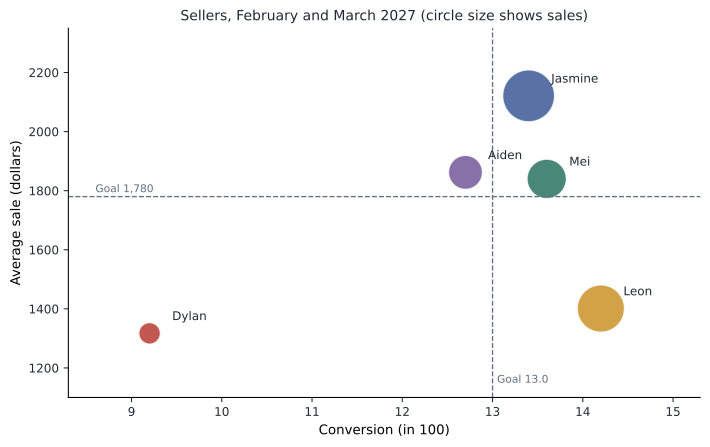
The table and the chart suggest three different coaching conversations. Jasmine sells the most and the largest tickets but rarely sells protection. Leon converts best but sells the smallest tickets; he sells in-stock sofas well and avoids custom orders. Dylan is behind on sales and conversion, as expected for a new seller, but Marcus's report raised a different concern: two of the six plans he sold were cancelled within 30 days.
Choosing whom to coach first
Bev's note asks which conversation will make the biggest difference. Aiden estimated the size of each opportunity for the remaining 17 weeks of the season.
Worked problem
Sizing three coaching opportunities
Over the rest of the season, Jasmine is expected to make about 200 more transactions, and Leon about 250. If coaching raised Jasmine's attachment from 16 to 26 in 100, and Leon's average sale by 150 dollars, what would each add? Protection plans average 199 dollars.
Show solution
- Extra plans for Jasmine:
- \[200 \times (0.26 - 0.16) = 20 \text{ plans}\]
- Extra plan sales:
- \[20 \times 199 = 3{,}980 \text{ dollars}\]
- Extra sales from Leon:
- \[250 \times 150 = 37{,}500 \text{ dollars}\]
- Extra margin from Leon at 46 in 100:
- \[37{,}500 \times 0.46 = 17{,}250 \text{ dollars}\]
Answer: Leon's opportunity is worth much more in dollars. But Dylan's cancellations are a different kind of problem: if a new seller is pressuring customers, the cost is customers' trust and the store's reputation, and it must be addressed immediately, whatever the dollar value. Aiden decided to raise Dylan's cancellations with him the same week, with Bev present, as a conduct conversation rather than a coaching one, and to make Leon the subject of his formal coaching record.
This is a common pattern. Not every performance gap is a coaching opportunity. A seller who does not yet have a skill needs coaching or training. A seller who knows the rule and breaks it needs a clear conversation about expectations. Mixing the two confuses both.
Observing before talking
Aiden did not start with Leon's numbers. He spent three shifts observing Leon on the floor with the checklist, without interrupting. The checklist from SLS-250 has ten skills, each scored 0 (not done), 1 (partly) or 2 (done well).
| Skill | Leon's score | What Aiden saw |
|---|---|---|
| Greeting within a minute | 2 | Fast and friendly every time |
| Opening question about the room or need | 2 | Asks about the room and who uses it |
| Discovery (ROOMS checklist) | 1 | Covers the room and size, rarely asks about how long they plan to keep it |
| Product presentation in benefits | 2 | Clear and confident on in-stock pieces |
| Showing options (good, better, best) | 1 | Often shows only the 999 and 1,799 lines |
| Offering custom options | 0 | Did not mention custom fabric in four of five sectional conversations |
| Handling objections | 2 | Calm and honest |
| Complete price and add-ons | 2 | Shows delivery and taxes; offers the protection plan |
| Closing and counter checklist | 2 | Clean read-back every time |
| Follow-up with consent | 1 | Quotes given but follow-up calls late |
The checklist pointed to one root cause behind the low average sale. Leon was not withholding the better products on purpose; he was not comfortable with custom orders, so he steered customers toward what was in stock. When a couple asked whether a sectional came in a different fabric, he said, "That one comes in grey and oatmeal," which was true for stock but not for special order.
The coaching conversation
SLS-230 introduced the GROW model: agree the Goal, explore the Reality, consider the Options, and agree the Way forward. Aiden used it for a 25-minute conversation with Leon on Wednesday, April 7, before the store opened.
| Stage | What Aiden asked | What Leon said | What they agreed |
|---|---|---|---|
| Goal | "What would you like your average sale to be by the end of May?" | About 1,550, closer to the team | A target of 1,550 by May 31 |
| Reality | "What happens when a customer asks for a different fabric?" | "I don't want to get the order wrong, so I show what we have." | Leon is unsure of the custom process, not unwilling |
| Options | "What would help you feel sure about custom orders?" | Shadowing Jasmine, a checklist, practising on a quiet day | Three options listed |
| Way forward | "Which will you start with, and when?" | Shadow two of Jasmine's custom orders this month and use the custom-order checklist on every sectional | Review together on April 21 and May 5 |
Aiden asked more than he told. The answers were Leon's, which matters: research on coaching summarized in SLS-230 suggests people are more likely to follow through on actions they chose themselves. He also kept the conversation on one behaviour, offering custom options, instead of trying to fix discovery and follow-up at the same time.
Following up
Coaching without follow-up is just advice. Aiden booked two short check-ins and agreed what they would look at: the share of sectional conversations in which custom options were offered (from Aiden's observation and the quote log), the number of custom orders written, and the average sale.
Worked problem
Checking progress at the first follow-up
At the April 21 check-in, Leon had offered custom options in 9 of 12 observed sectional conversations and written 3 custom orders averaging 3,450 dollars, against none in the previous two months. His average sale for April 1 to 20 was 1,520 dollars on 31 transactions. What changed, and is he on track for 1,550 by the end of May?
Show solution
- Custom offer rate:
- \[\frac{9}{12} = 0.75\]
- Sales from his 31 April transactions:
- \[31 \times 1{,}520 = 47{,}120 \text{ dollars}\]
- Share from the three custom orders:
- \[\frac{3 \times 3{,}450}{47{,}120} = \frac{10{,}350}{47{,}120} \approx 0.22\]
Answer: Leon now offers custom options in three of four sectional conversations, and the three custom orders produced about 22 in 100 of his April sales. His average sale, 1,520 dollars, is already close to the 1,550 target. The check-in focused on what had worked, and Leon chose a second behaviour, following up quotes within two days, for the next four weeks.
The conduct conversation with Dylan
The deliverable is about Leon, but Bev asked Aiden to summarize the Dylan conversation as well, because it shows the difference between coaching and setting expectations. Aiden and Bev met Dylan on Tuesday, April 6. They described what the report showed, two of six plans cancelled within 30 days and one customer's comment that she "felt she had to say yes", and asked Dylan what had happened. Dylan said he thought the plans were required for financing. They corrected the misunderstanding, restated the store's rule that plans are offered once, clearly and in writing, and that a customer's no is accepted, and arranged for Carl to show him how he offers a plan. They also agreed that Aiden would sit in on Dylan's next five plan conversations.
Bev pointed out that this conversation also touched the law. Telling customers a plan is required when it is not could be a misleading representation under the Competition Act and Saskatchewan's consumer protection law, and SLS-256 explained why tying a plan to financing is not allowed. A misunderstanding caught early is a training issue; repeated after this conversation, it would be a disciplinary one.
Coaching the whole team
One-to-one coaching changes one person at a time. Aiden also used Bev's ten-minute pre-shift huddle from SLS-250, held before opening on Thursdays and Saturdays, to work on the team's shared habits. Each huddle had the same shape: one number from the week, one example of something done well, and one skill to practise. In the first week of April the number was the department's quote follow-up rate, 58 quotes written in March and only 31 followed up within two days. The example was Mei, who had called a couple back the day after their visit with a photo of the sectional in the fabric they had asked about, and sold it. The practice was a two-minute role-play of a follow-up call that asked for permission before sending anything.
Huddles work because they are short, regular and specific. They also let a newer lead recognize people in front of their colleagues, which Aiden found easier than giving praise one to one. The rule he set himself was to name a behaviour, not a result: "Mei followed up within a day with exactly what the customer asked for" teaches the team something, while "Mei made a big sale" does not.
Template: the coaching record
| Section | What to include |
|---|---|
| Seller and reason | Who, and why this person and behaviour were chosen, with the size of the opportunity |
| Evidence | Results and observed checklist scores |
| Conversation | The GROW notes, in the seller's words where possible |
| Agreed actions | What, by when and how progress will be measured |
| Follow-up | Dates and results of check-ins |
| Related conduct issues | Any separate expectation conversations, kept apart from coaching |
Model answer and Bev's scoring
Bev scored Aiden's coaching record 19 out of 20. She gave full marks for the choice of seller, the observation and the GROW notes, and for separating Dylan's conduct issue from coaching. She took one point from the follow-up section: "You measured what Leon did and his average sale, but not whether customers who were offered custom options were happy with the wait. Custom orders take seven weeks. Check that the extra sales don't come back as complaints in June."
| Criterion | Excellent (4) | Developing (2) | Aiden |
|---|---|---|---|
| Choice of focus | Biggest opportunity chosen with sizing; conduct issues separated | Easiest person chosen | 4 |
| Evidence | Results and observation both used | Numbers only, no observation | 4 |
| Coaching conversation | Seller-owned goal and actions, one behaviour | Manager tells, many behaviours | 4 |
| Measures | Behaviour, result and customer effect measured | Results only | 3 |
| Follow-up | Dated check-ins with progress recorded | None | 4 |
Reflection
Think of a time someone coached you well. Did they ask or tell? How will you coach someone who has worked in a job longer than you have?
Common mistakes
MistakeCoaching the person who is easiest to talk to.
InsteadChoose the biggest opportunity, sized in dollars or risk.
MistakeStarting with the numbers and a verdict.
InsteadObserve first and ask what is happening before deciding.
MistakeWorking on five behaviours at once.
InsteadAgree one behaviour and add another once it is a habit.
MistakeTreating a rule broken knowingly as a coaching need.
InsteadHave a separate, clear expectations conversation.
MistakeEnding with "let me know how it goes".
InsteadBook dated follow-ups with agreed measures.
Summary and key terms
- February and March sales matched the plan at 560,000 dollars, but the sellers' patterns differed.
- Size coaching opportunities before choosing: Leon's average sale was worth far more than Jasmine's plan attachment.
- Conduct issues, such as pressure that causes cancellations, need an expectations conversation, not coaching.
- Observation with the floor checklist found Leon's root cause: he avoided custom orders because he was unsure of the process.
- A GROW conversation and dated follow-ups raised his custom offers to 75 in 100 and his average sale to about 1,520 dollars.
- Coaching record
- A written note of the evidence, conversation, actions and follow-up for one seller.
- GROW
- A coaching structure: goal, reality, options, way forward.
- Root cause
- The underlying reason for a result, found by observation and questions.
- Conduct conversation
- A conversation that restates expectations when a known rule is broken.
- Floor checklist
- The ten-skill observation tool, each skill scored 0 to 2.
- Custom offer rate
- The share of suitable conversations in which a seller offers custom options.
Practice problems
Work each problem on paper first, then reveal the answer to check.
Mei had 57 transactions and 12 plans. What was her attachment, and how many plans would 28 in 100 have meant?
Show answer
12 ÷ 57 ≈ 21 in 100; 57 × 0.28 ≈ 16 plans.
Leon raises his average sale from 1,401 to 1,550 dollars on 250 transactions. What extra sales does that give?
Show answer
(1,550 − 1,401) × 250 = 37,250 dollars.
Why did Aiden raise Dylan's cancellations with Bev present and not as part of coaching?
Show answer
Telling customers a plan is required is a conduct and legal issue that needed a clear expectation immediately.
Lesson quiz · 5 questions
Score 60% or more to complete this lesson.
Create a free account to save your progress, take quizzes and earn a certificate.