
SLS-298 · Lesson 5 of 12 · 27 min
Planning the assortment
▶ Video coming soon A video version of this lesson is on the way.
Stage 5 is the biggest buying decision of the season, and in a real store it happens months before the first customer walks in. The decision brief, dated Monday, November 30, 2026 in the simulation timeline, contains the open-to-buy plan Bev presented to the owners, the fall 2026 sell-through report for sectionals, supplier lead times, and the category sales for spring 2026. Your task is an assortment and open-to-buy plan for spring: how much to buy, in which categories, at which price lines, in which colours, and how much to hold back.
Merchandise planning in SLS-253 gave you the tools: markup, open-to-buy, sell-through, stock turn and assortment breadth and depth. This stage asks you to use them together, under the constraint that you cannot see the future. You know what sold last fall and last spring; you do not know what will sell in May.
How much to buy: the open-to-buy
The open-to-buy for a season is the amount of merchandise, at retail, that can be bought so that the department ends the season with its planned inventory. The formula is the one from SLS-253: planned sales plus planned reductions plus planned ending inventory, minus the inventory you start with.
Worked problem
The season's open-to-buy
The spring plan has sales of 1,850,000 dollars, markdowns of 148,000, employee discounts of 0.5 in 100 of sales and shrink of 0.8 in 100 of sales. Inventory at retail is planned at 1,560,000 dollars on February 1 and 1,450,000 dollars at the end of July. The initial markup is 52 in 100 of retail. What is the open-to-buy at retail and at cost?
Show solution
- Planned reductions:
- \[148{,}000 + 1{,}850{,}000 \times 0.005 + 1{,}850{,}000 \times 0.008 = 148{,}000 + 9{,}250 + 14{,}800 = 172{,}050\]
- Open-to-buy at retail:
- \[1{,}850{,}000 + 172{,}050 + 1{,}450{,}000 - 1{,}560{,}000 = 1{,}912{,}050\]
- At cost, with a 52 in 100 initial markup:
- \[1{,}912{,}050 \times (1 - 0.52) = 917{,}784\]
Answer: The department can buy 1,912,050 dollars of merchandise at retail, which is 917,784 dollars at cost, for the season. Reductions are part of the formula because merchandise that is marked down, discounted or lost still has to be replaced.
The plan does not spend all of that at once. Following store policy, 70 in 100 is committed in the initial orders and 30 in 100 is kept in reserve for reorders of what sells, special-order stock and corrections later in the season.
Worked problem
Committed and reserve
Split the open-to-buy into committed and reserve amounts at retail.
Show solution
- Committed:
- \[1{,}912{,}050 \times 0.70 = 1{,}338{,}435\]
- Reserve:
- \[1{,}912{,}050 \times 0.30 = 573{,}615\]
Answer: About 1,338,000 dollars at retail is ordered now and about 574,000 is held back. The reserve is the department's answer to uncertainty: it lets Aiden buy more of what customers want once the season shows it.
Monthly flow
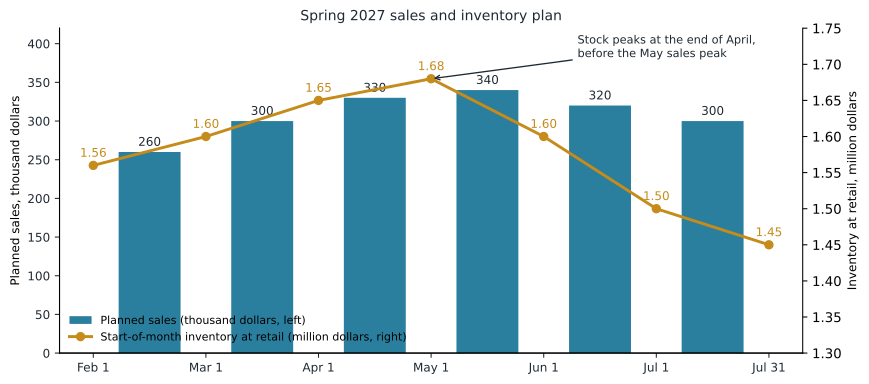
The season open-to-buy is a total; suppliers need monthly orders. The plan sets an inventory figure for the start of each month, and the open-to-buy for a month is calculated the same way as for the season.
| Month | Planned sales | Start-of-month inventory at retail | End-of-month inventory at retail |
|---|---|---|---|
| February | 260,000 | 1,560,000 | 1,600,000 |
| March | 300,000 | 1,600,000 | 1,650,000 |
| April | 330,000 | 1,650,000 | 1,680,000 |
| May | 340,000 | 1,680,000 | 1,600,000 |
| June | 320,000 | 1,600,000 | 1,500,000 |
| July | 300,000 | 1,500,000 | 1,450,000 |
Worked problem
February's open-to-buy
Planned reductions for each month are about 9.3 in 100 of that month's sales. What is February's open-to-buy at retail?
Show solution
- February reductions:
- \[260{,}000 \times 0.093 = 24{,}180\]
- February open-to-buy:
- \[260{,}000 + 24{,}180 + 1{,}600{,}000 - 1{,}560{,}000 = 324{,}180\]
Answer: February needs about 324,180 dollars of merchandise at retail to arrive during the month. Inventory is planned to rise in February, March and April and fall in May, June and July, so the department is buying ahead of its busiest month. With upholstery lead times of six to eight weeks, March and April receipts have to be ordered in January and February.
What to buy: categories and price lines
The category plan shares the sales plan among the department's main categories, using spring 2026 as the starting point and adjusting for the new sofa price line.
| Category | Spring 2026 share (in 100) | Spring 2027 plan (dollars) | Share (in 100) | Notes |
|---|---|---|---|---|
| Sofas | 36 | 703,000 | 38 | New 999 line |
| Sectionals | 35 | 629,000 | 34 | Colour mix changed after fall |
| Recliners and lift chairs | 17 | 296,000 | 16 | Steady |
| Accent chairs and ottomans | 9 | 166,500 | 9 | Mustard chair lesson applied |
| Fabric protection and other services | 3 | 55,500 | 3 | Sold with furniture |
| Total | 100 | 1,850,000 | 100 |
Sofas carry the change. SLS-253 set three price lines for sofas: 999, 1,799 and 2,799 dollars, a good, better and best ladder with clear steps in quality: fabric grade, cushion construction and frame warranty. The 999 line is new. It is aimed at first-home buyers who used to leave the store for online sellers when the cheapest sofa on the floor was 1,499.
Worked problem
The sofa price-line plan
Aiden planned 120 sofas at 999 dollars, 210 at 1,799 and 60 at 2,799, with the rest of the sofa plan coming from custom orders. What do the three lines produce, and how much is left for custom orders?
Show solution
- 999 line:
- \[120 \times 999 = 119{,}880\]
- 1,799 line:
- \[210 \times 1{,}799 = 377{,}790\]
- 2,799 line:
- \[60 \times 2{,}799 = 167{,}940\]
- Total of the three lines:
- \[119{,}880 + 377{,}790 + 167{,}940 = 665{,}610\]
- Left for custom sofas:
- \[703{,}000 - 665{,}610 = 37{,}390\]
Answer: The three lines produce 665,610 dollars and custom sofa orders need to bring in about 37,390 dollars. Most of the units are in the middle line, which is where most customers buy once they can see a cheaper and a better option on either side.
The 999 line has a lower margin: about 40 in 100 instead of the department's 46, because the supplier's cost is a larger share of a low price. Bev asked whether it was worth it.
Worked problem
What does the 999 line cost in margin?
If the 119,880 dollars of 999-line sales earn 40 in 100 instead of 46, how much margin is given up compared with selling the same dollars at the department rate? How many extra 999 sofas would cover it?
Show solution
- Margin given up:
- \[119{,}880 \times (0.46 - 0.40) \approx 7{,}193 \text{ dollars}\]
- Margin on one 999 sofa:
- \[999 \times 0.40 \approx 400 \text{ dollars}\]
- Sofas to cover the gap:
- \[\frac{7{,}193}{400} \approx 18\]
Answer: The lower margin costs about 7,200 dollars if the 999 sofas only replace sales the department would have made anyway. If at least 18 of the 120 are sales to customers who would otherwise have left, the line pays for itself, and every extra new customer is a chance to sell a chair, a protection plan or, years later, a sectional. Aiden recorded the 18-sofa test in his plan so that the midseason review could check it.
How many of each: the sectional colour mix
The fall 2026 report from SLS-253 is the best evidence for the spring sectional buy. Of 64 sectionals received in August, the department had sold, after eight weeks, 18 of 24 grey, 13 of 18 oatmeal, 4 of 12 navy and 2 of 10 forest green.
| Colour | Received | Sold in eight weeks | Sell-through (in 100) | Decision for spring |
|---|---|---|---|---|
| Grey (style A) | 24 | 18 | 75 | Buy deepest |
| Oatmeal (style B) | 18 | 13 | 72 | Buy deep |
| Navy (style A) | 12 | 4 | 33 | Keep a small range, main-aisle display |
| Forest green (style C) | 10 | 2 | 20 | Drop |
Worked problem
Allocating the spring sectional buy
The initial spring buy is 60 sectionals. Six are a terracotta test colour. Allocate the other 54 to grey, oatmeal and navy in proportion to the units each sold in the fall, dropping forest green.
Show solution
- Units sold in the fall in the three colours kept:
- \[18 + 13 + 4 = 35\]
- Grey:
- \[54 \times \frac{18}{35} \approx 27.8\]
- Oatmeal:
- \[54 \times \frac{13}{35} \approx 20.1\]
- Navy:
- \[54 \times \frac{4}{35} \approx 6.2\]
Answer: The proportional split is about 28 grey, 20 oatmeal and 6 navy. Aiden rounded grey down to 27 and navy up to 7, because the navy display on the main aisle in SLS-253 was helping and a single extra piece let him keep one on the floor and six in stock. The buy is 27 grey, 20 oatmeal, 7 navy and 6 terracotta, matching the plan presented to the owners.
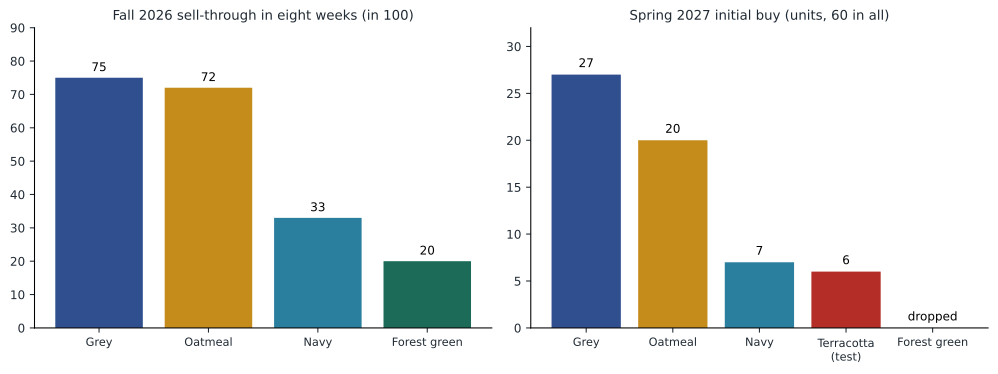
The terracotta test follows the advice in SLS-253 on testing new colours: buy a small number, give them a good floor position, and set a clear rule in advance. Aiden's rule was that terracotta would be reordered if at least 4 of the 6 sold by the end of April, and cleared through the markdown budget otherwise.
The 60 sectionals are only the stock buy. Many sectional customers choose their own fabric and configuration from swatches, and those special orders are bought one at a time when the customer has paid a deposit, so they do not need open-to-buy in advance in the same way. Spring 2026 special orders made up a little over half of sectional sales. Aiden kept that assumption, which is why the stock buy is small compared with the 629,000-dollar category plan, and he noted that a fall in special orders would show up first as a gap between sectional sales and the stock that had sold.
Breadth, depth and what not to buy
A department with 9,000 square feet cannot show everything. The assortment plan therefore says how many different styles to carry (breadth) and how many of each to stock (depth). Aiden kept breadth roughly the same as last spring, with 34 sofa and sectional styles on the floor, but made it deeper in the best sellers and thinner in the slow ones. He dropped four slow sofa styles to make room for the 999 line and the terracotta test.
He also applied the lesson of the mustard accent chairs in SLS-253. Thirty were bought in spring 2026 at a cost of 288 dollars and a ticket of 600, and they had to be cleared at 450, 360 and 300. For spring 2027 he bought accent chairs in smaller first orders, 8 to 12 of each colour, with reorders funded from the reserve once sell-through passed 50 in 100 in four weeks.
Template: the assortment and open-to-buy plan
| Section | What to include |
|---|---|
| Open-to-buy | Season total at retail and cost, committed and reserve, with working |
| Monthly flow | Receipts needed by month and order dates given lead times |
| Category plan | Sales by category with reasons for changes |
| Price lines | Lines, units and the test for any new line |
| Colour and size mix | Allocation from sell-through evidence |
| Rules for the reserve | When reorders, tests and clearances will happen |
Model answer and Bev's scoring
Bev scored Aiden's plan 18 out of 20. The open-to-buy, the colour allocation and the reserve rules were complete and correct. She took one point from the monthly flow because the order dates did not allow for the Chinese New Year factory closure that delays some imported frames in February, and one from the price lines because the plan did not say how the 999 sofas would be displayed so they did not pull customers down from the 1,799 line. "A good, better, best ladder works when customers see all three together," she wrote.
| Criterion | Excellent (4) | Developing (2) | Aiden |
|---|---|---|---|
| Open-to-buy arithmetic | Correct season and monthly figures, working shown | Errors in reductions or inventory | 4 |
| Use of evidence | Every buying decision tied to sell-through or sales data | Decisions by preference | 4 |
| Price lines | Clear ladder with a test for the new line | Lines without reasoning | 3 |
| Flow and lead times | Orders timed to arrive before demand | Late or unrealistic orders | 3 |
| Reserve rules | Clear rules for reorders, tests and clearance | No rules | 4 |
Reflection
What would you do with the reserve if grey sectionals sold out by mid-March? What evidence would make you drop the 999 sofa line at the end of the season?
Common mistakes
MistakeLeaving reductions out of the open-to-buy.
InsteadAdd planned markdowns, discounts and shrink, because lost or reduced stock must be replaced.
MistakeCommitting the whole open-to-buy in the first orders.
InsteadHold a reserve for reorders and corrections.
MistakeOrdering for May in May.
InsteadAllow for lead times; stock must arrive before the peak.
MistakeBuying colours by personal taste.
InsteadAllocate from sell-through and set test rules in advance.
MistakeAdding a cheaper price line without checking the margin.
InsteadWork out the margin given up and how many new customers it needs.
Summary and key terms
- The season open-to-buy is planned sales plus reductions plus ending inventory minus starting inventory: 1,912,050 dollars at retail, 917,784 at cost.
- Seventy in 100 is committed and 30 in 100 held in reserve.
- Inventory builds before the May peak, so March and April receipts are ordered in January and February.
- Sofa price lines of 999, 1,799 and 2,799 form a good, better, best ladder; the 999 line pays for itself if about 18 of its sales are new.
- The 54 core sectionals are allocated by fall units sold: 27 grey, 20 oatmeal, 7 navy, plus 6 terracotta to test.
- Open-to-buy
- The amount of merchandise that can be bought for a period while meeting the planned ending inventory.
- Committed open-to-buy
- The part of the open-to-buy placed in initial orders.
- Reserve
- The part of the open-to-buy held back for reorders and changes.
- Price line
- A set price point at which a group of products is sold.
- Breadth
- The number of different styles or items carried.
- Depth
- The number of units carried of each style or item.
Practice problems
Work each problem on paper first, then reveal the answer to check.
May has planned sales of 340,000, reductions of 9.3 in 100 of sales, a start inventory of 1,680,000 and an end inventory of 1,600,000. What is May's open-to-buy at retail?
Show answer
Reductions 31,620; 340,000 + 31,620 + 1,600,000 − 1,680,000 = 291,620 dollars.
If the reserve is 573,615 dollars at retail and the initial markup is 52 in 100, what is it at cost?
Show answer
573,615 × 0.48 ≈ 275,335 dollars.
Grey sold 18 of 24 in the fall. What was its sell-through, and why is that a reason to buy deeper?
Show answer
75 in 100; it sold quickly, so more stock is likely to sell without markdowns.
Lesson quiz · 5 questions
Score 60% or more to complete this lesson.
Create a free account to save your progress, take quizzes and earn a certificate.