
SLS-213 · Lesson 8 of 12 · 20 min
Discounting and what it costs
▶ Video coming soon A video version of this lesson is on the way.
At the end of October 2026, Grace Liu, Ridgeline's sales operations analyst, presented a short report at the monthly sales meeting. She had pulled every closed deal from the CRM for the first ten months of the year and compared the price on each proposal with the price on the signed contract. The average discount was 7.4 in 100. Deals that had been discounted by more than 10 in 100 had closed, on average, only two days faster than deals with smaller discounts. And the three account executives with the highest average discounts had not had the highest win rates. "We are giving away a lot of money," Grace said, "and I can't find much evidence it's buying us anything."
Grace's findings are common. Studies by pricing consultancies and sales-analytics vendors regularly report that discounting is inconsistent, that it is concentrated among a few sellers and customers, and that it is weakly linked to win rates. Those studies come from companies with an interest in selling pricing advice and tools, so their exact figures should be treated with caution, but the pattern is consistent with what most sales managers see in their own data. This lesson explains why discounts cost more than they appear to, when a discount makes sense, and what to offer instead.
Why discounts cost so much
Lesson 1 showed that a discount comes entirely out of gross profit, because the cost of delivering the product or service does not change. The lower a product's margin, the larger the share of profit a discount takes. A useful way to see this is to ask how much more a business must sell to earn the same gross profit after a discount.
If a product has a gross margin m (as a fraction of price) and the price is cut by a fraction d, then to keep gross profit unchanged, sales volume must rise by a fraction equal to d ÷ (m − d).
Worked problem
How much more must be sold?
Ridgeline's managed print service has a gross margin of about 30 in 100. A seller offers a 10 in 100 discount. By how much must volume rise to earn the same gross profit? What if the margin were 45 in 100, like Juniper & Pine's furniture?
Show solution
- At m = 0.30 and d = 0.10: 0.10 ÷ (0.30 − 0.10) = 0.10 ÷ 0.20 = 0.50.
- Volume must rise by 50 in 100: the business must sell one and a half times as much.
- At m = 0.45 and d = 0.10: 0.10 ÷ (0.45 − 0.10) = 0.10 ÷ 0.35 = about 0.286.
- Volume must rise by about 29 in 100.
Answer: At a 30 in 100 margin, a 10 in 100 discount requires 50 in 100 more volume to break even on gross profit. At 45 in 100, it requires about 29 in 100 more. Discounts are most expensive on low-margin products.
| Gross margin | 5 in 100 discount | 10 in 100 discount | 15 in 100 discount |
|---|---|---|---|
| 20 in 100 (appliances) | 33 in 100 more volume | 100 in 100 more (double) | 300 in 100 more (four times) |
| 30 in 100 (managed print) | 20 in 100 more | 50 in 100 more | 100 in 100 more (double) |
| 45 in 100 (furniture) | 13 in 100 more | 29 in 100 more | 50 in 100 more |
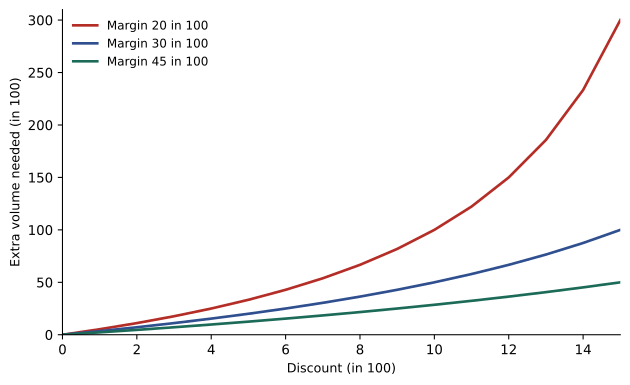
The table explains why Juniper & Pine's appliance associates have much less discount authority than its furniture associates. Appliances carry a gross margin of about 20 in 100 at the store; a 10 in 100 discount on a refrigerator would require selling twice as many refrigerators to earn the same profit. Furniture margins are higher, so there is more room, though not as much as associates often assume.
Discounts and commission
Discounts also cost the salesperson. Maya's commission is 5 in 100 of first-year revenue up to her quota, as SLS-101 described. A 10 in 100 discount on a 40,000-dollar deal reduces revenue by 4,000 dollars and her commission by 200 dollars. If the discount is needed to win the deal, that is a good trade for her. If the deal would have closed anyway, she has paid 200 dollars of her own money, and her company has paid 3,800 dollars more, for nothing. Many companies pay commission on gross profit rather than revenue for exactly this reason: it makes the seller feel the true cost of a discount.
When a discount makes sense
Discounts are not always wrong. They make sense when they buy something of value, such as:
| What the discount buys | Example | Why it is worth it |
|---|---|---|
| Volume | A lower page price for a committed minimum volume | Higher volume spreads fixed costs and raises total profit |
| Term | A lower monthly price for a five-year contract instead of three | Two extra years of revenue and lower selling costs |
| Timing | A small discount for signing before the end of a quarter | Helps meet a target, but only if the deal was at risk of slipping |
| Reduced cost to serve | A lower price for a single delivery address or electronic invoicing | The seller's costs fall too |
| Strategic value | A first customer in a new market, or a strong reference | Future sales to similar customers |
| Competition on a like-for-like offer | Matching a genuine lower price on an identical product | Avoids losing a sale where value is truly equal |
Each of these is a trade, in the if-then form from lesson 6. A discount given without a trade is simply a price cut, and it sets the price for the next negotiation with the same customer. Customers remember what they paid last time, and procurement departments keep records.
Alternatives to discounting
When a customer pushes on price, a seller usually has options that cost less than a discount.
- Change the scope. A smaller first phase, fewer rooms, a less expensive model.
- Change the payment terms. Monthly payments, a later start date, a deposit and balance on delivery, or financing.
- Add value rather than subtract price. Training, extended warranty, faster service, free delivery, or a first-year service review, especially items that cost little to provide.
- Bundle. A package price for buying several items together, which raises the total sale.
- Rebate on performance. A credit if the customer reaches a volume level, so the discount is earned rather than given.
Juniper & Pine's package price on four or more appliances is a bundle: the store gives up some margin on each appliance in exchange for a larger total sale, one delivery trip instead of several, and a customer who is less likely to buy the remaining appliances elsewhere.
Worked problem
Is the package price worth it?
The Moraleses' four appliances would sell separately for 5,910 dollars; the package price is 5,646 dollars. The store's gross margin on the appliances at full price is about 20 in 100. Without the package, Carl estimates the Moraleses would have bought only the refrigerator and range at Juniper & Pine (4,098 dollars at full price) and the rest elsewhere. Which earns the store more gross profit?
Show solution
- Cost of the four appliances at a 20 in 100 margin: 5,910 × 0.80 = 4,728 dollars.
- Gross profit on the package: 5,646 − 4,728 = 918 dollars.
- Gross profit on the refrigerator and range alone: 4,098 × 0.20 = 819.60 dollars.
- Difference: 918 − 819.60 = 98.40 dollars in favour of the package, before counting one delivery trip instead of two.
Answer: The package earns the store about 98 dollars more gross profit than the likely alternative, and saves a delivery trip. It is a discount that buys something: a larger, more complete sale.
Discount governance
Because discounts are so expensive, most companies control them through discount governance: rules about who can approve what. Ridgeline's bands, from lesson 1, are typical. Many larger companies also have a deal desk, a small team that reviews non-standard deals, checks the pricing and approves or rejects discounts above a threshold. Approval rules are not a sign of distrust. They make discounting deliberate, consistent and recorded, so the company can learn from it, as Grace's report did.
Approval also protects customers from unfair treatment. If every seller can give any discount, two similar customers may pay very different prices, which damages trust when they find out. In some situations it may also raise legal issues.
Price discrimination and the law
In Canada, price discrimination between competing business customers is no longer a criminal offence on its own: the Competition Act's price discrimination provision was repealed in 2009. Pricing can still raise issues under the Act's civil provisions, such as abuse of dominance by a very large firm, and agreements between competitors to fix prices remain a serious criminal offence under section 45. Consistent, documented discount rules are still good practice, because unexplained differences damage trust. Sellers should not need to know the details of these laws, but they should know that their company's discount rules exist partly to keep pricing fair and lawful, and that any question about unusual pricing between competing customers belongs with their manager.
Discounts in retail
Retail discounting has its own patterns. Price-match policies, promotions and clearance markdowns are set by the store, not negotiated by associates, and they must be applied consistently. When a customer asks Aiden for a better price, his options are the ones his authority allows: a price match on an identical in-stock item from a local competitor's current advertised price, package pricing, haul-away and delivery adjustments, or a referral to Bev for anything else. Inventing an extra discount for a customer who pushes hard, while the next customer pays full price, is unfair to the second customer and costs the store money it has not chosen to spend.
Price-match requests need care. Juniper & Pine matches the price of an identical model, in stock at a local competitor, at the competitor's current advertised price, and excludes open-box items, clearance, financing offers and online-only marketplace sellers. When Aiden checks a match, he confirms the model number, the availability and the advertised price on the competitor's website or flyer. Many apparent matches turn out to be different models with similar names, which manufacturers make for different retailers.
Grace's recommendations
Grace's report ended with three recommendations, which Rob Kowalski adopted for 2027. Every discount above 5 in 100 must be linked in the CRM to a specific trade. Commission will be paid on gross profit for managed print and RoomFlow deals. And each account executive will see their own average discount and win rate every month, alongside the team's. "Most people discount because it feels like the safe thing to do," Grace said. "If they can see what it costs and what it doesn't buy, they'll do it less."
The long life of a discount
A discount also lasts longer than the deal it was given on. A customer who received 10 in 100 off this year will expect at least the same next year, and in a multi-year contract, a lower starting price usually means lower revenue in every year that follows. Price increases written into the contract are calculated from the discounted base. That is why Ridgeline's contracts state the list price and the discount separately, and say whether the discount continues at renewal. A discount recorded as a one-time concession for an early signature is much easier to remove later than one built silently into the price.
Retailers face a similar problem with promotions. When shoppers learn that a product is regularly on sale, many stop buying it at full price and wait. Retail pricing research calls this training customers to wait for the sale. It is one reason Juniper & Pine keeps its major promotions to a few planned weekends a year rather than running constant discounts.
Common mistakes
MistakeThinking a 10 in 100 discount costs 10 in 100.
InsteadCalculate what it costs in gross profit and how much extra volume it would take to recover.
MistakeDiscounting to close a deal that would have closed anyway.
InsteadFind out what the customer really needs before offering money.
MistakeGiving a discount without a trade.
InsteadLink every discount to volume, term, timing, cost to serve or strategic value.
MistakeReaching for price first.
InsteadTry scope, payment terms, added value, bundles or performance rebates first.
MistakeImprovising discounts outside policy.
InsteadStay within your authority and apply price-match and promotion rules consistently.
Summary and key terms
- A discount comes entirely out of gross profit, so its true cost is much larger than its share of revenue.
- To keep gross profit unchanged after a discount d at margin m, volume must rise by d ÷ (m − d): at 30 in 100 margin, a 10 in 100 discount needs 50 in 100 more volume.
- Low-margin products such as appliances can afford very little discounting.
- Discounts also reduce commission, which is one reason many companies pay commission on gross profit.
- A discount makes sense when it buys volume, term, timing, lower cost to serve, strategic value or a genuine like-for-like match.
- Alternatives include changing scope or payment terms, adding value, bundling and performance rebates.
- Discount governance and deal desks make discounting deliberate and consistent. Canada repealed its price discrimination offence in 2009, but price-fixing remains criminal.
- In retail, discounts follow store policy and price matches must be verified.
- Discount
- A reduction from the standard or proposed price.
- Gross margin
- Gross profit as a share of revenue: (price − cost) ÷ price.
- Discount governance
- Rules setting who may approve discounts of different sizes.
- Deal desk
- A team that reviews and approves non-standard deals and discounts.
- Bundle
- Several products or services sold together at a package price.
- Price match
- A store policy of matching a competitor's current price on an identical product, under set conditions.
Practice problems
Work each problem on paper first, then reveal the answer to check.
At a gross margin of 25 in 100, what extra volume is needed after a 5 in 100 discount?
Show answer
0.05 ÷ (0.25 − 0.05) = 0.05 ÷ 0.20 = 0.25, or 25 in 100.
A seller earns 5 in 100 commission on revenue. What does a 3,000-dollar discount cost them?
Show answer
3,000 × 0.05 = 150 dollars.
Name three alternatives to a discount.
Show answer
Any three of: change scope, change payment terms, add value, bundle, rebate on performance.
Lesson quiz · 5 questions
Score 60% or more to complete this lesson.
Create a free account to save your progress, take quizzes and earn a certificate.