
SLS-213 · Lesson 3 of 12 · 19 min
Handling objections
▶ Video coming soon A video version of this lesson is on the way.
On a busy Saturday in October 2026, Aiden watched Carl Jensen handle an objection that Aiden would have fumbled. A man in his sixties had been looking at a front-loading washer for twenty minutes. When Carl suggested they write it up, the man said, "I don't know. I've heard these things get mouldy." Aiden would have launched into a defence of the machine. Carl said, "That's a fair worry, and some people do have that problem. Can I ask what you've heard?" The man explained that his daughter's washer smelled and she had had to replace the door seal. Carl asked how she used it. It turned out she kept the door closed between loads. Carl explained the door-open habit and the cleaning cycle, showed the man the seal design on this model, and pointed out that a top-loader without an agitator was also an option if he preferred. The man bought the front-loader.
Afterward, Carl explained what he had done. "I didn't answer the first thing he said. I found out what he meant first. Then I answered that, honestly, and I gave him a way out if my answer didn't satisfy him." That is the whole of this lesson in three sentences. The rest is about doing it reliably.
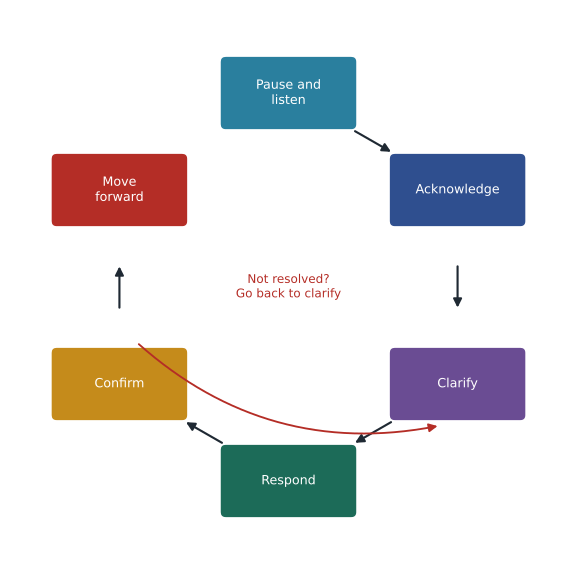
A method for handling objections
Many sales trainers teach objection-handling methods with acronyms. They differ in detail but share a common structure. The version Darnell used at Ridgeline, and which this course uses, has six steps.
| Step | What to do | Why it matters |
|---|---|---|
| 1. Pause and listen | Let the customer finish; do not interrupt or rush to answer | Rushing signals defensiveness and you may answer the wrong thing |
| 2. Acknowledge | Show you heard and that the concern is reasonable | Customers relax when they feel understood, not argued with |
| 3. Clarify | Ask a question to find out what the objection really means | The same words can mean very different things (lesson 2) |
| 4. Respond | Answer the real concern with facts, evidence or options | An honest, specific answer builds trust |
| 5. Confirm | Check whether the answer resolved the concern | An unresolved objection will come back later |
| 6. Move forward | Return to the next step in the sale | Handling an objection is a means, not an end |
Steps 1 and 2: listening and acknowledging
The first two steps sound easy and are often skipped. When a salesperson hears an objection they have heard a hundred times, the temptation is to interrupt with a prepared answer. That tells the customer that their concern is routine and that the seller is more interested in winning the point than in understanding them. SLS-120 covered active listening in depth; objection handling is where it matters most.
Acknowledging is not agreeing. "That's a fair question" or "I can see why that would worry you" signals respect without conceding that the concern is correct. Avoid acknowledgements that sound like a script, such as "I understand exactly how you feel", and avoid "but" straight after an acknowledgement, which cancels it. "That's a fair concern. Can I ask what's behind it?" works better than "I understand, but..."
Step 3: clarifying
Clarifying is the step that separates good objection handling from bad. Its purpose is to find the real objection, as lesson 2 described, and to understand it well enough to answer it. Good clarifying questions are short and open.
| Objection | Clarifying question |
|---|---|
| "Your price is too high." | "Too high compared with what?" or "What were you expecting to invest?" |
| "We're happy with our current supplier." | "What do they do especially well for you?" or "If you could change one thing, what would it be?" |
| "I need to think about it." | "Of course. What part would you like to think through?" |
| "Send me some information." | "Happy to. So I send the right thing, what would you like it to answer?" |
| "I need to check with my manager." | "That makes sense. What do you think will matter most to them?" |
A useful clarifying technique for suspected hidden objections is to ask whether anything else stands in the way: "If we could sort out the delivery date, is there anything else that would stop you going ahead?" This is sometimes called isolating the objection. Used honestly, it helps both sides see what really needs to be resolved. Used aggressively, as a trap to make the customer commit, it feels manipulative; lesson 10 returns to this.
Step 4: responding
Once the real objection is clear, the response depends on its type.
| Objection type | Useful responses |
|---|---|
| Need | Ask questions about the cost of the current situation; share how similar customers saw the problem; accept that some customers really do not need it now |
| Product | Explain how the solution meets the need; show it; admit genuine limitations and offer alternatives |
| Source | Acknowledge past problems honestly; explain what has changed; offer references, guarantees or a smaller first step |
| Price or value | Reconnect price to value; compare like with like; change scope, timing or terms rather than price |
| Time | Find out what the customer needs to decide; agree a specific next step and date; respect genuine constraints |
| Authority | Offer to help prepare for the decision-maker; ask to meet them; provide a short business case |
Three response techniques are worth knowing by name, because sales training uses them widely.
Feel, felt, found. "I can see why you feel that way. Other clinic managers have felt the same. What they found was that..." This technique works when it is genuine, because it normalizes the concern and offers evidence from similar customers. It fails when it is used as a script, because many buyers recognize it.
Reframing. Restating the objection in a way that points to value. "So the question is whether the time your staff save on printer problems is worth more than the monthly fee" turns a price objection into a value comparison. Reframing must be honest; a reframe that changes the customer's meaning is manipulation.
Boomerang. Turning the reason for the objection into a reason to buy. "You're busy right now, which is exactly why fixing the booking problem before your dealer visits in January would save you the most trouble." This works only when it is true and is easily overused.
Answering honestly when the objection is right
Sometimes the customer's objection is simply correct. The product does not do what they need, the price really is higher than a competitor's for the same thing, or the company really did let them down. The best response then is to say so. Admitting a genuine limitation builds credibility for everything else the seller says. It also lets the conversation move to whether the limitation matters: a printer that cannot staple booklets is a problem for a school that prints booklets, and irrelevant for a law office that does not.
When Keystone Grain's operations director, Dale Petrie, told Maya in October that Ridgeline's video-room package cost more than one he had seen online, she checked. He was right: an online retailer sold a similar camera and speaker bar for about 1,100 dollars less than Ridgeline's equipment price. Maya told him so. Then she explained what Ridgeline's price included that the online package did not: on-site installation, integration with RoomFlow booking, a two-year on-site service agreement and training for his staff. She also told him that if he only wanted the hardware, buying it online was a reasonable choice and Ridgeline could still provide RoomFlow. Dale bought the full package. Later he told her that her honesty about the hardware price was why he trusted the rest of her answer.
Step 5: confirming
After responding, check. "Does that answer your concern about the seal?" or "Is that the information you needed for your finance team?" Confirming does two things. It tells the seller whether the objection is resolved, and it gives the customer a chance to raise anything still bothering them. If the answer is no, go back to clarifying; do not repeat the same answer more forcefully.
Step 6: moving forward
Once an objection is resolved, return to the sale: the next question in discovery, the next part of the presentation, or the request for commitment. Sellers who resolve an objection and then wait in silence often find that the customer raises another, because nothing has moved the conversation forward. Lesson 9 covers asking for commitment.
Anticipating objections
The most efficient way to handle an objection is to deal with it before the customer raises it. If a seller knows that a product's price is higher than competitors', or that the company had delivery problems last year, raising the issue early, honestly and on the seller's own terms is often better than waiting. This is sometimes called pre-empting an objection.
Worked problem
When to pre-empt a known objection
Ridgeline's managed print proposal for Prairie Valley costs about 6 in 100 more per page than the incumbent supplier's current contract. Maya knows the procurement officer will compare page prices. Her proposal also includes a fleet reduction from 61 to 44 devices. If the current fleet costs 5,050 dollars a month in device fees and Ridgeline's proposed fleet costs 3,700 dollars a month, should she pre-empt the page-price objection?
Show solution
- Monthly device-fee saving: 5,050 − 3,700 = 1,350 dollars.
- Annual device-fee saving: 1,350 × 12 = 16,200 dollars.
- The page-price difference will be visible to procurement whatever Maya does.
- Raising it first, with the fleet saving beside it, lets her frame the comparison as total cost rather than page price.
Answer: Yes. The higher page price will be noticed anyway, so Maya should raise it in the proposal herself and set it beside the 16,200-dollar annual saving on device fees, so the comparison is on total cost.
Pre-empting works best for objections that are both likely and answerable. It is a poor idea for objections the customer may never think of, because raising them can create a worry that did not exist.
Objections in a retail setting
Retail objection handling is faster and more informal than in B2B, and the steps often happen in a few sentences. The principles are the same. Bev Halvorsen taught her associates a short version: "Hear it, check it, answer it, ask." Hear the objection fully, check what it means, answer honestly, and ask whether that helps.
Retail also has some objections that rarely appear in B2B. "I'll wait for the sale" is one. Juniper & Pine's policy allows associates to explain honestly when the next promotion is expected if it has been announced, and to offer a price adjustment if the price drops within 14 days of purchase, but not to invent urgency. "I'm just looking" is another; it is usually a request for space rather than an objection, and SLS-250 covers how to respond.
When not to overcome an objection
Not every objection should be overcome. If the customer genuinely does not need the product, cannot afford it, or would be better served by something else, the right response is to say so. Talking someone into a purchase they will regret produces returns, complaints, bad reviews and lost referrals. In retail it can also cross legal lines: Saskatchewan's consumer protection law treats some forms of high-pressure selling as unfair practices, as SLS-150 explains.
Carl Jensen once talked a young couple out of a 3,200-dollar refrigerator and into a 1,700-dollar one when it became clear that they were stretching to afford it and did not need the features. They came back two years later to furnish their first house, and asked for him by name.
Handling objections well also depends on the seller's state of mind. A seller who hears every objection as a threat tends to talk faster, defend harder and listen less. Experienced sellers often describe a deliberate shift in attitude: they treat the objection as the customer thinking aloud, and they get curious rather than defensive. Some find it helps to take a breath before answering, or to write the objection down, which slows the conversation and shows the customer that the concern is being taken seriously. Curiosity is also more persuasive than argument. A customer who is asked a genuine question about their concern usually explains it more fully, and often answers part of it themselves.
Common mistakes
MistakeInterrupting with a prepared answer.
InsteadLet the customer finish, acknowledge the concern, then ask what is behind it.
MistakeSaying "I understand, but..."
InsteadAcknowledge without "but"; follow with a clarifying question.
MistakeRepeating the same answer more forcefully when it does not work.
InsteadGo back to clarifying; the real concern may be different.
MistakeDenying a genuine limitation.
InsteadAdmit it, then explore whether it matters for this customer.
MistakeTreating every objection as something to overcome.
InsteadRecognize when the customer genuinely should not buy, and say so.
Summary and key terms
- Handling an objection well has six steps: pause and listen, acknowledge, clarify, respond, confirm and move forward.
- Acknowledging is not agreeing, and "but" after an acknowledgement cancels it.
- Clarifying questions find the real objection; isolating checks whether anything else stands in the way.
- Responses depend on the type: discovery for need objections, evidence and alternatives for product objections, honesty and guarantees for source objections, value and like-for-like comparison for price objections, and clear next steps for time objections.
- Feel-felt-found, reframing and the boomerang are useful when honest and harmful when scripted.
- Admitting a correct objection builds credibility.
- Confirm the answer worked and move the sale forward.
- Pre-empt objections that are likely and answerable.
- Some objections should not be overcome, because the customer should not buy.
- Acknowledging
- Showing the customer their concern has been heard and is reasonable, without necessarily agreeing.
- Clarifying
- Asking questions to find out what an objection really means.
- Isolating
- Checking whether anything other than the stated objection stands in the way.
- Reframing
- Restating an objection in a way that points to value, without changing its meaning.
- Feel, felt, found
- A response that normalizes a concern by describing how similar customers felt and what they found.
- Pre-empting
- Raising a likely objection yourself before the customer does.
Practice problems
Work each problem on paper first, then reveal the answer to check.
Write a clarifying question for "That's more than I wanted to spend."
Show answer
For example: "What were you hoping to invest?" or "What are you comparing it with?"
A device-fee saving is 900 dollars a month. What is the annual saving?
Show answer
900 × 12 = 10,800 dollars.
When is pre-empting an objection a poor idea?
Show answer
When the customer is unlikely to raise it, because raising it can create a worry that did not exist.
Lesson quiz · 5 questions
Score 60% or more to complete this lesson.
Create a free account to save your progress, take quizzes and earn a certificate.