
SLS-213 · Lesson 2 of 12 · 21 min
Types of objections
▶ Video coming soon A video version of this lesson is on the way.
Early in Darnell's second workshop session, he wrote on the whiteboard every objection his sellers had heard in the previous week. The list filled the board: "Your price is too high." "We need to think about it." "Send me some information." "We're happy with our current supplier." "I'll need to run it past finance." "Can you do it by the first of the month?" "We had a bad experience with you five years ago." Then he asked the group to sort them. After twenty minutes of argument, the sellers agreed that the same words could mean very different things depending on who said them and when.
An objection is any concern, question or statement from a customer that stands in the way of the sale moving forward. SLS-101 introduced objections as a normal part of selling and described a simple way to respond. This lesson looks more closely at what objections are, where they come from and how to tell one kind from another, because the right response depends on what the objection really means. Lesson 3 then covers how to handle them.
Objections are information
New salespeople often hear an objection as rejection. Experienced ones hear it as information. A customer who raises a concern is still engaged: they are telling you what stands between them and a decision. Customers who have already decided not to buy rarely bother to object; they simply stop returning calls. Neil Rackham's research for *SPIN Selling* (1988), based on observing thousands of sales calls, found that in large sales, calls with many objections were often calls where the seller had pitched solutions too early, before the customer understood why the solution mattered. In other words, many objections are caused by the seller, and the best way to handle them is to prevent them through better discovery.
That finding is worth keeping in mind. When Maya heard "that seems expensive" in her first weeks, it usually meant she had shown a price before showing the cost of the customer's current problem. When she spent more time on discovery, as SLS-120 and SLS-211 describe, price objections became less frequent and easier to answer.
Five common types
Sales writers classify objections in different ways. The classification below is practical rather than scientific, but it covers almost everything a seller will hear.
| Type | What the customer is saying | Typical words |
|---|---|---|
| Need | I am not sure I have a problem worth solving | "We're fine as we are." "That's not a priority this year." |
| Product or solution | I am not sure your solution fits my problem | "Will it work with our current system?" "Your machine is too big for our office." |
| Source | I am not sure about you or your company | "We've never heard of you." "We had a bad delivery from you before." |
| Price or value | I am not sure it is worth what it costs | "That's more than we budgeted." "The other store is cheaper." |
| Time or stall | I am not ready to decide now | "Let me think about it." "Call me next quarter." |
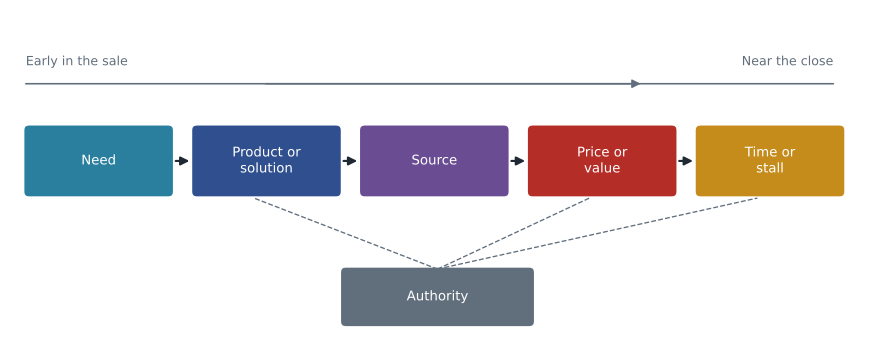
A sixth category, authority objections, overlaps with several of these. "I need to check with my manager" or "my wife has to see it first" may be a genuine statement about who decides, or it may be a polite way to delay. Lesson 3 shows how to find out which.
Need objections
A need objection means the customer does not yet see a problem worth solving, or does not see it as urgent. These are common early in a sale, especially when the seller has made the first contact. They are also the hardest to overcome by argument, because nobody can be talked into feeling a need. The response is usually more discovery: asking questions that help the customer see the cost of the current situation, as SLS-211 explains.
When Prairie Valley's facilities manager first told Maya in August that the school division's print setup "works fine", she was raising a need objection. Two months later, after the division's own audit showed that 14 schools were running 61 different printer models with four different toner suppliers, the same manager was the person pushing for a request for proposals. The need had been there all along; it had not been visible.
Product or solution objections
A product objection means the customer is not convinced that your solution fits. These are often the most useful objections a seller can hear, because they point to a specific gap. Some are based on a real limitation of the product, and some on a misunderstanding.
When Elaine Morales told Aiden that the counter-depth refrigerator she liked would not hold enough for a family of five, she was making a product objection based on a real trade-off: counter-depth models are shallower and hold less. Aiden's job was not to argue that it held more than it did. It was to find out what mattered most. If the look of the kitchen mattered more than capacity, a counter-depth model plus a small second fridge in the basement might suit her. If capacity mattered more, a standard-depth model with flush installation was the better answer.
Source objections
A source objection is about the seller or the seller's company rather than the product. It may come from a past experience, a reputation, a lack of familiarity or a loyalty to a current supplier. "We've always bought from Cobalt Office" is a source objection; so is "I don't buy furniture from big stores."
Source objections based on a real past failure deserve respect. Northfield Family Clinic, Maya's first win, had complained about late delivery of two desks five years earlier. Maya did not dismiss the complaint. She acknowledged it, explained what Ridgeline had changed in its delivery process since then, and offered a delivery-date guarantee in the contract. Source objections based on unfamiliarity are usually answered with evidence: references from similar customers, case studies and small first commitments that let the customer test the relationship.
Price and value objections
Price objections are the ones salespeople fear most, and the ones customers raise most often. They are rarely as simple as they sound. "Your price is too high" can mean several different things.
| What the customer might mean | What would help |
|---|---|
| I do not yet see enough value to justify the price | More discovery and a clearer link between the solution and the cost of the problem |
| I have a lower quote and want you to match it | A careful comparison of what the quotes actually include |
| It is over my budget this year | Options: a smaller first phase, different payment terms, or a later start |
| I always ask for a better price | A calm, confident answer and, if appropriate, a small trade rather than a gift |
| I am not the one who decides and I am nervous about the cost | Help preparing a business case for the person who does decide |
Separating price from value is the core skill here. Price is what the customer pays. Value is what the customer gets, measured against what they would otherwise have. A customer comparing a 2,499-dollar refrigerator with a 2,199-dollar one is comparing prices. A customer comparing a refrigerator that fits their space and comes with next-week delivery against one that needs a cabinet removed and arrives in six weeks is comparing value. Lessons 3 and 8 return to this distinction.
Worked problem
Are the two quotes really comparable?
The Moraleses showed Aiden a competitor quote of 5,300 dollars for four kitchen appliances. Juniper & Pine's price for the same brand package was 5,646 dollars. The competitor quote did not include delivery (149 dollars), haul-away of the old appliances (60 dollars for four), or installation of the dishwasher (189 dollars), all of which Juniper & Pine includes on a four-appliance package. Which quote is lower once the services the Moraleses need are added?
Show solution
- Add the services to the competitor's quote: 149 + 60 + 189 = 398 dollars.
- Competitor total: 5,300 + 398 = 5,698 dollars.
- Juniper & Pine total, with the services included: 5,646 dollars.
- Difference: 5,698 − 5,646 = 52 dollars in Juniper & Pine's favour.
Answer: Once delivery, haul-away and installation are counted, the competitor's quote is 52 dollars higher. The price objection was really a comparison objection, and the right response was a clear side-by-side, not a discount.
Time objections and stalls
"Let me think about it" is the most common objection in retail and one of the most common in B2B. Sometimes it is exactly what it sounds like: the customer needs time to consider a large purchase, compare options or talk to someone. Sometimes it is a polite way of saying no, or a sign that another objection has not been voiced. The seller's job is to find out which, without pressure.
A stall is a delay without a clear reason. A genuine timing constraint is a delay with one: a budget that resets in April, a renovation that will not be finished until December, a board that meets once a month. Genuine constraints are not really objections at all; they are facts to plan around. Stalls are worth exploring gently, because the real concern is often still unspoken.
Stated and hidden objections
Not every objection is the real one. Customers sometimes give a polite or easy reason instead of the true one, either to avoid conflict or because they have not put the real concern into words. A buyer who says "it's too expensive" may really be worried about the disruption of switching suppliers. A shopper who says "I need to measure" may have already measured and be unsure about the colour.
These hidden objections are sometimes called smokescreens. The term is a little unfair, because the customer is rarely being dishonest; they are protecting themselves from an awkward conversation. The best way to uncover a hidden objection is to ask, respectfully, whether there is anything else. Lesson 3 shows how.
Objections at different stages
Objections tend to appear at predictable points in a sale. Need objections dominate the early conversations, when the customer is deciding whether to engage at all. Product and source objections appear during discovery and presentations. Price objections usually appear once a proposal or quote is on the table. Time and authority objections appear near the close. Knowing this helps a seller anticipate objections and prepare for them, and it helps diagnose problems: a seller who hears many price objections in a first meeting is probably talking about price too early.
| Stage | Most likely objections | Prevention |
|---|---|---|
| First contact | Need, source | Research the customer; lead with a relevant insight, not a pitch |
| Discovery | Need, product | Ask about the cost of the problem before proposing solutions |
| Presentation | Product, source | Tie each feature to a need the customer stated; offer references |
| Proposal | Price, value | Show value before price; compare like with like |
| Close | Time, authority | Map decision-makers early; agree a decision date in advance |
Keeping an objection log
Darnell asked every seller in the workshop to keep a simple log for four weeks: the date, the customer, the exact words of each objection, the type, the stage and what happened next. At the end of September, Maya's log had 23 entries. Nine were price objections, six were time objections, four were source objections, three were product objections and one was a need objection. Seven of the nine price objections had come in first or second meetings.
Worked problem
Reading an objection log
Maya's log had 23 objections: 9 price, 6 time, 4 source, 3 product, 1 need. Seven of the 9 price objections came in a first or second meeting. What share of her objections were about price, and what share of the price objections came early?
Show solution
- Price share of all objections: 9 ÷ 23 = about 0.39, or about 39 in 100.
- Early share of price objections: 7 ÷ 9 = about 0.78, or about 78 in 100.
- Interpretation: most of Maya's price objections came before she could have shown value.
Answer: About 39 in 100 of Maya's objections were about price, and about 78 in 100 of those came early in the sale. The pattern pointed to talking about price too soon, which she fixed by holding pricing until after discovery.
Aiden kept the same kind of log on the sales floor at Juniper & Pine, on a small notebook in his pocket. His most common objection, by far, was "I'm just looking", which is less an objection than a signal that the shopper is not ready to be sold to. SLS-250 covers how to approach shoppers who say it.
Common mistakes
MistakeHearing every objection as rejection.
InsteadTreat objections as information about what stands between the customer and a decision.
MistakeAnswering the words rather than the meaning.
InsteadIdentify the type of objection and what the customer really means before responding.
MistakeTreating every price objection as a request for a discount.
InsteadFind out whether the customer doubts the value, has a comparison, faces a budget limit or is testing.
MistakeAssuming the stated objection is the real one.
InsteadCheck gently whether there is anything else behind it.
MistakeIgnoring patterns in your own objections.
InsteadKeep an objection log and look for objections you are causing by pitching or pricing too early.
Summary and key terms
- An objection is any concern, question or statement that stands in the way of a sale moving forward, and it is information rather than rejection.
- Rackham's research found that many objections in large sales are caused by presenting solutions too early.
- Common types are need, product or solution, source, price or value, and time objections, with authority objections overlapping several.
- Price objections can mean doubts about value, a competing quote, a budget limit, a habit of asking, or a nervous decision-maker.
- Comparing quotes like for like often turns a price objection into a value discussion.
- Stalls are delays without a clear reason; genuine timing constraints are facts to plan around.
- Hidden objections lie behind stated ones.
- Objections appear at predictable stages, and an objection log reveals patterns a seller can fix.
- Objection
- A customer concern, question or statement that stands in the way of the sale moving forward.
- Need objection
- An objection showing the customer does not yet see a problem worth solving.
- Source objection
- An objection about the seller or the seller's company rather than the product.
- Price objection
- An objection about what the solution costs, often really about value.
- Stall
- A delay in the decision without a clear reason.
- Hidden objection
- The real concern behind a stated objection, sometimes called a smokescreen.
Practice problems
Work each problem on paper first, then reveal the answer to check.
Classify: "We've used the same supplier for twelve years."
Show answer
A source objection, based on loyalty to a current supplier.
A competitor quotes 3,900 dollars without delivery (120) or setup (180). Your quote is 4,150 with both included. Which is lower overall?
Show answer
Competitor: 3,900 + 120 + 180 = 4,200 dollars, so yours is 50 dollars lower.
Of 30 logged objections, 12 are price. What share is that?
Show answer
12 ÷ 30 = 0.40, or 40 in 100.
Lesson quiz · 5 questions
Score 60% or more to complete this lesson.
Create a free account to save your progress, take quizzes and earn a certificate.