
SLS-130 · Lesson 6 of 12 · 18 min
Service recovery
▶ Video coming soon A video version of this lesson is on the way.
In early November 2026, a Juniper & Pine delivery crew carrying a refrigerator up a narrow staircase gouged the wall at the top of the stairs. The customer, Denise Morin, had moved into the house three weeks earlier. She phoned the store that afternoon, upset rather than angry: the house was new, she had just painted, and she was hosting her family for dinner that weekend. Aiden took the call. By the end of the week the wall had been repaired by a painter the store paid for, Denise had received a handwritten note from Bev, and the store had a new rule about measuring staircases before large deliveries. In her online review the following week, Denise gave the store five stars and wrote that "they made a bad day into a reason to trust them".
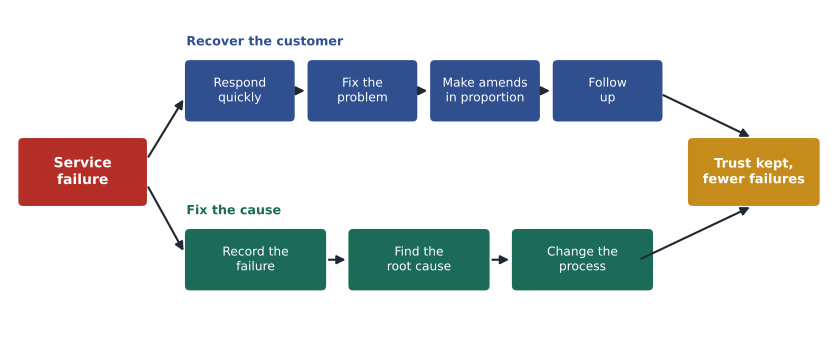
What happened between the phone call and the review is called service recovery: the actions an organization takes to put things right after a service failure. Lesson 5 covered handling complaints. This lesson goes further, into how to make up for a failure, how much compensation is appropriate, how quickly to act, the conditions under which recovery can actually increase loyalty, and how to make sure the same failure does not happen again.
What service recovery is
A service failure is any time the service falls short of what the customer was promised or reasonably expected: a late delivery, a damaged product, a wrong invoice, a rude response, a broken promise. Failures are inevitable in any business that serves many customers. What differs between businesses is how they respond.
Service recovery has two purposes. The first is to restore the customer's trust and satisfaction, which keeps them as a customer. The second is to learn from the failure so it happens less often. A business that recovers brilliantly from the same failure every week is wasting money; a business that never recovers at all is losing customers. Good service recovery does both.
Justice: how customers judge a recovery
Researchers who study service recovery, including Stephen Tax and Stephen Brown in the 1990s, found that customers judge recovery along three dimensions of fairness, often called justice.
| Dimension | The customer asks | Denise Morin's case |
|---|---|---|
| Outcome fairness (distributive justice) | Was the result fair? Was I fixed and compensated in proportion to what happened? | The wall was professionally repaired at no cost to her |
| Process fairness (procedural justice) | Was the process quick, easy and reasonable? Did I have to fight for it? | One call; the store arranged the painter; repaired within four days |
| Interaction fairness (interactional justice) | Was I treated with honesty, courtesy and respect? | Aiden listened, apologized sincerely and kept her informed; Bev wrote personally |
The three dimensions work together. A generous outcome reached through a slow, grudging process can still leave a customer unhappy. A courteous apology without any fix feels empty. Interaction fairness often matters more than staff expect: customers frequently say the way they were treated was what decided whether they stayed.
Speed matters
The faster a failure is recovered, the less damage it does. Every day a problem stays open, the customer thinks about it, tells someone about it and becomes more certain the business does not care. Fast recovery also costs less, because the customer's expectations of compensation grow with the wait. A refrigerator that is replaced the next day may need only an apology; one replaced two weeks later, after the customer has thrown away spoiled food, may need much more.
Speed depends on empowerment. Front-line staff who can fix most problems themselves, within clear limits, recover faster than staff who must ask permission for everything. Juniper & Pine's limits, introduced in lesson 5, allowed Aiden to book the painter without waiting for approval, because the cost was within the store's damage-repair budget. Bev's role was to support the decision, not to make it.
Making amends: compensation in proportion
When a failure has cost the customer something real, such as time, money, effort or embarrassment, fixing the original problem may not be enough. Compensation recognizes that cost. It can take many forms: a refund, a discount, a credit toward a future purchase, free delivery, an upgrade, or a small gesture such as a gift card. In business accounts it is often a service credit, as in lesson 3's SLA, or extra service at no charge.
The key principle is proportionality: compensation should match the size of the failure and its impact on the customer. Too little feels insulting. Too much is expensive, can make the customer suspicious, and can teach customers that complaining pays. Asking what would make things right, as lesson 5 suggested, helps find the right level. So does a simple scale that staff can use consistently.
| Level | Typical failure | Usual recovery at Juniper & Pine |
|---|---|---|
| 1. Minor | Short delay, small error corrected on the spot | Sincere apology and a quick fix |
| 2. Moderate | Missed delivery window, repeat call needed, small product defect | Apology, fix, and a small gesture such as free redelivery or a 25 to 50 dollar credit |
| 3. Significant | Damage to the product or the home, lost day off work, repeated failures | Apology, full fix at no cost, and compensation in proportion, decided with a manager |
| 4. Serious | Safety issue, injury, major damage | Immediate escalation to a manager, insurance involved, personal follow-up from senior staff |
Worked problem
Choosing a proportionate gesture
A customer took an unpaid afternoon off for a mattress delivery that never arrived; the crew had the wrong address. She earns about 28 dollars an hour and lost four hours. The mattress cost 1,450 dollars. Bev is considering three options: a 50 dollar credit, a 150 dollar credit, or a 30 in 100 refund on the mattress. Which is most proportionate?
Show solution
- Estimate the customer's direct loss: 4 hours × 28 dollars = 112 dollars of lost pay.
- Option A, 50 dollars, is less than half of what she lost; it would feel inadequate.
- Option B, 150 dollars, covers the lost pay with a little extra to recognize the frustration.
- Option C, a 30 in 100 refund: 1,450 × 0.30 = 435 dollars, nearly four times the loss and far beyond the failure.
- Add the non-money parts: an apology, a confirmed new delivery at a time that suits her, and a follow-up call.
Answer: Option B, a 150 dollar credit, is proportionate: it covers her real loss of about 112 dollars and recognizes the frustration, without overcompensating. It should come with an apology, a guaranteed delivery slot of her choosing and a follow-up.
The service recovery paradox
Denise's five-star review illustrates something called the service recovery paradox: the observation that a customer whose problem is recovered very well can end up more satisfied and loyal than a customer who never had a problem at all. The idea was described by Michael McCollough and Sundar Bharadwaj in 1992, and it is popular in service training because it sounds encouraging.
The research is more cautious than the slogan. Reviews of many studies have found that the paradox does sometimes appear, but not reliably. It is more likely when the failure is minor, when it is the customer's first failure with the business, when the customer does not think the business could easily have prevented it, and when the recovery is excellent on all three kinds of fairness. It is much less likely after a serious failure, after repeated failures, or when the customer blames the business for carelessness. After a second failure, the paradox usually disappears.
The practical lesson is clear. Recovery is worth doing well, because a good recovery limits damage and can sometimes strengthen a relationship. But no business should rely on failures as a way to build loyalty. Preventing the failure is still better.
Fixing the cause
Every recovered failure should leave the business slightly better at avoiding the next one. That requires the second path in the recovery diagram: recording what happened, finding the root cause, and changing the process. A useful technique is to ask "why?" several times. The wall was damaged. Why? The refrigerator was too wide to turn at the top of the stairs. Why was that not known? Nobody measured the staircase. Why not? The order form did not ask about stairs. The fix was to add questions about stairs, doorways and turns to the order form for large items, and to have associates ask them at the time of sale. The crew had not been careless; the process had not given them the information they needed.
Root-cause fixes often cost less than one recovery. The new order-form questions took Marcus Dube an hour to set up. The painter for Denise's wall cost 380 dollars. If the questions prevent even one more incident a year, they have paid for themselves many times over.
When recovery is abused
A small number of customers learn that complaining brings rewards and begin to complain about everything, or invent problems to get credits. Staff sometimes respond by becoming suspicious of all complaints, which punishes the honest majority. A better approach is to keep recovery generous for genuine failures while using records to spot patterns. Juniper & Pine's complaint log, from lesson 5, records every goodwill credit against the customer's account. If the same household has received credits on most of its recent orders, the next complaint goes to a manager, who checks the facts before agreeing anything.
Checking facts is not the same as accusing the customer. The manager might ask for a photo of the damage, arrange an inspection, or offer to fix the problem rather than give money. Most customers with a real problem are happy to help, because they want it solved. The few who are abusing the system usually lose interest when the response is a repair visit rather than a credit. In business accounts, the equivalent protection is the contract: service credits follow agreed rules, and anything beyond them is a decision for the account team, recorded and explained.
The opposite mistake is more common. Many businesses are so worried about abuse that they make every customer prove every problem, which turns a small failure into a long, insulting process. Remember the three kinds of fairness: a process that treats honest customers as suspects fails on process and interaction fairness, however fair the final outcome.
Service recovery in business accounts
Recovery in business-to-business service has the same principles, with some differences. Failures often affect many people inside the customer, so recovery may need to address the decision-maker as well as the users. Compensation is usually framed by the contract, such as service credits, but a supplier can do more than the contract requires when the relationship is valuable. And the customer often expects a written account of what went wrong and what will prevent a repeat, sometimes called an incident report or root-cause summary.
When RoomFlow, Ridgeline's room-booking software, went down for most of a Tuesday morning in late October 2026, every customer using it was affected, including Prairie Valley School Division, whose staff could not book rooms for parent meetings. Ridgeline's support team posted updates every thirty minutes on a status page. The next day, Maya and Farida Haddad, Ridgeline's senior account manager, called each affected customer, apologized, explained that a failed software update had caused the outage, and described the new testing step that would prevent a repeat. The contract required a service credit for the downtime; Ridgeline applied it automatically, without customers having to ask. Prairie Valley's facilities manager later told Farida that the calls, more than the credit, were what convinced her to stay.
Common mistakes
MistakeFixing the customer's problem but not the cause.
InsteadRecord each failure, find the root cause and change the process, so the same failure happens less often.
MistakeMaking customers fight for a fair outcome.
InsteadMake recovery quick and easy; process fairness matters as much as the outcome.
MistakeOver- or under-compensating.
InsteadMatch compensation to the size and impact of the failure, using a consistent scale.
MistakeCounting on the service recovery paradox.
InsteadRecover well, but remember the paradox is unreliable and usually vanishes after a serious or repeated failure.
MistakeWaiting for business customers to ask for credits.
InsteadApply contract credits automatically and explain what went wrong and what will prevent a repeat.
Summary and key terms
- Service recovery is what an organization does to put things right after a service failure.
- It has two paths: recovering the customer and fixing the cause.
- Customers judge recovery on outcome, process and interaction fairness.
- Speed reduces damage and cost, and depends on front-line staff having authority to act within clear limits.
- Compensation should be proportionate to the size and impact of the failure.
- The service recovery paradox, where an excellent recovery leaves a customer more loyal than if nothing had gone wrong, does sometimes occur but is unreliable and rarely survives serious or repeated failures.
- Root-cause analysis, such as asking why several times, turns each recovery into a process improvement.
- In business accounts, recovery includes the decision-maker, contract credits and a written account of the cause and fix.
- Service failure
- Service that falls short of what the customer was promised or reasonably expected.
- Service recovery
- Actions taken to put things right for the customer after a service failure.
- Justice dimensions
- Outcome, process and interaction fairness, the three ways customers judge a recovery.
- Proportionality
- Matching compensation to the size and impact of a failure.
- Service recovery paradox
- The finding that an excellent recovery can sometimes leave a customer more satisfied than if no failure had occurred.
- Root cause
- The underlying reason a failure happened, which must be fixed to stop it recurring.
Practice problems
Work each problem on paper first, then reveal the answer to check.
Name the three justice dimensions and give one example of each.
Show answer
Outcome fairness (the fix and compensation), process fairness (speed and ease), interaction fairness (honesty and courtesy).
When is the service recovery paradox least likely to occur?
Show answer
After serious or repeated failures, or when the customer believes the business could easily have prevented the failure.
A customer lost 3 hours of pay at 25 dollars an hour due to a missed delivery. What is her direct loss?
Show answer
3 × 25 = 75 dollars.
Lesson quiz · 5 questions
Score 60% or more to complete this lesson.
Create a free account to save your progress, take quizzes and earn a certificate.