
SLS-130 · Lesson 5 of 12 · 18 min
Handling complaints
▶ Video coming soon A video version of this lesson is on the way.
On the last Monday of October 2026, Bev printed the store's complaint log for the month and handed a copy to each associate. It listed 37 complaints. "Thirty-seven people cared enough to tell us something was wrong," she said. "That's not bad news. The bad news is the people who didn't tell us." She pointed out that the store had made about 1,900 sales and 640 deliveries that month. If only a small share of unhappy customers complain, as most research suggests, then 37 complaints meant many more unhappy customers the store knew nothing about.
This lesson treats complaints as information and opportunity, not as attacks. It covers why customers complain or stay silent, how to receive a complaint, a step-by-step method for handling one, how to record complaints so the business can learn from them, and how complaints work in business accounts.
Why complaints are valuable
A complaint tells a business three things it badly needs to know. It identifies a specific failure, often one that affects other customers too. It shows how the customer felt about it, which helps the business decide how serious it is. And it gives the business a chance to put things right with a customer who has not yet left. A customer who complains is, in a sense, giving the business a second chance.
The customers who do not complain are the bigger risk. Studies of complaining behaviour going back to the 1970s, including work for the US Office of Consumer Affairs by the research firm TARP, found that most dissatisfied customers never complain to the business at all. They simply buy elsewhere and tell other people. The exact ratios quoted in training materials vary widely and should not be treated as precise, but the pattern is consistent: for every complaint a business receives, there are usually several unhappy customers it never hears from.
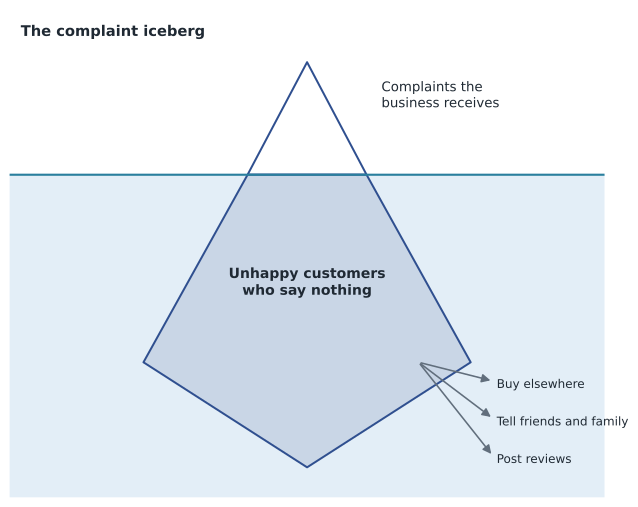
Why customers stay silent
Understanding why customers do not complain helps a business make complaining easier. Common reasons include believing it will not change anything, not knowing how or where to complain, finding it awkward or confrontational, not having time, and expecting to be treated as a nuisance. Business customers add another reason: the person affected is often not the person who deals with the supplier. A nurse whose printer jams every day may never tell the office manager, who therefore never tells Ridgeline.
Businesses can lower these barriers. They can make it easy to give feedback in several channels, tell customers explicitly that they want to hear about problems, respond visibly to the feedback they get, and ask directly after important moments. Juniper & Pine's delivery crews began asking one question before leaving each home: "Is there anything about the delivery that wasn't right?" In the first weeks of November the number of delivery complaints rose, and the number of bad online reviews about delivery fell. Problems were being caught at the door instead of on the internet.
Receiving a complaint
The first minute of a complaint decides much of what follows. Customers who complain are often already frustrated, and many have rehearsed what they will say. They are watching for signs that they will be dismissed. Three things help at this stage.
First, let them finish. Interrupting to explain or defend, even with correct information, tells the customer you are not listening. Most people run out of steam within a minute or two if they are allowed to speak. Second, acknowledge the feeling before addressing the facts: "That sounds really frustrating, especially after you took the morning off." Acknowledging a feeling is not the same as admitting fault; it simply shows the customer they are being heard. Third, thank them for raising it. It sounds odd to thank someone who is angry, but it reframes the conversation: the complaint is welcome information, not an attack.
What to avoid is just as important. Do not argue about whose fault it was, especially in front of the customer. Do not blame colleagues or another department. Do not use policy as a shield. And do not promise things you cannot deliver to make the conversation end faster.
A method for handling complaints
Many service teams use a simple sequence for complaints. Different organizations give it different names; one common version is listen, empathize, apologize, solve, follow up. The steps overlap with the five stages of a service interaction from lesson 4, with extra attention to feelings and to apology.
| Step | What to do | Example from Juniper & Pine |
|---|---|---|
| Listen | Let the customer explain fully; take notes; ask questions only to clarify | The customer explains that the new sofa has a torn seam found after delivery |
| Empathize | Acknowledge the feeling and the impact on the customer | "You were looking forward to this, and finding a tear is really disappointing." |
| Apologize | Apologize sincerely for the experience, without excuses | "I'm sorry this happened. That's not the standard we aim for." |
| Solve | Agree a fix that suits the customer, with options where possible | Offer a repair visit this week or a replacement sofa in about three weeks |
| Follow up | Confirm the fix happened and the customer is satisfied | Call after the repair visit to check the result |
Apologizing well
Apologies are often done badly. A good apology is sincere, specific and does not contain a hidden excuse. "I'm sorry the delivery crew left without removing your old washer, and that you had to call twice" is specific. "I'm sorry if you were inconvenienced" suggests that the customer may be overreacting. "I'm sorry, but we've been very short-staffed" turns the apology into a request for the customer's sympathy.
Some staff worry that apologizing admits legal liability. Apologizing for a customer's experience is not the same as admitting legal fault, and several Canadian provinces, including Saskatchewan, have apology laws that say an apology cannot be used as an admission of liability in a civil case. Serious incidents, such as a delivery crew damaging a customer's home, may involve insurance and should be escalated to a manager, who will know what can be said. For ordinary service failures, a sincere apology is almost always the right thing.
Finding a fair solution
The right solution depends on what went wrong and what the customer needs. It usually has two parts: fixing the problem itself, and, where the failure caused real inconvenience, recognizing that cost. Lesson 6 covers the second part, sometimes called compensation, in detail.
Asking customers what they want often produces a reasonable answer. The customer with the torn seam wanted the sofa fixed before her family visited for a holiday; she did not want a new sofa if it meant waiting three weeks. A repair visit that week met her actual need better than the more expensive replacement. Staff who assume that every complainer wants money can end up spending more and satisfying less.
Staff also need to know how much they are allowed to do without asking. Juniper & Pine gives associates authority to offer free redelivery, a repair visit, or a goodwill credit of up to 100 dollars; anything larger goes to Bev or the assistant manager. Clear limits let associates solve most complaints on the spot, which customers strongly prefer to being told someone will call them.
Worked problem
Reading the complaint log
Juniper & Pine's October complaint log has 37 entries, grouped by cause: delivery timing 14, product damage or defects 9, staff behaviour 5, billing and fees 4, special-order delays 3, other 2. The store made about 1,900 sales in the month. Work out the share of complaints from each of the two largest causes and the complaint rate per 1,000 sales.
Show solution
- Check the total: 14 + 9 + 5 + 4 + 3 + 2 = 37.
- Delivery timing: 14 ÷ 37 × 100 = 37.8, about 38 in 100 complaints.
- Damage or defects: 9 ÷ 37 × 100 = 24.3, about 24 in 100.
- Together these two causes are 23 of 37 complaints, about 62 in 100.
- Complaint rate: 37 ÷ 1,900 × 1,000 = 19.5 complaints per 1,000 sales.
Answer: Delivery timing (about 38 in 100) and damage or defects (about 24 in 100) cause nearly two-thirds of all complaints, so they are where improvement will pay off most. The store received about 19.5 complaints per 1,000 sales, a figure worth tracking each month, remembering that it understates the number of unhappy customers.
Recording complaints so the business learns
A complaint handled well satisfies one customer. A complaint recorded well can prevent the same failure for hundreds. Useful complaint records include the date and channel, the customer and order, a short description, a cause category chosen from a fixed list, what was done, who owns it, and when it was closed. Fixed categories matter because they allow counting and comparison over time; free text alone makes patterns hard to see.
Reviewing complaints regularly turns them into improvements. The question to ask is not "who made this mistake?" but "why did the system let this happen?" The fourteen delivery-timing complaints at Juniper & Pine were not caused by fourteen careless drivers. They were caused by route planning that happened too late in the evening, which lesson 2's blueprint revealed. Fixing the cause would remove most of those complaints at once.
Records also protect customers and staff. If a dispute is later escalated to a manager, to the card company or to a consumer protection office, a clear record of what was said and promised helps everyone.
Speed matters for complaints as much as for any other contact. Juniper & Pine's standard from lesson 3 is that every complaint is logged the same day, assigned an owner and closed or updated within three business days. Bev tracks the number of complaints still open after three days, because a complaint that sits unanswered tends to grow: the customer calls again, writes a review or asks for more compensation than they would have accepted on the first day. An update that says "I don't have an answer yet, but the supplier has promised one by Thursday" counts, because it shows the customer the complaint has not been forgotten.
Complaints in business-to-business accounts
Business customers complain differently. They are less likely to raise their voices and more likely to escalate in writing, copy senior people, or mention the contract. Their complaints often concern repeated or systemic problems rather than a single bad moment: invoices that are wrong every month, a fault that keeps returning, a support line that never calls back. They may also complain to the account executive about a team the account executive does not manage.
In late October 2026, Helen Park at Riverbend Dental Group emailed Maya, copying the clinic director, to say that the reception printer had jammed four times in two weeks and that each time the technician had "fixed" it in a few minutes and left. Maya's response followed the same method as a retail complaint, adapted to the setting. She replied within an hour to acknowledge the email and promise a full answer the next day. She called Janet to listen to the full story, and learned the jams were worst on Monday mornings, when the clinic printed a week of patient forms at once. She apologized for the repeated visits that had not fixed the cause. She arranged for a senior technician to inspect the printer and review its fault log, and offered a loan printer until the issue was solved. Then she wrote a short summary of the actions, with dates, and sent it to Janet and the director.
The inspection found that the clinic was printing far more than the printer was designed for in a single batch. The fix was moving reception to a larger model already covered by the contract at no extra charge. Maya followed up two weeks later; there had been no jams. In business accounts, how a complaint is handled is often remembered long after the original problem, and Maya noted it in her account plan for the February renewal.
Common mistakes
MistakeInterrupting to explain or defend.
InsteadLet the customer finish, then acknowledge the feeling before discussing facts.
MistakeApologizing with a hidden excuse, such as "sorry, but we're short-staffed".
InsteadApologize sincerely and specifically for the customer's experience, without excuses.
MistakeAssuming every complainer wants money.
InsteadAsk what would make it right; the customer's actual need is often cheaper and more satisfying to meet.
MistakeRecording complaints only as free text.
InsteadUse fixed cause categories so complaints can be counted and patterns found.
MistakeTreating complaints as individual mistakes.
InsteadAsk why the system allowed the failure, and fix the cause.
Summary and key terms
- Complaints are valuable information and a second chance with a customer who has not yet left.
- Most dissatisfied customers never complain, so received complaints understate dissatisfaction; businesses should make complaining easy and ask after important moments.
- When receiving a complaint, let the customer finish, acknowledge the feeling and thank them.
- A common method is listen, empathize, apologize, solve and follow up.
- Good apologies are sincere, specific and contain no excuses, and apology laws in many places limit their use as admissions of liability.
- Front-line staff need clear authority to solve most complaints on the spot.
- Complaints recorded with fixed cause categories reveal patterns; reviews should ask why the system allowed the failure.
- Business customers often escalate in writing about repeated problems, and a structured written response matters.
- Complaint
- A customer's expression of dissatisfaction with a product, service or experience.
- Silent dissatisfied customer
- An unhappy customer who does not complain to the business but may leave or tell others.
- Acknowledging a feeling
- Showing you understand how the customer feels, without necessarily agreeing about the facts.
- Apology law
- A law that limits the use of an apology as evidence of legal liability.
- Cause category
- A fixed label for the reason behind a complaint, used to count and compare complaints.
- Escalation
- Passing a complaint to someone with more authority or expertise.
Practice problems
Work each problem on paper first, then reveal the answer to check.
Why do received complaints understate customer dissatisfaction?
Show answer
Most dissatisfied customers never complain; they leave or tell others instead.
Rewrite "I'm sorry if you were inconvenienced" as a better apology for a late delivery.
Show answer
For example: "I'm sorry the delivery arrived three hours late and you lost your afternoon waiting for it."
A store had 24 complaints, 9 about billing. What share is that, in 100?
Show answer
9 ÷ 24 × 100 = 37.5 in 100.
Lesson quiz · 5 questions
Score 60% or more to complete this lesson.
Create a free account to save your progress, take quizzes and earn a certificate.