
SLS-101 · Lesson 8 of 12 · 18 min
Asking for the business
▶ Video coming soon A video version of this lesson is on the way.
In early October Aiden spent forty minutes with a young couple choosing a sectional for their first house. They had measured the room, picked a fabric, sat in both configurations twice and asked about delivery. Then they stood in the aisle smiling at each other, and Aiden, unsure what to do, said, "Well, take your time and let me know." They thanked him and left. They came back three days later and bought the sectional from another associate. Bev heard about it and found Aiden in the break room. "You did everything right except the last thing," she said. "They were waiting for you to ask."
Many sellers find asking for the sale the hardest step. They worry about sounding pushy or hearing no. Yet customers who have reached a decision often want help taking the final step, and a seller who never asks leaves them uncertain. This lesson is about closing: recognizing when a customer is ready and asking clearly for a commitment, in a way that respects their choice.
What closing really means
Closing is often described as a set of clever phrases that trap customers into buying. That idea gives selling a bad name and rarely works with modern buyers. A better definition is simple: closing is asking the customer for a commitment that moves the purchase forward. In a store, that commitment is usually the purchase itself. In a long B2B sale, it may be a smaller step: a site visit, a meeting with the decision maker, a trial, or a signed proposal.
Closing is the natural end of good selling, not a separate trick. If discovery was thorough and the presentation connected the product to the customer's needs, the close is easy: the seller is simply asking whether the customer wants what they have already said they want. When closing feels hard, the problem is usually earlier. The seller has not yet understood the need, has not addressed a concern, or is asking before the customer has reached the decision stage of their journey.
Buying signals
Customers signal readiness in what they say and do. Aiden's couple showed nearly all of the common signals, and he missed them.
| Kind of signal | Examples |
|---|---|
| Questions about ownership | "How soon could it be delivered?" "Does the warranty cover the cushions?" |
| Questions about payment | "Do you offer financing?" "Is there a discount if we buy the ottoman too?" |
| Talking as if they already own it | "It'll look great under the window." "The kids will love the chaise end." |
| Physical signals | Sitting in it again, measuring, taking photos, looking at each other and nodding |
| B2B signals | Asking about contract terms, implementation dates or references; bringing in the person who signs; asking for a revised quote |
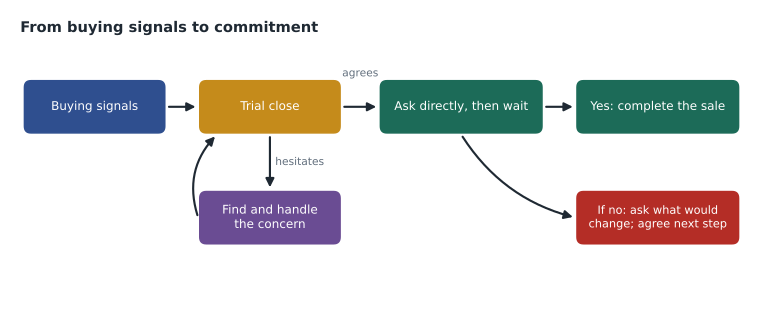
When a seller notices buying signals, the right move is usually a trial close: a question that tests readiness without asking for the final decision. "It sounds like the chaise on the left fits the room best; is that the one you're leaning toward?" "If we can install over the long weekend so the clinic isn't disrupted, would that address Dr. Anand's concern?" A yes means the customer is close; a hesitation reveals a concern still to be handled.
Asking clearly
When the signals are strong and concerns are handled, ask directly and then stop talking. Clear, plain questions work better than elaborate techniques.
- The direct ask: "Would you like to go ahead with the sectional in the grey fabric?"
- The choice of next steps: "Would you prefer delivery next Thursday or the following Saturday?" This works only when the customer has already shown they want to buy; used too early, it feels manipulative.
- The summary close: briefly restate what the customer needs and how the solution delivers it, then ask. "You wanted reliable printing, secure release for patient letters and no surprise repair bills, and this contract covers all three. Shall I prepare the agreement for Dr. Anand to sign?"
- The next-step close in B2B: ask for the specific action that moves the deal forward. "Could we book thirty minutes with Dr. Anand next week to go through the proposal?"
After asking, silence is important. Many sellers ask, feel uncomfortable during the pause, and fill it by adding discounts or talking the customer out of deciding. The customer needs a few seconds to think. Waiting quietly shows confidence and respect.
Advances and continuations
In complex B2B sales, the outcome of a meeting is rarely a signed order. Neil Rackham, whose research on large sales led to the SPIN selling method, drew a useful distinction between two kinds of meeting outcome. An advance is a specific action by the customer that moves the sale forward, such as agreeing to a trial, arranging a meeting with the decision maker or agreeing to evaluate a proposal by a set date. A continuation is a pleasant ending that commits the customer to nothing: "Send us some information," "Keep in touch," "Call me next month."
Continuations feel like progress, which is why they are dangerous. Maya's CRM in her first month was full of them. Darnell's rule is that every meeting should end with an advance or an honest no. If the customer will not commit to any next step, that itself is information: the need may not be real, the timing may be wrong, or the seller is talking to the wrong person.
Hearing no
Customers often say no, and a good seller treats no as information rather than failure. A no can mean "not this product," "not now," "not at this price" or "not you." Asking a calm follow-up question, such as "Can I ask what's holding you back?" or "What would need to be different?", often uncovers a concern that can be addressed, or confirms that the sale is genuinely not right. Either answer is useful.
There is also a point at which to stop. Pressing a customer who has clearly decided against buying damages trust, can breach consumer protection rules against high-pressure tactics, and wastes time that could go to customers who do want to buy. A graceful exit ("Thanks for considering us; may I check in after your budget is set in the spring?") leaves the door open.
Completing the sale in a store
In retail, saying yes is not quite the end of the close. The seller still has to complete the sale smoothly, and the details matter: confirming the exact product, colour and size; checking stock and delivery or pickup dates; explaining payment and any financing honestly; offering relevant add-ons and protection plans without pressure; and making sure the customer knows what happens next. A customer who is confused at the till about delivery or the return policy may cancel the next day. Bev asks associates to finish every big-ticket sale by reading back the order and delivery details and handing over a printed summary with their own name and phone number.
Add-ons should be offered once, clearly, and only when relevant. A mattress protector with a new mattress, or a power bar with a television, may genuinely help the customer. A protection plan should be explained accurately, including what it covers and what the manufacturer's warranty already covers. If the customer declines, the seller accepts it and moves on. Repeating the offer turns a good close into a pressured one.
Pressure, urgency and fairness
There is a real difference between legitimate urgency and pressure. Legitimate urgency is a true fact the customer would want to know: the sale ends Sunday, only two units are left in that colour, or installation slots before the school year are filling up. Pressure is manufactured urgency or emotional force: false deadlines, claims that "this price is only for today" when it is not, refusing to let a customer leave to think, or making them feel foolish for hesitating. Pressure tactics can breach consumer protection law, which in every province prohibits misleading representations, and for some sales, such as door-to-door contracts, gives consumers a cooling-off period to cancel. Course SLS-150 covers these rules.
A simple test applies: would the seller be comfortable if the customer later discovered everything said and done during the close? If a deadline was real, the answer is yes. If it was invented, the answer is no, and the customer who discovers it will not come back.
Mutual action plans in B2B
In longer B2B sales, the final stage often involves several steps on both sides: a legal review of the contract, a meeting with the person who signs, a credit check, an installation schedule. Many B2B sellers use a mutual action plan, a short shared list of the steps both parties will take before the purchase, with dates and owners. For Northfield, Maya's plan listed Dr. Anand's review of the proposal, the bookkeeper's check of the payment terms, Ridgeline's confirmation of installation dates, and a signing date. Building the plan together is itself a form of closing: a customer who agrees to a plan has committed to the steps that lead to a decision, and a customer who will not agree to one is telling the seller something important.
Why sellers avoid asking
Many sellers, especially new ones, avoid asking for commitment for understandable reasons. Some fear rejection and feel that a customer who has not been asked cannot say no. Some worry about seeming pushy, often because they have been on the receiving end of pushy selling themselves. Some are unsure whether the customer is ready and would rather wait. Recognizing these fears helps overcome them. A no is information, not a personal judgment. Asking clearly after good discovery is the opposite of pushy; it is a service to a customer who has already said what they need. And a trial close resolves the uncertainty about readiness at little cost.
Bev's advice to Aiden was practical. For one week, he was to end every serious conversation by asking a direct question about the customer's decision, whatever the answer turned out to be. By Friday the fear had faded, and his sales had risen. Most customers, he found, were relieved to be asked. The few who said no usually explained why, which gave him something specific to work on.
Worked problem
The value of asking
Over a quarter, Maya presents 24 proposals. Her current close rate is 25 in 100, with an average first-year deal value of 14,000 dollars. Darnell believes that asking clearly for commitment at the end of each proposal meeting, instead of waiting for customers to call back, could raise her close rate to 33 in 100. How much extra revenue would that bring in the quarter?
Show solution
- Current wins and revenue:
- \[0.25 \times 24 = 6 \text{ wins}\]
- \[6 \times 14{,}000 = 84{,}000 \text{ dollars}\]
- Wins and revenue at the higher close rate:
- \[0.33 \times 24 = 7.92 \approx 8 \text{ wins}\]
- \[8 \times 14{,}000 = 112{,}000 \text{ dollars}\]
- Difference:
- \[112{,}000 - 84{,}000 = 28{,}000 \text{ dollars}\]
Answer: About two extra wins and 28,000 dollars of extra first-year revenue in the quarter, from the same 24 proposals. Closing well does not create demand; it stops good opportunities from leaking away at the last step.
Aiden learned the lesson quickly. The following Saturday, a man spent twenty minutes comparing two recliners and then asked how long delivery took. Aiden told him, then asked, "Would you like to take the leather one?" The man said yes, and then laughed. "I was wondering if you'd ever ask."
Common mistakes
MistakeWaiting for the customer to say they want to buy.
InsteadWhen buying signals appear, use a trial close and then ask directly.
MistakeUsing pressure tactics or trick closes.
InsteadAsk plain questions and respect the answer; pressure damages trust and can breach consumer protection rules.
MistakeFilling the silence after asking with discounts or extra talk.
InsteadAsk, then wait quietly; the customer needs time to think.
MistakeCounting "send me some information" as progress.
InsteadThat is a continuation; aim for an advance, a specific action by the customer, or an honest no.
Summary and key terms
- Closing is asking the customer for a commitment that moves the purchase forward; it is the natural end of good selling, not a trick.
- Buying signals include questions about ownership and payment, talking as if the customer owns the product, physical signals and, in B2B, questions about contracts, implementation and references.
- A trial close tests readiness and surfaces concerns.
- Clear asks include the direct ask, a choice of next steps once the customer is ready, the summary close and, in B2B, the next-step close; after asking, wait in silence.
- In complex sales, aim for advances rather than continuations.
- Treat no as information, ask what would need to change, and know when to stop.
- Closing
- Asking the customer for a commitment that moves the purchase forward.
- Buying signal
- Something a customer says or does that suggests readiness to buy.
- Trial close
- A question that tests readiness without asking for the final decision.
- Advance
- A specific action by the customer that moves a sale forward.
- Continuation
- A meeting outcome that keeps contact going but commits the customer to nothing.
- Close rate
- The share of opportunities or proposals that become sales.
Practice problems
Work each problem on paper first, then reveal the answer to check.
A customer asks, "Can it be delivered before Christmas?" What kind of signal is this, and what should the seller do?
Show answer
A question about ownership, which is a buying signal; answer it and use a trial close or ask directly.
Classify each outcome as an advance or a continuation: (a) "Call me in a month," (b) "Let's book a demo with our IT lead on the 14th."
Show answer
(a) is a continuation; (b) is an advance.
A seller presents 30 proposals at a 20 in 100 close rate with an average deal of 5,000 dollars. What revenue does that produce?
Show answer
0.20 × 30 = 6 wins; 6 × 5,000 = 30,000 dollars.
Lesson quiz · 5 questions
Score 60% or more to complete this lesson.
Create a free account to save your progress, take quizzes and earn a certificate.