
SLS-101 · Lesson 7 of 12 · 18 min
Opening and building rapport
▶ Video coming soon A video version of this lesson is on the way.
Aiden's first week on the floor taught him that "Can I help you?" is almost the worst sentence in retail. Nine customers out of ten answered "Just looking, thanks," and after that it felt awkward to approach them again. Bev watched him for a morning and then showed him another way. She let a woman look at a display of dining chairs for a minute, walked over, and said, "Those are new this month. The grey ones are the most comfortable for long dinners; try sitting in one." The woman sat, laughed, and asked whether they came in a lighter colour. Ten minutes later she was choosing a table to go with them.
The first minute of a sales conversation sets its direction. It decides whether the customer relaxes or braces, whether they share their real situation or protect it, and whether they see the seller as a helper or an obstacle. This lesson covers how to open a conversation in a store and in a business meeting, and how to build genuine rapport, the sense of ease and connection that makes honest conversation possible.
First impressions
People form impressions of a stranger within seconds, based on appearance, posture, facial expression, voice and the first few words. Those impressions are not always fair, but they are real, and they shape how the rest of the conversation is heard. A seller does not need to be glamorous. They need to look prepared, attentive and at ease: dressed appropriately for the setting, on time, phone away, making comfortable eye contact and smiling naturally.
What counts as appropriate varies. On the Juniper & Pine floor, staff wear the store's dark green shirts and comfortable shoes, because customers want someone who can climb onto a display bed or lift a cushion. At a law firm, Maya dresses closer to what the partners wear. At Keystone Grain Equipment's plant, she wears safety boots and leaves the blazer in the car. The rule is to fit the customer's world closely enough that appearance does not become the topic.
Opening in a store
Retail openings face a particular problem: the customer did not ask to talk to anyone, and many are wary of being sold to. Good retail openings share four habits.
- Acknowledge quickly, approach patiently. Make eye contact and say hello within moments of a customer entering the section, so they feel noticed, then give them a little time to look before approaching.
- Open with something specific. Comment on the product they are looking at, a feature, or the situation ("Those are the ones that come in three lengths"), rather than asking a yes-or-no question they can deflect.
- Invite interaction. Ask them to try the product: sit in the chair, open the fridge, feel the fabric. Touching a product turns browsing into considering.
- Read the signals. If the customer answers briefly and turns away, step back and stay available; if they ask a question or keep talking, move into discovery.
Timing matters. A customer who walks straight to a product, picks up the price tag and looks around is often ready for help. One who wanders slowly through the whole store may want space. Bev's rule of thumb for new associates is to approach when the customer stops moving: a pause in front of one product usually means interest.
Opening a business meeting
In a B2B meeting, the customer agreed to talk, but they are busy and probably sceptical. A strong opening respects their time and makes the purpose clear. Many sales trainers teach a short structure for this, sometimes called an upfront agreement or upfront contract: a few sentences, said early, that confirm the time available, the purpose, what each side will do and how the meeting might end.
Maya's opening at Northfield sounded like this: "Thanks for making time, Janet. We have thirty minutes; does that still work for you? My goal today is to understand how the clinic uses its printers and shared rooms, and what the expansion next door involves. I'll ask quite a few questions, and of course ask me anything. By the end we can decide together whether it makes sense for me to come back and look at the rooms, or whether we're not the right fit. Does that sound reasonable?" It took under a minute. It told Janet the meeting would be about her clinic, not a product pitch, and that she could say no.
| Part of the opening | Purpose | Example phrase |
|---|---|---|
| Thanks and time check | Shows respect and confirms the time | "We have thirty minutes; does that still work?" |
| Purpose | Sets the focus on the customer | "My goal is to understand how you use..." |
| What each side will do | Gives permission to ask questions | "I'll ask a few questions, and ask me anything." |
| Possible outcomes | Removes pressure, including the option of no | "We can decide together whether it makes sense to continue." |
| Agreement | Gets a small yes before starting | "Does that sound reasonable?" |
What rapport is, and what it is not
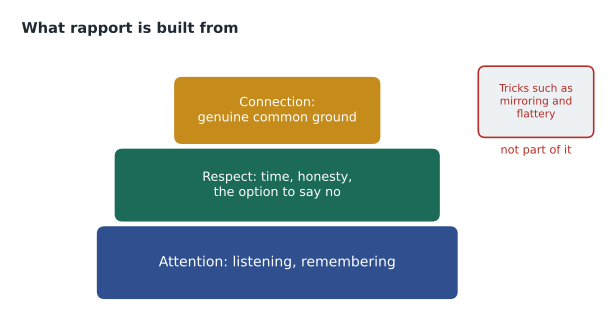
Rapport is a state of mutual ease and understanding between two people, in which each feels heard and respected. It is what lets a customer say "honestly, our budget is about half that" or "my husband hates leather" instead of politely ending the conversation. Rapport is not the same as friendship, flattery or small talk, although small talk can help. It grows from attention.
Some sales training teaches rapport tricks: copying the customer's posture, repeating their words, inventing common interests. Customers usually notice and feel manipulated. Genuine rapport comes from simpler things: being interested in the person and their problem, listening without interrupting, remembering what they said, and being honest. If a seller and customer happen to share something, a hometown, a sports team, children the same age, it can help to mention it, but it should never be manufactured.
Small talk deserves care. In many workplaces in Saskatchewan, a minute about the weather or the drive in is a normal way to start. Some customers, especially busy ones, prefer to get straight to business, and some cultures and individuals find personal questions from a stranger intrusive. A good rule is to follow the customer's lead: offer a brief pleasant opening, and if they move to business, move with them.
Moving from opening to discovery
The opening's job is to earn permission to ask questions. Once the customer has agreed to the purpose, the seller should move to discovery promptly with a broad, easy question that invites the customer to talk. In a store: "What's the room like where it'll go?" In a business meeting: "Could you walk me through what happens when one of the printers goes down?" Questions about the customer's world are easier to answer than questions about their budget or decision process, which come later once rapport is stronger.
Openings by phone and video
On the phone, a seller has no appearance or setting to help, so the first sentence carries more weight. A good phone opening names the caller and company clearly, gives a brief reason for calling that relates to the customer, and asks permission to continue: "Hi Janet, it's Maya Chen from Ridgeline Workplace Solutions. Owen mentioned the clinic's printers have been giving you trouble, and I'd like to ask a couple of questions about how that's affecting the front desk. Is now a reasonable time, or would later in the week be better?" Asking permission feels risky to new sellers, but customers who agree are far more attentive than customers who feel trapped.
On video, the opening should also deal with the practical setup: confirming everyone can see and hear, introducing anyone new, and checking that the time still works. Looking at the camera rather than the screen when speaking helps the customer feel addressed, and a brief natural moment of small talk works as well on video as in person, provided it stays brief.
Opening with more than one customer
Retail sellers often serve couples, families and friends shopping together, and B2B sellers often meet several people at once. Openings should include everyone. Aiden learned to greet each person in a group, to ask who would be using the product, and to direct questions to the person who answers them rather than assuming one person is in charge. A common mistake is to address only the person who seems to be paying, or only the person who spoke first. The quiet partner is often the one who decides.
In business meetings, the same principle applies. If Dr. Anand joins a meeting with Janet, Maya should briefly recap the purpose for him, ask what he would most like to get out of the conversation, and make sure his concerns are heard, not just Janet's. Each person in the room is at their own stage of the buyer's journey and needs to feel the meeting is worth their time.
Respect in the first minute
Every customer deserves the same respect from the first moment, whatever their age, appearance, accent, disability or apparent budget. Judging customers by appearance is unfair and also bad business: the man in work boots may be furnishing a new house, and the student may be buying for her parents. Sellers should also be ready to adapt openings for customers with disabilities, for example by facing a customer who lip-reads, speaking to a wheelchair user at eye level where possible, or offering a seat to someone who looks tired, always asking rather than assuming what help is wanted.
Respect also means accepting a polite refusal. A customer who says "just looking" after a good opening should be thanked and left to browse, with a clear way to find help later: "I'm Aiden; I'll be nearby if any questions come up." Many of those customers come back.
Rapport over time
Rapport is not built once and kept forever. It grows through repeated contact in which the customer finds the seller attentive, honest and useful, and it fades if contact becomes rare or one-sided. In long B2B relationships, sellers maintain rapport through regular, valuable conversations, remembering details the customer shared, and showing interest in the customer's goals beyond the next order. In retail, rapport with returning customers shows in small things: remembering what they bought last time, asking how it is working, and greeting them by name if they have shared it. Customers who feel known return more often and send their friends.
Rapport also has limits. It does not entitle the seller to pressure a customer, to expect a sale out of friendship, or to blur professional boundaries. A good relationship makes honest conversation possible; it does not replace the work of understanding needs and showing value.
Worked problem
What a better opening is worth
Juniper & Pine's furniture department sees about 600 shopping groups a week, and 90 of them buy, at an average sale of 1,150 dollars. Bev believes better openings could lift the share of groups who buy to 17 in 100. What is the current conversion rate, and how much extra weekly revenue would the change bring at the same average sale?
Show solution
- Conversion rate is buyers divided by shoppers.
- \[90 \div 600 = 0.15\]
- So 15 in 100 shopping groups currently buy.
- At 17 in 100, the number of buying groups would be:
- \[0.17 \times 600 = 102\]
- Extra sales and revenue:
- \[102 - 90 = 12 \text{ extra sales}\]
- \[12 \times 1{,}150 = 13{,}800 \text{ dollars a week}\]
Answer: The department converts 15 in 100 shopping groups today. Raising that to 17 in 100 would add about 12 sales and 13,800 dollars of revenue a week, or roughly 717,600 dollars over 52 weeks, without a single extra customer coming through the door. Small improvements in the first minute have large effects.
Common mistakes
MistakeOpening with "Can I help you?" in a store.
InsteadOpen with a specific comment about the product or situation and invite the customer to try something.
MistakeStarting a business meeting with a product presentation.
InsteadThank the customer, check the time, state a customer-focused purpose and agree how the meeting will run.
MistakeUsing mirroring and flattery to build rapport.
InsteadCustomers sense manipulation; build rapport through attention, listening, memory and honesty.
MistakeForcing small talk on a customer who wants to get to business.
InsteadFollow the customer's lead and move to business when they do.
Summary and key terms
- The first minute shapes the whole conversation.
- Sellers should look prepared and at ease and fit the customer's setting.
- In a store, acknowledge customers quickly, approach patiently, open with something specific, invite them to try the product and read their signals.
- In a business meeting, an upfront agreement thanks the customer, checks the time, states a customer-focused purpose, explains what each side will do and allows for either outcome.
- Rapport is mutual ease and understanding built from attention and respect; tricks such as mirroring and invented common ground backfire.
- Follow the customer's lead on small talk and move promptly to easy, open discovery questions.
- Small improvements in conversion produce large gains in revenue.
- Rapport
- A state of mutual ease and understanding in which each person feels heard and respected.
- Upfront agreement
- A short statement at the start of a meeting confirming time, purpose, roles and possible outcomes.
- Conversion rate
- The share of shoppers or prospects who buy.
- Approach
- The moment a seller first engages a customer in conversation.
- Small talk
- Light conversation that eases the start of a meeting.
Practice problems
Work each problem on paper first, then reveal the answer to check.
Rewrite "Can I help you?" for a customer looking at recliners.
Show answer
For example: "Those three all recline at the touch of a button. The middle one has the firmest back support; have a seat and try it."
A store has 800 shoppers a week and 120 buy. What is the conversion rate?
Show answer
120 ÷ 800 = 0.15, or 15 in 100.
What are the parts of an upfront agreement?
Show answer
Thanks and a time check, a customer-focused purpose, what each side will do, possible outcomes including no, and a small agreement to proceed.
Lesson quiz · 5 questions
Score 60% or more to complete this lesson.
Create a free account to save your progress, take quizzes and earn a certificate.