
SLS-101 · Lesson 6 of 12 · 18 min
Preparing for a sales call
▶ Video coming soon A video version of this lesson is on the way.
Before Maya's first meeting at Northfield Family Clinic, Darnell gave her a one-page form and told her not to leave the office until it was filled in. It asked for six things: what she knew about the clinic, what she knew about the people she would meet, what she believed their problem was, what she wanted to achieve by the end of the meeting, the questions she would ask, and what she would do if the meeting went badly. Maya filled it in in forty minutes. "Most of that I could have made up on the spot," she said. "Then you'd have made it up," Darnell replied. "I'd rather you found it out."
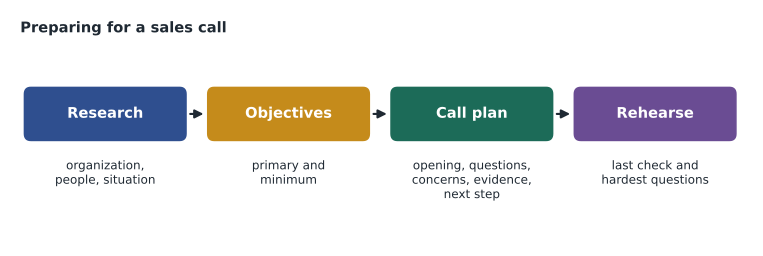
Preparation is the least visible part of selling and one of the most valuable. Buyers notice immediately whether a seller has done their homework, and they reward it with time, candour and attention. This lesson covers what to research, how to set objectives for a call, how to plan the conversation, and how preparation differs between B2B and retail.
Research: the customer, the people and the situation
Good preparation answers three groups of questions. The first is about the organization or household. For a business: what does it do, how big is it, how is it doing, what has changed recently, and what has it bought before? For Northfield, Maya found the clinic's website (eight physicians, two nurse practitioners, extended hours three evenings a week), a local news story about its planned expansion into the unit next door, and Ridgeline's own CRM, which showed that the clinic had bought two desks from Ridgeline five years earlier and had complained about late delivery.
The second group is about the people. Who will be in the meeting, what are their roles, how long have they been there, and what are they likely to care about? Janet Morrow, the office manager, had been at the clinic for eleven years; her professional networking profile listed scheduling and patient experience as her interests. Dr. Ravi Anand, the managing physician, had approval over larger purchases. Maya noted that Janet would care about daily workflow and Dr. Anand about cost, patient privacy and disruption.
The third group is about the situation. What problem does the customer seem to have, what triggered the conversation, what alternatives do they have, and what might stop them buying? Owen's call notes said the printers broke weekly, the waiting-room chairs were worn, and staff struggled with a paper booking sheet for shared rooms. The expansion news suggested a larger opportunity: furniture and equipment for new rooms. The old delivery complaint was a risk Maya would need to address before it was raised.
| Source | What it tells you | Caution |
|---|---|---|
| The customer's website and social media | Services, size, people, recent news | Presents the organization as it wants to be seen |
| News, public records, industry publications | Expansions, funding, leadership changes, problems | May be out of date |
| Your own CRM and colleagues | Past purchases, complaints, previous contacts | Only as good as the notes people left |
| Professional networking profiles | Roles, tenure, interests, shared contacts | Use for context; do not mention personal details in a way that feels intrusive |
| The customer themselves, before the meeting | Agenda, attendees, what they want to cover | Ask briefly and respect their time |
Research has a limit. Fifteen to thirty minutes is enough for most first meetings; a large opportunity might justify a few hours. Sellers who spend a day researching a small prospect are avoiding the harder work of calling people. And research is never a substitute for discovery: it gives the seller good questions to ask, not answers to assume.
Setting objectives for the call
Every sales call needs a clear objective, and the objective is rarely "make the sale". In a B2B sale with several steps, a first meeting succeeds if it moves the customer forward on their journey. Darnell teaches his team to set two objectives for each call.
- Primary objective: the best realistic outcome. For Northfield: "Janet agrees to a site visit next week, with Dr. Anand present for the last part, so I can see the printers, rooms and the unit next door."
- Minimum objective: the outcome that still makes the call worthwhile. For Northfield: "I understand the printer, chair and booking problems well enough to know whether we can help, and Janet agrees to a follow-up call."
Good objectives describe something the customer will do, such as agree, share, introduce or schedule, rather than something the seller will do, such as present or explain. That keeps the focus on the buyer's progress. A useful test is to imagine walking out of the meeting: could you say for certain whether the objective was met?
Planning the conversation
A call plan sets out how the conversation might go. It is not a script; it is a set of prepared parts that the seller can use in whatever order the conversation needs.
| Part of the plan | Northfield Family Clinic example |
|---|---|
| Opening | Thank Janet, confirm the 30 minutes, check whether Dr. Anand can join, state the purpose: to understand how the clinic uses its printers, waiting room and shared rooms |
| Key questions | How often do the printers fail and what happens then? How are the shared rooms booked now? What does the expansion involve and when? Who else is involved in decisions like this? |
| Likely concerns | Cost of a contract; disruption during installation; Ridgeline's late delivery five years ago |
| Evidence to bring | A reference from another clinic using managed print; a one-page outline of RoomFlow |
| Proposed next step | A site visit next week |
| Plan B | If Dr. Anand cannot join, ask Janet how he likes to receive information and offer a short summary for him |
The planned questions are the most important part. They should be open, specific to the customer and tied to the research. "Tell me about your printers" is weak. "Owen mentioned the printers go down about once a week. What happens in the clinic when that happens?" is strong, because it shows preparation and invites a story about the real cost of the problem.
Preparing to sell in a store
Retail sellers do not usually know who will walk through the door, so their preparation looks different. It is about readiness rather than research. Before each shift at Juniper & Pine, Bev runs a ten-minute huddle covering the day's promotions, new arrivals, items out of stock, delivery lead times and the store's sales target. Aiden then walks his section: straightening displays, checking price tags, making sure demonstration models work, and noting which products he knows least about.
Product knowledge is the retail seller's main preparation. A customer who asks whether a recliner will fit through a narrow door, or whether a washer can be stacked, expects an accurate answer immediately. Aiden keeps a small notebook of questions he could not answer and looks them up before his next shift. Carl's advice is simpler: "Sit on every sofa, open every fridge, read every warranty. You can't sell what you haven't touched."
Retail sellers can also prepare for the customers they expect. Saturday mornings bring families, weekday evenings bring couples after work, and the first warm weekend of spring brings patio furniture shoppers. Knowing that lets an associate prepare the right products and questions, just as Maya prepares for a particular clinic.
On the day: the last fifteen minutes
Research and planning happen in advance, but the last fifteen minutes before a meeting matter too. Darnell's team uses a short checklist: confirm the time, place and attendees; check the route and parking, or test the video link; reread the call plan and the last notes in the CRM; check whether anything has changed, such as a news story or a new email from the customer; and bring what was promised, whether that is a sample, a reference's contact details or a printed floor plan. Arriving five minutes early, not twenty, avoids both lateness and the awkwardness of waiting too long in reception.
Maya adds one habit of her own. Just before each meeting she writes, on the top line of her notebook, the single most important thing she wants to learn. For Northfield it was: "What happens when the printers fail?" If the meeting is interrupted or cut short, she makes sure to ask that question before anything else.
Rehearsing and anticipating
For important meetings, a short rehearsal is worthwhile. Darnell sometimes plays the customer while a team member practises the opening and the first two questions. The point is not to memorize words but to hear how they sound and to smooth out awkward phrasing. Rehearsal also helps with the hardest part of preparation: anticipating difficult questions. Before Northfield, Maya listed the three questions she least wanted to be asked, which were about Ridgeline's old delivery problem, the cost of a five-year contract and what would happen to patient data stored on the printers, and prepared an honest answer to each.
Preparing for video and phone meetings
Remote meetings need their own preparation. A seller should test the link and the camera, choose a quiet place with a plain background and good light in front rather than behind, close unrelated windows and notifications, and have any materials ready to share. It helps to send a short agenda beforehand and to check whether the customer would rather have cameras on or off. On the phone, preparation matters even more, because neither side can see the other's reactions. Maya keeps her call plan open in front of her and pauses more often to check that the customer is following.
Retail has its version of remote selling too. Juniper & Pine offers video appointments for customers who want to see a sofa before visiting, and associates prepare for them by setting up the product in good light, checking fabric samples and confirming stock and delivery dates before the call begins.
Recording what you learn
Preparation for the next call begins at the end of this one. Within an hour of every meeting, Maya writes a short summary in the CRM: what she learned, what the customer agreed to, what she promised, and the next step with a date. She also sends the customer a brief email confirming the next step. The notes make her next preparation faster and allow a colleague to pick up the account if she is away. In retail, Aiden does the same in his notebook for customers who said they would come back, recording what they looked at and what questions remained.
Worked problem
Deciding where to spend preparation time
Maya has three meetings next week and about 3 hours for preparation. She estimates: Northfield Family Clinic, a 30 per cent chance of an 18,000-dollar deal; Keystone Grain Equipment, a 10 per cent chance of a 60,000-dollar deal; and a small accounting office, a 50 per cent chance of a 4,000-dollar deal. Using expected value, how should she share her preparation time?
Show solution
- Expected value is the chance of winning multiplied by the deal value.
- \[\text{Northfield: } 0.30 \times 18{,}000 = 5{,}400 \text{ dollars}\]
- \[\text{Keystone: } 0.10 \times 60{,}000 = 6{,}000 \text{ dollars}\]
- \[\text{Accounting office: } 0.50 \times 4{,}000 = 2{,}000 \text{ dollars}\]
- Total expected value.
- \[5{,}400 + 6{,}000 + 2{,}000 = 13{,}400 \text{ dollars}\]
- Share 180 minutes in proportion to expected value.
- \[\text{Northfield: } 180 \times \tfrac{5{,}400}{13{,}400} \approx 73 \text{ minutes}\]
- \[\text{Keystone: } 180 \times \tfrac{6{,}000}{13{,}400} \approx 81 \text{ minutes}\]
- \[\text{Accounting office: } 180 \times \tfrac{2{,}000}{13{,}400} \approx 27 \text{ minutes}\]
Answer: Roughly 73 minutes for Northfield, 81 for Keystone and 27 for the accounting office. The calculation is a guide, not a rule: if Keystone is a new kind of customer for Maya, she may need extra time to understand its industry, and good preparation may itself raise the chance of winning.
Common mistakes
MistakeSkipping preparation because you can improvise.
InsteadBuyers notice when you have done your homework, and prepared questions lead to better conversations.
MistakeSetting "make the sale" as the objective for every call.
InsteadSet a primary and a minimum objective describing what the customer will do next.
MistakeWriting a script and following it word for word.
InsteadPrepare parts (opening, questions, concerns, evidence, next step) and use them as the conversation requires.
MistakeTreating research as a substitute for discovery.
InsteadResearch gives you better questions; only the customer can tell you their real situation.
Summary and key terms
- Preparation covers research, objectives and a call plan.
- Research answers questions about the organization or household, the people involved and the situation, using sources such as websites, news, your own CRM and colleagues, and professional profiles; it should be proportionate to the opportunity.
- Each call should have a primary objective and a minimum objective, both describing what the customer will do.
- A call plan prepares an opening, key questions, likely concerns, evidence, a proposed next step and a plan B, without becoming a script.
- Retail preparation focuses on readiness: the shift huddle, the section, product knowledge and expected customers.
- Expected value can help decide where to spend preparation time.
- Primary objective
- The best realistic outcome of a sales call.
- Minimum objective
- The least outcome that still makes a call worthwhile.
- Call plan
- A prepared set of opening, questions, concerns, evidence and next step for a sales conversation.
- Expected value
- The chance of an outcome multiplied by its value.
- Shift huddle
- A short team meeting before a retail shift covering promotions, stock and targets.
Practice problems
Work each problem on paper first, then reveal the answer to check.
Rewrite this objective so it describes what the customer will do: "Present our furniture range."
Show answer
For example: "The customer agrees to a showroom visit and shares the floor plan for the new offices."
A deal has a 25 per cent chance of being worth 12,000 dollars. What is its expected value?
Show answer
0.25 × 12,000 = 3,000 dollars.
Name three things a retail associate can do to prepare before a shift.
Show answer
Attend the huddle, walk and tidy the section, check that demonstration models work, review promotions and stock, and look up unanswered product questions.
Lesson quiz · 5 questions
Score 60% or more to complete this lesson.
Create a free account to save your progress, take quizzes and earn a certificate.