
ROB-450 · Lesson 6 of 12 · 26 min
Mobile, service and personal care robots
Robots that move among people without a fence face a different safety problem from caged industrial arms. They cannot rely on keeping people away; they must detect people, predict what they will do, slow or stop in time, and remain stable and harmless when something goes wrong. The people around them range from trained warehouse staff to shoppers, hospital patients, children and people with visual or mobility impairments who did not choose to share space with a robot. This lesson covers the standards and laws for mobile robots in industrial settings, service robots in public and commercial spaces, and personal care robots that help or carry people. ROB-430 covered the human factors of shared spaces and ROB-440 lesson 9 sized AMR fleets; here the emphasis is on the safety requirements and the legal context.
A map of the standards
Several families of standards apply depending on where a robot works and what it does. Choosing the right one is the first step of any compliance plan, and many robots fall under more than one.
| Robot type | Main safety standards | Typical setting |
|---|---|---|
| Driverless industrial trucks and AMRs | ISO 3691-4:2023; ANSI/A3 R15.08-1 and -2; ANSI/ITSDF B56.5 | Factories and warehouses with trained staff |
| Industrial mobile manipulators | ANSI/A3 R15.08-2 with ISO 10218 | Machine tending and picking |
| Personal care robots | ISO 13482:2014 (under revision at the time of writing) | Homes, care facilities, public spaces |
| Service robots for commercial use | UL 3300; ISO 13482 by analogy | Hotels, shops, hospitals, offices |
| Automated mobile platforms | UL 3100 | Mobile platforms used indoors in commercial and industrial settings |
| Household robots | IEC 60335-2-2 (including robotic vacuum cleaners); IEC 60335-2-107 (robotic lawnmowers) | Homes and gardens |
| Exoskeletons and wearable robots | ISO 13482 for physical assistant robots; medical rules if used for therapy | Workplaces and rehabilitation |
ISO 3691-4 covers driverless industrial trucks and their systems, including autonomous mobile robots carrying loads. It requires personnel detection on the path of travel, speed limits matched to the stopping capability, designated operating zones with different rules, such as restricted zones where people are not allowed and operating hazard zones requiring additional measures, warning devices, and information for the user about how to prepare the site. ANSI/A3 R15.08 Part 1 (2020) covers manufacturers' requirements for industrial mobile robots, Part 2 (2023) covers integration and use, and Part 3, on users' requirements, was in development at the time of writing. ISO 13482 covers three types of personal care robots: mobile servant robots that carry objects or perform tasks, physical assistant robots that help a person perform tasks, such as exoskeletons, and person carrier robots that transport people.
Detecting people and stopping in time
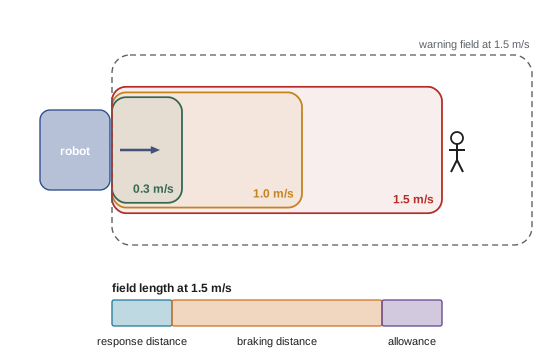
The central safety function of a mobile robot is to stop before it hits a person. It needs three things: a sensor that reliably detects people in its path, such as a safety-rated laser scanner meeting IEC 61496-3 with a protective field; a safety-rated controller that monitors speed and switches fields as speed changes; and brakes that stop the robot within the distance covered by the field. Because stopping distance grows with the square of speed, protective fields must grow with speed, and robots often switch among several fields as they accelerate, turn or approach doors.
Here \( v \) is the speed, \( t_r \) the total response time of sensor, controller and brake actuation, \( a \) the guaranteed deceleration and \( C \) an allowance for sensor measurement error, wheel slip and the distance a person can move while the robot stops. The guaranteed deceleration is the hard part: it depends on load, floor surface, wheel wear, slope and contamination such as water or dust. ISO 3691-4 requires stopping tests under defined conditions, and good practice uses worst-case values or a statistical margin.
# Protective field length for an AMR: nominal calculation versus a Monte Carlo worst case
import random
random.seed(450)
def field(v, t_r, a, c):
    return v * t_r + v * v / (2 * a) + c
v = 1.5                                   # m/s, top speed in open aisles
nominal = field(v, t_r=0.18, a=0.8, c=0.20)
samples = []
for _ in range(100_000):
    t_r = random.gauss(0.18, 0.015)               # sensor + controller + brake response
    a = random.uniform(0.55, 0.9)                 # deceleration: wet floor, worn wheels, full load
    samples.append(field(v, t_r, a, c=0.20))
samples.sort()
p999 = samples[int(0.999 * len(samples))]
print(f"nominal field length: {nominal:.2f} m")
print(f"99.9th percentile:    {p999:.2f} m")
for speed in (0.3, 0.7, 1.0, 1.5):
print(f"speed {speed:.1f} m/s -> worst-case field {field(speed, 0.21, 0.55, 0.20):.2f} m")nominal field length: 1.88 m 99.9th percentile: 2.54 m speed 0.3 m/s -> worst-case field 0.34 m speed 0.7 m/s -> worst-case field 0.79 m speed 1.0 m/s -> worst-case field 1.32 m speed 1.5 m/s -> worst-case field 2.56 m
The nominal field is noticeably shorter than the worst case once wet floors, worn wheels and heavy loads are considered, which is why fields designed from datasheet values can fail in service. The table of fields by speed also shows why slowing down near intersections and doors is so effective: halving speed reduces the braking term to a quarter.
Laser scanners mounted at one height see only a plane. People are usually detected by their legs, but a person lying on the floor, a child, a forklift's raised forks, a table top or an overhanging load may not be. Risk assessments must check what the sensors can and cannot see and add measures such as additional sensors, 3D cameras, mechanical bumpers or operating rules. Drop-offs such as loading docks and stairs need cliff detection. And robots that carry or tow loads must consider the load's own reach, since a cart can strike a person the robot's scanner did not cover.
Stability and physical contact
A mobile robot or mobile manipulator that tips over can crush someone or drop its load. Static stability depends on the position of the centre of gravity relative to the wheelbase; dynamic stability adds the effects of acceleration, braking, turning and arm motion. A simple check gives a first estimate of the braking deceleration at which a robot begins to pitch forward.
Worked problem
Braking and tipping of a tall service robot
A service robot has its centre of gravity 0.90 m above the floor and 0.20 m behind the line of its front wheel contacts. At what braking deceleration does it start to tip forward, and what slope angle tips it statically to the side if the half-track width is 0.25 m?
Show solution
- Forward tipping begins when the inertial moment exceeds the restoring moment: \( m a h > m g d \), so \( a > g d/h \).
- \( a_{tip} = 9.81 \times 0.20/0.90 \approx 2.2 \) m/s².
- Side tipping on a slope occurs when \( \tan\theta > w/h \): \( \theta = \arctan(0.25/0.90) \approx 15.5^{\circ} \).
- The braking deceleration used for the protective field must stay well below 2.2 m/s², and the robot should not operate on cross-slopes near 15 degrees, with margins for loads and bumps.
Answer: Tipping begins at about 2.2 m/s² of braking and about 15.5 degrees of cross-slope; both limits constrain speed, field design and permitted routes.
Some contact with people is inevitable for robots in crowded spaces, so designers also limit the harm when contact occurs: low mass and speed, soft bumpers that detect contact, rounded shapes without pinch points, wheels shrouded to avoid trapping feet, and limits on the force an arm can exert. ISO 13482 contains requirements on these aspects, and the body-region force and pressure limits developed for collaborative industrial robots, discussed in ROB-430, are often used as a reference for service robots, with care because the public includes children and frail people.
Service robots in public spaces
Cleaning robots in shopping centres, delivery robots in hospitals and hotels, security robots in car parks and sidewalk delivery robots all operate among the public. Their risk assessments must consider people who are distracted, who cannot see or hear the robot, who move unpredictably, or who interfere deliberately. They must also consider effects beyond physical injury: blocking a fire exit or an accessible ramp, frightening people, or capturing images of people, which raises the privacy issues covered in ROB-430.
In Canada, robots on public sidewalks and roads are governed by provincial highway traffic laws and municipal bylaws. Ontario's Ministry of Transportation proposed in 2020 a pilot framework for small delivery devices on sidewalks and roads, while Toronto City Council banned delivery robots from city sidewalks in December 2021, citing pedestrian safety and accessibility concerns raised by groups such as CNIB. Rules were still evolving at the time of writing, and operators need to check provincial and municipal requirements for each location. Inside buildings, the owner's OHS duties to workers and its duties as an occupier toward visitors under provincial occupiers' liability laws apply, together with accessibility law such as Ontario's AODA standards, which require that accessible routes remain usable.
Worked problem
Risk review for a hospital delivery robot route
A hospital plans a route for a 120 kg delivery robot from the pharmacy to three wards, passing a waiting area, two corridor corners, a fire door and an elevator. List the key hazards and route-design measures.
Show solution
- Waiting area: children and people with walkers; reduce speed to 0.5 m/s and widen warning fields, or route around the area.
- Corners: limited sensor view of approaching people; slow to 0.3 m/s and add convex mirrors or overhead sensors that share position data.
- Fire door: the robot must never stop in the doorway or hold it open; configure no-stop zones and fire alarm integration so the robot clears exits.
- Elevator: avoid sharing the car with patients on stretchers; give priority to people and use a dedicated service elevator if available.
Answer: The route design itself is a major safety measure: slow zones, no-stop zones, fire alarm integration and elevator rules complement the robot's own safety functions.
Personal care robots and exoskeletons
Personal care robots work closest to people, often in physical contact. A physical assistant robot such as a lower-body exoskeleton supports a person's movement; a failure can cause a fall or force a joint beyond its natural range. ISO 13482 requires risk assessment with hazards specific to close contact, such as excessive force or speed of joints, incorrect assistance timing, stress on the body from prolonged use, electrical and thermal hazards from batteries against the skin, and unexpected behaviour on loss of power. Person carrier robots, such as self-balancing or autonomous wheelchairs, raise vehicle-like hazards of collision, falls from curbs and tipping on slopes.
An important boundary separates personal care robots from medical devices. An exoskeleton sold to help warehouse workers lift is a workplace or consumer product; the same device sold to help stroke patients walk again in a clinic is a medical device, regulated by Health Canada or the US Food and Drug Administration, as lesson 7 explains. Manufacturers decide the intended use, and their marketing claims can move a product across the line.
| Hazard in personal care robots | Example | Design response |
|---|---|---|
| Excessive joint force or range | Exoskeleton hyperextends a knee | Mechanical end stops, torque limits, safety-rated monitoring |
| Wrong timing of assistance | Assistance fires during a stumble | Intent detection with fallbacks, easy manual override |
| Loss of power | Exoskeleton collapses or locks | Defined safe state for power loss, battery monitoring, warnings |
| Skin contact | Pressure sores or burns from straps or batteries | Pressure distribution, temperature limits, usage time guidance |
| Falls and tipping | Person carrier tips at a curb | Stability control, curb detection, speed limits on slopes |
| Battery fire | Thermal runaway in a charger or the robot | Certified cells and packs, battery management, safe charging locations |
Lithium-ion batteries deserve particular attention in all mobile robots. A fire in a robot charging area can spread quickly in a warehouse or a care home. Battery packs certified to recognized standards, such as UL 2271 for light electric vehicle batteries where applicable, battery management systems, charging locations away from exits and combustibles, and fire detection are typical measures, and insurers increasingly ask about them, as lesson 8 notes.
Common mistakes
MistakeSizing protective fields from catalogue braking data.
InsteadMeasure stopping performance under worst-case load, floor and wheel conditions and add a margin.
MistakeAssuming a single-plane scanner detects every person.
InsteadCheck for people lying down, children, overhanging loads and drop-offs, and add sensors or rules.
MistakeTreating a public-space robot like a warehouse AMR.
InsteadAssess untrained, vulnerable and interfering members of the public, accessibility and emergency routes.
MistakeIgnoring the boundary between personal care and medical use.
InsteadDefine the intended use carefully, since medical claims bring medical device regulation.
MistakeTreating battery fire as an electrical detail.
InsteadAssess charging locations, battery certification and fire detection as part of the deployment.
Summary and key terms
- ISO 3691-4 and ANSI/A3 R15.08 govern industrial mobile robots; ISO 13482 covers personal care robots; UL 3300, UL 3100 and IEC 60335 parts cover service, platform and household robots.
- The key safety function is detecting people and stopping in time, with protective fields that grow with speed and are sized for worst-case braking.
- Stability limits on braking and slopes and harm-limiting design matter when contact cannot be ruled out.
- Public-space robots in Canada face provincial traffic law, municipal bylaws such as Toronto's sidewalk ban, occupiers' liability and accessibility law.
- Personal care robots and exoskeletons face close-contact hazards, and medical claims bring medical device regulation.
- Battery fire risk must be managed through certified packs, battery management and safe charging locations.
- AMR
- Autonomous mobile robot that plans its own path.
- Protective field
- Area monitored by a safety sensor in which detection triggers a stop.
- Outer warning field
- Larger area in which detection triggers slowing or a signal, not a stop.
- Personal care robot
- A service robot that improves quality of life, such as a mobile servant, physical assistant or person carrier.
- Physical assistant robot
- A robot that helps a person perform tasks by supplementing their strength, such as an exoskeleton.
- Personal delivery device
- US statutory term for a sidewalk delivery robot.
- Static stability
- Resistance to tipping when stationary on a slope.
- Cliff detection
- Sensing of drop-offs such as stairs and loading docks.
Practice problems
Work each problem on paper first, then reveal the answer to check.
Compute the field length for v = 1.0 m/s, tr = 0.2 s, a = 0.6 m/s², C = 0.2 m.
Show answer
\( 0.2 + 1/1.2 + 0.2 \approx 1.23 \) m.
By what factor does braking distance change if speed is halved?
Show answer
It falls to one quarter.
A robot's CG is 1.2 m high and 0.3 m behind the front contact. Tipping deceleration?
Show answer
\( 9.81 \times 0.3/1.2 \approx 2.45 \) m/s².
Which standard covers personal care robots?
Show answer
ISO 13482.
Name two people a single-plane laser scanner might miss.
Show answer
A person lying on the floor and a small child below or between scan lines; also overhanging loads.
Why must a robot never stop in a fire door opening?
Show answer
It could block an emergency exit or prevent the door from closing to contain fire.
When does an exoskeleton become a medical device?
Show answer
When it is intended or marketed for a medical purpose such as rehabilitation therapy.
Give two battery fire precautions for a robot fleet.
Show answer
Certified packs with battery management, and charging areas away from exits and combustibles with fire detection.
Lesson quiz · 5 questions
Score 60% or more to complete this lesson.
Create a free account to save your progress, take quizzes and earn a certificate.