
ROB-450 · Lesson 11 of 12 · 27 min
Ethics, autonomy and the future of work
Laws and standards set minimum requirements, but they rarely answer the hardest questions about robots: how a robot should share unavoidable risk among different people, who is morally responsible when an autonomous system causes harm, whether some decisions should never be delegated to machines, and how the gains and losses from automation should be distributed. ROB-430 lesson 11 introduced frameworks for robot ethics and privacy in human-robot interaction, including value sensitive design and the IEEE 7000 series. This lesson goes further into four debates that robotics engineers increasingly face in their work: machine ethics and risk distribution, responsibility and meaningful human control, robots and the use of force, and automation and work. The aim is not to give answers to contested questions, but to equip you to recognize them, reason about them carefully and take part in decisions honestly.
Machine ethics and the distribution of risk
Philosopher James Moor distinguished between implicit ethical agents, machines whose design constrains them to behave acceptably, such as a robot that cannot exceed safe speeds, and explicit ethical agents, which represent ethical considerations and reason about them. Almost all real robots are implicit ethical agents: their ethics lies in the choices engineers make about speeds, margins, priorities and what to do when goals conflict. Those choices are ethical even when they look like parameter settings.
Public debate about automated vehicles often focuses on trolley problems, imagined dilemmas in which a vehicle must choose whom to hit. The Moral Machine experiment, published in Nature in 2018, collected about 40 million decisions from people in over 200 countries and territories on such dilemmas and found both broad preferences, such as sparing more lives, and cultural variation. Critics point out that real systems almost never face clean dilemmas with certain outcomes; the realistic ethical questions concern how risk is distributed in everyday driving. How much margin should a vehicle leave to a cyclist compared with an oncoming truck? Should a delivery robot slow down more near children than adults, given that it may misjudge ages? Should a robot's planner treat pedestrians outside crosswalks differently? Every such choice shifts small probabilities of harm between groups, and over millions of encounters those small shifts determine who is hurt.
Worked problem
Making risk distribution explicit
A sidewalk robot's planner passes pedestrians with a lateral clearance of 0.5 m by default. Engineers propose increasing clearance to 1.0 m for people detected with mobility aids, which would add about 4 per cent to average trip times. How should the team reason about this?
Show solution
- Identify affected groups: people with mobility aids, who may be slower to move aside and more severely harmed by a fall; other pedestrians; customers waiting for deliveries.
- Compare burdens: a small delay to deliveries against a reduction in risk to a group already facing barriers in public space.
- Consider detection limits: if mobility aids are detected unreliably, the measure may protect some people but not others, so a larger default clearance may be fairer.
- Document and consult: record the reasoning, consult disability organizations and revisit with field data.
Answer: The larger clearance is ethically well supported because it reduces risk to more vulnerable people at modest cost; the team should also check whether unreliable detection makes a larger default clearance the fairer option.
Responsibility, control and moral crumple zones
Lesson 1 introduced the responsibility gap: the worry, articulated by philosopher Andreas Matthias in 2004, that learning machines may cause harm in ways no human could foresee or control, so that no one is fully responsible. Others argue that the gap can be closed by assigning responsibility to those who choose to deploy such systems, by strict liability rules, and by designing systems so that humans retain meaningful control. Researchers Filippo Santoni de Sio and Jeroen van den Hoven proposed two conditions for meaningful human control: tracking, meaning the system responds to the relevant moral reasons of the people who design and deploy it, and tracing, meaning outcomes can be traced back to at least one person who understands the system's capabilities and their own responsibility.
Anthropologist Madeleine Clare Elish described a moral crumple zone: in complex automated systems, the human operator nearest to an accident often absorbs the blame for failures that really arose from the system's design, much as a car's crumple zone absorbs a collision. Supervisors of automated vehicles, operators of surgical robots and remote monitors of delivery robots may be given nominal control but little practical ability to intervene in time. Research on automation shows that people supervising highly reliable automation become less vigilant, take seconds to regain situation awareness when asked to take over, and tend to trust the system's outputs too much, a pattern called automation bias. Designing a role in which a human cannot realistically prevent harm, and then blaming that human when harm occurs, is an ethical failure by the designers.
| Design choice | Effect on responsibility |
|---|---|
| Clear allocation of tasks between human and machine | People know what they are responsible for and can be trained for it |
| Realistic takeover times and alerts | Human supervisors can actually intervene, so their responsibility is meaningful |
| Logging and explainable records of decisions | Outcomes can be traced to design, data or operator choices |
| Limits on operational domain | The system is used only where its designers can foresee its behaviour |
| Independent review and incident analysis | Lessons are learned and blame is not simply placed on the nearest operator |
Robots and the use of force
Some robots are designed to apply force to people, which raises the gravest ethical questions. Police and security services use remotely operated robots for bomb disposal, surveillance and negotiation. In 2016, Dallas police used a bomb disposal robot carrying an explosive to kill a gunman who had shot police officers, the first known use of a robot by US police to kill a suspect, prompting debate about rules for such use. In 2022, San Francisco's Board of Supervisors approved a policy allowing police to use robots with lethal force in extreme circumstances, then reversed the decision within a week after public opposition. These cases concern remotely operated robots with humans deciding to use force; the deeper debate concerns systems that select and engage targets without human intervention.
Lethal autonomous weapon systems have been discussed internationally for more than a decade. Under the Convention on Certain Conventional Weapons, a Group of Governmental Experts has met since 2017, and its current mandate tasks it with developing, by consensus, elements of a possible instrument on such systems by the end of 2026. In 2023 the UN Secretary-General and the President of the International Committee of the Red Cross jointly called on states to conclude a legally binding instrument by 2026, and the UN General Assembly has adopted resolutions on the subject since December 2023. Many states and civil society groups support a two-tier approach that would prohibit systems that cannot be used in compliance with international humanitarian law or that operate without meaningful human control, and regulate others. Other states argue that existing international humanitarian law is sufficient and oppose new binding rules. The United States' Department of Defense policy, updated in 2023, requires autonomous weapon systems to allow commanders and operators to exercise appropriate levels of human judgment over the use of force. Canada's foreign affairs minister was mandated in 2019 to advance international efforts to ban the development and use of fully autonomous weapons systems, and Canada has participated in the international discussions. Engineers working on robots with possible military or policing uses should know their employer's policies, applicable export controls and their own professional obligations, and should be able to raise concerns through proper channels.
Automation and work
Debates about robots and jobs are as old as robots. Estimates of the share of jobs at risk depend heavily on method. A 2013 study by Carl Frey and Michael Osborne estimated that 47 per cent of US employment was in occupations at high risk of computerization. Later OECD studies that looked at tasks within jobs rather than whole occupations found much lower shares, with a 2019 OECD estimate of about 14 per cent of jobs across member countries at high risk of automation and another 32 per cent likely to change significantly. More recent work focuses on artificial intelligence. Statistics Canada estimated in 2024 that, based on 2021 data, 31 per cent of Canadian employees were in occupations highly exposed to AI with low complementarity, meaning AI could substitute for many of their tasks, 29 per cent were highly exposed with high complementarity, meaning AI is more likely to assist them, and 40 per cent had low exposure.
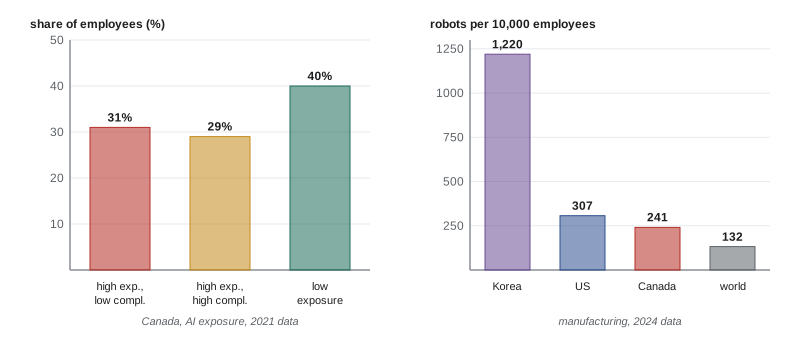
Physical robots and AI affect different work. Industrial robots have most affected routine manual jobs in manufacturing, such as welding, painting and material handling, while AI affects many cognitive tasks in offices. Mobile robots and AI-enabled manipulation now extend automation to warehouse picking, cleaning and some care tasks. The evidence suggests that automation changes tasks within jobs more often than it eliminates whole jobs, creates new jobs such as robot technicians and fleet supervisors, and raises productivity, but that its costs fall unevenly: on workers without post-secondary education, on older workers whose skills are tied to particular machines, and on regions dependent on a few industries. Whether the gains are shared depends on policy, bargaining power and company choices, not on technology alone.
# Scenario analysis for a regional workforce of 250,000 using exposure shares (illustrative)
import random
random.seed(450)
workforce = 250_000
shares = {"high exposure, low complementarity": 0.31,
          "high exposure, high complementarity": 0.29,
          "low exposure": 0.40}
for k, s in shares.items():
    print(f"{k:38s} {s * workforce:9,.0f} workers")
# uncertain outcomes over a decade: displacement rate among low-complementarity jobs,
# and new jobs created per displaced job
results = []
for _ in range(20_000):
    displaced = workforce * shares["high exposure, low complementarity"] * random.uniform(0.05, 0.25)
    created = displaced * random.uniform(0.5, 1.3)
    results.append(created - displaced)
results.sort()
p10, p50, p90 = (results[int(q * len(results))] for q in (0.10, 0.50, 0.90))
print(f"net change in jobs: 10th pct {p10:,.0f}, median {p50:,.0f}, 90th pct {p90:,.0f}")high exposure, low complementarity 77,500 workers high exposure, high complementarity 72,500 workers low exposure 100,000 workers net change in jobs: 10th pct -5,210, median -930, 90th pct 2,498
The wide range of outcomes in this illustration reflects real uncertainty, and the net figure hides the most important ethical fact: even when as many jobs are created as lost, the new jobs often go to different people, in different places, requiring different skills. Responsible deployment therefore attends to transitions as well as totals.
Policy responses in Canada include employment insurance, provincial and federal training programs, sector councils and apprenticeship systems, and labour law that requires bargaining with unions over changes to working conditions; some collective agreements contain technological change clauses requiring notice and consultation before new technology is introduced, and the Canada Labour Code has provisions on technological change for federally regulated unionized workplaces. Debates continue over whether automation should be taxed differently, how to fund lifelong learning, and how to support workers and communities in transition.
Practising ethics as an engineer
Ethics in robotics is not only for philosophers. Professional engineering codes in Canada and the United States require engineers to hold paramount the safety, health and welfare of the public. Practical tools include ethics and impact reviews at project milestones; consultation with affected groups, including workers, disability organizations and communities; red-teaming that asks how a robot could be misused or cause harm to people not considered; honest communication of limitations to customers and the public; and channels to raise concerns without retaliation. When an engineer's concern about safety is not addressed, professional codes and, in some cases, whistleblower protections support escalation.
Worked problem
Responding to an ethical concern in a project
An engineer on a warehouse robot project learns that the customer plans to use the robots' cameras to rank workers by speed and publish the rankings on screens in the break room. The contract permits the customer to use camera data as it wishes. What should the engineer consider and do?
Show solution
- Identify the issues: worker privacy, stress and safety (rushing increases injuries), possible discrimination against workers with disabilities, and legal duties such as electronic monitoring policies and, in the EU, high-risk AI rules for monitoring workers.
- Check obligations: company policy, professional code, privacy and employment law in the relevant jurisdiction.
- Raise the concern internally with documentation, proposing alternatives such as aggregate rather than individual metrics and worker consultation.
- If the concern involves illegal practices or serious harm and is not addressed, escalate through professional and legal channels.
Answer: The engineer should document and raise the concern, propose less harmful alternatives and escalate if the practice is unlawful or seriously harmful; contract permission does not settle ethical or legal questions.
Common mistakes
MistakeTreating ethical choices as mere parameter tuning.
InsteadSpeeds, margins and priorities distribute risk among people and should be reasoned about and documented.
MistakeAssuming trolley problems capture automated vehicle ethics.
InsteadThe realistic questions concern the everyday distribution of small risks.
MistakePlacing a human in the loop without realistic ability to intervene.
InsteadDesign takeover times, alerts and roles so human control is meaningful, avoiding moral crumple zones.
MistakeQuoting a single figure for jobs at risk from automation.
InsteadEstimates vary widely with method; consider tasks, complementarity and distribution of effects.
MistakeBelieving ethics is someone else's job.
InsteadEngineering codes require engineers to hold public safety paramount and to raise concerns.
Summary and key terms
- Most robots are implicit ethical agents whose design choices distribute risk among people.
- Realistic machine ethics concerns everyday risk distribution more than trolley dilemmas.
- Responsibility gaps can be narrowed by meaningful human control, tracking and tracing, strict liability and good logging; moral crumple zones should be avoided.
- Robots and force raise grave questions; international talks on lethal autonomous weapons aim at elements of an instrument by the end of 2026, with states divided on binding rules.
- Estimates of automation exposure vary by method; StatCan estimated 31 per cent of Canadian employees highly exposed to AI with low complementarity.
- Gains and losses from automation depend on policy, bargaining and company choices, and engineers have professional duties to raise ethical concerns.
- Implicit ethical agent
- A machine whose design constrains it to behave acceptably without ethical reasoning.
- Explicit ethical agent
- A machine that represents and reasons about ethical considerations.
- Meaningful human control
- Human control that satisfies tracking and tracing conditions.
- Moral crumple zone
- The tendency for nearby human operators to absorb blame for automated system failures.
- Automation bias
- Over-reliance on automated outputs.
- Lethal autonomous weapon system
- A weapon that selects and engages targets without further human intervention.
- Complementarity
- The extent to which a technology assists rather than replaces workers' tasks.
- Technological change clause
- A collective agreement term requiring notice and consultation before introducing new technology.
Practice problems
Work each problem on paper first, then reveal the answer to check.
Explain the difference between implicit and explicit ethical agents.
Show answer
Implicit agents are constrained by design to behave acceptably; explicit agents reason about ethics.
Why do critics say trolley problems mislead?
Show answer
Real systems rarely face certain dilemmas; the key issue is distributing small risks in everyday operation.
Name the two conditions for meaningful human control.
Show answer
Tracking and tracing.
What is a moral crumple zone?
Show answer
A situation where the human operator absorbs blame for failures that arose from system design.
What did the Moral Machine experiment collect?
Show answer
About 40 million decisions on dilemmas from people in over 200 countries and territories.
By what date is the CCW expert group mandated to develop elements of an instrument on autonomous weapons?
Show answer
The end of 2026.
Apply StatCan shares to 80,000 workers: how many in high exposure, low complementarity occupations?
Show answer
\( 0.31 \times 80\,000 = 24\,800 \).
Give two practical tools for ethics in robot projects.
Show answer
Ethics and impact reviews, stakeholder consultation, red-teaming, honest disclosure of limits, channels to raise concerns.
Lesson quiz · 5 questions
Score 60% or more to complete this lesson.
Create a free account to save your progress, take quizzes and earn a certificate.