
ROB-420 · Lesson 11 of 12 · 29 min
Automation in trucking, transit, mining, agriculture and sidewalk delivery
Robotaxis attract the most attention, but some of the earliest and most economically compelling uses of vehicle autonomy are elsewhere: on highways carrying freight, on rails and dedicated lanes carrying passengers, in open-pit mines hauling ore, on farms working fields and on sidewalks delivering parcels. Each domain has its own operational design domain, economics, safety challenges and regulation. Several have advantages over urban robotaxis: simpler or more controlled environments, high labour costs or labour shortages, and long operating hours that amortize expensive equipment. This lesson surveys these applications, with attention to Canadian examples, and draws out what they teach about choosing where autonomy works first.
Highway trucking
Long-haul trucking is a strong candidate for automation. Highways are structured, with no pedestrians, controlled access, gentle curves and consistent markings. Driver shortages are persistent in both Canada and the United States, and hours-of-service rules limit how long a human driver can drive each day, while an automated truck could operate nearly continuously. Many developers have adopted a hub-to-hub model: human drivers handle local pickup and delivery in complex urban areas, while automated trucks drive the highway segments between transfer hubs near interchanges.
The challenges are substantial. A loaded tractor-trailer can weigh up to about 36,000 kg in the US and over 60,000 kg in some Canadian configurations, so stopping distances are long and sensors must see far, often beyond 300 m for highway speeds, and must classify small debris in the lane. Trailers vary, with different lengths, loads and dynamics, and the truck must detect trailer sway and handle jackknife risk on slippery roads. Breakdowns, tire failures and roadside inspections need procedures without a driver on board.
At the time of writing (October 2026), automated trucking has begun commercial driverless operation in Texas and the US Southwest. Aurora launched driverless commercial runs between Dallas and Houston in 2025 and has since extended its network, including a roughly 1,000-mile route between Fort Worth and Phoenix, operating some trucks with no one on board. Other companies run driverless trucks in industrial settings such as oil-field logistics. In Canada, Ontario's automated commercial motor vehicle pilot allows trucks to be tested with a qualified driver present, and Canadian companies and carriers have conducted highway trials, but cold-weather operation and cross-border rules remain hurdles.
Worked problem
Truck stopping and sensing range
A loaded truck travels at 100 km/h. Its automated system has 0.5 s latency and can brake at 4 m/s². What sensing range is needed to stop for a stationary object, with a 20 % margin?
Show solution
- \( v = 27.8 \) m/s; latency distance \( 13.9 \) m.
- Braking distance \( 27.8^2/(2 \times 4) = 96.5 \) m.
- Total 110.4 m; with 20 % margin about 132 m.
- Detection and classification also take time, so the required perception range is longer still, and on wet or snowy roads braking falls further.
Answer: About 130 m at minimum on dry roads; designers aim for reliable detection well beyond 200 m to cover classification time, wet roads and lane-change alternatives.
Worked problem
Platooning fuel savings
Two trucks drive in a close-following platoon. The following truck saves 10 % fuel and the lead truck 4 % because of reduced drag. Each truck uses 35 L per 100 km and drives 150,000 km per year. How much fuel does the pair save annually?
Show solution
- Fuel per truck per year: \( 35 \times 1500 = 52\,500 \) L.
- Savings: \( 0.10 \times 52\,500 + 0.04 \times 52\,500 = 5250 + 2100 = 7350 \) L.
Answer: About 7,350 L per year for the pair, although real savings depend on gaps, speed and traffic, and close following needs vehicle-to-vehicle communication and automated longitudinal control.
Winter is a particular test for automated trucking in Canada. Lane markings disappear under snow, plowed snowbanks narrow the road, blowing snow blinds lidar and cameras, and trailers can slide on black ice. Developers working toward Canadian operations combine radar, which sees through snow better than lidar, with map-relative localization to roadside features, and estimate road friction continuously from wheel slip and weather data so that speed and following distance adapt. Until such capabilities are validated, the operational design domain of most automated trucks excludes heavy snow, which in practice confines driverless operation to southern routes or to the warmer months.
Transit
Automated transit is older than most people realize. Vancouver's SkyTrain has run driverless trains since 1986, and Montreal's Réseau express métropolitain, REM, opened its first driverless light-metro segment in 2023. These systems operate at the highest grade of automation for rail, with no staff on board in normal operation, but in a fully protected guideway with platform screen doors or intrusion detection. Their safety record shows what automation can achieve when the operating environment is controlled.
On roads, the picture is different. Low-speed automated shuttles have been tested in many cities in both countries, typically carrying a dozen or so passengers at 20 to 25 km/h (12 to 15 mph) on fixed routes, often with an attendant on board. Trials have shown the technology works in limited settings but also exposed limits: shuttles that stop for every leaf or snowflake detected by their lidar, slow speeds that frustrate other road users, and costs that remain high when an attendant is still needed. Full-size automated buses have been tested in depots, where precise docking and parking are valuable, and on dedicated busways. Automated transit has the potential to serve low-density areas with on-demand service, but integrating it with existing transit and funding it fairly are policy questions as much as technical ones.
Mining: autonomous haulage
Open-pit mining was one of the first industries to deploy driverless vehicles commercially at scale. Autonomous haulage systems, AHS, from major equipment makers operate fleets of ultra-class haul trucks carrying more than 300 tonnes each, around the clock, in mines in Australia, the Americas and elsewhere. Canada's oil sands in northern Alberta are a prominent example: operators such as Suncor and Imperial have converted large fleets of haul trucks to autonomous operation. The environment suits automation: private sites with controlled access, known routes, trained personnel, and an operator who controls the whole system. Benefits reported by operators include improved safety by removing drivers from fatigue-prone night shifts and hazardous areas, more consistent operation, lower tire and fuel costs and higher productivity.
Mine autonomy is not trivial, though. Haul roads change daily as the pit advances, dust and snow obscure sensors, temperatures in northern Alberta fall below minus 40 degrees Celsius, and light vehicles driven by people share the site. AHS deployments rely on high-accuracy GNSS, site-wide wireless networks, central fleet management that assigns routes and enforces separation, and strict site rules: every person and light vehicle carries a transponder, and autonomous zones are controlled. Workforce transition has been a significant issue, with drivers retrained for roles in control rooms and maintenance.
# Autonomous haulage: compare productivity of staffed and autonomous truck fleets
import numpy as np
rng = np.random.default_rng(21)
payload_t, cycle_min = 320, 35.0                # tonnes per load, average cycle time
hours_year = 8760
def annual_tonnes(utilization, n_trucks, cycle_sd):
    cycles = rng.normal(cycle_min, cycle_sd, size=(n_trucks, 2000)).clip(25, 60)
    loads_per_hour = 60 / cycles.mean()
    return n_trucks * loads_per_hour * payload_t * hours_year * utilization
staffed = annual_tonnes(utilization=0.70, n_trucks=20, cycle_sd=5.0)    # shift changes, breaks
auton = annual_tonnes(utilization=0.80, n_trucks=20, cycle_sd=3.0)      # fewer interruptions
print(f"staffed fleet:     {staffed / 1e6:6.1f} Mt per year")
print(f"autonomous fleet: {auton / 1e6:6.1f} Mt per year (+{100 * (auton / staffed - 1):.0f} %)")staffed fleet: 67.2 Mt per year autonomous fleet: 76.9 Mt per year (+14 %)
Agriculture
Farms have used automation for decades. GNSS auto-steer, using RTK corrections from Lesson 3, guides tractors along parallel passes with centimetre accuracy and is now standard on large farms across the Canadian Prairies and the US Midwest, reducing overlap, fuel and operator fatigue. The next step is driverless operation: equipment makers have introduced autonomous tractors for tillage and other tasks that a farmer supervises remotely from a phone or tablet, using cameras and machine learning to detect obstacles. Smaller autonomous robots target weeding, scouting and specialty crops, and agricultural drones spray and map fields under the drone rules of Lesson 7.
Agriculture suits autonomy because fields are private, sparsely populated and structured, and because labour is scarce at critical times such as seeding and harvest. Challenges include connectivity in rural areas, detecting people or animals in tall crops, the variety of implements and soil conditions, the cost of equipment for smaller farms, and questions about who owns and controls farm data. Farmer right-to-repair concerns also apply to autonomous equipment.
Worked problem
Auto-steer overlap savings
A 12 m sprayer without auto-steer overlaps adjacent passes by an average of 0.6 m. With RTK auto-steer the overlap is 0.05 m. On a 400 ha field, how much area is double-sprayed in each case?
Show solution
- Overlap fraction without auto-steer: \( 0.6/12 = 5 \) %, so 20 ha double-sprayed.
- With auto-steer: \( 0.05/12 \approx 0.42 \) %, about 1.7 ha.
Answer: About 20 ha versus 1.7 ha, saving roughly 18 ha worth of chemical, fuel and time on one pass, which is why auto-steer spread quickly.
Sidewalk delivery robots
Small wheeled robots that travel on sidewalks at walking speed deliver food and parcels on university campuses and in some urban neighbourhoods. They are slow, light, typically under about 50 kg loaded, and can stop quickly, so the kinetic energy involved is small, and they are often supervised remotely by people who handle difficult crossings, with one supervisor monitoring several robots. Many US states have passed laws defining personal delivery devices and setting weight and speed limits for them. In Canada, rules are provincial and municipal: Ontario created a pilot framework that lets municipalities allow such devices under conditions, while Toronto chose to prohibit them on its sidewalks. The debate centres on sharing scarce sidewalk space, especially with people using wheelchairs, walkers or white canes, for whom a robot blocking a curb ramp is a real barrier. Snow-covered sidewalks pose an additional challenge in Canadian winters.
Lessons across domains
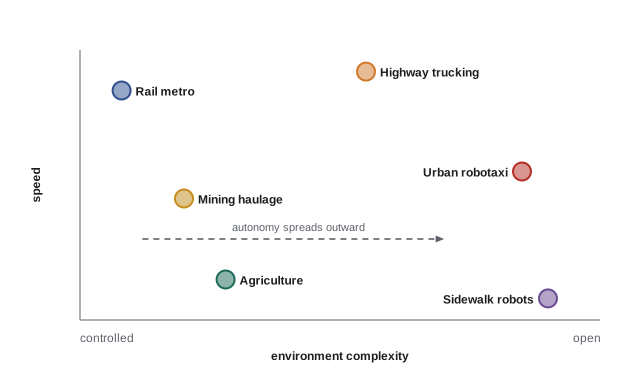
Comparing these domains suggests a pattern. Autonomy is easiest where the environment is controlled, the operator controls the whole system, interactions with the public are few, speeds or energies are modest, and the economic value of each automated hour is high. Rail metros and mines satisfy most of these and automated early; agriculture and highway trucking satisfy several and are now deploying; urban robotaxis and sidewalk robots face open environments and the public and require the most validation. For each application, defining a narrow, well-understood operational design domain and expanding it gradually, as in Lesson 1, is the common thread.
| Domain | Environment | Key advantage | Key challenge |
|---|---|---|---|
| Rail metro | Protected guideway | Fully controlled | Platform safety and evacuation |
| Mining haulage | Private site | Operator controls everything | Dust, cold, changing roads, mixed fleets |
| Agriculture | Private fields | Sparse people, labour shortage | Connectivity, obstacle detection in crops |
| Highway trucking | Public highway | Structured roads, long hours | High energy, long stopping distance, weather |
| Transit shuttles | Public roads, fixed routes | Known routes, low speed | Cost, over-cautious stops, mixed traffic |
| Sidewalk robots | Public sidewalks | Low speed and mass | Sharing space, accessibility, snow |
Common mistakes
MistakeAssuming robotaxis are the first or only autonomous vehicle market.
InsteadMining, rail, agriculture and trucking deployed autonomy early or are deploying now.
MistakeUnderestimating truck stopping distance.
InsteadHeavy trucks need long sensing range and margin, especially on slippery roads.
MistakeTreating mine autonomy as identical to road autonomy.
InsteadMines are controlled sites with central fleet management and different hazards.
MistakeIgnoring workforce impacts.
InsteadPlan retraining and new roles as automation changes jobs.
MistakeForgetting accessibility when deploying sidewalk robots.
InsteadRobots must not block curb ramps or endanger people with disabilities.
Summary and key terms
- Highway trucking uses hub-to-hub models; driverless commercial runs operate in Texas and the US Southwest at the time of writing.
- Driverless rail transit has run in Vancouver since 1986; road shuttles remain limited trials.
- Autonomous haulage is widely deployed in mines, including Canada's oil sands.
- Agriculture moved from RTK auto-steer to supervised driverless tractors and field robots.
- Sidewalk delivery robots operate under state laws in the US and provincial and municipal rules in Canada.
- Autonomy spreads first where environments are controlled and the economic value is high.
- Hub-to-hub
- A trucking model where automated trucks drive highway segments between transfer hubs.
- Platooning
- Close-following vehicle groups coordinated by communication to reduce drag.
- Hours of service
- Rules limiting how long commercial drivers can drive.
- Grade of automation
- A rail scale describing how much of train operation is automated.
- Autonomous haulage system
- A fleet of driverless mine trucks managed centrally.
- Fleet management system
- Software assigning routes and tasks to vehicles across a site.
- Auto-steer
- GNSS-based automatic steering for agricultural machinery.
- Personal delivery device
- A small robot that delivers goods on sidewalks or crosswalks.
- Remote supervision
- Humans monitoring and assisting several robots from a distance.
- Utilization
- Fraction of available time that equipment is productively working.
Practice problems
Work each problem on paper first, then reveal the answer to check.
Why do hours-of-service rules matter for automated trucks?
Show answer
An automated truck is not limited by driver hours.
Since when has Vancouver's SkyTrain run driverless?
Show answer
1986.
Name two Canadian oil sands operators using autonomous haulage.
Show answer
Suncor and Imperial.
Why are mines suited to early autonomy?
Show answer
Private, controlled sites with known routes and trained staff.
Name two challenges for autonomous haulage in northern Alberta.
Show answer
Extreme cold, dust, snow, changing haul roads or mixed fleets.
What does RTK auto-steer reduce?
Show answer
Overlap, fuel use, inputs and fatigue.
Why are sidewalk robots controversial?
Show answer
They share scarce sidewalk space and may block accessibility.
What is the hub-to-hub model?
Show answer
Humans drive locally; automated trucks drive highway legs between hubs.
Lead truck saves 4 % and follower 10 %: average saving per truck?
Show answer
7 %.
What common thread links successful autonomy domains?
Show answer
A narrow, well-defined ODD expanded gradually.
Lesson quiz · 5 questions
Score 60% or more to complete this lesson.
Create a free account to save your progress, take quizzes and earn a certificate.