
ROB-100 · Lesson 1 of 12 · 25 min
What makes a machine a robot
Robots have moved out of science fiction and into factories, warehouses, hospitals, farms, homes and the streets of many cities. Industrial arms weld car bodies and pack boxes, mobile robots carry shelves across fulfilment centres, surgical systems steady a surgeon's instruments, robot vacuums map living rooms, and driverless taxis carry paying passengers. Yet the word robot is used so loosely that it can mean almost anything, from a chatbot to a kitchen blender with a timer. This course is a first look at robotics as a field of science and engineering: what robots are, how they sense, think and act, how they are built and programmed, where they are used, and the questions they raise for safety, work and society. This first lesson sets out a working definition of a robot, the sense, think and act loop at the heart of every robot, the idea of autonomy, the main ways robots are classified, and the disciplines that come together in robotics.
Defining a robot
There is no single definition of a robot that everyone accepts, but most definitions share three ideas. A robot is a physical machine, not just software; it gathers information about itself and its surroundings through sensors; and it uses that information to decide on and carry out physical actions in the world, through actuators such as motors. A useful working definition for this course is: a robot is a machine that senses its environment, processes that information with a computer, and acts physically on the world with some degree of autonomy. The standards world has its own definitions. The international vocabulary standard for robotics, ISO 8373, defines a robot as a programmed actuated mechanism with a degree of autonomy to perform locomotion, manipulation or positioning, and separates industrial robots, used in automation applications, from service robots, which perform useful tasks for people or equipment outside industrial automation.
These definitions rule some things in and some things out. A washing machine follows a fixed program and senses water level and temperature, but it does not move about or manipulate objects in a way that adapts to its surroundings, so most people would not call it a robot. A remotely piloted bomb-disposal vehicle moves and manipulates objects, but a human makes every decision, so it is better described as a teleoperated machine, though many such machines are now gaining autonomous features. A chatbot can hold a conversation but has no body and no actuators, so in robotics it is software, not a robot, however intelligent it seems. A robot vacuum that maps a room, detects stairs and plans its own cleaning path fits the definition well, even though it is a modest consumer product.
| Machine | Senses? | Decides? | Acts physically? | A robot? |
|---|---|---|---|---|
| Toaster with a timer | Barely (a timer) | No | Heats only | No |
| Chatbot | Text input | Yes | No | No: software only |
| Teleoperated inspection crawler | Cameras for the operator | The human decides | Yes | Teleoperated machine |
| Industrial arm repeating a taught path | Joint encoders, safety sensors | Follows a program | Yes | Yes, with limited autonomy |
| Robot vacuum | Bumpers, cliff sensors, lidar or camera | Plans paths, avoids obstacles | Yes | Yes |
| Driverless taxi | Cameras, lidar, radar, GPS | Plans routes and manoeuvres | Yes | Yes, highly autonomous |
Sense, think and act
Every robot, from a toy to a planetary rover, runs some version of the same loop. It senses: sensors measure the robot's own state, such as the angles of its joints or the speed of its wheels, and the state of its surroundings, such as the distance to a wall or the image in front of a camera. It thinks: a computer processes the sensor data, estimates what is going on, and decides what to do next, whether that is following a fixed program, steering around an obstacle or planning a route across a city. It acts: actuators such as electric motors turn wheels, move joints, open grippers or spin propellers, changing the robot and its environment. The loop then repeats, many times a second, so the robot can respond to the effects of its own actions and to changes around it.
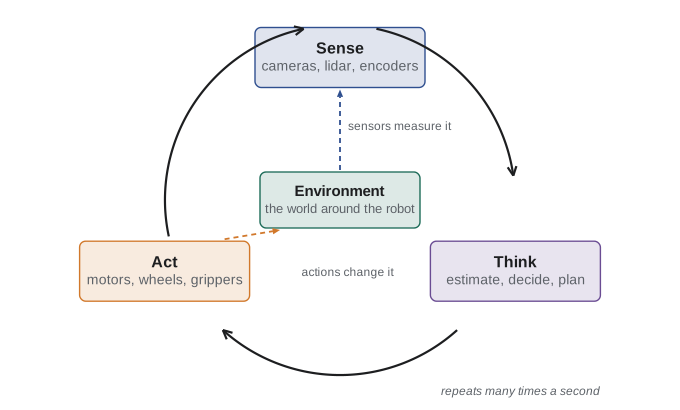
The speed of the loop matters. A balancing robot or a drone must react within milliseconds, or it will fall or crash, so its lowest-level control loops run hundreds or thousands of times a second. A warehouse robot planning which shelf to fetch next can take a second or two. Most robots therefore run several loops at once, at different speeds: a fast inner loop that holds a motor at the right speed, a slower loop that steers along a path, and a much slower one that decides where to go. You will see this layered structure again in lessons 7 and 8.
Worked problem
How fast must the loop run?
A delivery robot travels at 1.5 m/s. Its designers want it to move no more than 3 cm between successive updates of its obstacle-avoidance loop. How many times per second must the loop run, and what is the time available for each cycle?
Show solution
- Distance per cycle must be at most 0.03 m.
- Cycles per second: \( f = v / d = 1.5 / 0.03 = 50 \) Hz.
- Time per cycle: \( T = 1/f = 1/50 = 0.02 \) s, or 20 ms.
- Sensing, processing and commanding the motors must all fit within that 20 ms budget.
Answer: At least 50 times a second, leaving 20 ms for each cycle.
Autonomy is a spectrum
Autonomy is the ability of a robot to perform its task without a human making each decision. It is not all or nothing. At one end, a teleoperated machine is driven entirely by a person, who sees through its cameras and commands every movement. Next come machines with assistance, such as a surgical robot that filters out the surgeon's hand tremor, or a teleoperated arm that stops itself before it hits something. Supervised autonomy lets the robot carry out a task on its own while a human monitors and can step in, as with many warehouse robots and today's planetary rovers, which receive goals from Earth and drive themselves between them. Full autonomy, within a defined domain, means the robot handles its task with no human in the loop, as a driverless taxi does inside its approved service area. Engineers often describe a robot's autonomy as relative to a particular task and environment: a robot can be fully autonomous at vacuuming a living room and helpless on a staircase.
More autonomy is not always better. Every step towards autonomy shifts responsibility from a person to the robot's designers and software, and demands better sensing, more reliable decision-making and stronger safety cases. Many of the most successful robots in use today have modest autonomy in carefully controlled environments, such as a welding robot inside a fenced cell, precisely because that makes them reliable and safe. Lesson 10 returns to the safety and ethical questions autonomy raises.
Ways of classifying robots
Robots can be grouped in several ways, and a single robot usually belongs to several groups at once:
- By application: industrial robots used in manufacturing and automation; professional service robots used in logistics, health care, agriculture, cleaning, inspection and defence; and consumer service robots such as vacuums, lawn mowers, pool cleaners and educational kits.
- By mobility: fixed robots bolted to a floor, bench or ceiling, such as most industrial arms; and mobile robots that move through their environment on wheels, tracks or legs, or by flying or swimming.
- By form: manipulators (robot arms), wheeled and tracked mobile robots, legged robots including quadrupeds and humanoids, aerial robots (drones), marine and underwater robots, and space robots.
- By how they work with people: robots that work behind guards or in separate areas, and collaborative applications in which robot and person share a workspace under specific safety measures.
- By autonomy: from teleoperated to fully autonomous within a domain, as described above.
The International Federation of Robotics (IFR), which publishes the most widely cited annual statistics on robots, uses the industrial versus service split. Its World Robotics 2025 report counted 542,000 industrial robots installed worldwide in 2024, more than twice as many as a decade earlier, and an operational stock of about 4.66 million industrial robots at work in factories. Lesson 9 looks at these numbers in more detail.
The disciplines behind robotics
Robotics is not a single subject but a meeting point of several. Mechanical engineering supplies the structure, joints, gears and the mathematics of motion: kinematics, which describes where the parts of a robot are, and dynamics, which relates motion to forces. Electrical and electronics engineering supplies the motors, power systems, batteries, circuits and sensors. Computing science supplies the software: operating systems, programming, algorithms for perception, planning and learning, and the networks that connect robots. Control engineering, which grew out of both mechanical and electrical engineering, supplies the theory of feedback that keeps robots stable and accurate. Mathematics, especially linear algebra, calculus, probability and optimization, underpins all of them. Increasingly, artificial intelligence and machine learning supply ways for robots to perceive and act in messy, unpredictable environments. And because robots work among people, robotics also draws on psychology, design, ethics, law and economics.
This breadth is one reason robotics is exciting to study and one reason it is hard. A robot that works well needs all of its parts to work together: a brilliant planning algorithm is useless if the motors cannot follow its commands, and a beautifully engineered arm is useless if its software cannot tell where the objects it should grasp are. Robotics teams therefore mix specialists, and good roboticists learn enough about each discipline to talk across the boundaries. The Robotics program this course opens follows that pattern: programming, mathematics and physics first, then electronics, kinematics, control, estimation, vision, planning and learning.
Why robots, and why now?
Robots are used for tasks often summarized as the three Ds: dull, dirty and dangerous. Dull tasks are repetitive and tiring, such as placing the same part in a machine thousands of times a day. Dirty tasks include painting, grinding and cleaning sewers. Dangerous tasks include handling radioactive or explosive material, working in mines, at height, underwater or in space. Robots also bring precision, consistency and speed that people cannot sustain, and they can work in places people cannot go at all, such as inside a nuclear reactor or on the surface of Mars. A fourth reason has become pressing in recent years: in many countries, including Canada and the United States, ageing populations and labour shortages in manufacturing, logistics, agriculture and care work have made automation a way to keep production going, not just to cut costs.
Several trends have come together to make robots more capable and more affordable. Sensors such as cameras, lidar and inertial measurement units have become cheap and small, largely thanks to the smartphone and automotive industries. Computers powerful enough to process camera images in real time now fit inside a robot. Batteries hold more energy for their weight. Open-source software, especially the Robot Operating System (ROS), lets developers build on shared tools instead of starting from scratch. And advances in machine learning, including large models trained on images, text and robot data, are helping robots recognize objects and follow instructions in ways that were impractical a decade ago. At the same time, real robots remain far less capable than science fiction suggests: handling soft or tangled objects, working reliably in cluttered homes and recovering from unexpected situations are still open research problems.
Common mistakes
MistakeCalling any automated machine or software a robot.
InsteadCheck for the three elements: sensing, computing and physical action with some autonomy.
MistakeThinking autonomy is all or nothing.
InsteadTreat autonomy as a spectrum, relative to a task and an environment.
MistakeAssuming more autonomy always means a better robot.
InsteadMatch autonomy to the task, the environment and the safety case.
MistakeImagining robots as mainly humanoids.
InsteadMost robots are arms, wheeled platforms, drones and specialized machines.
MistakeTreating robotics as purely a software or purely a mechanical subject.
InsteadExpect mechanics, electronics, control and computing to work together.
Summary and key terms
- A robot senses its environment, processes information with a computer and acts physically with some autonomy.
- ISO 8373 separates industrial robots from service robots.
- The sense, think and act loop runs continuously, often at several speeds at once.
- Autonomy ranges from teleoperation to full autonomy within a defined domain.
- Robots are classified by application, mobility, form, interaction with people and autonomy.
- Robotics combines mechanical, electrical, control and computing disciplines, built on mathematics.
- Robots handle dull, dirty and dangerous tasks and help address labour shortages.
- Robot
- A machine that senses, computes and acts physically with some autonomy.
- Sensor
- A device that measures a property of the robot or its environment.
- Actuator
- A device, such as a motor, that produces motion or force.
- Autonomy
- The ability to perform a task without a human making each decision.
- Teleoperation
- Control of a machine by a remote human operator.
- Sense, think and act loop
- The repeating cycle of measuring, deciding and acting.
- Industrial robot
- A robot used in manufacturing and automation applications.
- Service robot
- A robot that performs useful tasks outside industrial automation.
- Manipulator
- A robot arm built to move and handle objects.
- Mobile robot
- A robot that moves through its environment.
Practice problems
Work each problem on paper first, then reveal the answer to check.
Name the three elements in the working definition of a robot.
Show answer
Sensing, computing and physical action, with some autonomy.
Is a chatbot a robot in the robotics sense? Why?
Show answer
No: it has no body or actuators.
What does ISO 8373 cover?
Show answer
Robotics vocabulary, including the definition of a robot.
A robot moves at 2 m/s and should move at most 4 cm per cycle. Loop rate?
Show answer
50 Hz.
What is supervised autonomy?
Show answer
The robot performs the task itself while a human monitors and can intervene.
Give two ways of classifying robots.
Show answer
By application, mobility, form, human interaction or autonomy.
What are the three Ds?
Show answer
Dull, dirty and dangerous.
How many industrial robots were installed worldwide in 2024, per IFR?
Show answer
About 542,000.
Name two technology trends making robots more capable.
Show answer
Cheap sensors, onboard computing, better batteries, open-source software, machine learning.
Why do robots often run several loops at once?
Show answer
Different tasks need different response speeds.
Lesson quiz · 5 questions
Score 60% or more to complete this lesson.
Create a free account to save your progress, take quizzes and earn a certificate.