
RAC-330 · Lesson 3 of 12 · 20 min
Air conditioning processes on the chart
The clinic's new packaged heat pump had been running since spring, and Dr. Amara Singh was happy with it, with one exception. On the hottest afternoons of the previous summer the operatories had felt clammy, even though the thermostat showed the setpoint. Marcus had promised to look at it before the next cooling season, and in February, with the unit idle, he and Theo sat in the truck with the summer trend logs from the economizer controller and a psychrometric chart. "Every box in this unit does something to the air," Marcus said. "Mix, cool, dry, heat. Draw what each one does and you'll see what the operatories got."
This lesson shows how the basic processes of air conditioning appear on the psychrometric chart: sensible heating and cooling, cooling with dehumidification, mixing, humidification and reheat. It introduces the sensible heat ratio, the apparatus dew point and the bypass factor, and calculates the clinic unit's coil and the winter humidification at the seniors' residence.
Sensible heating and cooling
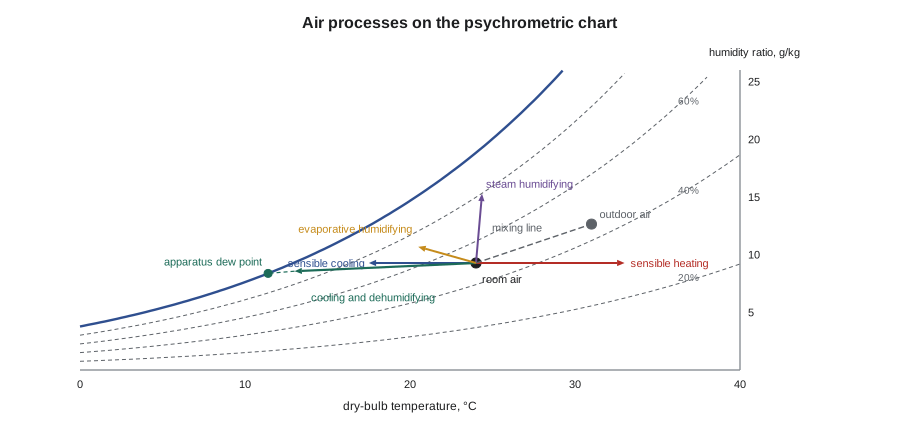
Sensible heating adds heat without changing the moisture content, so the state point moves horizontally to the right along a line of constant humidity ratio. A furnace, a heat pump in heating mode, an electric heater or a hot-water coil all do this. The dew point does not change, the relative humidity falls, and the enthalpy rises by the heat added.
Sensible cooling is the reverse, a horizontal move to the left. It happens when air passes over a coil whose surface is above the air's dew point, so no water condenses: a chilled-water coil running warm, a cooling coil on a dry day, or a radiant panel. The relative humidity rises as the air cools; if the air were cooled all the way to the saturation curve, it would reach its dew point.
In field units the sensible heat equation is Q = 1.21 × airflow in L/s × temperature change in kelvin, giving watts, for standard air.
Cooling and dehumidifying
Most comfort cooling coils run with their surfaces well below the dew point of the air entering them. As the air passes through, it is cooled and some of its water condenses on the fins and drips into the drain pan. On the chart the state moves down and to the left: down because the humidity ratio falls, left because the temperature falls. The change in enthalpy is the total cooling, which divides into a sensible part, the temperature change, and a latent part, the moisture removed times the heat of condensation.
The sensible heat ratio, SHR, is the sensible capacity divided by the total. A coil with an SHR of 0.75 spends three-quarters of its capacity lowering the temperature and a quarter removing moisture. On the chart the SHR sets the slope of the coil line, and the protractor in the corner of the chart gives the slope for any SHR. A room with a lot of moisture to remove, such as a crowded room, a kitchen or a room with a lot of outdoor air, needs a lower SHR from its equipment than a sunny room full of glass and few people.
Apparatus dew point and bypass factor
Real coils do not cool all the air to the same temperature. Air touching the fins is cooled almost to the coil surface temperature, while some passes between the fins and is cooled less. A useful model treats the coil as if part of the air were cooled to a single effective surface temperature, called the apparatus dew point, ADP, and saturated there, while the rest bypassed the coil untouched. The leaving air is the mixture of the two, so it lies on the straight line from the entering air to the ADP on the saturation curve.
The bypass factor is the fraction that behaves as if it bypassed: the distance from the leaving air to the ADP divided by the distance from the entering air to the ADP, measured along the line or in dry-bulb degrees. Deep coils with many rows and close fin spacing have low bypass factors, about 0.05 to 0.15; shallow coils and high face velocities give higher ones. The model is simple, but it explains why a coil's leaving air is not saturated, why slowing the airflow lowers the leaving temperature and the SHR, and why a coil can dehumidify only if its ADP is below the entering dew point.
Mixing two airstreams
When two airstreams mix, the result lies on the straight line joining their two state points, closer to the larger stream. The mixed humidity ratio and enthalpy are the mass-weighted averages of the two; the mixed dry bulb is very nearly the mass-weighted average temperature. This is how outdoor air and return air combine in the mixing box of a rooftop unit or air handler, as lesson 9 of RAC-320 showed for the clinic's economizer.
If the line between two states crosses the saturation curve, as it can when very cold outdoor air mixes with warm, humid return air, the mixture would be supersaturated. In practice fog forms or the excess water condenses or freezes on the dampers and filters, which is one reason minimum outdoor air on very cold days is often preheated.
The clinic's coil on a hot afternoon
Marcus and Theo took one afternoon from the summer logs: return air at 24 °C (75 °F) and 50 % relative humidity, outdoor air at 31 °C (88 °F) and 45 %, the economizer at its minimum position of 25 % outdoor air, and supply air leaving the coil at 13 °C (55.4 °F) and about 92 % relative humidity. The script mixes the two streams, calculates the coil's total, sensible and latent capacity and the condensate, finds the apparatus dew point by extending the coil line to the saturation curve, and then turns to a winter problem at the seniors' residence.
import math
def p_atm(z_m):
    """Standard atmospheric pressure, kPa, at an elevation in metres."""
    return 101.325 * (1 - 2.25577e-5 * z_m) ** 5.2559
def pws(t):
    """Saturation pressure of water vapour over water, kPa, t in deg C (Magnus form)."""
    return 0.61094 * math.exp(17.625 * t / (t + 243.04))
def w_from_rh(t, rh, p):
    """Humidity ratio, kg of water per kg of dry air."""
    pv = rh * pws(t)
    return 0.622 * pv / (p - pv)
def pv_from_w(w, p):
    return w * p / (0.622 + w)
def dew_point(pv):
    a = math.log(pv / 0.61094)
    return 243.04 * a / (17.625 - a)
def enthalpy(t, w):
    """kJ per kg of dry air."""
    return 1.006 * t + w * (2501 + 1.86 * t)
def spec_volume(t, w, p):
    """Cubic metres per kg of dry air."""
    return 0.287042 * (t + 273.15) * (1 + 1.607858 * w) / p
def wet_bulb(t, w, p):
    """Thermodynamic wet-bulb temperature found by bisection."""
    lo, hi = -40.0, t
    for _ in range(60):
        m = (lo + hi) / 2
        ws = w_from_rh(m, 1.0, p)
        wc = ((2501 - 2.326 * m) * ws - 1.006 * (t - m)) / (2501 + 1.86 * t - 4.186 * m)
        lo, hi = (lo, m) if wc > w else (m, hi)
    return (lo + hi) / 2
def rel_humidity(t, w, p):
    return pv_from_w(w, p) / pws(t)

P = p_atm(330)
# 1. mixing at the clinic rooftop unit: 25 % outdoor air
flow = 0.566                                   # m3/s supply air (566 L/s)
ret_t, ret_rh = 24.0, 0.50
out_t, out_rh = 31.0, 0.45
oa = 0.25
w_r, w_o = w_from_rh(ret_t, ret_rh, P), w_from_rh(out_t, out_rh, P)
m = flow / spec_volume(ret_t, w_r, P)          # kg/s of dry air (close enough to use the return state)
w_m = (1 - oa) * w_r + oa * w_o
h_m = (1 - oa) * enthalpy(ret_t, w_r) + oa * enthalpy(out_t, w_o)
t_m = (h_m - 2501 * w_m) / (1.006 + 1.86 * w_m)
print(f"mixed air {t_m:.1f} C, {w_m * 1000:.2f} g/kg, {rel_humidity(t_m, w_m, P):.0%} RH, h={h_m:.1f} kJ/kg")
# 2. cooling and dehumidifying coil
sup_t, sup_rh = 13.0, 0.92
w_s = w_from_rh(sup_t, sup_rh, P); h_s = enthalpy(sup_t, w_s)
total = m * (h_m - h_s); sens = m * (1.006 + 1.86 * w_m) * (t_m - sup_t)
print(f"coil: total {total:.2f} kW, sensible {sens:.2f} kW, latent {total - sens:.2f} kW, SHR {sens / total:.2f}")
print(f"condensate {m * (w_m - w_s) * 3600:.1f} kg/h")
# apparatus dew point: extend the coil line until it meets saturation
for i in range(1, 4000):
    t = sup_t - i * 0.005
    w = w_s + (w_s - w_m) / (sup_t - t_m) * (t - sup_t)
    if w >= w_from_rh(t, 1.0, P):
        break
print(f"apparatus dew point about {t:.1f} C, bypass factor {(sup_t - t) / (t_m - t):.2f}")
# 3. winter humidification at the seniors' residence air handler
flow_w = 2.0                                   # m3/s (2,000 L/s) of outdoor air for ventilation
o_t, o_rh, room_t, target = -15.0, 0.70, 21.0, 0.35
w_o2 = w_from_rh(o_t, o_rh, P); w_t = w_from_rh(room_t, target, P)
m2 = flow_w / spec_volume(o_t, w_o2, P)
print(f"heated to {room_t:.0f} C with no water the air is at {rel_humidity(room_t, w_o2, P):.0%} RH")
print(f"steam to reach {target:.0%}: {m2 * (w_t - w_o2) * 3600:.0f} kg/h")mixed air 25.8 C, 10.53 g/kg, 49% RH, h=52.8 kJ/kg coil: total 10.94 kW, sensible 8.33 kW, latent 2.61 kW, SHR 0.76 condensate 3.7 kg/h apparatus dew point about 11.4 C, bypass factor 0.11 heated to 21 C with no water the air is at 5% RH steam to reach 35%: 45 kg/h
The mixed air entered the coil at about 25.8 °C and 10.5 g/kg. The coil was delivering about 10.9 kW in total, 8.3 kW sensible and 2.6 kW latent, an SHR of 0.76, and condensing about 3.7 kg of water an hour. Its apparatus dew point was about 11.4 °C and its bypass factor about 0.11.
Those were healthy numbers for a coil, so the coil itself was not the problem. Marcus looked at the operatories instead. Each had a dental chair, a patient, a dentist, an assistant, a sterilizer next door and a lot of breath; the rooms' own moisture load was higher than the rest of the clinic's, so the SHR they needed was lower than 0.76. Air supplied at the coil's condition could take out the rooms' heat but not all their moisture, and the humidity in the operatories drifted up to about 60 % on humid afternoons. Lesson 4 explains why that felt clammy, and lesson 6 how to estimate a room's sensible and latent loads.
Humidification
Humidifying adds water to the air. How the state point moves depends on how the water is added.
- Steam humidifiers inject steam, from an electrode or resistance-element canister or from a boiler. The steam carries its own heat, so the state moves almost straight up the chart, rising slightly in temperature. This is the common choice for commercial air handlers and for buildings that need close humidity control.
- Evaporative humidifiers, including wetted-media, bypass and fan-powered residential types, evaporate liquid water into the air. The heat for evaporation comes from the air, so the state moves up and to the left along a line of nearly constant wet bulb. A furnace-mounted humidifier works because it sits in warm supply or return air that can supply that heat.
- Atomizing and ultrasonic humidifiers spray fine droplets that evaporate in the air; they also cool it, and with untreated water they leave mineral dust, which is why they need treated or reverse-osmosis water in commercial use.
The amount of water needed is the mass flow of air times the rise in humidity ratio. The seniors' residence had a dedicated outdoor air unit that heated 2,000 L/s (4,200 cfm) of ventilation air for the corridors and common rooms, with a steam humidifier after the heating coil. The script found the water it needed on a design day.
Outdoor air at −15 °C and 70 % holds so little water that, heated to 21 °C, it is at about 5 % relative humidity. To bring it to 35 % the humidifier had to add about 45 kg of water an hour, about a litre every 80 seconds, which is why the unit had a large electrode canister on its own circuit and a drain that carried away the mineral-laden water it periodically flushed. Wes Kaminski, the residence's maintenance supervisor, had asked Northfield why the humidifier used so much water and power; the answer was simply the psychrometrics of cold outdoor air.
A humidifier can also cause damage. Steam or droplets that do not fully absorb before they reach a coil, a damper, a filter or a duct elbow condense there and soak the duct lining, so dispersion tubes are installed with the absorption distance the manufacturer specifies, a high-limit humidistat in the duct stops the humidifier if the duct air approaches saturation, and the room humidity setpoint is reset downward in very cold weather to protect windows and walls.
Dehumidification and reheat
When a space needs more moisture removed than its sensible load would require, as in the clinic's operatories, an indoor swimming pool, a museum or a humid basement, cooling alone overcools the room. The usual remedies are to make the coil drier by lowering its temperature or the airflow, which lowers the SHR; to treat the outdoor air separately, with a dedicated outdoor air unit that dries it deeply before it enters; or to cool the air below the temperature the room needs and then reheat it. Reheat can come from hot gas from the condenser, which is free heat that would otherwise be rejected, or from electric or hot-water coils, which are wasteful and restricted by energy codes in many cases. Standalone dehumidifiers, refrigeration systems that cool air over a coil and reheat it over their own condenser, are common in basements and crawlspaces.
For the clinic, Marcus had two options to present to Dr. Singh in the spring. The unit's controller supported a dehumidification mode that lowered the blower speed when the space humidity rose, lowering the SHR at the cost of some sensible capacity; and the operatories' supply diffusers could be rebalanced to give them a larger share of the drier air. Both were cheap. Lesson 12 finishes the story.
Common mistakes
MistakeExpecting a coil to dehumidify when its surface is above the entering dew point.
InsteadDehumidifying needs an apparatus dew point below the entering air's dew point.
MistakeAveraging the temperatures of two airstreams without weighting them.
InsteadWeight by mass flow; the mix lies on the line between the two states.
MistakeTreating an evaporative humidifier as if it added no cooling.
InsteadEvaporation takes heat from the air; the state moves along a wet-bulb line.
MistakeInstalling steam dispersion tubes just ahead of a coil or elbow.
InsteadAllow the manufacturer's absorption distance and fit a duct high-limit humidistat.
MistakeJudging coil performance by supply temperature alone.
InsteadMeasure both temperature and humidity to find sensible and latent capacity.
Summary and key terms
- Sensible heating and cooling move the state horizontally; humidity ratio and dew point do not change.
- Cooling and dehumidifying moves the state down and to the left; total capacity is mass flow times enthalpy change.
- The sensible heat ratio is sensible divided by total capacity and sets the slope of the coil line.
- The apparatus dew point and bypass factor model a coil's leaving air as a mix of saturated and bypassed air.
- Mixed air lies on the line between two states, at mass-weighted humidity ratio and enthalpy.
- Steam humidification moves nearly straight up; evaporative humidification follows a wet-bulb line.
- Sensible heat ratio
- Sensible capacity divided by total capacity.
- Apparatus dew point
- The effective coil surface temperature toward which leaving air is driven.
- Bypass factor
- The fraction of air treated as passing through a coil unchanged.
- Latent load
- The part of a cooling load due to moisture that must be removed.
- Mixing box
- The section where outdoor and return air combine before the filter and coil.
- Steam humidifier
- A humidifier that injects steam, adding moisture with little temperature change.
- Evaporative humidifier
- A humidifier that evaporates liquid water, cooling the air as it humidifies.
- Reheat
- Heating air after a cooling coil to control humidity without overcooling the space.
Practice problems
Work each problem on paper first, then reveal the answer to check.
Air at 25 °C (77 °F) passes over a coil at 18 °C (64 °F); its dew point is 14 °C (57 °F). What kind of process is it?
Show answer
Sensible cooling only, because the coil surface is above the dew point.
A coil handles 500 L/s with a 12 K drop. What is its sensible capacity?
Show answer
1.21 × 500 × 12 ≈ 7.3 kW.
A coil delivers 10 kW total and 7.5 kW sensible. What is its SHR?
Show answer
0.75.
Which humidifier type lowers the air temperature as it humidifies?
Show answer
An evaporative humidifier.
Lesson quiz · 5 questions
Score 60% or more to complete this lesson.
Create a free account to save your progress, take quizzes and earn a certificate.