
RAC-330 · Lesson 1 of 12 · 22 min
Moist air and its properties
The Novak retrofit had gone well. The cold-climate heat pump carried the house through its first cold snap, the oil tank was gone, and Irene Novak, who was an engineer, had a spreadsheet of her daily electricity use that she was rather proud of. Then, in the second week of January, she called Northfield. "The basement windows are running with water every morning," she said. "There's a puddle on the sill and the paint is starting to peel. We never had this with the old furnace. Did the heat pump do something?"
Dana sent Theo, now in the third year of his apprenticeship and spending the winter on the comfort side of the business with Marcus, the crew lead. "Take the hygrometer and a surface thermometer," she said. "And before you go, tell me what you think is happening." Theo thought about the air sealing the Novaks had done before the heat pump went in, and the old chimney that had been capped when the furnace came out. He had a guess. This course is about how to turn guesses like that into numbers: the properties of moist air, the loads on a building, the movement of air through fans and ducts, and the ventilation that keeps indoor air healthy.
This first lesson describes the properties of moist air that every technician uses: dry-bulb and wet-bulb temperature, humidity ratio, relative humidity, dew point, enthalpy and specific volume. RAC-110 introduced some of them with a simple formula; here they are defined properly and calculated, so that the chart in lesson 2 and the processes in lesson 3 make sense.
Air is a mixture
The air in a house is a mixture of dry air, which is mostly nitrogen and oxygen and behaves as a single gas for our purposes, and water vapour. The amount of vapour is small, from almost nothing in very cold outdoor air to a few percent by mass on a humid summer day, but it matters enormously. It decides whether people feel comfortable, whether windows sweat and mould grows, how much latent load a cooling coil has to remove, and how much water a condensate drain has to carry.
Two ideas from earlier courses are needed. First, each gas in a mixture exerts its own partial pressure, and the partial pressures add up to the total. At sea level the total is about 101.3 kPa (14.7 psia), so if the vapour exerts 1.4 kPa, the dry air exerts the rest. Second, as RAC-110 explained, water at a given temperature has a saturation pressure: the vapour pressure at which it is in balance with liquid water. Air can hold vapour up to that pressure and no more; any extra condenses.
Psychrometrics is the study of this mixture. Because the mass of dry air does not change as air is heated, cooled, humidified or dried, almost every psychrometric property is expressed per kilogram or pound of dry air, not per kilogram or pound of the mixture. That convention makes the arithmetic of processes much simpler, and it is why the units look odd at first.
Dry-bulb and wet-bulb temperature
The dry-bulb temperature is the ordinary air temperature, measured by a thermometer shielded from radiation and kept dry. It is what the thermostat reads.
The wet-bulb temperature is measured by a thermometer whose bulb is covered by a wet wick and has air moving over it, as in a sling psychrometer or a digital psychrometer with a wetted sensor. Water evaporates from the wick and cools it, and the drier the air, the faster the evaporation and the lower the reading. In saturated air nothing evaporates, so the wet-bulb and dry-bulb temperatures are equal. The difference between them, the wet-bulb depression, is a direct indication of how dry the air is. Most digital instruments now calculate the wet bulb from dry bulb and relative humidity instead of measuring it, which is accurate enough for service work if the sensor is in calibration.
The wet-bulb temperature matters for two reasons. It is very nearly a line of constant enthalpy, which is why the capacity test in RAC-320 lesson 11 could find enthalpy from the wet bulb alone. And it governs evaporative processes: the coldest a cooling tower or evaporative cooler can make water or air is the wet-bulb temperature, as RAC-210 described.
Humidity ratio and relative humidity
The humidity ratio, also called the moisture content or specific humidity, is the mass of water vapour per mass of dry air, in grams per kilogram (g/kg) or grains per pound (gr/lb, with 7,000 grains in a pound). It changes only when water is added or removed. Heating air does not change it; cooling air does not change it unless the air is cooled below its dew point and water condenses. That makes humidity ratio the property to track when following air through a process.
Here p is the total pressure, p_v the vapour pressure and 0.622 the ratio of the molar masses of water and dry air.
Relative humidity is the vapour pressure as a fraction of the saturation pressure at the air's temperature. It is what most people mean by humidity, and what the thermostat or a hygrometer displays. Because the saturation pressure rises steeply with temperature, relative humidity changes whenever the temperature changes, even when the amount of water does not. Air at −10 °C (14 °F) and 80 % relative humidity, heated to room temperature without adding water, ends up at about 9 or 10 % relative humidity, which is why winter air in a leaky house is so dry.
Theo had seen the opposite in the Novak house. Before the retrofit, the house was leaky and the oil furnace drew combustion air from the basement and sent it up the chimney, so cold, dry outdoor air was constantly replacing indoor air. After air sealing and the removal of the chimney draft, the same family, cooking and showering and breathing, was putting the same moisture into a house that was exchanging much less air with outdoors. The humidity ratio inside rose.
Dew point
The dew point is the temperature at which air with a given humidity ratio would become saturated if it were cooled. Any surface colder than the dew point collects condensation; air cooled below it loses water. Like the humidity ratio, the dew point depends only on how much water the air holds, not on its temperature, so it is a good single number for describing the moisture in air.
The dew point is the property that explained the Novaks' windows. The basement windows were old double-glazed units in steel frames, and on a cold night the inside surface of the glass was much colder than the room air. Whenever the glass was colder than the room's dew point, water condensed on it.
Enthalpy and specific volume
Enthalpy is the heat content of the moist air per kilogram or pound of dry air, measured from an arbitrary zero: 0 °C dry air in SI units. It has a sensible part, from the temperature of the dry air and vapour, and a latent part, the heat that was needed to evaporate the water the air carries. Because the latent part is large, a small amount of moisture carries a lot of energy, which is why dehumidifying is such a large share of the work of a cooling coil.
h = 1.006\,T + W\,(2501 + 1.86\,T) \quad \text{kJ/kg}
The specific volume is the volume occupied by one kilogram or pound of dry air with its vapour, about 0.83 to 0.88 m³/kg (13.3 to 14.1 ft³/lb) at room conditions near sea level. It converts a measured airflow in litres per second or cubic metres per second into a mass flow, and it increases with temperature, humidity and, importantly, altitude. That is why airflow formulas use a standard air density, and why lesson 2 corrects them at higher elevations.
Specific volume rarely needs calculating in residential work, but it explains where the familiar factors come from. The sensible heat factor 1.21 W per L/s per kelvin is simply the density of standard air times its specific heat, with the unit conversions folded in.
Measuring humidity
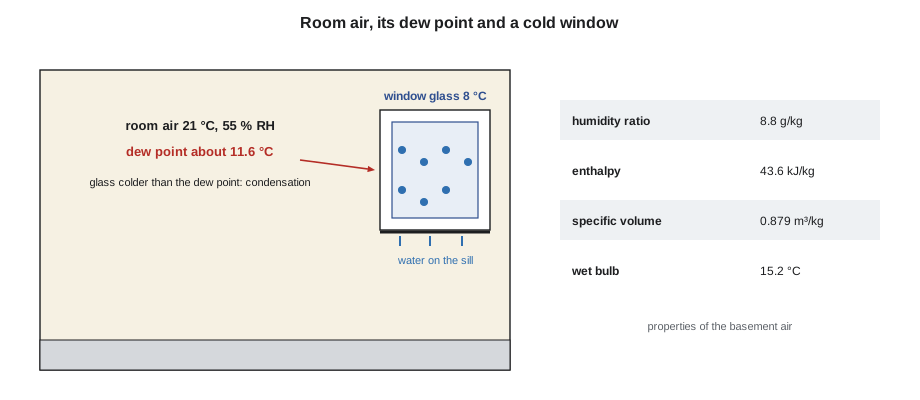
Theo arrived at the Novak house at 8 a.m., when the windows were at their worst. The outdoor temperature had been −15 °C (5 °F) overnight. He let his digital psychrometer settle in the basement for ten minutes, away from his own breath and the windows, and read 21.0 °C (70 °F) and 55 % relative humidity. He then measured the inside surface of the window glass with a surface thermometer, a thermocouple pressed flat against the glass: 8 °C (46 °F).
He was careful about the instruments. Digital humidity sensors drift, especially after being stored in a cold truck, so Northfield checked them every few months against a salt calibration kit, in which saturated salt solutions in sealed chambers hold known relative humidities. An infrared thermometer would have read the window poorly, because glass is partly transparent and reflective in the infrared; a contact probe gave a true surface temperature.
Calculating the properties
Theo ran the numbers on his tablet that evening. The script uses the atmospheric pressure at Kitchener's elevation, the Magnus formula for the saturation pressure that RAC-110 introduced, and the definitions above. It finds the humidity ratio, dew point, wet bulb, enthalpy and specific volume of the basement air, checks the window against the dew point, finds the dew point at lower humidities, and shows what happens to cold outdoor air when it is heated.
import math
def p_atm(z_m):
    """Standard atmospheric pressure, kPa, at an elevation in metres."""
    return 101.325 * (1 - 2.25577e-5 * z_m) ** 5.2559
def pws(t):
    """Saturation pressure of water vapour over water, kPa, t in deg C (Magnus form)."""
    return 0.61094 * math.exp(17.625 * t / (t + 243.04))
def w_from_rh(t, rh, p):
    """Humidity ratio, kg of water per kg of dry air."""
    pv = rh * pws(t)
    return 0.622 * pv / (p - pv)
def pv_from_w(w, p):
    return w * p / (0.622 + w)
def dew_point(pv):
    a = math.log(pv / 0.61094)
    return 243.04 * a / (17.625 - a)
def enthalpy(t, w):
    """kJ per kg of dry air."""
    return 1.006 * t + w * (2501 + 1.86 * t)
def spec_volume(t, w, p):
    """Cubic metres per kg of dry air."""
    return 0.287042 * (t + 273.15) * (1 + 1.607858 * w) / p
def wet_bulb(t, w, p):
    """Thermodynamic wet-bulb temperature found by bisection."""
    lo, hi = -40.0, t
    for _ in range(60):
        m = (lo + hi) / 2
        ws = w_from_rh(m, 1.0, p)
        wc = ((2501 - 2.326 * m) * ws - 1.006 * (t - m)) / (2501 + 1.86 * t - 4.186 * m)
        lo, hi = (lo, m) if wc > w else (m, hi)
    return (lo + hi) / 2
def rel_humidity(t, w, p):
    return pv_from_w(w, p) / pws(t)

P = p_atm(330)                  # Kitchener is about 330 m above sea level
room_t, room_rh = 21.0, 0.55    # Novak basement in January
glass_t = 8.0                   # inside surface of the old basement window on a -15 deg C night

w = w_from_rh(room_t, room_rh, P)
pv = pv_from_w(w, P)
td = dew_point(pv)
print(f"pressure {P:.1f} kPa")
print(f"humidity ratio {w * 1000:.1f} g/kg, vapour pressure {pv:.2f} kPa")
print(f"dew point {td:.1f} deg C, wet bulb {wet_bulb(room_t, w, P):.1f} deg C")
print(f"enthalpy {enthalpy(room_t, w):.1f} kJ/kg, specific volume {spec_volume(room_t, w, P):.3f} m3/kg")
print("glass below dew point: condensation" if glass_t < td else "glass above dew point: dry")
for target in (0.45, 0.40, 0.35):
    w2 = w_from_rh(room_t, target, P)
    print(f"at {target:.0%} RH the dew point is {dew_point(pv_from_w(w2, P)):.1f} deg C")
# outdoor air brought in and heated
out_t, out_rh = -10.0, 0.80
w_out = w_from_rh(out_t, out_rh, P)
print(f"outdoor air {out_t:.0f} deg C at {out_rh:.0%}: {w_out * 1000:.2f} g/kg, "
f"{rel_humidity(room_t, w_out, P):.0%} RH once heated to {room_t:.0f} deg C")pressure 97.4 kPa humidity ratio 8.8 g/kg, vapour pressure 1.37 kPa dew point 11.6 deg C, wet bulb 15.2 deg C enthalpy 43.6 kJ/kg, specific volume 0.879 m3/kg glass below dew point: condensation at 45% RH the dew point is 8.6 deg C at 40% RH the dew point is 6.9 deg C at 35% RH the dew point is 5.0 deg C outdoor air -10 deg C at 80%: 1.47 g/kg, 9% RH once heated to 21 deg C
The room's dew point was about 11.6 °C, and the glass was at 8 °C, well below it. Water would condense on the glass every cold night until either the glass got warmer or the air got drier. At 40 % relative humidity the dew point would fall to about 7 °C; at 35 %, to about 5 °C. The last line of the output showed why the old, leaky house had never had the problem: outdoor air brought in on a cold day and heated to room temperature ends up at under 10 % relative humidity, so the more of it the house exchanged, the drier the inside air.
| Property | What it measures | Changes when air is heated? | Changes when water is added or removed? |
|---|---|---|---|
| Dry-bulb temperature | Ordinary air temperature | Yes | Only through the heat involved |
| Wet-bulb temperature | Temperature of a wetted, ventilated sensor; tracks enthalpy | Yes | Yes |
| Humidity ratio | Mass of vapour per mass of dry air | No | Yes |
| Relative humidity | Vapour pressure as a fraction of saturation | Yes, it falls | Yes |
| Dew point | Temperature at which the air would saturate | No | Yes |
| Enthalpy | Heat content per mass of dry air | Yes | Yes |
| Specific volume | Volume per mass of dry air | Yes | Slightly |
What to do about the windows
Theo's report to Dana had two parts. The immediate cause was the cold glass: old steel-framed basement windows with a poor seal between the panes, and blinds that the Novaks kept closed at night, which kept room air from warming the glass. The underlying cause was that the house now held moisture it used to lose. The air sealing had been worth doing, cutting the heat loss and the drafts the Novaks used to complain about, but a tighter house needs controlled ventilation to replace what leakage used to do, and the Novaks' house had only a bathroom fan and a range hood.
Dana agreed and added a third point: the target. A relative humidity of 30 to 40 % in a cold Canadian or US winter is a common guide for houses with ordinary windows; higher than that and condensation and mould become likely on cold surfaces, lower and occupants complain of dry skin and static. The right target falls as the outdoor temperature falls, because the coldest surfaces get colder. The answer for the Novaks, which lesson 11 works through, was a heat recovery ventilator, sized to the house and balanced, which would bring the humidity down while recovering most of the heat in the exhaust air. In the meantime, Theo suggested running the bathroom fan longer after showers, using the range hood when cooking, and opening the blinds at night.
The case is a good example of why psychrometrics is not only an engineer's subject. Every comfort technician meets windows that sweat, basements that smell, systems that cool but leave the air clammy, and houses where nobody can agree whether it is too dry or too damp. The properties in this lesson are the vocabulary for all of them.
Moisture sources in a house
To understand why the Novak house humidity rose, it helps to know where indoor moisture comes from. People breathe and perspire, a typical family adding several litres of water to the air every day from that alone. Cooking, especially boiling, showers and baths, drying clothes indoors, house plants, aquariums and firewood stored inside all add more. In a new house, or after major renovation, drying concrete, plaster and lumber release moisture for the first year or two. A wet basement, through damp walls or a floor without a vapour barrier, can add as much as all the rest together.
Moisture leaves a house in three ways: with the air that leaves it, whether by leakage, exhaust fans or ventilation; by condensing on cold surfaces, which is the problem; and, in summer, by condensing on the cooling coil. In winter, ventilation is the main control. In summer, ventilation brings humid outdoor air in, and the cooling system has to take its moisture out, which is the subject of lessons 3, 4 and 6.
Common mistakes
MistakeTreating relative humidity as the amount of water in the air.
InsteadUse humidity ratio or dew point; relative humidity changes with temperature even when the water content does not.
MistakeMeasuring window glass with an infrared thermometer.
InsteadUse a contact surface probe; glass is partly transparent and reflective in the infrared.
MistakeReading a digital hygrometer straight out of a cold truck.
InsteadLet it settle at room conditions and keep it in calibration.
MistakeBlaming the new heat pump for winter condensation.
InsteadCheck the indoor humidity against the coldest surfaces; tighter houses keep more moisture.
MistakeUsing the sea-level sensible heat factor at every elevation.
InsteadCorrect for air density at higher elevations, as lesson 2 explains.
Summary and key terms
- Moist air is dry air plus water vapour; properties are expressed per mass of dry air.
- Dry bulb is the ordinary temperature; wet bulb, from a wetted ventilated sensor, tracks enthalpy and is lower in drier air.
- Humidity ratio and dew point measure the water content and do not change when air is simply heated.
- Relative humidity is vapour pressure divided by saturation pressure and falls when air is heated.
- Enthalpy combines sensible and latent heat; specific volume converts volume flow into mass flow.
- Condensation forms on any surface colder than the air's dew point; tighter houses need controlled ventilation to manage moisture.
- Psychrometrics
- The study of the properties and processes of moist air.
- Dry-bulb temperature
- The temperature of air measured by an ordinary shielded thermometer.
- Wet-bulb temperature
- The temperature of a wetted, ventilated sensor; lower than dry bulb in unsaturated air.
- Humidity ratio
- The mass of water vapour per unit mass of dry air.
- Relative humidity
- The vapour pressure of the air divided by the saturation pressure at its temperature.
- Dew point
- The temperature at which air would become saturated if cooled at constant moisture content.
- Enthalpy
- The heat content of moist air per unit mass of dry air.
- Specific volume
- The volume of moist air per unit mass of dry air.
- Saturation pressure
- The vapour pressure of water in balance with liquid water at a given temperature.
Practice problems
Work each problem on paper first, then reveal the answer to check.
Air at 24 °C (75 °F) is heated to 30 °C (86 °F) with no water added. What happens to its humidity ratio, dew point and relative humidity?
Show answer
Humidity ratio and dew point stay the same; relative humidity falls.
A room's dew point is 12 °C (54 °F). A cold-water pipe runs through it at 10 °C (50 °F). What happens?
Show answer
The pipe is below the dew point, so water condenses on it; insulate the pipe.
Why do houses get dry in winter when they leak a lot of air?
Show answer
Cold outdoor air holds very little water; heated to room temperature its relative humidity is very low.
What instrument gives a true surface temperature on window glass?
Show answer
A contact surface probe, not an infrared thermometer.
Lesson quiz · 5 questions
Score 60% or more to complete this lesson.
Create a free account to save your progress, take quizzes and earn a certificate.