
RAC-310 · Lesson 6 of 12 · 18 min
Ice machines: freeze cycles, harvest, water treatment and sanitation
The community ice arena's snack bar ice machine had a history with Northfield. In RAC-130 Raj found its compressor grounded; in RAC-210 Theo watched him clean up the burnout that followed. In August the arena manager called again. The machine was running, but on tournament weekends, when the snack bar sold cold drinks to hundreds of families, the bin ran empty by early afternoon. "It used to keep up," she said. Theo found the machine where it had always been, in a storage room behind the snack bar with no ventilation, at 35 °C (95 °F) on a summer afternoon. Inside the machine, the evaporator plate had a white crust of scale, and the water trough had a pink film along its edge.
Ice is food. It goes into drinks, it touches fish and produce in display cases, and it is used in hospitals. An ice machine is therefore a refrigeration system that must also meet the standards of food equipment: it must make clean ice safely, and keep it clean in storage. This lesson covers how cube, flake and nugget machines work, how their production depends on air and water temperatures, why water treatment and cleaning matter as much as refrigeration, and how to diagnose the commonest complaint, not enough ice.
Types of ice machine
- Cube machines: freeze water on a cold vertical evaporator plate or grid, then release the ice with a harvest cycle. They make clear, hard cubes for drinks and are the most common type in food service.
- Flake machines: freeze water on the inside wall of a refrigerated cylinder, where a rotating auger scrapes it off continuously. They make soft flakes for display cases and medical use.
- Nugget or chewable ice machines: like flake machines, but the auger forces the ice through an extruding head that compresses it into small pellets.
- Self-contained machines have the ice-making head and bin in one cabinet; modular heads sit on a separate bin; remote-condenser machines have their condenser outdoors or on a roof, which keeps their heat out of the room.
Most ice machines are air-cooled. Water-cooled machines, which use once-through potable water for their condenser, are restricted or discouraged in many places because of the water they waste. Remote air-cooled condensers are the usual solution where the room is hot or the heat is unwanted.
The cube machine's cycle
A cube machine runs in two alternating cycles, freeze and harvest. In the freeze cycle, the compressor runs, refrigerant flows through tubing bonded to the back of the evaporator plate, and a water pump circulates water from a trough over the front of the plate. Water freezes onto the plate in thin layers, which is what makes the ice clear: dissolved minerals and air stay in the circulating water instead of being trapped in the ice. As the ice grows, the trough's water level falls, and the circulating water becomes more concentrated in minerals.
When the ice reaches the right thickness, the machine starts the harvest. The thickness is sensed by a probe that the water touches as the ice grows close to it, by a timer, or by the suction pressure falling to a set point. In the harvest cycle, a hot-gas solenoid valve opens and sends discharge gas directly into the evaporator, warming the plate so the ice slab loosens and slides off into the bin. Many machines also open a water inlet valve or a purge valve during harvest, flushing the mineral-laden water left in the trough down the drain, and refill the trough with fresh water for the next freeze. A curtain switch or a sensor detects that the ice has fallen and ends the harvest. When the bin is full, a bin level control, which may be a thermostat bulb touched by the ice, a curtain that cannot swing open or an infrared or ultrasonic sensor, stops the machine.
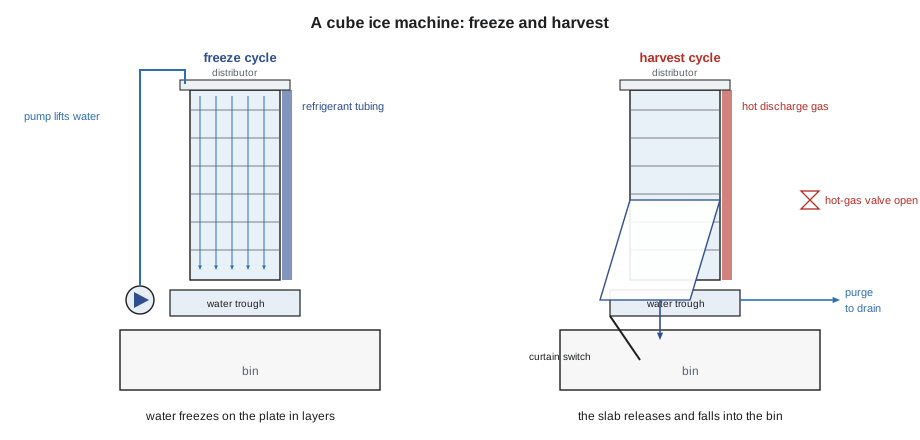
The freeze cycle's length depends on the condensing temperature and the water temperature. Warm water takes longer to cool to freezing, and a hot condenser reduces the machine's capacity. Harvest time depends on how quickly the hot gas warms the plate and how clean the plate is: scale on the plate holds the ice, so harvest takes longer, and the ice may break up or bridge across the plate instead of falling cleanly.
Production depends on air and water
Ice machine capacity is rated in kilograms (pounds) of ice per 24 hours at standard conditions. Manufacturers publish tables showing production at other air and water temperatures, and the differences are large. Industry rating standards use reference conditions such as 21 °C air and 10 °C water and, for a harder test, 32 °C air and 21 °C water (70 °F air and 50 °F water and, for a harder test, 90 °F air and 70 °F water). A machine bought for its rating in a cool room may make a fifth less ice in a hot, unventilated one.
The script below uses a manufacturer-style capacity table to estimate the arena machine's production at its rating, in its hot storage room in July, with a scaled evaporator, and if it were moved to the cooler corridor outside the snack bar.
# Ice machine production at site conditions, from a manufacturer-style capacity table (illustrative values)
AIR = [10, 21, 32, 38]            # C, air entering the condenser
WATER = [10, 21, 27]              # C, potable water inlet
KG = [[250, 225, 210],            # kg of ice per 24 h
      [240, 215, 200],
      [215, 195, 180],
      [195, 175, 160]]

def interp(xs, x):
    for i in range(len(xs) - 1):
        if xs[i] <= x <= xs[i + 1]:
            return i, (x - xs[i]) / (xs[i + 1] - xs[i])
    raise ValueError('outside the table')

def production(air, water):
    i, fa = interp(AIR, air)
    j, fw = interp(WATER, water)
    low = KG[i][j] * (1 - fw) + KG[i][j + 1] * fw
    high = KG[i + 1][j] * (1 - fw) + KG[i + 1][j + 1] * fw
    return low * (1 - fa) + high * fa

DEMAND = 180                      # kg per day on a tournament weekend
for label, air, water, scale in (('rating, cool room', 21, 10, 1.00),
                                 ('storage room in July', 35, 15, 1.00),
                                 ('July, scaled evaporator', 35, 15, 0.85),
                                 ('moved to the corridor', 24, 15, 1.00)):
    kg = production(air, water) * scale
    print(f"{label:24s} air {air:2d} C, water {water:2d} C: {kg:5.0f} kg/day "
f"({'meets' if kg >= DEMAND else 'short of'} {DEMAND} kg)")rating, cool room air 21 C, water 10 C: 240 kg/day (meets 180 kg) storage room in July air 35 C, water 15 C: 196 kg/day (meets 180 kg) July, scaled evaporator air 35 C, water 15 C: 167 kg/day (short of 180 kg) moved to the corridor air 24 C, water 15 C: 222 kg/day (meets 180 kg)
The hot room alone took the machine from about 240 kg (530 lb) to about 196 kg (432 lb) a day, close to the tournament demand of 180 kg (400 lb). The scale, which slows both freeze and harvest, took it below. Cleaning would restore the plate, but the machine would still run close to its limit every summer weekend. Theo's recommendation was to descale and sanitize the machine, add water treatment, and ask the arena to move it to the corridor or vent the storage room, with a remote condenser as the longer-term option.
Measuring actual production
Before blaming a machine for low production, measure it. Catch one full harvest in a clean container and weigh it, and time a complete freeze and harvest cycle. Production per day is the weight per harvest multiplied by the number of cycles in 24 hours. Compare the result, at the measured air and water temperatures, with the manufacturer's table. If the machine is within the table's values, it is working correctly and the problem is demand, location or water. If it is well below, the refrigeration system, the water system or the harvest needs attention. Manufacturers' service manuals usually list the expected freeze time, harvest time and suction pressure at the end of the freeze for each condition, which are better diagnostic data than general rules.
Water: scale, filters and treatment
All water contains dissolved minerals, mostly calcium and magnesium carbonates, which make it hard. As water freezes on the plate, the minerals stay in the trough water and concentrate, and some deposit as scale on the plate, the trough, the distributor and the water pump. Scale insulates the plate, lengthens the freeze and harvest, blocks the distributor so water runs unevenly, and makes cubes cloudy or misshapen. In flake and nugget machines, scale on the cylinder wall makes the auger work harder, and can break gearmotors and bearings.
- Sediment filters remove particles that can block valves and distributors.
- Carbon filters remove chlorine and organic compounds that affect the ice's taste and smell.
- Scale inhibitors, often a phosphate cartridge, keep minerals in solution so less scale forms.
- Softening is used cautiously: very soft water can produce soft, cloudy or slow-freezing ice in some machines, so manufacturers specify whether and how to soften.
Filter cartridges must be changed on schedule, usually every six months or by the gallons or litres shown on the cartridge, and the date written on the housing. An exhausted filter does nothing, and a carbon filter left too long can grow bacteria. The purge setting on many machines, which controls how much trough water is flushed each cycle, can be raised in hard water areas to reduce scale, at the cost of more water use.
Cleaning and sanitizing
Ice machines need regular cleaning and sanitizing because their wet, dark, cool interiors grow slime, mould and bacteria. The pink or black film Theo found in the arena machine's trough is a common sight in machines that have gone too long between cleanings. Food codes treat the ice machine and bin as food-contact surfaces that must be kept clean, and many manufacturers recommend cleaning at least every six months, more often in dusty, yeasty or greasy environments such as bakeries and bars.
- Cleaning removes scale and deposits, using the manufacturer's descaler, usually a mild acid solution safe for the machine's materials. Many ice machine evaporators are nickel plated, and strong or wrong acids can strip the plating.
- Sanitizing kills microorganisms, using a food-contact sanitizer at the concentration the manufacturer specifies, after cleaning and rinsing.
- The bin, the ice chute, the door and the ice scoop are cleaned and sanitized too, and the scoop stored outside the ice, in a holder.
- Many machines have an automatic clean cycle that circulates the solutions; removable parts such as the distributor, curtain and trough are cleaned by hand.
- Air-cooled condensers and their filters are cleaned at the same visit.
Cleaning chemicals are hazardous. Read the safety data sheet, wear eye protection and gloves, never mix descaler and sanitizer, and lock out the machine before reaching into it, because the water pump, auger and harvest mechanism can start without warning. Discard all the ice made during and immediately after cleaning. The arena's machine took Theo most of a morning: a full descale, a sanitize, a new water filter assembly with a scale inhibitor, and a cleaning schedule left with the manager, who agreed to talk to the facility manager about moving the machine.
| Complaint | Likely causes | Checks |
|---|---|---|
| Low production | Hot room, dirty condenser, scale, warm water, low charge, slow harvest | Weigh a harvest and time a cycle; compare with the table |
| Thin or incomplete cubes | Low water flow from a blocked distributor or weak pump, uneven refrigerant feed | Water pattern on the plate; frost pattern on the back of the evaporator |
| Ice will not release | Scale on the plate, failed hot-gas valve, weak harvest assist | Plate condition; temperature of the hot-gas line during harvest |
| Cloudy or soft ice | Hard water with low purge, water treatment wrong, freeze too fast | Water analysis; purge setting; filter type |
| Machine stops with bin not full | Bin level control misadjusted or dirty sensor | Sensor cleanliness and adjustment |
| Water on the floor | Blocked drain, cracked trough, float valve stuck, bin drain not trapped | Drains, air gaps and inlet valve |
Installation and drains
Ice machines have more plumbing than most refrigeration equipment: a potable water supply with a shut-off and filter, and drains from the machine, the bin and, for water-cooled machines, the condenser. Plumbing codes require food equipment drains to discharge through an air gap to an indirect waste receptor, so sewage can never back up into the ice. A bin drain connected directly to a floor drain without an air gap is a code violation and a contamination hazard. The drain lines must be sized and sloped so the purge water drains fast enough, and they must not be run through a cold space where they could freeze.
Machines installed in hot rooms, cramped alcoves or next to cooking equipment underperform and fail early, for the same reasons as the self-contained units in lesson 4. The manufacturer's installation instructions give the air and water temperature limits and the clearances, and a machine installed outside them may not be covered by the warranty.
Common mistakes
MistakeAssuming low production is a refrigeration fault.
InsteadWeigh a harvest and time the cycle, then compare with the table at measured conditions.
MistakeUsing any acid cleaner on a nickel-plated evaporator.
InsteadUse the manufacturer's descaler at the stated concentration.
MistakeCleaning without sanitizing, or sanitizing without cleaning first.
InsteadClean, rinse, sanitize, and do both on schedule.
MistakeLeaving exhausted water filters in place.
InsteadChange cartridges on schedule and date the housing.
MistakeConnecting a bin drain directly to a floor drain.
InsteadUse an air gap to an indirect waste.
Summary and key terms
- Ice is food, so ice machines must make and store clean ice as well as cold ice.
- Cube machines alternate freeze and harvest cycles; flake and nugget machines use an auger in a cylinder.
- Production falls substantially in hot rooms and with warm water; check against the manufacturer's table.
- Scale lengthens freeze and harvest and damages auger machines; water treatment and purge settings control it.
- Regular cleaning removes scale; sanitizing kills microorganisms; both are needed.
- Drains need air gaps, and machines need the installation conditions their manufacturers specify.
- Freeze cycle
- The part of an ice machine cycle in which ice forms on the evaporator.
- Harvest cycle
- The part of a cycle in which the evaporator is warmed to release the ice.
- Hot-gas valve
- A solenoid valve that sends discharge gas to the evaporator for harvest.
- Purge
- Flushing mineral-laden water from the trough to the drain.
- Bin level control
- The device that stops an ice machine when its bin is full.
- Scale inhibitor
- A treatment that keeps minerals dissolved so less scale forms.
- Air gap
- An open vertical space between a drain outlet and the receptor it discharges into.
Practice problems
Work each problem on paper first, then reveal the answer to check.
A cube machine makes about a fifth less ice than its rating. Before checking the refrigeration system, what should be measured?
Show answer
The air and water temperatures, harvest weight and cycle time, compared with the manufacturer's table.
Why does scale on the evaporator plate slow harvest?
Show answer
It holds the ice and insulates the plate.
What is the difference between cleaning and sanitizing an ice machine?
Show answer
Cleaning removes scale and deposits; sanitizing kills microorganisms.
Why must an ice bin drain have an air gap?
Show answer
So waste water can never back up into the ice.
Lesson quiz · 5 questions
Score 60% or more to complete this lesson.
Create a free account to save your progress, take quizzes and earn a certificate.