
RAC-310 · Lesson 4 of 12 · 18 min
Reach-ins, prep tables and self-contained equipment
Rosa called on a Saturday in July. Her restaurant's sandwich prep table, the refrigerated counter on the cook line with food pans under a lid on top and a cabinet below, was holding the pans at 9 °C (48 °F), and the health inspector was due in two weeks. Her cooks had already turned the thermostat to its coldest setting, which had frozen the lettuce in the cabinet below while the pans on top stayed warm. Theo arrived at the height of lunch service. The kitchen was 34 °C (93 °F) at the line, the prep table's lid had been propped open all morning so the cooks could reach the pans, and the condenser grille at the bottom of the unit was felted with grease and lint.
Self-contained equipment makes up most of a food service technician's work: reach-in refrigerators and freezers, prep tables, under-counter units, bar coolers, back-bar bottle coolers, merchandisers and blast chillers. They are small, mass-produced systems, usually with a capillary tube or fixed metering device and a factory charge, built to sit in hot, greasy, crowded rooms and be opened hundreds of times a day. This lesson covers how they are built, why they fail, and how propane, R-290, has become the standard refrigerant in many of them.
How self-contained units are built
A reach-in is an insulated cabinet with a refrigeration system mounted either on top, top-mount, or underneath, bottom-mount. Top-mount units take their condenser air from the warmer air near the ceiling but keep the condenser away from floor dust and mop water; bottom-mount units are easier to reach and keep the top free for storage but breathe the dust and grease near the floor. The evaporator is usually a fan coil inside the cabinet's top or back, with off-cycle or electric defrost, and the condensate is often evaporated in a pan heated by the hot discharge line or an electric heater, so no drain is needed.
- Reach-ins: one, two or three doors, solid or glass, with shelves; designed to hold cold product.
- Prep tables: sandwich and pizza tables with pans in a refrigerated rail on top and a cabinet or drawers below; the rail is the hard part, because it is open to the kitchen.
- Under-counter and worktop units: short cabinets under a work surface, often with drawers that are harder to seal than doors.
- Bar and back-bar coolers: glass-door bottle coolers, beer dispensers and keg coolers, often in warm bars with little ventilation.
- Blast chillers: high-capacity cabinets designed to cool hot cooked food quickly, with probes that measure the food's core temperature.
Most of these units use a capillary tube and a hermetic reciprocating or rotary compressor with a small charge, weighed in at the factory. Many have an electronic controller instead of a mechanical thermostat, as RAC-230 described, and some have an electronic expansion valve and variable-speed compressor. All are tested and listed to equipment safety and sanitation standards. Sanitation listing, for example to NSF/ANSI 7 for commercial refrigerators and freezers, which health inspectors in many places look for, sets construction requirements such as cleanable surfaces and the ability of a prep rail to hold food pans at safe temperature under defined test conditions.
Why prep tables struggle
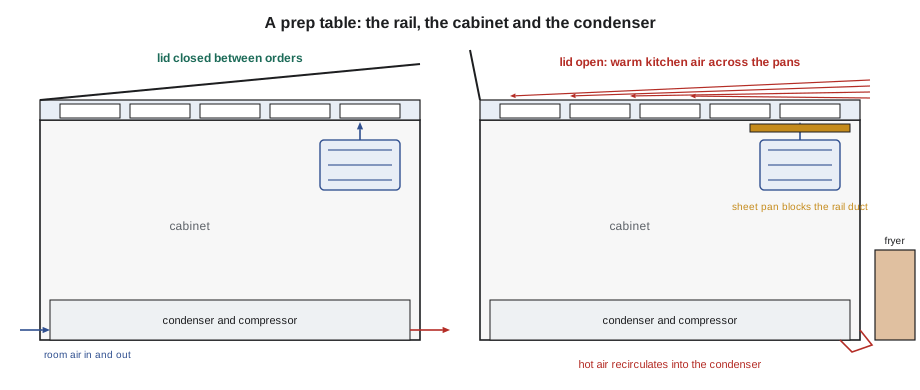
A prep table's top rail holds food in open pans, cooled from below and around by cold air from the cabinet or from a separate rail coil. When the lid is closed, the rail holds temperature easily. When the lid is open, warm kitchen air flows across the pans and the food warms from the top. Manufacturers design and test rails to hold food at safe temperature with the lid open for a limited time in a room of defined temperature, and many recommend the lid be closed whenever the pans are not being reached into. Pans overfilled above the rail's cold zone, or filled with food that was not cold when it went in, will not hold temperature however well the refrigeration works.
At Rosa's, three problems combined. The condenser was so dirty that the unit's capacity had fallen sharply. The lid had been open for hours in a kitchen hotter than the unit's rating. And the cooks, trying to fix the warm rail, had turned the cabinet thermostat down until the cabinet froze, which did nothing for the rail because its air path was blocked by a sheet pan someone had wedged under the rail's air duct to stop cold air blowing onto the cooks' hands. Theo cleaned the condenser, removed the sheet pan, reset the thermostat, and talked with Rosa about keeping the lid closed between orders. The rail was at 4 °C (40 °F) in an hour and held it through the evening service.
The condenser and the kitchen
A self-contained unit rejects its heat into the room it stands in: the heat removed from the cabinet plus the compressor's electrical input. In a hot kitchen that heat makes the room hotter, and the hotter room raises the unit's condensing temperature, reducing its capacity and increasing its power. A dirty condenser raises the condensing temperature further. The script below compares a prep table with a clean and a dirty condenser, and then checks what a propane leak would mean in the space around it.
# A self-contained prep table in a hot kitchen: heat rejected, effect of a dirty condenser, and an R-290 leak check
CAPACITY = 0.60            # kW of refrigeration the table needs on average
PRICE = 0.13               # dollars per kWh (illustrative)
for label, cop in (('clean condenser', 1.9), ('dirty condenser', 1.4)):
    power = CAPACITY / cop                 # kW electrical while running
    rejected = CAPACITY + power            # kW of heat into the kitchen
    yearly = power * 24 * 365 * 0.6        # kWh at a 60 % run fraction
    print(f"{label:16s} power {power:4.2f} kW, heat to kitchen {rejected:4.2f} kW, {yearly:5.0f} kWh/yr, ${yearly * PRICE:4.0f}/yr")

# R-290: if the whole charge leaked into the space around the unit, what fraction of the lower flammable limit?
LFL = 0.038                # kg/m3 for propane
charge = 0.150             # kg on this unit's nameplate
for volume in (60.0, 10.0, 1.0):          # whole kitchen, a corner alcove, the space under the counter
    c = charge / volume
print(f"charge spread through {volume:4.0f} m3: {c:.4f} kg/m3 = {100 * c / LFL:5.1f} % of LFL")clean condenser power 0.32 kW, heat to kitchen 0.92 kW, 1660 kWh/yr, $ 216/yr dirty condenser power 0.43 kW, heat to kitchen 1.03 kW, 2253 kWh/yr, $ 293/yr charge spread through 60 m3: 0.0025 kg/m3 = 6.6 % of LFL charge spread through 10 m3: 0.0150 kg/m3 = 39.5 % of LFL charge spread through 1 m3: 0.1500 kg/m3 = 394.7 % of LFL
The dirty condenser costs about a third more electricity a year, and it also raises the condensing pressure, the compressor's discharge temperature and the risk of overheating the compressor, which RAC-210 linked to early failures. Condenser cleaning is the single most valuable thing in a self-contained unit's maintenance, and in a greasy kitchen it may need to be done monthly. Grease-laden lint needs a brush and a degreaser made for coils, not just a vacuum. Many newer units have a removable filter in front of the condenser, which staff can wash weekly if someone shows them how.
Placement matters as much as cleaning. A reach-in pushed tight against a wall, or a prep table whose condenser grille faces a fryer, recirculates its own hot air. Manufacturers state the clearances needed for condenser airflow, and units installed without them are a common cause of compressor failures in the first few years. Recording the room temperature at the condenser inlet on every call helps make the case for moving a unit.
Propane in self-contained equipment
Many new reach-ins, prep tables, merchandisers and beverage coolers use propane, R-290, a hydrocarbon refrigerant in safety group A3: lower toxicity, higher flammability. It has a GWP of about 3, excellent efficiency and good capacity, and because the regulations on HFCs in self-contained equipment have tightened in both countries, as lesson 9 describes, it has become the default choice for many manufacturers. Harvest Lane's checkout beverage coolers and ice cream island are both propane units.
Because propane is highly flammable, the amount allowed in a self-contained unit is limited by the equipment safety standard the unit is built and listed to. Canadian equipment is certified to Canadian versions of the same international family of safety standards, and the permitted charge depends on the standard edition and the unit's design; the nameplate states the refrigerant and its charge. Units with larger capacities use more than one independent circuit, each within the limit, rather than one large charge.
The script's leak check shows why charge limits and design rules matter. A full 150 g (5.3 oz) charge spread through a whole kitchen is only a few per cent of the lower flammable limit, the LFL. The same charge leaking into a small enclosed space, such as the area under a counter or a closed cabinet, can exceed it many times over, because propane is heavier than air and pools near the floor. Units designed for propane keep electrical parts that could spark away from where leaked refrigerant would collect, or use sealed or non-sparking components, and the room and installation rules in the manufacturer's instructions are part of that safety design.
Servicing propane units
Working on propane equipment needs training beyond what an A2L refrigerant requires, as RAC-220 described for A2Ls. The principles are the same, but the margin is smaller.
- Read the nameplate and the manufacturer's service instructions first; many propane units are designed for component replacement rather than refrigerant circuit repair in the field.
- Ventilate the area, remove ignition sources, and monitor with a leak detector designed for hydrocarbons before and during work.
- Use recovery equipment, vacuum pumps and tools rated for flammable refrigerants. Recover the charge unless the manufacturer's procedure and the applicable rules say otherwise.
- Purge the circuit with nitrogen before any brazing, and confirm with the detector that no refrigerant remains. Many manufacturers prefer mechanical connections, such as press or crimp fittings rated for the service, where brazing would otherwise be needed.
- Charge by weight, to the gram or tenth of an ounce, with an accurate scale. A charge measured by pressure or sight glass is not accurate enough for systems with charges this small.
- Replace electrical parts with the manufacturer's listed parts. A standard relay or thermostat in place of a sealed one can defeat the unit's safety design.
Because the charges are so small, an error that would be trivial on a large system is significant here. A gauge set connected to a 150 g (5.3 oz) system can hold a measurable fraction of the charge in its hoses. Short hoses, or low-loss fittings, and charging by weight help. Many technicians use piercing valves or service ports fitted only during service and removed afterward, sealing the access points so they cannot become leaks.
Diagnosing small self-contained systems
Self-contained systems have few parts, so their faults follow a short list. A unit that runs all the time and does not get cold has a dirty condenser, a failed condenser or evaporator fan, a low charge from a leak, a restriction, a weak compressor, an overloaded cabinet, a failed door gasket or a room that is hotter than the unit is designed for. A unit that does not run has an electrical or control fault, often a failed start relay, overload or thermostat, as RAC-130 covered. A unit with ice in the cabinet has a defrost or drain fault, or a door left ajar. Before connecting gauges, which on a small capillary system carries a real risk of losing charge and introducing contaminants, check everything that can be checked from outside: condenser cleanliness, both fans, door gaskets, cabinet loading, room temperature, compressor amps against the nameplate and the temperature drop across the evaporator.
When gauges are needed and the unit has no service ports, the decision to add them is a decision to open the system. Some technicians use a pressure-temperature reading clamped on the suction and discharge lines as a first check, and add access valves only when the diagnosis points to a refrigerant problem. Every access valve added should be removed and the tube sealed, or fitted with a sealed cap, before the job is finished.
Common mistakes
MistakeTurning the thermostat colder to fix a warm prep rail.
InsteadFind out why the rail is warm: the lid, the air path, overfilled pans or the condenser.
MistakeVacuuming a greasy condenser and calling it clean.
InsteadUse a brush and a coil degreaser; grease holds lint.
MistakeInstalling a reach-in tight against a wall or beside a fryer.
InsteadLeave the manufacturer's clearances for condenser airflow.
MistakeBrazing on a propane unit without purging and confirming it is free of refrigerant.
InsteadRecover, purge with nitrogen and check with a hydrocarbon detector first, or use rated mechanical fittings.
MistakeReplacing a sealed relay with a standard one on a propane unit.
InsteadUse the manufacturer's listed parts.
Summary and key terms
- Self-contained units are small factory-charged systems in hot, busy rooms.
- Prep rails depend on closed lids, clear air paths and correctly filled pans.
- Condenser cleaning and clearances are the most valuable maintenance on these units.
- Propane, R-290, is now common in self-contained equipment; its charge is limited by the safety standard the unit is listed to.
- Propane service needs training, ventilation, rated tools, nitrogen purging before brazing and charging by weight.
- Check everything outside the circuit before connecting gauges to a small system.
- Top-mount
- A self-contained unit with its refrigeration system on top of the cabinet.
- Bottom-mount
- A self-contained unit with its refrigeration system below the cabinet.
- Prep rail
- The refrigerated pan area on top of a prep table.
- Condensate evaporator pan
- A heated pan that evaporates defrost water from a self-contained unit.
- A3
- The ASHRAE safety group for refrigerants of lower toxicity and higher flammability, such as propane.
- LFL
- Lower flammable limit, the lowest concentration of a gas in air that can burn.
- Blast chiller
- A cabinet designed to cool hot cooked food quickly.
Practice problems
Work each problem on paper first, then reveal the answer to check.
A reach-in in a hot kitchen runs constantly and its condenser is felted with grease. What does the dirt do to the system?
Show answer
It raises the condensing temperature, reducing capacity and increasing power and compressor temperature.
Why is a small propane leak more hazardous under a counter than in the open kitchen?
Show answer
The heavier-than-air gas collects in the small space and can exceed the LFL.
How should a propane unit's charge be measured?
Show answer
By weight with an accurate scale.
A prep rail is warm while the cabinet below is freezing. Name two causes to check before the refrigeration system.
Show answer
The lid left open and a blocked rail air path; also overfilled or warm pans.
Lesson quiz · 5 questions
Score 60% or more to complete this lesson.
Create a free account to save your progress, take quizzes and earn a certificate.